The SafalMoney Promise: Your Complete Investment Framework for the Rest of 2026
SafalMoney's complete investment framework for the rest of 2026 - the principles, tools, portfolio architecture, and forward-looking roadmap that every HNI investor needs heading into August and beyond.
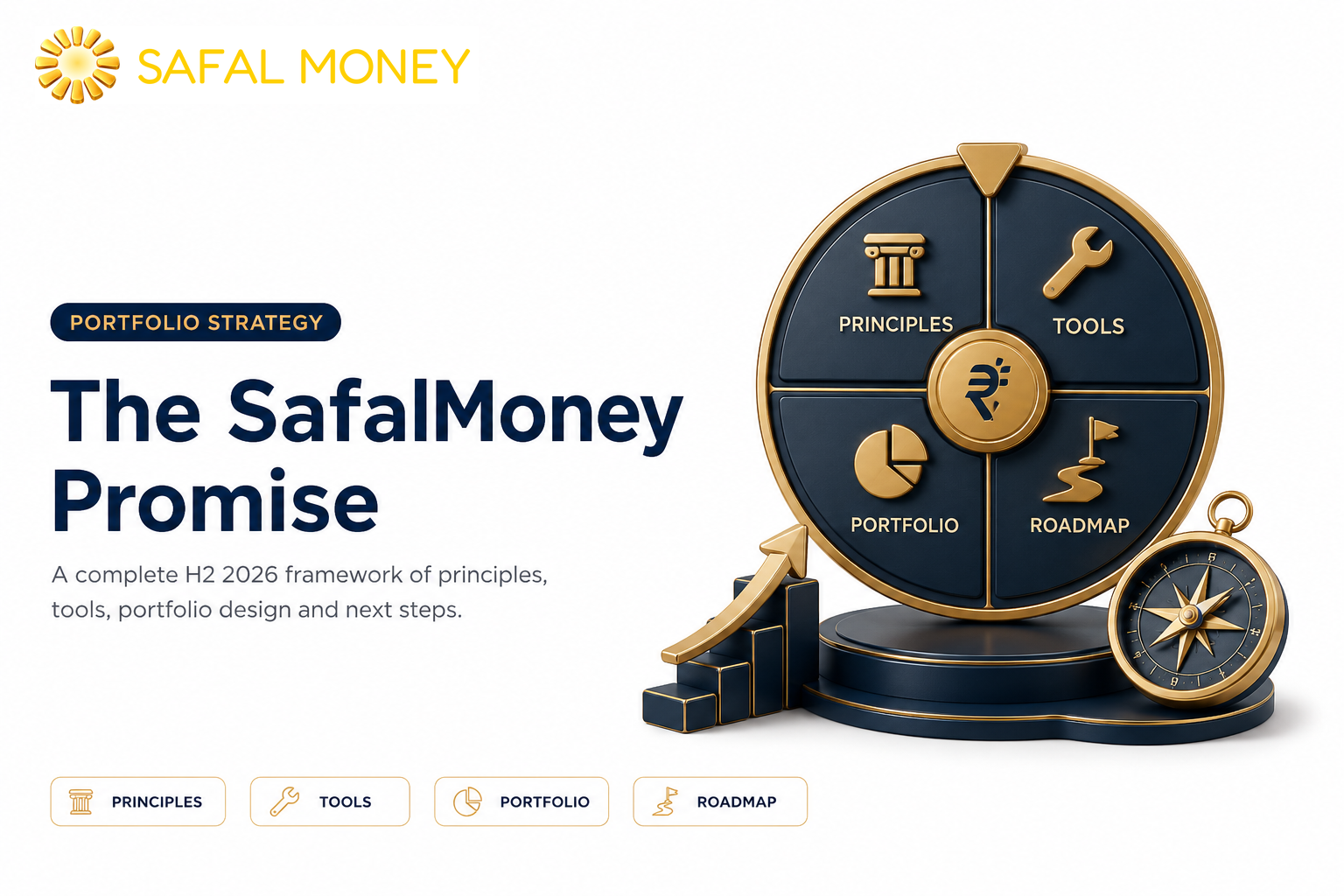
This is the final article of SafalMoney's July 2026 content calendar - the capstone of a month that has built the most comprehensive SIF and mutual fund reference library available to Indian HNI investors.
It would be easy to end July with a summary of what has been covered. But a summary is backward-looking, and the purpose of this month's research was never to document the past - it was to prepare investors for better decisions going forward.
This final article is forward-looking. It states SafalMoney's investment framework for H2 2026 - the principles that guide every allocation decision, the portfolio architecture that translates those principles into specific positions, and the promise that SafalMoney makes to every investor who has spent time with our research this month.
The Foundation: Five Principles That Never Change
Before the H2 2026 framework, the principles. These do not change with market conditions, interest rate cycles, or new product launches. They are the bedrock on which every SafalMoney recommendation is built.
Principle 1: Evidence over instinct. Every portfolio decision should be grounded in evidence - historical data, structural analysis, and objective assessment - not in market sentiment, financial media narratives, or the persuasive confidence of any individual's prediction. SafalScore™ and SafalCheck™ are tools that operationalise this principle - replacing subjective judgment with systematic, reproducible analysis. When evidence is ambiguous, the right response is diversification - not a larger bet on the uncertain outcome.
Principle 2: Structure before selection. The most important investment decision is not which fund to buy - it is what asset allocation to maintain. A well-structured portfolio in mediocre funds will almost always outperform a poorly structured portfolio in excellent funds. Determine the right allocation - equity vs debt vs SIF vs gold, large vs mid vs small cap, long vs short duration - before selecting the specific vehicles. SafalScore™ defines the structure; SafalCheck™ helps select within the structure.
Principle 3: Time is the most powerful tool available. The mathematics of compounding mean that starting earlier, staying longer, and avoiding unnecessary exits are more powerful than any selection skill. Every year of unnecessary non-investment, every panic exit at a market trough, and every chase of short-term performance is a permanent reduction in the long-term compounding base. The investor who stays invested through a 30% correction and recovers will end up substantially wealthier than the investor who exits and waits for certainty - because certainty never arrives and the re-entry point is always emotionally difficult.
Principle 4: Tax efficiency is a guaranteed return. Unlike market returns - which are uncertain - tax savings are guaranteed. Every rupee of unnecessary tax paid is a permanent reduction in the compounding base. Annual LTCG harvesting, arbitrage fund usage, HUF structuring, NPS 80CCD(1B) contributions, and tax-loss harvesting are not optional refinements for sophisticated investors - they are fundamental portfolio management activities that every HNI investor should execute without exception, every year.
Principle 5: Honesty about uncertainty. No one - not SafalMoney, not any fund manager, not any economist - knows what markets will do in the next 12 months. The appropriate response to this uncertainty is not to pretend it does not exist, and not to be paralysed by it. The appropriate response is to build a portfolio that performs adequately across multiple scenarios - not one that is optimised for a single predicted outcome. Diversification across asset classes, strategies, and geographies is not a concession to uncertainty - it is the correct structural response to an uncertain world.
The H2 2026 Macro Framework: Three Scenarios and How to Position for Each
The macroeconomic backdrop for H2 2026 has been built through multiple pieces of research this month - particularly the Macro Trinity, China Slowdown, India's Inflation Outlook, Monsoon and Markets, and July Market Update articles. Here is the synthesised framework.
The Base Case (55% probability): Soft Landing with Continued Easing
Oil remains in the $65-$80 range. The 2026 monsoon concludes normal-to-above-normal. CPI stays within 4-5% through December. RBI delivers 1-2 more rate cuts in H2. Equity markets continue their broadly constructive trajectory - Nifty 50 delivers 10-14% full-year returns. Mid cap outperforms large cap. Long-duration debt delivers 9-11% total returns from duration benefit. Rural consumption picks up strongly in Q3 following good kharif harvest. SIF long-short generates alpha from sector divergence in financials, consumption, and manufacturing.
Portfolio positioning for the base case: Maintain full equity allocation per SafalScore™ target. Extend duration in debt - dynamic bond funds and gilt funds. Overweight financials, consumption, and rate-sensitive sectors within equity. Maintain SIF allocation - the constructive macro environment supports alpha generation from sector divergence.
The Upside Case (20% probability): Accelerated Easing and Global Risk-On
The US Fed pivots more aggressively than expected to rate cuts, triggering global risk-on appetite. FII flows to India accelerate significantly as China's relative underperformance intensifies. RBI front-loads remaining rate cuts. Equity markets rally 20-25% full year. Mid and small cap deliver 25-35%. Long-duration debt delivers 12-15%.
Portfolio positioning for the upside case: The base case positioning captures most of the upside automatically - full equity allocation, extended debt duration, and SIF exposure. No tactical changes are needed to benefit from the upside case; the base case structure participates in it fully.
The Downside Case (25% probability): Oil Spike or Global Recession
A geopolitical event drives oil above $90 sustained - re-igniting Indian inflation and forcing RBI to pause or reverse cuts. Or a global recession trigger (US labour market deterioration, China credit event, European banking stress) drives risk-off across all emerging markets. Indian equity corrects 20-35%. Long-duration debt underperforms if inflation re-emerges. Rupee weakens.
Portfolio positioning for the downside case: The debt allocation (maintained at 25-35% of overall portfolio) provides the buffer that absorbs equity volatility. Gold ETF (10% of portfolio for most profiles) benefits from the risk-off environment. SIF's short book provides partial equity portfolio protection. The downside case is managed through structure - not through the impossible task of predicting and timing the exit before it arrives.
The Complete H2 2026 Portfolio Architecture
The SafalMoney H2 2026 portfolio architecture translates the macro framework and investment principles into specific allocation targets - applicable to a balanced HNI investor with a Moderately Aggressive profile, 7-10 year horizon, and SafalScore™ in the 121-149 range.
| Allocation | Weight | Vehicle | Rationale |
|---|---|---|---|
| Equity: 55-60% of portfolio | |||
| Large Cap (Index) | 20% | Nifty 50 / Nifty 100 index fund | Core equity anchor, low cost, FII inflow beneficiary |
| Flexi Cap (Active) | 15% | Active flexi cap with consistent rolling returns | Manager flexibility to tilt toward rate cut beneficiaries |
| Mid Cap (Active) | 15% | Active mid cap, deployed via STP over 12 months | Rural consumption and capex cycle beneficiary |
| Small Cap (Active) | 5% | Satellite SIP position | 10-year horizon required; capped for Moderately Aggressive profiles |
| International | 5% | US tech / global diversified fund | Selective global exposure, modest currency risk |
| SIF: 15-20% of portfolio | |||
| Equity Long-Short SIF | 10-12% | 2 AMC partners (fundamental + quantitative) | Core alpha engine, multi-AMC diversification |
| Hybrid Long-Short SIF | 5-8% | 1 AMC partner | Lower volatility SIF complement |
| Debt: 20-25% of portfolio | |||
| Dynamic Bond Fund | 10% | Actively managed duration | Primary rate cut duration beneficiary |
| Gilt Fund | 5% | Direct long-duration play | Highest duration benefit from RBI easing |
| Arbitrage Fund | 5% | Short-term parking | Equity taxation for 30% bracket, T+2 liquidity |
| Alternatives: 5% of portfolio | |||
| Gold ETF | 5% | Inflation hedge | Low correlation, portfolio stabiliser in risk-off scenarios |
This architecture is appropriate for the base case macro environment - constructive but not without risk. It captures the equity upside from rate cuts and FII flows, benefits from duration in the debt allocation, generates long-short alpha through the SIF layer, and maintains enough defensive allocation (debt + gold) to absorb a meaningful correction without requiring panic-driven selling.
The SIF Roadmap for H2 2026: Three Milestones
For investors at different stages of their SIF journey, H2 2026 presents three distinct milestones - each appropriate for a different starting point.
Milestone 1: First SIF Investment (for investors not yet in SIF)
The objective for H2 2026 is straightforward: complete SafalScore™, complete accredited investor certification, select one Equity Long-Short SIF fund using SafalCheck™ guidance - see the complete Equity Long-Short investor guide and the AMC review series - and make the initial ₹10L investment.
The specific fund selection matters less than the timing - the longer the delay, the more time is lost on the alpha compounding clock. For investors who have been evaluating SIF for months without acting: the research is complete, the regulatory framework is established, the AMC track records - while still short - are available, and the macro environment is supportive. The time for evaluation has passed. August 2026 is the time for the first investment.
Milestone 2: Multi-AMC Diversification (for investors with 1 SIF fund)
Investors who made their first SIF investment in late 2025 or early 2026 now have 6-12 months of live track record across their initial fund. The objective for H2 2026 is to add a second SIF fund from a different AMC - with a different strategy approach (if the first fund was fundamental, add a quantitative; if the first was Equity LS, consider adding Hybrid LS for lower volatility complement).
Multi-AMC diversification reduces the concentration risk that a single-fund SIF allocation carries - particularly in the strategy's early track record phase where confidence in any individual manager should be calibrated appropriately.
Milestone 3: Full Portfolio Integration (for investors with 2+ SIF funds)
Investors who already have a multi-fund SIF allocation should focus on full portfolio integration in H2 2026 - ensuring the SIF allocation is correctly sized relative to the overall portfolio (per SafalScore™), the annual LTCG harvest strategy is in place, the SIF's overlap with conventional equity funds is monitored, and the annual review calendar is scheduled.
Full portfolio integration means SIF is no longer a separate experiment - it is a core component of a unified portfolio architecture with clear roles, target allocations, monitoring metrics, and annual review discipline.
The SafalMoney Commitment to Investors: What We Promise
Every promise SafalMoney makes to investors is grounded in the same five principles stated earlier in this article. But the specific commitments deserve explicit statement - because promises only mean something when they are specific enough to be held accountable.
We promise independence. SafalMoney's research, SafalScore™ outputs, and SafalCheck™ evaluations are not influenced by AMC commission rates, fund marketing budgets, or distributor incentive structures. A fund with lower trail commission will receive a higher SafalCheck™ rating than a fund with higher trail commission if the lower-commission fund is better quality. This is our commitment - and we invite every investor to test it by comparing our recommendations against the commission rates of the recommended funds.
We promise honesty about limitations. SIF is not appropriate for every investor - SafalScore™'s guardrails exist to protect investors from SIF allocations their profile does not support. Not every SIF fund is good - SafalCheck™ exists to differentiate quality from marketing. Not every macro prediction we make will be correct - which is why our frameworks prepare for multiple scenarios rather than optimising for one. When we are wrong - in our macro calls, in our fund assessments, in our allocation frameworks - we will say so explicitly.
We promise depth over volume. This month's research was not filler content - every article was written to genuinely inform a specific investment decision. The SIF Glossary answers real terminology questions. The fund review series provides independent assessments that cannot be found from the AMCs themselves. The tax articles provide framework that a qualified CA can implement. Depth over volume is a commitment that sometimes means fewer articles than a content-maximising approach would produce - and always means better articles.
We promise continuity. July 2026 is not the end of SafalMoney's research commitment - it is a milestone in an ongoing programme. August 2026 will bring new fund developments, new macro data, SIF track record updates, and new investor questions. SafalMoney's research desk will be here - with the same standards of independence, honesty, and depth - for every month of your investment journey.
We promise to put your interests first. This is not a platitude - it has specific operational meaning. It means recommending 0% SIF when SafalScore™ indicates 0% is correct, even though a 0% recommendation generates no revenue for SafalMoney. It means flagging fund manager changes in existing SIF recommendations even when the new manager might maintain the fund's performance. It means telling investors when a simpler, lower-cost portfolio - for instance, a Direct plan instead of a Regular plan - is likely to serve them better than a complex, higher-revenue-generating alternative. Investors first - always.
What to Expect from SafalMoney in August 2026 and Beyond
This month's content calendar was the foundation. August 2026 and the months ahead will build on it with three specific additions.
First: Track record updates. As SIF funds accumulate 12-18 months of live performance data through the second half of 2026, SafalCheck™ evaluations will incorporate actual performance evidence alongside the framework-based assessment. The August and September fund updates will be the first SafalCheck™ revisions that meaningfully integrate live performance data - giving investors the most evidence-based fund assessments yet available.
Second: SafalScore™ recalibration updates. The 2026 SafalScore™ recalibration referenced in the July market update will be published with full transparency - explaining which factor weights changed, why they changed, and how the changes affect strategy recommendations. Investors whose SafalScore™ recommendations change materially will receive specific guidance on how to adjust their portfolios.
Third: New strategy coverage as the SIF universe expands. Several AMCs have indicated intent to launch new SIF strategy types in H2 2026 - including more sophisticated sector-specific long-short strategies and international long-short approaches. As these strategies launch and complete the regulatory and due diligence process, SafalMoney will add them to the SafalCheck™ evaluation framework and provide the same independent, structured assessment that has characterised this month's fund review series.
The investment landscape will continue to evolve. SafalMoney's commitment is to evolve with it - always providing the independent, evidence-based research that allows Indian HNI investors to make better decisions than they would make alone.
A Final Word: The Investor You Are in August 2026
This month's research library is extensive. Not every investor will have read every piece - and that is not the expectation. The expectation is that SafalMoney's July library has answered the specific questions most relevant to your portfolio, given you the frameworks to evaluate SIF and mutual fund decisions objectively, and provided the macro context to understand why the current environment favours specific positioning.
The measure of July's success is not how many articles were read - it is what you do differently in August because you read them.
If you calculate SafalScore™ for the first time because of this month's content - that is the measure. If you switch from a Regular plan to a Direct plan because of what you read - that is the measure. If you extend duration in your debt allocation because of the macro research - that is the measure. If you make your first SIF investment because the comprehensive coverage this month provided the confidence you needed - that is the measure. If you schedule your annual portfolio audit for August because the audit framework showed you how - that is the measure.
The investor who reads extensively and makes no changes has learned a great deal and benefited nothing. The investor who reads a handful of articles and makes one correct portfolio change has invested their reading time well.
SafalMoney's promise is to keep providing the research that makes those portfolio changes possible. Your promise to yourself - and to the wealth you are building for your family - is to act on what you know.
August awaits. The portfolio that serves your goals best is not the one you are planning - it is the one you are building.
Frequently Asked Questions
What is SafalMoney's overall investment stance for H2 2026?
Constructively positioned with disciplined risk management. The macro backdrop - lower oil, moderating inflation, RBI easing cycle, normal monsoon, structural FII rotation from China to India - supports a fully invested equity allocation, duration extension in debt, and maintained SIF allocation per SafalScore™. The primary risks (oil spike, monsoon disappointment, global recession) are tail scenarios managed through portfolio structure - adequate debt allocation, gold ETF hedge, and SIF short book partial protection - rather than through market timing attempts.
What is the single most important action an HNI investor should take in August 2026?
If not yet invested in SIF and SafalScore™ recommends SIF - initiate the accredited investor certification and first SIF investment. The research is complete, the framework is established, and the macro environment is supportive. Delay is the primary cost at this stage. If already invested in SIF - extend duration in the debt portfolio, shifting from short-duration instruments to dynamic bond funds or gilt funds to capture the rate cut opportunity that is most clearly available right now.
How should investors interpret the base case, upside case, and downside case scenarios?
The scenarios are not predictions - they are probability-weighted outcomes used to design a robust portfolio. The base case portfolio (55-60% equity, 15-20% SIF, 20-25% debt, 5% gold) is designed to perform well in the base case, participate meaningfully in the upside case, and absorb the downside case without permanent capital damage. Investors should not restructure their portfolios to maximise returns in one scenario at the expense of resilience across all scenarios - that is not portfolio management, it is speculation.
What makes SafalMoney different from other mutual fund distributors?
Three things distinguish SafalMoney - specialisation in SIF (depth of SIF research, evaluation tools like SafalScore™ and SafalCheck™, and implementation support), independence (research and recommendations are not influenced by AMC commission structures or distributor incentive programmes), and honesty (recommending 0% SIF when that is correct, flagging risks in funds we distribute, and acknowledging uncertainty in macro views rather than projecting false confidence). These three commitments are the foundation of the trust that long-term investor-advisor relationships require.
What will SafalMoney cover in August 2026 and beyond?
August 2026 will bring the first SafalCheck™ revisions incorporating meaningful live SIF performance data, SafalScore™ recalibration transparency updates, coverage of new SIF strategy launches, the August monsoon outcome analysis and portfolio implications, and the Q1 FY27 corporate earnings assessment. The research calendar continues with the same depth and independence that characterised July - serving the evolving questions of SafalMoney investors as the investment landscape develops through H2 2026 and into 2027.
Last updated: 31 July 2026