July 2026 Market Update: SIF AUM Growth, New Fund Launches & Key Developments
The SafalMoney July 2026 market update - SIF AUM milestones, new fund launches, RBI policy developments, equity market performance, and what it all means for your HNI portfolio.
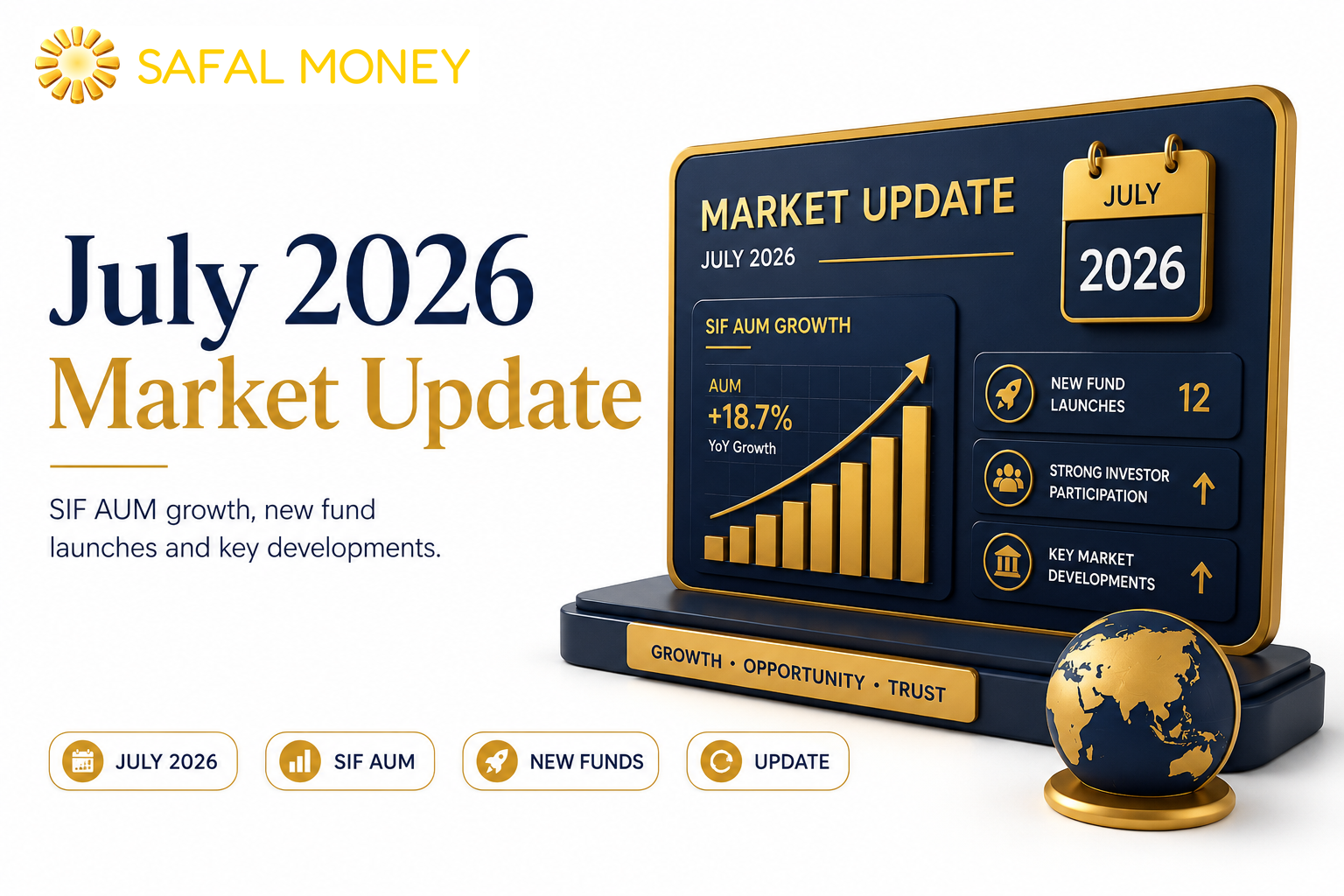
July 2026 has been a month of meaningful developments for Indian HNI investors - across equity markets, the SIF industry, monetary policy, and macroeconomic indicators. This monthly market update from SafalMoney's Research Desk synthesises the key developments, what they mean for existing SIF and mutual fund investors, and the forward-looking portfolio considerations heading into August.
This article follows SafalMoney's monthly market update format - structured for investors who want a comprehensive yet concise briefing, not a daily news digest.
Indian Equity Markets in July 2026: The Broad Picture
Indian equity markets have continued their broadly constructive trajectory through July 2026, supported by a confluence of domestic and global tailwinds that have been building through the first half of the year.
Large cap performance: the Nifty 50 has delivered positive returns through July, extending the year-to-date gains that began with the post-budget rally in February. The index has been supported by strong corporate earnings from the banking and financial services sector, continued FII inflows as global investors allocate to Indian equities as part of the China reallocation thesis, and improving domestic macro indicators.
Mid cap performance: the Nifty Midcap 150 has outperformed the Nifty 50 on a year-to-date basis through July - a continuation of the mid cap relative outperformance that has characterised much of the 2025–2026 market environment. The mid cap rally has been broad-based, with manufacturing, capital goods, consumer discretionary, and select financial companies driving returns.
Small cap performance: the Nifty Smallcap 250 has been more mixed in July - after a strong first half, small cap stocks have seen some consolidation as valuations in the segment attract increasing scrutiny from institutional investors. The SIP-driven retail inflow into small cap funds continues to provide demand support, but the return of some volatility in July is consistent with the elevated valuation levels in the segment.
Sectoral highlights: banking and financial services, capital goods, healthcare, and consumer staples have been the strongest performing sectors through July. Information technology has been mixed - global IT spending uncertainty continues to weigh on large cap IT despite strong execution from Indian IT majors. Energy - particularly upstream oil and gas - has faced headwinds from the continued moderation in global crude prices.
SIF Industry Update: AUM Growth and Milestones
The most significant July 2026 development for SafalMoney investors is the continued rapid growth of India's SIF industry - confirming that the asset class is moving firmly beyond early-adopter status into mainstream HNI portfolio allocation.
Industry AUM trajectory: the collective AUM of all SEBI-registered Specialised Investment Funds has grown substantially since the first fund launches in late 2025. The growth trajectory reflects both new investor inflows and NAV appreciation across strategies that have performed well in the 2026 market environment. The industry is tracking toward a significant AUM milestone that would cement SIF as a meaningful segment of India's overall mutual fund ecosystem.
The significance of AUM growth for investors: rising SIF industry AUM is positive for existing investors for several structural reasons. Larger AUM attracts more qualified fund management talent to the space. It signals SEBI's confidence in the framework and reduces regulatory revision risk. It creates a more competitive environment that may eventually drive expense ratios lower. And it validates the asset class for institutional investors - family offices, corporate treasuries - whose participation will deepen the SIF ecosystem further.
Caution on individual fund AUM: while rising industry AUM is broadly positive, rapidly rising AUM within a single SIF fund can be a constraint on alpha generation - particularly for funds with significant mid and small cap long-book exposure where market impact costs rise with position size. SafalCheck™ monitors individual fund AUM levels as part of its ongoing evaluation of SIF partner funds.
New SIF Fund Launches in July 2026
July 2026 has seen continued activity in SIF fund launches as additional AMCs enter the space and existing SIF managers expand their strategy offerings.
NFO activity: several AMCs have either launched or announced upcoming NFOs for new SIF strategies in July. The new launches reflect the evolving sophistication of India's SIF market - moving beyond the initial wave of Equity Long-Short strategies toward more specialised offerings including sector-specific long-short strategies, enhanced income strategies with IDCW focus, and international long-short approaches.
What new launches mean for existing investors: new fund launches create both opportunity and distraction. The opportunity: new strategies may offer differentiated exposure not available in existing SIF funds - expanding the strategy options within the SafalMoney partner network. The distraction: the excitement of NFOs can tempt investors to chase new funds without adequate evaluation, disrupting a well-constructed existing SIF allocation.
SafalMoney's position on NFOs: evaluate new SIF funds with the full SafalCheck™ framework before allocating, regardless of AMC brand or marketing narrative. An NFO from a reputed AMC is still an unproven strategy - the fund manager's track record in similar strategies at other funds is more predictive than the NFO prospectus.
Expanding strategy universe: the expanding SIF strategy universe is structurally positive for HNI portfolio construction. When only Equity Long-Short strategies were available, multi-AMC SIF diversification was limited to manager diversification within the same strategy type. As Hybrid Long-Short, Debt Long-Short, and specialised sector strategies become available, true strategy diversification within the SIF allocation becomes possible - reducing correlation between SIF positions and improving the overall portfolio's risk-return profile.
RBI and Monetary Policy: July 2026 Update
The Reserve Bank of India's monetary policy stance remains a central variable for both debt and equity investors through the second half of 2026.
Policy rate trajectory: the RBI has maintained its easing bias through July 2026, having delivered rate cuts in the earlier part of the year. The Monetary Policy Committee's forward guidance has emphasised data dependence - specifically monitoring the 2026 monsoon outcome, global commodity price trajectory, and the US Federal Reserve's policy path before committing to further action.
The June 2026 CPI data: headline CPI inflation for June 2026 has come in at a level consistent with the RBI's comfort zone - supported by lower food prices from the satisfactory early monsoon progress and continued moderation in core inflation. The June CPI print has been interpreted by market participants as supportive of continued RBI easing in the second half of 2026.
Rate cut implications for portfolios: if the RBI delivers additional rate cuts in August–October 2026 as the market currently anticipates, the implications are clear and actionable. Long-duration debt funds and gilt funds are the primary beneficiaries. Financial sector equity - banks, NBFCs, housing finance companies - benefits through lower cost of funds and improved credit demand. Consumer discretionary benefits through lower EMI burden on auto, housing, and consumer durable purchases.
The risk to the rate cut narrative: the primary risk is a monsoon disappointment in August - the remaining critical month of the southwest monsoon season. If August rainfall is significantly deficient in key agricultural states, food inflation risk for Q4 2026 rises, potentially constraining the RBI's easing trajectory. Portfolio positioning should account for this tail risk, particularly for investors who have extended duration significantly in anticipation of rate cuts.
Global Macro Developments Affecting Indian Investors: July 2026
Several global developments in July 2026 have direct relevance for Indian HNI portfolio positioning.
US Federal Reserve signals: the US Fed has maintained a cautious approach to rate policy through mid-2026, balancing resilient US labour market data against moderating inflation. The Fed's eventual pivot to rate cuts - when it comes - will be a positive for Indian equity markets through two channels: reduced dollar strength (positive for rupee and emerging market flows) and improved global risk appetite that typically supports FII inflows to India.
China macro developments: China's economic data through July 2026 continues to reflect the structural slowdown dynamics - weak property sector, modest consumer spending recovery, and continued geopolitical trade pressures. Global fund managers' relative preference for India over China has been a consistent theme in FII flow data through the first half of 2026. This structural rotation provides an ongoing tailwind for Indian equity valuations.
Crude oil price developments: Brent crude has traded in a range through July 2026, with the Iran-US normalisation contributing to an adequately supplied global oil market. The absence of a significant oil price spike is a continued positive for India's macro environment - supporting lower inflation, a manageable current account deficit, and rupee stability. Any geopolitical disruption to this supply balance remains the primary external risk to India's macro outlook for the second half of 2026.
Global bond markets: US Treasury yields have been volatile through July as markets continue to price and reprice the Fed's rate trajectory. For Indian investors with international fund exposure, this volatility is a reminder that international funds carry both market risk and currency risk - the rupee's movement against the dollar adds a layer of return uncertainty that domestic investors must account for in their international allocation sizing.
Rupee and Currency: July 2026 Update
The Indian rupee has remained broadly stable against the US dollar through July 2026 - trading in a range that reflects the balance between India's improving current account position (supported by lower oil prices) and continued demand for dollars from importers and foreign currency debt servicing.
RBI foreign exchange management: the RBI has continued its active management of rupee volatility - intervening in both spot and forward markets to prevent excessive currency movement in either direction. India's foreign exchange reserves remain at comfortable levels, providing the RBI with adequate firepower to manage currency volatility without distorting monetary policy.
Currency implications for portfolios:
For domestic equity and debt fund investors, the rupee's stability in July reduces the external currency risk that can complicate portfolio planning. A stable rupee means FII returns on Indian investments are not being eroded by currency depreciation - which is supportive of continued FII inflows.
For investors with international mutual fund exposure, the rupee's trajectory against the dollar is a direct component of total return. In a stable rupee environment, the returns from international funds reflect more purely the performance of the underlying international equity markets - without significant currency gain or drag.
For SIF investors, the rupee is relevant primarily through its effect on import costs (particularly oil) and through macroeconomic implications rather than direct currency exposure in the SIF portfolio itself.
SafalMoney Platform Update: July 2026
July 2026 has been an active month for SafalMoney's platform development and investor services.
SafalScore™ recalibration: SafalMoney's research team has completed the annual recalibration of the SafalScore™ model - updating the factor weights and guardrail parameters to reflect the evolving SIF strategy landscape, the expanded universe of available AMC partners, and learnings from the first full year of SIF market operation. Investors who calculated their SafalScore™ in 2025 are encouraged to recalculate with the updated model for the most current strategy recommendations.
SafalCheck™ AMC evaluations updated: SafalCheck™ evaluations for all 9 SafalMoney AMC partner funds have been updated through July 2026. The updated evaluations incorporate the first meaningful track record data from funds that launched in late 2025 and early 2026 - providing the first real-market performance data to complement the framework-based evaluation that was necessarily the primary tool at launch.
New AMC partnerships under evaluation: SafalMoney's research team is currently evaluating additional AMC SIF strategies that launched in 2026 for potential inclusion in the SafalMoney partner network. Investors will be informed of new partner additions through the SafalMoney newsletter and platform notifications.
Investor education milestone: SafalMoney's July 2026 content calendar - which this article is part of - has crossed 85 comprehensive research articles covering SIF, mutual funds, macro markets, portfolio strategy, and tax planning. The full library is available at the Knowledge Hub for all registered investors.
Portfolio Action Checklist: What HNI Investors Should Do in July–August 2026
The July 2026 market and macro developments suggest several specific portfolio review actions for HNI investors.
Review duration in debt allocation: with the RBI easing cycle underway and June CPI supportive, investors who have not yet extended duration in their debt portfolio should consider moving from liquid and ultra-short funds toward dynamic bond funds or medium-to-long duration funds. The monsoon outcome in August is the primary variable to monitor before committing to very long duration positions.
Recalculate SafalScore™: SafalMoney recommends annual SafalScore™ recalculation for all investors. If your last calculation was more than 12 months ago - or if your life circumstances have changed significantly - recalculate now to ensure your SIF allocation and strategy selection reflect your current profile.
Review SIF allocation drift: if equity markets have moved your overall portfolio allocation away from your SafalScore™ target, rebalance. Use new investment flows to rebalance where possible, directing new capital to underweight categories to avoid unnecessary tax events from redemptions.
Monitor monsoon progress for August: August is the final critical month of the 2026 southwest monsoon season. Deficient August rainfall in the northwest agricultural belt - particularly Rajasthan, Haryana, and western Uttar Pradesh - would be the primary risk to the lower-inflation, rate-cut thesis. Monitor IMD weekly rainfall data and adjust portfolio positioning if a significant August shortfall emerges.
Evaluate NFO participation carefully: several new SIF NFOs have been announced for July–August 2026. Evaluate against the SafalCheck™ criteria - fund manager track record in similar strategies, AMC commitment to SIF, strategy differentiation from existing portfolio holdings - before allocating. Do not chase NFO excitement without rigorous evaluation.
Check SIF exit load calendars: for investors who made initial SIF investments in late 2025 or early 2026, the 12-month exit load period for those initial investments may be approaching. Review exit load calendars to ensure any planned SIF rebalancing or strategy changes are timed to avoid unnecessary exit load charges.
Forward Look: August–September 2026
The key variables to monitor in August–September 2026 and their portfolio implications:
August monsoon progress: the most important domestic macro variable for Q3 2026. Normal August rainfall confirms the lower food inflation, rate cut, rural income thesis. Deficient August rainfall introduces upside food inflation risk that may constrain RBI action.
RBI MPC meeting: the next Monetary Policy Committee meeting will incorporate the monsoon data, June–July CPI prints, and global macro developments. The market is currently pricing additional rate cuts - any surprise hold or hawkish shift would be negative for long-duration debt and rate-sensitive equity sectors.
Q1 FY27 corporate earnings season: July–August brings the first quarter earnings results for Indian listed companies. Banking sector earnings will be the primary focus - any deterioration in asset quality or margin pressure would be a negative signal for the financial sector overweight that characterises most large cap and flexi cap fund portfolios.
US Federal Reserve: any change in the Fed's rate trajectory - either acceleration of cuts or unexpected hawkishness - will affect global risk appetite, FII flows to India, and the rupee. Monitor Fed communication closely through August.
Global oil price developments: any significant disruption to global oil supply - geopolitical or weather-related - would change India's macro equation rapidly. Brent above $90 per barrel sustained would be the threshold at which India's inflation trajectory and RBI trajectory would need meaningful reassessment.
Frequently Asked Questions
How have Indian equity markets performed in July 2026?
Indian equity markets have delivered broadly positive performance through July 2026, with the Nifty 50 extending year-to-date gains supported by strong financial sector earnings, continued FII inflows from the China reallocation thesis, and improving domestic macro indicators including lower oil prices and moderating CPI. Mid cap has outperformed large cap on a year-to-date basis. Small cap has seen some consolidation in July after a strong first half, reflecting elevated valuations in the segment.
What is the SIF industry AUM in July 2026?
The SIF industry has seen significant AUM growth since the first fund launches in late 2025, reflecting strong investor interest from HNI investors and the expanding universe of AMC strategies available. Exact AUM figures are published by AMFI and individual AMCs monthly - SafalMoney recommends investors refer to the latest AMFI data for current figures. The growth trajectory confirms SIF's emergence as a meaningful HNI investment category within India's broader mutual fund ecosystem.
Should I invest in new SIF NFOs launching in July-August 2026?
Evaluate NFOs with the full SafalCheck™ framework rather than on the basis of AMC brand or marketing narrative. Key questions: Does the fund manager have a demonstrated track record in long-short or derivatives strategies at a previous fund? Does the strategy offer meaningful differentiation from SIF funds already in your portfolio? Is the AMC committed to SIF as a core business rather than a regulatory compliance exercise? If the answers are yes, an NFO can be a reasonable allocation - particularly if the strategy fills a gap in your existing SIF portfolio. If the answers are uncertain, waiting for 6-12 months of live track record before allocating is a disciplined approach.
What does the RBI rate trajectory mean for my mutual fund portfolio in July 2026?
The RBI's continued easing bias and the supportive June 2026 CPI data are positive for long-duration debt fund allocations - dynamic bond funds and gilt funds benefit most from rate cuts through NAV appreciation. For equity portfolios, the rate cut tailwind is most positive for financial sector stocks, consumer discretionary, and capital goods companies that benefit from lower borrowing costs. Investors who have not yet extended duration in their debt allocation should consider doing so - while monitoring the August monsoon outcome as the primary variable that could alter the rate cut timeline.
How should I position my portfolio for August-September 2026?
The key variables are the August monsoon outcome and the RBI MPC decision. In the base case - normal August monsoon, RBI delivers another rate cut - maintain current equity allocation, hold long-duration debt, and keep SIF allocation per SafalScore™. If August monsoon disappoints significantly, reduce long-duration debt exposure and review financial sector overweight in equity funds. In all scenarios, avoid making large tactical portfolio changes based on short-term developments - use an annual audit framework for structural decisions and make only modest tactical adjustments within existing allocation bands.
Last updated: 29 July 2026