China's Economic Slowdown: Which Indian MF Sectors Win and Which Lose?
China's structural slowdown is reshaping global capital flows, supply chains and India's equity markets. Here are the Indian MF sector winners and losers - and how SIF can position for both sides.
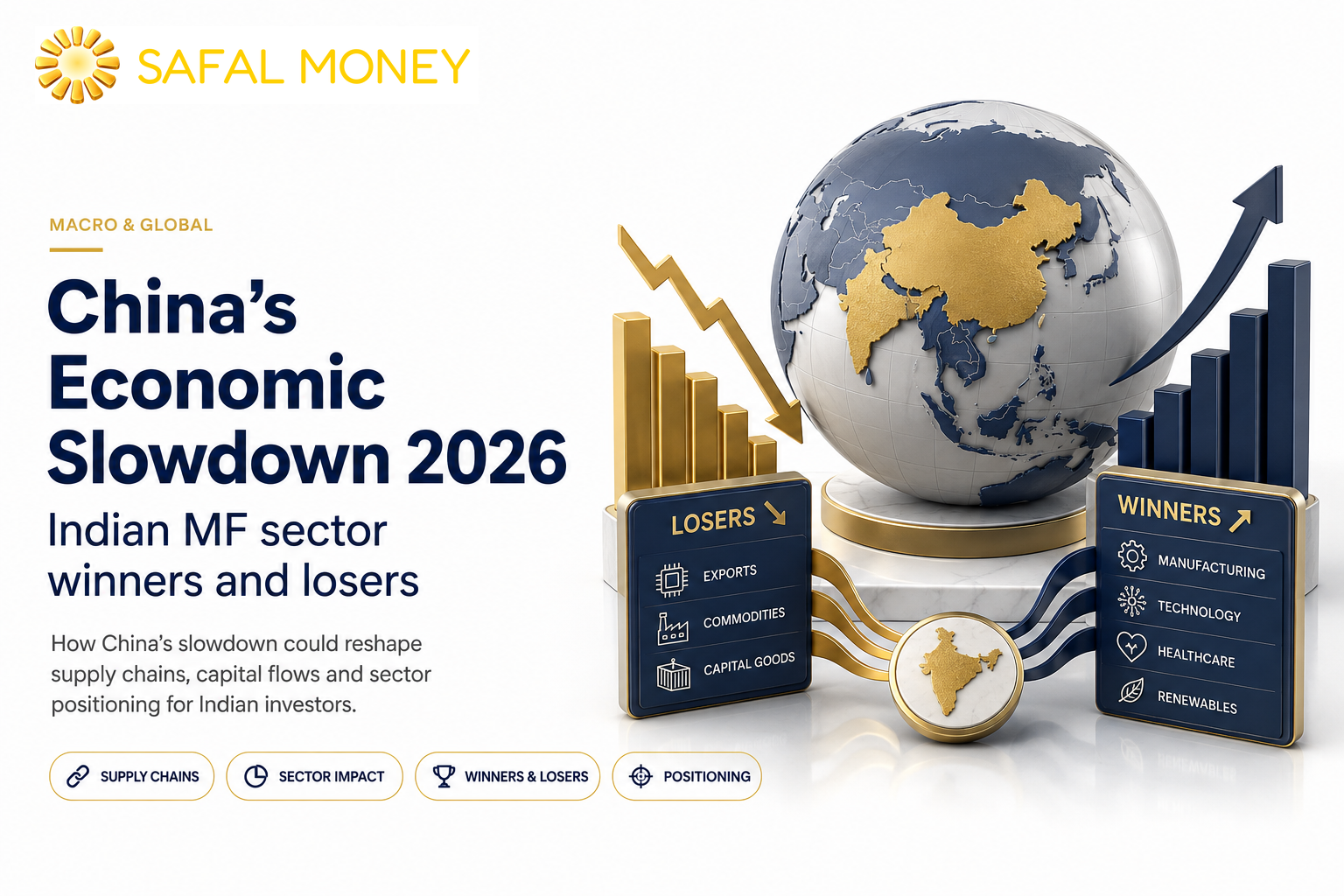
China's economic story has changed fundamentally. For four decades, the world's second-largest economy grew at rates that seemed to defy gravity — double-digit growth through the 2000s, then a managed deceleration to 6–7% through the 2010s. The narrative was simple: China grows, commodities rise, global supply chains orbit around Chinese manufacturing capacity, and investors who bet against China got hurt.
That narrative is over.
China faces a structural slowdown in 2026 as property distress, deflation risks, debt pressures, and demographic decline weigh on growth. China set its lowest economic growth target in decades, announcing it would aim for 4.5–5% expansion in 2026 as the world's second-largest economy grapples with weak domestic demand and an uncertain global outlook. And many analysts believe even these targets overstate real growth — China's actual 2025 GDP growth fell short of 3%, with structural factors showing little improvement.
For Indian investors, this is not just an interesting macroeconomic development to follow from a distance. China's structural slowdown is actively reshaping global capital flows, supply chain architecture, and India's equity market positioning in ways that create both significant opportunities and meaningful risks — right now, in 2026.
This article maps the three channels through which China's slowdown reaches India, identifies the specific Indian MF sectors that win and lose, and explains how SIF's long-short structure is uniquely positioned to capture both sides of this theme simultaneously.
Understanding China's Structural Slowdown — Why This Time Is Different
Before mapping the India implications, it is worth understanding why China's current slowdown is structural rather than cyclical — because this distinction determines whether the opportunity for India is temporary or generational.
The Property Crisis — Five Years and Counting. Five years after the property bust began in 2021, China still has not wholly stabilised the property sector. Investment in housing in China has halved in relation to its economy, dropping from 12.3% of GDP in 2020 to 6.1% in 2025. Property is the largest component of household wealth in China, accounting for 65% of total assets. The slump in property prices has contributed to a negative wealth effect where Chinese households do not feel better off, dampening their confidence and consumption.
Deflation and Weak Domestic Demand. China's property crisis is unfolding alongside an extended period of disinflation and deflationary pressure. When consumers expect prices to fall further, they delay purchases — creating a self-reinforcing demand weakness that monetary policy struggles to break. Due to weak domestic demand amid the property bust, China has relied more on trade, exporting more and importing less. Its 2025 trade surplus was a record, exceeding US$1 trillion.
Demographic Decline. China's aging population is accelerating quickly, adding long-term pressure to growth, fiscal sustainability, and the future path of housing and consumption. Fewer working-age people means slower productivity growth, lower consumer spending, and structurally weaker housing demand — all feeding into the property crisis in a self-reinforcing loop.
Overcapacity Across Industries. Despite weak domestic demand, industrial expansion has persisted, with overcapacity now extending beyond traditional heavy industries such as steel, cement, and chemicals to encompass emerging higher-end sectors and even spilling over into services. China's response to weak domestic demand has been to manufacture more and export aggressively — which is creating trade frictions globally and putting downward pressure on commodity prices that affects Indian sectors differently.
The IMF has explicitly warned that a prolonged resolution of the crisis is likely to result in a weaker recovery for the economy, as seen in Japan after its real estate bubble burst in the early 1990s. Japan's "lost decades" of economic growth are a lesson for China.
The Three Channels Through Which China's Slowdown Reaches India
China's slowdown does not affect India through one mechanism — it works through three distinct channels, each with different sector implications.
Channel 1: Manufacturing Supply Chain — The China+1 Opportunity
The China+1 strategy — multinational companies building manufacturing capacity outside China to reduce concentration risk — has been discussed for years. In 2026, it is moving from discussion to deployment.
India's manufacturing sector saw significant policy-driven investment acceleration in 2025–2026, with the Production Linked Incentive scheme now operational across 14 sectors. Electronics manufacturing has shown particularly strong growth, with smartphone assembly output exceeding ₹4.1 trillion in FY2025-26. The Apple iPhone playbook — continuing Chinese assembly while ramping India to 25% of global output — is in many ways the canonical illustration of how sophisticated buyers are running this trade-off.
The sectors where India is capturing China+1 supply chain share most meaningfully include pharmaceuticals, auto components, specialty chemicals, and specialty steel — investments where domestic demand is part of the rationale alongside export-platform potential, and categories with strong PLI architecture.
However, a critical caveat exists: India's trade deficit with China has widened significantly, growing from USD 99.2 billion in 2024-25 to USD 112.16 billion in 2025-26, concentrated in electronics, machinery, organic chemicals, and intermediate materials — exactly the categories where domestic value addition remains thin. India is capturing final assembly, not yet the full value chain. This is an important qualification on the China+1 optimism.
Channel 2: FDI Rotation — Multinationals Building India as a Manufacturing Alternative
Beyond supply chain diversification, China's slowdown and rising geopolitical risk are driving a more fundamental FDI reorientation. Organisations in the US and Europe are increasingly expanding their manufacturing footprint in India, alongside countries such as Vietnam, Mexico, and Canada, as part of a broader effort to diversify supply chains and reduce dependency risks.
India has become an undeniable player in global manufacturing, driven by foreign investment inflows of USD 81.04 billion in FY25, increased manufacturing investments, and PLI investments amounting to ₹2.16 lakh crore.
This FDI inflow creates a multi-year capex supercycle in Indian infrastructure, logistics, capital goods, and industrial manufacturing — the ecosystem required to absorb and utilise the incoming manufacturing investment.
Channel 3: EM Capital Allocation — FII Rotation From China to India
The third and most directly market-relevant channel is foreign institutional investor portfolio rotation. FIIs net sold nearly USD 18 billion of Indian equities in 2025 — the largest annual outflow on record — pushing foreign ownership to a 15-year low of approximately 17%. Capital rotated toward relatively undervalued China.
As China's structural weakness becomes undeniable and India's growth premium becomes more apparent, this rotation is reversing. With India's EM overweight now meaningfully reduced and US interest rates expected to trend lower, the risk-reward for foreign investors is turning more favourable, setting the stage for a potential reversal in FII flows in 2026.
This FII re-entry into Indian equities is one of the most powerful potential tailwinds for Nifty in 2026 — and it is directly driven by China's loss of attractiveness as an EM investment destination.
Indian MF Sector Winners: Where China's Slowdown Creates Opportunity
Winner 1: Specialty Chemicals — the most compelling China+1 play. China dominates global chemical manufacturing with significant cost and scale advantages. But rising geopolitical risk, China's overcapacity-driven price dumping, and the strategic desire of Western companies to diversify sourcing are creating genuine windows for Indian specialty chemical manufacturers. Specialty chemicals, particularly those used in pharmaceuticals (APIs), agrochemicals, and electric vehicle batteries, are growing the fastest — these segments offer higher profit margins and are less susceptible to commodity price fluctuations than bulk chemicals. The PLI scheme for specialty chemicals provides financial rewards based on incremental sales, encouraging domestic manufacturing of high-value products. MF plays: manufacturing-themed funds, specialty chemicals thematic funds, mid cap funds with significant chemical sector exposure, and flexi cap funds managed by research teams that have identified specific chemical company opportunities.
Winner 2: Pharmaceuticals and APIs — India's long-standing advantage gets stronger. India is already the world's pharmacy — supplying 20% of global generic medicines by volume. China's slowdown strengthens this position in two ways. First, China is a major supplier of Active Pharmaceutical Ingredients (APIs), the raw materials used in drug manufacturing — as Western pharmaceutical companies and regulators push for supply chain diversification away from single-source Chinese API dependence, Indian API manufacturers are positioned to absorb this demand. Second, China's economic weakness is reducing its domestic pharmaceutical consumption growth, redirecting global pharma investment toward markets with stronger demand dynamics, including India. MF plays: pharma sector funds, healthcare-focused thematic funds, and flexi cap funds with meaningful pharma exposure — pharma is also one of the most resilient sectors in a global slowdown, making it doubly relevant when China's weakness creates secondary global demand uncertainty.
Winner 3: Capital Goods and Defence Manufacturing — PLI supercycle. The FDI inflows and manufacturing capex driven by China+1 require an enormous supporting ecosystem — industrial machinery, engineering equipment, defence components, infrastructure, and logistics. Indian capital goods companies — engineering conglomerates, industrial automation firms, defence manufacturers — are the picks and shovels of the manufacturing supercycle. They benefit regardless of which specific manufacturing sector captures the most China+1 share. India's defence manufacturing sector is particularly notable: global supply chain reconfigurations have turned India's chemicals and capital goods sectors into export-driven engines. MF plays: infrastructure funds, capital goods sector funds, defence-themed funds, and mid cap funds with capital goods exposure.
Winner 4: IT Services — the software complement to hardware diversification. When multinationals build new manufacturing facilities in India, they also need software, ERP systems, digital infrastructure, and IT services to run them. India's IT sector is the natural beneficiary of the software and services spend that accompanies physical manufacturing investment. Additionally, as China restricts tech exports and tightens controls on overseas technology companies, it is trying to divert domestic capital toward its own technology ambitions — creating service opportunities for Indian IT companies in markets where Chinese technology alternatives are becoming politically sensitive. MF plays: IT sector funds, technology-themed funds, and large cap funds with significant IT weightings. Note that IT sector performance is also sensitive to US economic conditions — a US slowdown would be a headwind even if the China+1 IT theme is a tailwind.
Winner 5: Banking and Financial Services — FII re-entry beneficiary. When FIIs re-enter Indian equities, they typically start with large, liquid financials. FIIs' return to banking and financial services signals renewed faith in India's financial stability — key drivers include the RBI's rate cuts expected to boost credit growth by 12–14% in FY2026, and improved asset quality. The banking sector also benefits from the manufacturing capex supercycle through loan growth, as companies borrow to build factories, expand capacity, and develop supply chain infrastructure. MF plays: banking sector funds, financial services funds, and large cap or flexi cap funds with significant financial sector weightings.
Indian MF Sector Losers: Where China's Slowdown Creates Headwinds
Loser 1: Metals and Basic Materials — China demand collapse. China is the world's largest consumer of industrial metals — steel, copper, aluminium, zinc. When China's economy slows and its property sector collapses, demand for these metals falls significantly. China's overcapacity now extends beyond traditional heavy industries such as steel, cement, and chemicals. China's response has been to dump excess production in global markets at low prices, depressing global metal prices and squeezing margins for Indian metal producers who compete in the same export markets. Indian steel, aluminium, and mining companies face a structurally challenging environment when China is simultaneously consuming less and exporting more. MF implication: underweight metals and basic materials sector funds. Monitor closely for any signs of China stimulus that could reverse this dynamic temporarily.
Loser 2: Commodity Exporters With China Revenue Exposure. Several Indian companies earn meaningful revenue from exports to China — agricultural commodities, certain chemicals, and engineering goods. As China's domestic demand weakens and its import appetite shrinks, these companies face revenue headwinds. Industrial chemicals used in manufacturing and large-scale production activities are exposed here — shifts in Chinese demand can affect earnings expectations and stock performance of many Indian companies operating in these sectors. The distinction is important: specialty chemicals companies capturing China+1 share are winners; bulk chemical exporters dependent on Chinese import demand are losers. This nuance is exactly the kind of within-sector divergence that makes SIF's long-short structure particularly valuable for this theme.
Loser 3: Emerging Market Funds With High China Allocation. For Indian investors holding international funds or emerging market funds, China's structural weakness has a direct portfolio impact. Many EM index funds maintain significant China allocation — often 25–35% of EM index weight. India has raised special tariffs on Chinese chemicals and industrial products, including electronics, reflecting the increasingly competitive and sometimes adversarial economic relationship. For investors in broad EM funds, this China allocation has been a drag on performance and may continue to be. MF implication: review international and EM fund holdings for China allocation. India-specific international exposure or EM ex-China funds may be more appropriate for investors with a strong view on China's continued weakness.
How EM Index Weightings Are Shifting — India Rising, China Falling
One of the most important structural forces at play is the reweighting of emerging market indices. MSCI EM — the benchmark that global institutional investors track — has been gradually reducing China's weight and increasing India's as relative market performance diverges.
India's weight in the MSCI Emerging Markets index has been rising steadily. As India's market cap grows, economic fundamentals strengthen, and FII ownership increases, this reweighting creates passive buying pressure — global index funds tracking MSCI EM must buy more Indian equities as India's weight rises, regardless of active views on India vs China.
This passive reweighting tailwind is one of the most underappreciated structural drivers for Indian large cap equities over the next 5–10 years.
The China+1 Caveat: Not All That Glitters Is Gold
Read the Fine Print on China+1
In the enthusiasm around India's China+1 opportunity, several important caveats deserve attention. India is one among multiple countries benefiting from China+1, which includes Vietnam, Mexico, and other Southeast Asian nations with their own strengths. India's share of plus-one capture has, on some specific metrics, lagged Vietnam and Thailand — India's manufacturing-imports growth from Western countries was approximately 6.3% CAGR from 2014–2023, compared with approximately 12.4% for Vietnam and Thailand combined.
The structural challenges India must overcome — logistics costs, power reliability, land acquisition, and skilled labour availability at scale — are real and not trivial. The PLI scheme and infrastructure investment are addressing these systematically, but the timeline is years, not quarters.
For investors, this means the China+1 theme in India is a 5–10 year structural story, not a short-term trade. Funds and stocks that will benefit most from this theme require patient, long-horizon capital. Patience and consistency will define returns.
Thematic MF Plays: How to Access This Theme Through Mutual Funds
For Indian HNI investors who want to position for the China+1 and China slowdown themes through mutual funds, here are the most direct routes:
- Manufacturing-themed funds — several Indian AMCs have launched manufacturing or industrialisation-themed funds that invest across the capital goods, electronics, chemicals, and defence sectors benefiting from the PLI supercycle and China+1 FDI.
- Infrastructure funds — the capex cycle required to support manufacturing investment (roads, ports, power, logistics) creates multi-year opportunities in infrastructure-focused funds.
- Pharma and healthcare funds — structural beneficiaries of API diversification away from China, with the additional defensive quality of being less correlated to economic cycles.
- Flexi cap funds with research depth — the China+1 opportunity is not uniformly distributed; within each sector, specific companies are positioned better than others. Well-researched flexi cap fund managers tracking the on-the-ground progress of specific PLI beneficiaries are likely to capture the theme more efficiently than pure sector funds.
- Mid and small cap funds — many of the biggest beneficiaries of this industrial shift are mid and small-cap companies, higher risk but potentially higher reward. The specific contract manufacturers, component suppliers, and specialty chemical companies winning China+1 orders are predominantly mid and small caps, not Nifty 50 large caps.
How SIF's Long-Short Structure Maximises the China+1 Theme
The China+1 theme creates exactly the kind of within-sector divergence that long-short SIF strategies are designed to capture.
Consider the specialty chemicals sector. Some Indian chemical companies are genuine China+1 beneficiaries — winning new export orders, building new capacity, improving margins. Others in the same sector are commodity bulk chemical producers who face headwinds from Chinese dumping and demand weakness.
An Equity Long-Short SIF can go long the genuine China+1 beneficiaries — specialty chemical companies with strong export order books, PLI incentives, and unique product differentiation — while simultaneously shorting the bulk chemical producers exposed to Chinese overcapacity pressure. The fund captures the spread between these two groups within the same sector, generating returns from the divergence rather than simply from the sector direction.
The same logic applies across metals (short commodity producers, long engineered metals for defence and EV), pharmaceuticals (long API exporters, short China-revenue-dependent generics), and IT (long companies with manufacturing sector digital services exposure, short commoditised IT outsourcing).
This is precisely the strategy the Equity Long-Short SIF category is designed for — and it is one of the strongest structural arguments for including SIF as a complement to long-only mutual funds in a portfolio positioned for the India vs China theme.
Use SafalCheck™ to evaluate which Equity Long-Short SIF funds have meaningful exposure to the manufacturing and China+1 themes, and SafalZenith to determine your appropriate SIF allocation.
Free tool, no login required
Frequently Asked Questions
How does China's slowdown affect India?
China's slowdown creates both opportunities and risks for India through multiple channels. The opportunity channels include manufacturing supply chain diversification (China+1), FDI rotation as multinationals build India manufacturing capacity, and FII capital reallocation from Chinese to Indian equities. The risk channels include weaker global commodity demand (hurting Indian metal exporters), Chinese overcapacity-driven price dumping in global markets, and potential contagion to other emerging markets if China's slowdown becomes more severe. The net impact for India is broadly positive - particularly over a 5-10 year structural horizon - but with meaningful sector-specific divergence between winners and losers.
Which Indian sectors benefit from China's economic slowdown?
The primary Indian sector beneficiaries of China's structural slowdown are specialty chemicals (winning China+1 export orders and displacing Chinese capacity), pharmaceuticals and API manufacturers (diversification of Western sourcing away from Chinese APIs), capital goods and defence manufacturing (PLI supercycle and manufacturing FDI infrastructure), IT services (software spend accompanying manufacturing investment), and banking and financial services (FII re-entry beneficiary and credit growth from manufacturing capex). Mid and small cap companies in these sectors are often the most direct beneficiaries - though with commensurately higher risk.
Which Indian MF categories are best for the China+1 theme?
Manufacturing-themed funds, pharma and healthcare sector funds, infrastructure funds, and mid and small cap funds with research depth in PLI beneficiary sectors are the most direct mutual fund routes to the China+1 theme. Flexi cap funds managed by teams with active research into specific manufacturing winners are also well-positioned. This is a 5-10 year structural theme - it requires patient capital in funds with long-horizon mandates, not short-term sector rotation trades.
Does China's slowdown hurt Indian equity markets?
In the short term, China's slowdown can create headwinds for Indian markets through global risk-off sentiment and commodity price pressure. But structurally, China's slowdown is net positive for Indian equities through three channels: manufacturing supply chain migration, FDI rotation, and FII capital reallocation. The Iran-US conflict added a complicating overlay to this theme in 2026, but the underlying China+1 structural opportunity for India is a multi-year trend independent of short-term geopolitical developments.
How is SIF positioned for the China+1 India opportunity?
Equity Long-Short SIF strategies can capture the China+1 theme from both directions simultaneously - going long genuine beneficiaries (specialty chemical exporters, API manufacturers, PLI-backed electronics assemblers) while shorting companies exposed to headwinds from Chinese dumping or demand weakness (bulk chemical commodity producers, metal exporters with high China revenue). This long-short approach captures the spread between winners and losers within the same sector - a return driver that long-only mutual funds, which can only go long, cannot replicate. This makes Equity Long-Short SIF a particularly powerful complement to long-only thematic MF positions for investors positioned for the China+1 theme.
Last updated: 13 July 2026