The Complete HNI Portfolio 2026: SIF + Equity MF + Debt + Alternatives in One Architecture
The most complete HNI portfolio guide for 2026 - combining SIF, equity mutual funds, debt, gold, REITs and international funds into one coherent architecture across five corpus sizes with full allocation tables.
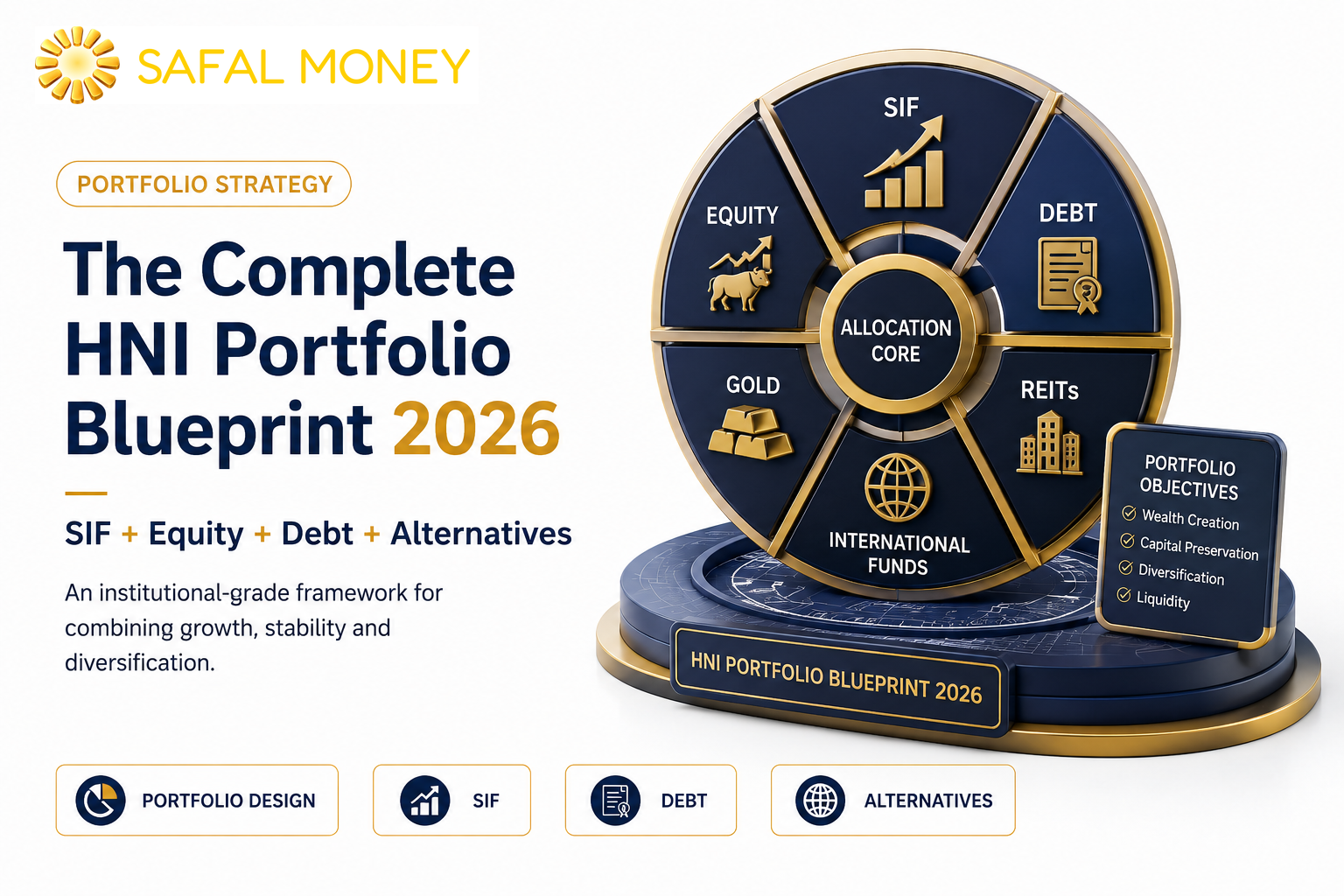
A complete HNI portfolio is not a collection of good investments. It is a system — where every component has a specific role, every allocation is sized for a reason, and the whole is designed to be resilient across multiple economic environments simultaneously.
Most HNI investors in India have the former — a collection of investments accumulated across years of varied advice. Very few have the latter — a coherent architecture built around a unified philosophy.
This article builds that architecture from scratch — specifically for July 2026, incorporating the current macro environment (Iran war partial resolution, US Fed hawkishness, RBI on pause, gold near record highs, SIF category maturing), the full range of available instruments, and five complete portfolio blueprints across different corpus sizes.
The unique feature of this architecture: it integrates SIF as a genuine portfolio layer — not as an add-on — alongside equity mutual funds, debt funds, gold, REITs, and international funds in a way that makes each component more powerful than it would be alone.
The Six Portfolio Roles: Every Investment Must Serve One
Before allocating a single rupee, define the six roles that a complete HNI portfolio must fulfil simultaneously:
Role 1: Growth Engine. Primary long-term wealth creation. This role is fulfilled by equity mutual funds (index + active) — capturing India's economic growth over 10+ year periods. Target: market-beating returns over full cycles.
Role 2: Uncorrelated Alpha. Returns that are independent of whether equity markets rise or fall. This role can only be fulfilled by SIF's long-short structure — no conventional mutual fund category provides this. Target: positive returns even in flat or falling markets, from both long and short book.
Role 3: Stability and Income. Capital preservation and regular income to fund lifestyle expenses. This role is fulfilled by debt mutual funds across the quality and duration spectrum. Target: consistent returns above inflation, with capital safety.
Role 4: Crisis and Inflation Hedge. Protection when everything else falls simultaneously. This role is fulfilled by gold — particularly when geopolitical crises (like the Iran war of 2026) cause equity, debt, and currency to all deteriorate together. Target: positive or flat returns during systemic stress events.
Role 5: Real Asset Income. Yield-generating real asset exposure without the illiquidity of direct property. This role is fulfilled by REITs and InvITs — providing 7–8% annual distribution income from commercial real estate and infrastructure. Target: stable income plus inflation-linked rent escalation over time.
Role 6: Geographic Diversification. Exposure to global growth drivers — particularly US technology and global healthcare — that have no direct Indian equivalent. This role is fulfilled by international funds. Target: reduce single-country concentration and capture global sector leadership.
A complete portfolio fills all six roles simultaneously. A portfolio that only fills roles 1 and 3 (equity + debt) is missing four critical functions — it has no uncorrelated alpha, no crisis hedge, no real asset income, and no geographic diversification.
The Current Macro Context: How July 2026 Shapes Portfolio Architecture
The specific portfolio proportions recommended below are not generic — they are calibrated to the July 2026 macro environment:
Equity: post-Iran war correction has created attractive entry points in mid and small cap segments. Index funds remain the cost-efficient core. Active mid cap and small cap are selectively attractive. Overweight domestic consumption and manufacturing (China+1 beneficiaries); underweight upstream oil producers and Gulf-exposed exporters.
SIF: the Iran war's sector divergence created exactly the environment where long-short SIF is most valuable. Equity Long-Short SIF can exploit the divergence between recovering sectors (aviation, OMCs, banking) and stressed sectors (IT facing US recession, upstream oil, Gulf exporters). Hybrid Long-Short SIF provides the downside protection that is valuable in this geopolitically uncertain environment.
Debt: RBI on pause at 5.25%, US Fed potentially hiking. Barbell approach: floater funds + banking PSU for rate-rise protection (40–50% of debt), short duration corporate bond for yield (30–40%), selective medium duration for eventual rate-cut positioning (10–20%). Avoid heavy concentration in long-duration gilt funds.
Gold: elevated geopolitical uncertainty, negative US real rates, active central bank buying — all structurally supportive. Maintain 8–10% of total portfolio in gold (higher than typical 5% baseline given current environment). See our dedicated gold investment guide for the current Gold ETF vs SGB comparison and the Budget 2026 SGB tax status.
REITs/InvITs: stable income from commercial real estate — provides a yield layer that reduces dependence on debt fund SWP for income generation.
International: US recession risk creates headwinds for US equity in the near term, but geographic diversification remains valuable at 5–7% of total portfolio.
The Architecture Principles: Non-Negotiable Rules
Before the specific blueprints, five non-negotiable principles govern every allocation decision:
- Liquid emergency corpus first — always. Minimum 6 months of expenses in liquid funds before any equity or SIF investment. This is not optional and is not counted as part of the investment portfolio allocation.
- Direct plans for all conventional mutual funds. Every equity and debt mutual fund allocation uses direct plans. Regular plan premiums are justified only for specialist services like SIF through SafalMoney.
- SIF allocation calculated by SafalZenith, not intuition. Use SafalZenith to calculate the SIF percentage. Never guess or use a generic number. The output is specific to the investor's profile.
- Individual SIF fund selection through SafalCheck™. After determining SIF percentage, evaluate specific funds using SafalCheck™ to identify the highest SafalScore™ options across strategy types.
- Annual rebalancing to target allocation. Every March 31, measure actual vs target allocation and rebalance through new contributions first, selling last. Document the target allocation in writing before markets move. See our complete rebalancing framework for the full annual review process.
Blueprint 1: The ₹25 Lakh Portfolio — The Foundation Builder
Investor profile: age 28–38, early accumulation phase, building toward larger corpus, moderate-to-aggressive risk profile, 10+ year horizon. Emergency corpus (not included): ₹4–6 lakh in liquid fund (separate from this portfolio).
| Role | Instrument | Allocation | Amount |
|---|---|---|---|
| Growth Engine | Nifty 50 Index Fund (Direct) | 40% | ₹10L |
| Growth Engine | Active Mid Cap Fund (Direct) | 20% | ₹5L |
| Uncorrelated Alpha | Hybrid Long-Short SIF | 16% | ₹4L* |
| Stability | Short Duration Corporate Bond | 15% | ₹3.75L |
| Crisis Hedge | Gold ETF | 6% | ₹1.5L |
| Real Asset Income | REITs (via ETF) | 3% | ₹0.75L |
*SIF note: ₹4L is below the ₹10L minimum. At ₹25L corpus, SafalZenith will recommend building corpus to ₹32–35L before initiating SIF. Allocate the 16% to a Balanced Advantage Fund as placeholder until corpus reaches ₹35L, then switch to SIF.
Key portfolio features: a simple, 6-holding portfolio — manageable and focused; equity-heavy (60%) appropriate for 10+ year horizon; no international fund — not yet cost-efficient at this corpus size; SIF deferred until corpus is sufficient.
Blueprint 2: The ₹50 Lakh Portfolio — The Entry Level
Investor profile: age 30–42, growing corpus, one SIF strategy appropriate, moderate-to-aggressive profile, 7+ year horizon.
| Role | Instrument | Allocation | Amount |
|---|---|---|---|
| Growth Engine | Nifty 50 + Nifty Next 50 Index | 28% | ₹14L |
| Growth Engine | Active Mid Cap Fund (Direct) | 16% | ₹8L |
| Growth Engine | Active Small Cap Fund (Direct) | 8% | ₹4L |
| Uncorrelated Alpha | Hybrid Long-Short SIF | 20% | ₹10L |
| Stability + Income | Banking PSU + Short Duration | 15% | ₹7.5L |
| Crisis Hedge | Gold SGB + ETF | 7% | ₹3.5L |
| Real Asset Income | REITs | 3% | ₹1.5L |
| Geographic Diversification | International Fund (S&P 500) | 3% | ₹1.5L |
Key portfolio features: SIF enters at exactly ₹10L (20% of ₹50L) — matching SafalZenith typical output for this profile; Hybrid Long-Short SIF only — appropriate for first-time SIF investor at this corpus; active small cap at 8% provides growth satellite — sized conservatively; all six portfolio roles now filled.
Blueprint 3: The ₹1 Crore Portfolio — The Core Architecture
Investor profile: age 35–50, established HNI, two SIF strategies appropriate, aggressive-to-moderate profile, 7+ year horizon, stable income.
| Role | Instrument | Allocation | Amount |
|---|---|---|---|
| Growth Engine | Nifty 50 + Next 50 Index | 22% | ₹22L |
| Growth Engine | Active Mid Cap (Direct) | 14% | ₹14L |
| Growth Engine | Active Small Cap (Direct) | 6% | ₹6L |
| Uncorrelated Alpha | Hybrid Long-Short SIF (Altiva) | 12% | ₹12L |
| Uncorrelated Alpha | Equity Long-Short SIF (DynaSIF) | 8% | ₹8L |
| Stability + Income | Floater + Banking PSU + Short Duration | 18% | ₹18L |
| Crisis Hedge | Gold SGB + ETF | 8% | ₹8L |
| Real Asset Income | REITs + InvITs | 5% | ₹5L |
| Geographic Diversification | International Fund | 5% | ₹5L |
| Flexibility Buffer | Liquid + Money Market | 2% | ₹2L |
Total SIF: 20% (₹20L) across two strategies.
Key portfolio features: two SIF strategies — Hybrid Long-Short for stability, Equity Long-Short for alpha; debt barbell — floater (rate-rise protection) + short duration (yield) + banking PSU (credit safety); gold at 8% reflects elevated 2026 geopolitical risk; REIT income at ₹3,500–₹4,000/month from ₹5L allocation at 7–8% yield; international fund adds US tech and global healthcare exposure.
Blueprint 4: The ₹2 Crore Portfolio — The Full Architecture
Investor profile: age 38–52, core HNI, three SIF strategies appropriate, aggressive profile with 7+ year horizon, stable high income.
| Role | Instrument | Allocation | Amount |
|---|---|---|---|
| Growth Engine | Nifty 50 + Next 50 Index | 18% | ₹36L |
| Growth Engine | Smart Beta (Nifty 200 Momentum 30) | 5% | ₹10L |
| Growth Engine | Active Mid Cap (Direct) | 12% | ₹24L |
| Growth Engine | Active Small Cap (Direct) | 6% | ₹12L |
| Uncorrelated Alpha | Hybrid Long-Short SIF (Altiva) | 10% | ₹20L |
| Uncorrelated Alpha | Equity Long-Short SIF (DynaSIF) | 8% | ₹16L |
| Uncorrelated Alpha | SMID Ex-Top 100 SIF (Altiva / iSIF) | 5% | ₹10L |
| Stability + Income | Floater + Banking PSU + Corporate Bond | 18% | ₹36L |
| Crisis Hedge | Gold SGB + Gold ETF | 9% | ₹18L |
| Real Asset Income | REITs + InvITs | 5% | ₹10L |
| Geographic Diversification | International (S&P 500 + World ETF) | 4% | ₹8L |
Total SIF: 23% (₹46L) across three strategies.
Key portfolio features: Smart Beta (momentum + quality factors) added as a low-cost alpha enhancer between passive and active equity; three SIF strategies — stability (Hybrid LS), alpha (Equity LS), growth satellite (SMID Ex-Top 100); debt allocation sophisticated — floater for rate protection + banking PSU for credit safety + short duration for yield; gold at 9% — highest allocation in any blueprint, reflecting current environment; REIT income approximately ₹7,000–₹8,000/month from ₹10L at 7–8% yield; international at 4% — meaningful geographic diversification without excessive currency risk concentration.
Blueprint 5: The ₹5 Crore Portfolio — The Institutional Level
Investor profile: age 35–50, UHNI, four SIF strategies appropriate, Zenith allocation candidate, 10+ year horizon, very high income.
| Role | Instrument | Allocation | Amount |
|---|---|---|---|
| Growth Engine | Nifty 50 + Next 50 Index | 14% | ₹70L |
| Growth Engine | Smart Beta Multi-Factor | 5% | ₹25L |
| Growth Engine | Active Mid Cap (Direct) | 10% | ₹50L |
| Growth Engine | Active Small Cap (Direct) | 6% | ₹30L |
| Growth Engine | Active Flexi Cap (Direct) | 5% | ₹25L |
| Uncorrelated Alpha | Hybrid Long-Short SIF (Altiva) | 8% | ₹40L |
| Uncorrelated Alpha | Equity Long-Short SIF (DynaSIF) | 8% | ₹40L |
| Uncorrelated Alpha | SMID Ex-Top 100 SIF | 6% | ₹30L |
| Uncorrelated Alpha | Multi-Asset Allocator SIF (DynaSIF) | 4% | ₹20L |
| Stability + Income | Full Debt Ladder (Liquid to Medium Duration) | 14% | ₹70L |
| Crisis Hedge | Gold SGB + ETF | 8% | ₹40L |
| Real Asset Income | REITs + InvITs | 6% | ₹30L |
| Geographic Diversification | International (S&P 500 + Nasdaq + World) | 4% | ₹20L |
| Opportunity Buffer | Arbitrage Fund | 2% | ₹10L |
Total SIF: 26% (₹1.30 crore) across four strategies.
Key portfolio features: four-layer SIF — Hybrid (stability) + Equity LS (alpha) + SMID Ex-Top 100 (growth satellite) + Multi-Asset Allocator (diversification); full debt ladder from liquid through medium duration — each tranche matched to a specific time horizon; REIT income approximately ₹17,500–₹20,000/month from ₹30L at 7–8% yield — meaningful passive income; international at 4% across three geographies — US large cap (S&P 500), US tech (Nasdaq 100), Global ex-US (World ETF); arbitrage fund as tax-efficient short-term opportunity buffer — accessible for tactical deployment without equity market risk; Smart Beta multi-factor — momentum + quality + low volatility combined — systematic factor alpha at low cost.
The Architecture's Response to Market Stress: A Simulation
How does Blueprint 3 (₹1 crore) respond to a severe market correction — specifically a 30% Nifty fall similar to the Iran war crash peak?
| Component | Weight | Market Movement | Portfolio Impact |
|---|---|---|---|
| Equity Index + Mid + Small | 42% | −30% average | −₹12.6L |
| Hybrid Long-Short SIF | 12% | −8% (hedged) | −₹0.96L |
| Equity Long-Short SIF | 8% | −15% (partial hedge) | −₹1.2L |
| Debt (Floater + Banking PSU) | 18% | +0.5% (stable) | +₹0.09L |
| Gold | 8% | +15% (safe haven) | +₹1.2L |
| REITs | 5% | −10% | −₹0.5L |
| International | 5% | −8% (USD buffer) | −₹0.4L |
| Liquid Buffer | 2% | 0% | 0 |
| Net Portfolio Impact | −₹14.37L (−14.4%) |
A pure equity portfolio with 100% Nifty would have fallen 30% — ₹30L on ₹1 crore.
The complete architecture fell only 14.4% — less than half the equity market decline — because SIF, gold, and debt played their designed roles: the Hybrid SIF cushioned the equity fall, gold surged as a safe haven, and debt remained stable.
This stress simulation illustrates the architecture's primary value: not maximum return in good times, but meaningful resilience in bad times.
Rebalancing the Complete Architecture: The Annual Trigger
Review every March 31. Rebalance when any component drifts more than 5 percentage points from its target. Use SafalZenith to recalculate SIF allocation annually — the recommended percentage changes as you age, as your corpus grows, and as your financial situation evolves.
For SIF rebalancing: submit redemption requests 3–4 weeks before desired completion to account for fortnightly windows and T+3 settlement.
Use SafalCheck™ during the annual review to verify that each SIF fund in the portfolio still merits its allocation — checking SafalScore™ relative to category peers and flagging any deterioration in fund manager quality, strategy adherence, or risk metrics.
Frequently Asked Questions
What is the complete HNI portfolio architecture for 2026?
The complete HNI portfolio architecture for 2026 combines six distinct roles across six asset categories: equity mutual funds (index + active) for growth, SIF for uncorrelated alpha through long-short strategies, debt mutual funds for stability and income, gold for crisis and inflation hedging, REITs and InvITs for real asset income, and international funds for geographic diversification. The specific allocation percentages across these categories depend on corpus size, age, risk profile, and investment horizon - with SIF allocation calculated through SafalZenith and individual fund selection evaluated through SafalCheck™.
How much SIF should be in a complete HNI portfolio?
SIF allocation ranges from 16-26% of total portfolio in the five blueprints in this guide - depending on corpus size and investor profile. The specific percentage for any individual investor is determined by SafalZenith, which evaluates 8 personal financial factors. SafalMoney's absolute ceiling for SIF allocation is 40% of total portfolio regardless of profile. Within the SIF allocation, the portfolio should hold 1-4 strategies across Hybrid Long-Short, Equity Long-Short, SMID Ex-Top 100, and Multi-Asset Allocator - depending on total SIF corpus and investor risk profile.
What is the role of gold in an HNI portfolio in 2026?
Gold in 2026 serves as the primary crisis and inflation hedge - providing positive or stable returns when equity markets fall due to geopolitical events (as demonstrated during the Iran war crash), when the rupee depreciates (gold rises in rupee terms), and when US real interest rates are negative (as they currently are at Fed funds 3.50-3.75% versus CPI 4.2%). SafalMoney recommends 8-10% gold allocation in the current environment - higher than the typical 5% given elevated geopolitical risk. Gold should be held primarily in Gold ETF (for new investments) and existing Sovereign Gold Bonds (for current SGB holders) - see our dedicated gold investment guide for the current SGB tax and issuance status.
How does SIF make the complete portfolio better?
SIF adds to the complete portfolio by providing uncorrelated alpha - returns generated from both rising and falling stocks simultaneously through the long-short structure. Without SIF, the entire equity allocation of a portfolio is fully correlated to market direction - everything rises and falls together. SIF's long and short book combination means the SIF component can generate positive returns even when equity markets are flat or falling - reducing overall portfolio volatility and improving risk-adjusted returns. The architecture stress simulation in this guide shows that adding SIF to an equity-debt-gold portfolio reduced the correction impact from 30% to approximately 14% during a severe equity market decline.
Should I build the complete portfolio immediately or gradually?
Build gradually and systematically. Start with the foundation: emergency corpus in liquid funds, then equity core (index fund SIP), then debt allocation. Add SIF when your corpus exceeds Rs 35-40L - initiating with one Hybrid Long-Short strategy. Add gold and REITs in small tranches as corpus grows. Add international funds when total corpus exceeds Rs 75L-1 crore. The complete 6-role architecture is most appropriate for Rs 1 crore+ portfolios. For smaller corpuses, prioritise the growth engine (equity) and stability (debt) roles, with SIF entering as the third priority once corpus is sufficient.
Last updated: 20 July 2026