Zenith SIF Portfolio: Building a Maximum-Allocation SIF Strategy for Aggressive HNI Investors
What does a maximum-allocation SIF portfolio look like for an aggressive HNI investor? The Zenith SIF Portfolio framework - 30-40% SIF allocation, multi-strategy construction, and full portfolio architecture.
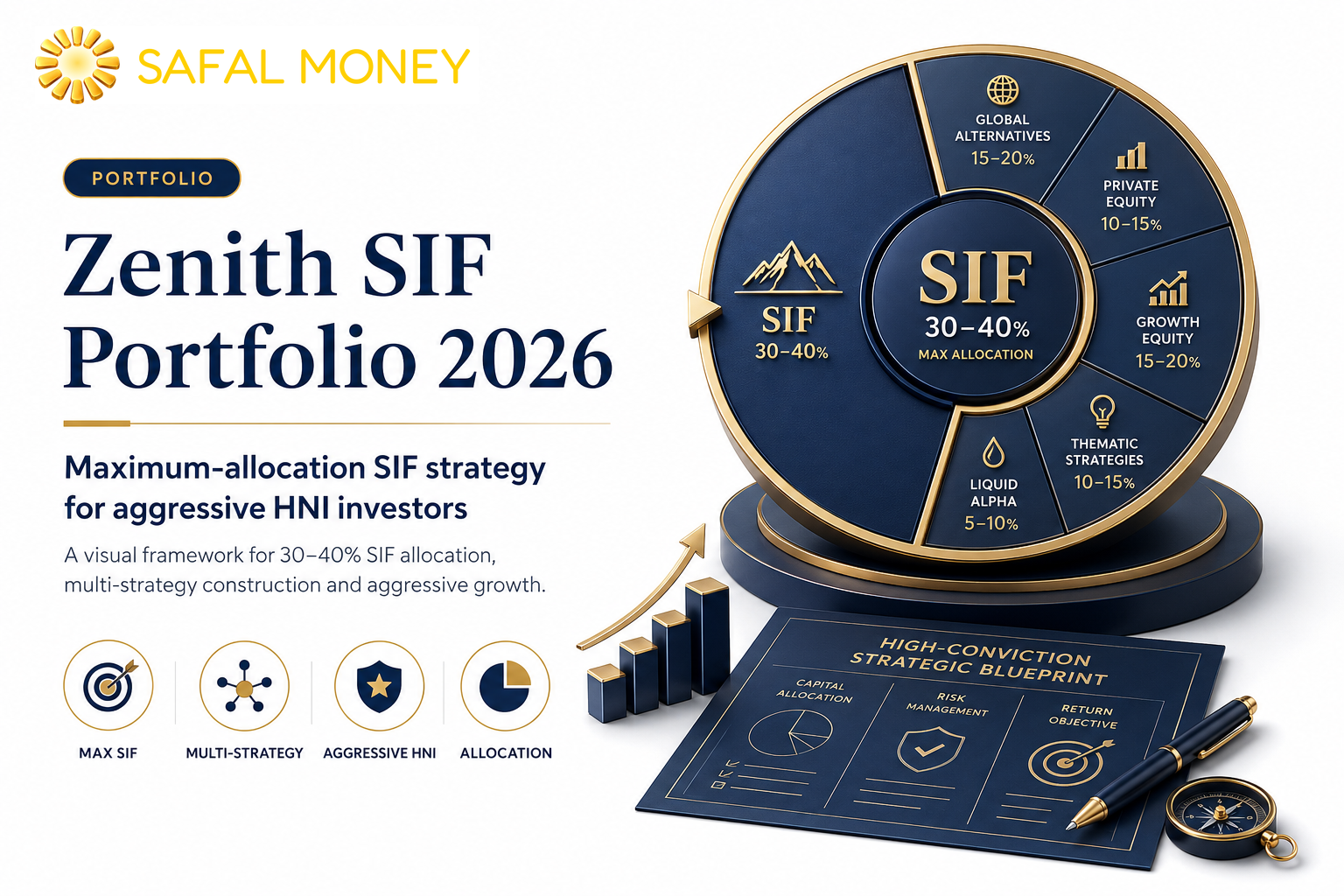
Most discussions about SIF allocation focus on the cautious end — how much is enough for a first-time SIF investor, what is the minimum appropriate corpus, how to start conservatively and build up. Those conversations are important.
This article is for a different audience: the aggressive HNI investor who has done the research, qualifies comfortably as an accredited investor, has a large enough corpus, and wants to understand what the maximum-allocation, full-conviction SIF portfolio actually looks like.
We call this the Zenith SIF Portfolio — not because it is the default recommendation for most investors, but because it represents the upper boundary of what SafalMoney considers responsible SIF allocation for the right investor profile. It is the portfolio that answers the question: "If I am genuinely suited to maximum SIF exposure — what does that look like, and how do I build it intelligently?"
Who Is the Zenith SIF Portfolio For?
Before building the portfolio, be precise about who it is and is not for.
The Zenith SIF Portfolio is appropriate for investors who meet all of the following:
- Age: 28–48 years — long enough investment horizon for SIF to demonstrate value across multiple full market cycles
- Total investable corpus: ₹2 crore or more — so that even at 35–40% SIF allocation, the absolute SIF corpus represents multiple ₹10 lakh minimums across several strategies with room for meaningful diversification
- Investment horizon for SIF allocation: genuine 7+ years — not "I think I will not need it for 7 years" but a financial plan that confirms this money has no claims on it for at least 7 years
- Risk profile: genuinely aggressive — has experienced market corrections of 30%+ and maintained or increased investment positions rather than selling
- Volatility tolerance: Very High — can watch a 20% SIF NAV decline for 6+ months without losing sleep or conviction
- Income: stable, high, and completely portfolio-independent — living expenses are fully covered by employment income with no dependence on portfolio distributions
- SIF familiarity: has already invested in at least one SIF strategy and understands the fortnightly redemption window, NAV volatility, and long-short strategy dynamics from experience
The Zenith Portfolio Is NOT Appropriate For
- Investors who have never held a SIF investment before — start with a moderate allocation and build up
- Anyone whose total corpus is below ₹2 crore — concentration risk becomes problematic
- Investors approaching retirement within 10 years — transition toward more conservative allocation
- Anyone who cannot genuinely absorb a 25% portfolio decline without forced selling
The SafalZenith Alignment: What Maximum Allocation Looks Like
SafalZenith — SafalMoney's SIF allocation tool — outputs an ideal SIF allocation percentage based on 8 personal financial factors. For investors who score in the Green-High Readiness zone (SafalZenith output above 160 out of 208), the tool typically recommends 30–40% SIF allocation, subject to the six safety caps.
The Zenith SIF Portfolio operates at this upper end — 35–40% of total investable portfolio in SIF across multiple strategies.
- At ₹2 crore total corpus: 35% = ₹70 lakh in SIF
- At ₹3 crore total corpus: 35% = ₹1.05 crore in SIF
- At ₹5 crore total corpus: 35% = ₹1.75 crore in SIF
Each of these amounts allows meaningful allocation across 3–4 distinct SIF strategies — which is essential for the Zenith Portfolio's multi-strategy construction philosophy.
The Zenith Portfolio's Core Philosophy: Multi-Strategy SIF Construction
The most important design principle of the Zenith SIF Portfolio is that the SIF allocation is not concentrated in one fund or one strategy type. It is deliberately diversified across multiple strategies that use different mechanisms, different market cap tilts, and different return drivers.
Why does this matter? Consider what happens in different market environments:
- Strongly rising bull market: pure Equity Long-Short strategies may underperform as the short book loses money on rising positions. But Hybrid Long-Short strategies — with their arbitrage and income components — may hold up better.
- Sharp geopolitical correction: Hybrid Long-Short strategies — particularly those with high arbitrage and low net equity exposure — provide the strongest downside protection. Pure Equity Long-Short strategies depend on how well their short books perform.
- Flat, volatile sideways market: Multi-Asset Long-Short strategies (like DynaSIF Active Asset Allocator) perform best — generating returns from commodity, debt, and equity spread simultaneously, independent of market direction.
- Sector rotation environment: sector-focused strategies and Ex-Top 100 strategies generate the most alpha when clear sector divergence exists.
No single SIF strategy type excels in all environments. The Zenith Portfolio deliberately holds multiple strategy types to ensure that at least some portion of the SIF allocation is in its optimal environment at any given time.
The Four-Layer Zenith SIF Construction
The Zenith SIF Portfolio organises its SIF allocation into four distinct layers, each with a specific role:
Layer 1: Stability Core (30–35% of SIF allocation)
The conservative anchor of the SIF portfolio. Holds the most proven, most conservative SIF strategy available — Edelweiss Altiva Hybrid Long-Short as the primary option, or Mirae Platinum Hybrid Long-Short as the alternative. This layer is designed to protect capital in corrections while generating steady income through arbitrage and debt components.
Layer 2: Alpha Engine (35–40% of SIF allocation)
The primary alpha-generation layer. Holds 1–2 pure Equity Long-Short SIF strategies — DynaSIF Equity Long-Short (360 ONE) as the primary choice based on Harsh Agarwal's credentials, and Bandhan Arudha Equity Long-Short as the secondary allocation once sufficient live track record is established. This layer takes the most market risk within the SIF allocation and is expected to generate the highest alpha over a full market cycle.
Layer 3: Growth Satellite (15–20% of SIF allocation)
The high-conviction growth layer. Holds 1 SMID-focused Equity Ex-Top 100 strategy — either iSIF Equity Ex-Top 100 (ICICI Prudential) or the Altiva Equity Ex-Top 100 (Edelweiss). This layer targets the mid and small cap universe where information asymmetry is highest and long-short alpha potential is richest. It carries the highest volatility within the SIF allocation.
Layer 4: Diversification Layer (10–15% of SIF allocation)
The genuinely uncorrelated layer. Holds the DynaSIF Active Asset Allocator Long-Short — the only true multi-asset long-short SIF in India, spanning equities, debt, and commodities simultaneously. This layer has the lowest correlation to the other three — it generates returns from commodity and fixed income dynamics that the equity-focused layers cannot capture.
The Zenith SIF Portfolio for ₹3 Crore Total Corpus
Total investable corpus: ₹3 crore. SafalZenith recommended SIF allocation: 35% = ₹1.05 crore. Investor profile: age 38, salaried, annual income ₹80 lakh, 12-year horizon, Very High volatility tolerance, Aggressive risk profile.
SIF allocation breakdown (₹1.05 crore):
| Layer | Strategy | Fund | % of SIF | Amount |
|---|---|---|---|---|
| Stability Core | Hybrid Long-Short | Edelweiss Altiva Hybrid L/S | 32% | ₹33.6L |
| Alpha Engine | Equity Long-Short | DynaSIF Equity L/S (360 ONE) | 25% | ₹26.25L |
| Alpha Engine | Equity Long-Short | Bandhan Arudha Equity L/S | 13% | ₹13.65L |
| Growth Satellite | SMID Equity L/S | Edelweiss Altiva Equity Ex-Top 100 | 18% | ₹18.9L |
| Diversification | Multi-Asset L/S | DynaSIF Active Asset Allocator | 12% | ₹12.6L |
| Total SIF | 100% | ₹1.05Cr |
No single fund exceeds ₹33.6 lakh (32% of SIF allocation, 11.2% of total portfolio) — well within the 20% of total portfolio single-fund cap.
The complete ₹3 crore portfolio — the SIF layer above plus the non-SIF sleeve (65% / ₹1.95 crore), spread across liquid, debt, domestic and international equity, gold, and real assets:
| Component | % of Portfolio | Amount |
|---|---|---|
| Liquid + Money Market | 6.5% | ₹19.5L |
| Debt MF (Short + Medium Duration) | 9.5% | ₹28.5L |
| Equity Core (Nifty 50 + Next 50 Index) | 18% | ₹54L |
| Active Mid Cap Fund | 12% | ₹36L |
| Active Small Cap Fund | 6.5% | ₹19.5L |
| International Fund (S&P 500) | 5.5% | ₹16.5L |
| Gold (SGB) | 4% | ₹12L |
| REITs + InvITs | 3% | ₹9L |
| Altiva Hybrid L/S SIF | 11.2% | ₹33.6L |
| DynaSIF Equity L/S SIF | 8.75% | ₹26.25L |
| Arudha Equity L/S SIF | 4.55% | ₹13.65L |
| Altiva Equity Ex-Top 100 SIF | 6.3% | ₹18.9L |
| DynaSIF Active Asset Allocator SIF | 4.2% | ₹12.6L |
| Total | 100% | ₹3 crore |
The Zenith Portfolio's Built-In Stress Test
A responsible maximum-allocation SIF portfolio must be stress-tested against realistic adverse scenarios. Here is how the Zenith Portfolio performs across three scenarios:
Scenario A: Severe market correction (Nifty falls 30%)
| Component | Movement | Impact on ₹3Cr Portfolio |
|---|---|---|
| Direct equity — index, active MF, international (42%) | Falls 28% | −₹35.3L |
| Hybrid Long-Short SIF (11.2%) | Falls 8% (downside protected) | −₹2.7L |
| Equity Long-Short SIF (13.3%) | Falls 15% (partial hedge) | −₹6.0L |
| SMID Ex-Top 100 SIF (6.3%) | Falls 20% (mid-small more volatile) | −₹3.8L |
| Multi-Asset SIF (4.2%) | Falls 5% (commodities/debt cushion) | −₹0.6L |
| Debt + Liquid (16%) | Flat to +1% | +₹0.5L |
| Gold (4%) | Rises 15% (safe haven) | +₹1.8L |
| REITs (3%) | Falls 10% | −₹0.9L |
| Total Portfolio Impact | −₹47.0L (−15.7%) |
vs a 100% equity portfolio falling 30% = −₹90L (−30%)
The Zenith SIF Portfolio's multi-strategy SIF allocation — particularly the Hybrid Long-Short and Multi-Asset Allocator layers — provides meaningful downside protection relative to a pure equity portfolio.
Scenario B: Sustained bull market (Nifty rises 25%)
The long book of the equity SIF strategies rises with the market, while the short book loses some of that gain. Net: SIF allocation participates at approximately 60–70% of the equity market upside — less than a pure equity portfolio but with significantly less downside in corrections. This is the expected tradeoff.
Scenario C: Flat volatile market (Nifty ±5% with high intra-year volatility)
This is where the Zenith Portfolio's multi-strategy SIF allocation shines most. The Hybrid Long-Short generates income from arbitrage, the Equity Long-Short generates alpha from stock selection spread, and the Multi-Asset Allocator generates returns from commodity and debt positioning — all independent of equity market direction. Total SIF contribution may exceed total equity contribution in this scenario.
Rebalancing the Zenith SIF Portfolio
With 35% of a ₹3 crore portfolio in SIF spread across 4 strategies, the rebalancing framework must be more sophisticated than a simple annual review.
Annual rebalancing trigger: if any SIF strategy's allocation drifts more than 5 percentage points from target (e.g., the Altiva Hybrid grows from 11.2% to 16.5% of total portfolio due to strong performance), rebalance by redirecting new contributions to underweight strategies rather than selling overperforming ones (to avoid capital gains tax events).
Strategy-level rebalancing: if SafalCheck™ evaluation of any SIF fund's SafalScore™ deteriorates significantly — due to fund manager departure, strategy drift, AUM bloat, or sustained underperformance relative to peers — replace that strategy with a better-rated alternative through the fortnightly redemption window.
Life event rebalancing: if the investor's age increases to above 50, income becomes variable, or horizon shortens for any reason, recalculate using SafalZenith and adjust SIF allocation downward accordingly — reducing Equity Long-Short first (highest volatility), then SMID Ex-Top 100, while maintaining the Hybrid Long-Short core longest.
The Build-Up Timeline: Getting to Zenith Allocation Responsibly
For investors who currently have a moderate SIF allocation and want to build toward the Zenith Portfolio, a phased approach is more appropriate than an immediate jump.
Phase 1 (Months 1–6): Foundation. Start with the Stability Core only — invest in Edelweiss Altiva Hybrid Long-Short at approximately 15% of total portfolio. Experience the fortnightly window, NAV volatility, and portfolio dynamics before adding complexity.
Phase 2 (Months 7–18): Alpha Engine. Add the first Equity Long-Short strategy — DynaSIF Equity Long-Short — at approximately 8–10% of total portfolio. Now at approximately 23–25% total SIF allocation across two strategies.
Phase 3 (Months 19–30): Full Zenith. Add the SMID Ex-Top 100 and Multi-Asset Allocator layers — completing the four-layer structure at 35% total SIF allocation. By this point, you have 18–24 months of live SIF experience across multiple strategies, and meaningful track record data to evaluate each strategy's live performance through SafalCheck™.
Free tool, no login required
Frequently Asked Questions
What is the Zenith SIF Portfolio?
The Zenith SIF Portfolio is SafalMoney's framework for maximum-allocation SIF construction for aggressive HNI investors who score in the Green-High Readiness zone on SafalZenith - typically recommending 35-40% SIF allocation. It organises the SIF allocation into four layers: a Stability Core (conservative Hybrid Long-Short), an Alpha Engine (pure Equity Long-Short strategies), a Growth Satellite (SMID Ex-Top 100 strategy), and a Diversification Layer (Multi-Asset Long-Short). This multi-strategy construction ensures the SIF allocation has differentiated return drivers across different market environments.
How much SIF allocation is in the Zenith Portfolio?
The Zenith SIF Portfolio allocates 35-40% of total investable portfolio to SIF - at the upper end of SafalMoney's recommended range. This is subject to six safety caps including the absolute 40% ceiling, single-fund maximum of 20% of total portfolio, and the requirement that no individual SIF strategy represents more than 20% of the total portfolio. For a Rs 3 crore corpus, the Zenith allocation is approximately Rs 1.05 crore across 4-5 SIF strategies.
Which SIF funds are in the Zenith Portfolio?
The Zenith Portfolio as constructed for a Rs 3 crore corpus includes Edelweiss Altiva Hybrid Long-Short (Stability Core), DynaSIF Equity Long-Short (Alpha Engine primary), Bandhan Arudha Equity Long-Short (Alpha Engine secondary, after sufficient track record is established), Edelweiss Altiva Equity Ex-Top 100 (Growth Satellite), and DynaSIF Active Asset Allocator (Diversification Layer). These selections are based on SafalCheck™ evaluations as of July 2026 and should be reviewed regularly as live performance data accumulates. Use SafalCheck™ to verify current SafalScore™ rankings before making any allocation decisions.
Is the Zenith SIF Portfolio right for me?
The Zenith SIF Portfolio is appropriate only for investors who meet all of these criteria simultaneously: age 28-48, total investable corpus Rs 2 crore or more, genuine 7+ year investment horizon, stable high income fully covering living expenses, Very High volatility tolerance demonstrated through market corrections, and at least 6-12 months of prior SIF investment experience. If you do not currently meet all these criteria, a more moderate SIF allocation is appropriate. Use SafalZenith to calculate your specific recommended allocation.
How do I evaluate whether the Zenith SIF funds are performing well?
Use SafalCheck™ to regularly evaluate the SafalScore™ of each SIF strategy in the Zenith Portfolio. Key metrics to monitor: Sharpe ratio versus category peers, Sortino ratio (downside risk-adjusted return), rolling returns versus benchmark, AUM growth (watch for capacity constraints in SMID strategies), fund manager stability, and March 2026 crash performance as the category's first major stress test. If any fund's SafalScore™ deteriorates significantly relative to peers, consider replacing it with a higher-rated alternative at the next fortnightly redemption window.
Last updated: 16 July 2026