SafalScore™ Deep Dive 2026: The 8-Factor SIF Allocation Model With Case Studies
A complete deep dive into SafalMoney's SafalScore™ - how each of the 8 factors works, what score ranges mean, 4 real case studies across investor profiles, and how to calculate yours free.
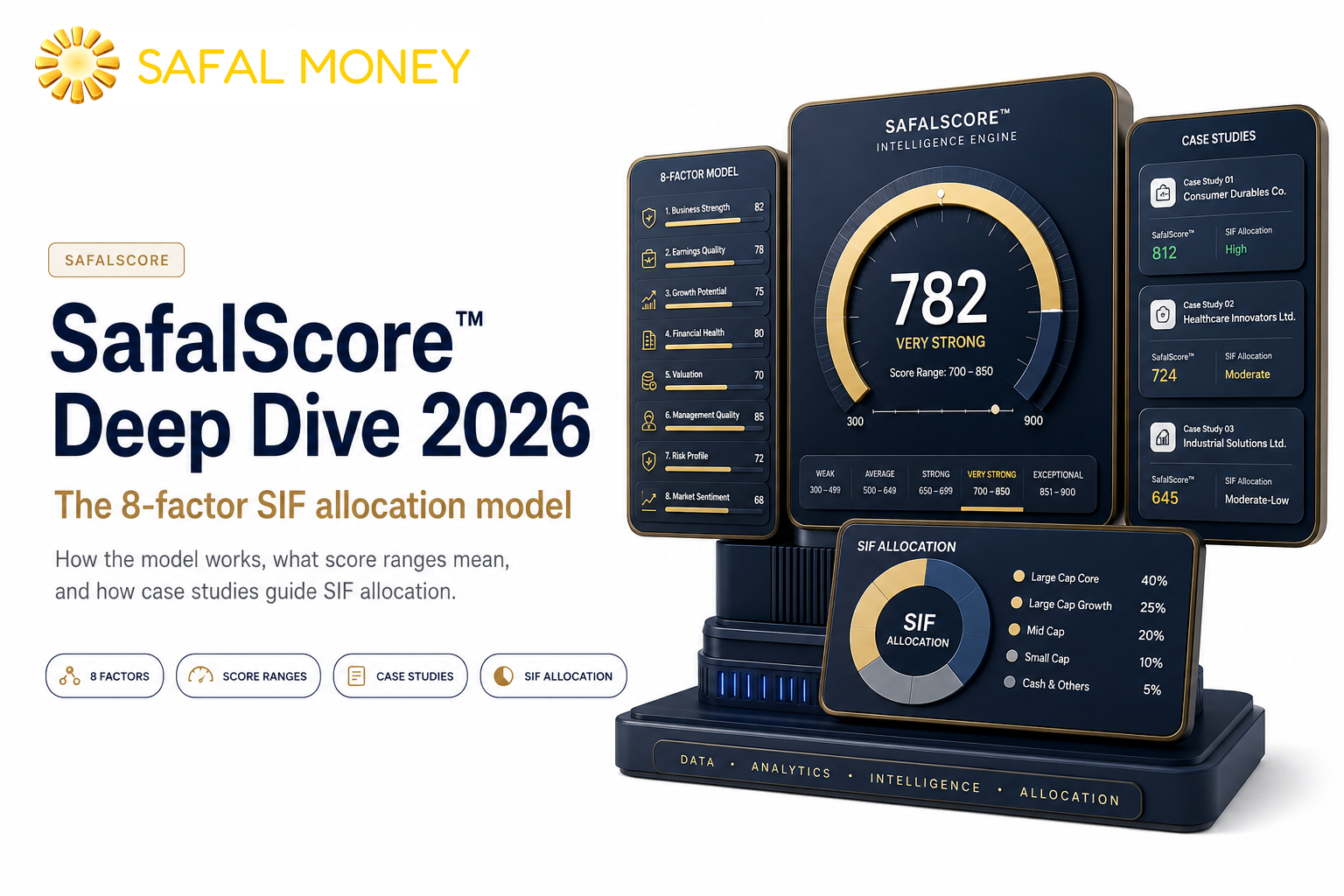
SafalMoney's proprietary 8-factor model, SafalScore™, calculates your ideal SIF allocation percentage. This article goes deeper than an overview — every factor is explained in full, the scoring logic behind each dimension is laid out with specific input ranges and their corresponding score impact, four complete case studies across four distinct investor archetypes show exactly how the same model produces dramatically different outputs for different financial profiles, and we address the most common questions investors ask when they first encounter their SafalScore™: why is my score lower than I expected, can I improve it, and what should I do with a red zone result.
This is the most detailed public explanation of the SafalScore™ model that SafalMoney has published. If you are serious about understanding your SIF allocation, read it carefully before using SafalZenith.
Why Does SafalScore™ Exist — The Problem It Solves
Before dissecting how SafalScore™ works, it is worth being precise about what problem it solves.
The fundamental challenge of SIF allocation is that the right answer is profoundly personal. There is no universal "correct" SIF allocation — a number that works for every HNI investor regardless of their age, wealth, income, risk tolerance, and horizon. Generic recommendations like "put 20% in SIF" are worse than useless — they give some investors false confidence to over-allocate, and give others unnecessary caution that leads to under-allocation or no allocation at all.
SafalScore™ replaces the generic recommendation with a personalised, data-driven output. It asks eight questions, weights the answers according to their relative importance in the allocation decision, applies six safety caps to prevent dangerous concentration, and outputs a specific allocation number — not a range.
The 208-point scale is not arbitrary. It reflects the maximum possible score across all eight factors, weighted in proportion to their importance. A score of 208 would represent the theoretically ideal SIF investor — the right age, sufficient wealth, appropriate debt balance, maximum volatility tolerance, maximum horizon, aggressive risk profile, high income, and no existing SIF concentration. In practice, most investors score between 60 and 170.
Factor 1: Age — The Horizon Proxy
Why age matters: age is the most direct proxy for investment horizon. A 30-year-old has 30+ years of active investing ahead. A 65-year-old has a much shorter relevant horizon for SIF's 3-year-plus structure. But age is not just about horizon — it also reflects wealth accumulation stage, income stability, and the ratio of human capital (future earnings) to financial capital (current portfolio).
| Age Range | Score Impact | Rationale |
|---|---|---|
| 25–35 | Very High | Maximum horizon, high human capital relative to financial capital |
| 36–45 | High | Prime accumulation phase, long horizon, income typically growing |
| 46–55 | Moderate | Horizon shortening but still meaningful; wealth typically peaking |
| 56–62 | Low-Moderate | Pre-retirement transition; capital preservation becoming primary |
| 63–70 | Low | Limited SIF horizon; liquidity needs rising |
| Above 70 | Very Low to Zero | SIF's fortnightly liquidity and 3-year minimum horizon poorly suited |
Common misconception: older investors sometimes feel penalised by the age factor. The reality is that age is being used as a horizon proxy, not a judgment on financial sophistication. A 68-year-old investor is perfectly capable of understanding SIF; the concern is whether a 3-year-plus illiquid strategy is appropriate for someone whose portfolio distribution needs may arise within that period.
Factor 2: Wealth (Total Investable Assets) — The Scale Enabler
Why wealth matters: the ₹10 lakh SIF minimum investment must be evaluated as a proportion of total investable assets. At ₹15 lakh corpus, ₹10 lakh in SIF is 67% concentration — dangerous regardless of other factors. At ₹5 crore corpus, ₹50 lakh in SIF is 10% — a manageable satellite allocation.
| Investable Corpus | Score Impact | SIF as % of Minimum Allocation |
|---|---|---|
| Below ₹15 lakh | Zero — hard block | 67%+ concentration — unsafe |
| ₹15–₹25 lakh | Very Low | 40–67% — borderline |
| ₹25–₹50 lakh | Low-Moderate | 20–40% — manageable with care |
| ₹50L–₹1 crore | Moderate | 10–20% — appropriate range begins |
| ₹1–₹3 crore | High | Multiple SIF strategies become practical |
| Above ₹3 crore | Very High | Full SIF platform access at reasonable concentration |
The ₹25 lakh practical floor: SafalMoney's consistent recommendation is that investors should have at least ₹25 lakh in total investable assets before making any SIF investment — so that the ₹10 lakh minimum represents 40% or less of total portfolio. The SafalScore™ model reflects this by applying heavy downward pressure on scores for investors below this threshold.
What counts as investable assets: equity mutual funds, debt mutual funds, stocks (current market value), fixed deposits, PPF (surrender value), NPS (current value), gold ETFs and SGBs, REITs and InvITs, and real estate other than primary residence (at estimated market value). Life insurance surrender values may be included if the policy has meaningful cash value. Personal assets (primary residence, vehicles, jewellery beyond investment grade, personal goods) are excluded.
Factor 3: Existing Debt Percentage — The Portfolio Balance Check
Why debt percentage matters: an investor with 80% of their portfolio in debt has a very conservative overall posture — adding Equity Long-Short SIF would create a dramatic shift toward risk that may not reflect their actual risk appetite. An investor with 5% in debt has essentially no defensive layer — they need debt before adding more equity-like instruments.
SafalScore™ uses the existing debt percentage not to penalise conservative investors but to assess portfolio balance — the degree to which the current portfolio is over or under-weighted in defensive instruments relative to what makes sense for the investor's overall profile.
| Existing Debt % | Score Impact | Interpretation |
|---|---|---|
| Below 10% | Low | Insufficient defensive layer; adding more equity-like SIF increases concentration risk |
| 10–25% | Moderate-High | Good balance; SIF adds alternative alpha without excessive equity concentration |
| 25–40% | High | Optimal balance for most HNI investors; SIF equity exposure is appropriate |
| 40–60% | Moderate | Conservative portfolio; SIF adds needed dynamism but allocation should be moderate |
| Above 60% | Low | Heavily defensive; Hybrid Long-Short SIF may be appropriate but Equity Long-Short warrants caution |
The rebalancing insight: for investors whose SafalScore™ is lowered by very high debt percentage (above 60%), SafalZenith recommends a rebalancing exercise — gradually migrating from conservative debt instruments toward equity mutual funds — before adding SIF. This creates a more balanced foundation for the SIF overlay.
Factor 4: Volatility Tolerance — The Behavioural Test
Why volatility tolerance matters: this is the most psychologically nuanced factor in the SafalScore™ model. Volatility tolerance is not the same as stated risk profile — it is a behavioural assessment of how an investor actually responds to NAV drawdowns, not how they think they will respond.
SafalScore™ assesses volatility tolerance through a structured set of scenario questions in SafalZenith: if your SIF investment fell 20% in three months, what would you do? Have you ever sold an investment during a market correction, and if so, at what percentage loss? How did you respond to the market crashes of 2020 and 2026? Does a 10% monthly portfolio loss affect your daily emotional state significantly?
The answers place investors on a 5-point volatility tolerance scale: Very Low, Low, Moderate, High, Very High.
| Volatility Tolerance | Score Impact | SIF Strategy Implication |
|---|---|---|
| Very Low | Very Low | SIF not recommended; investor will likely sell at the wrong time |
| Low | Low | Hybrid Long-Short SIF only; maximum 10% allocation |
| Moderate | Moderate | Hybrid Long-Short preferred; small Equity Long-Short satellite |
| High | High | Full range of SIF strategies appropriate |
| Very High | Very High | Maximum allocation within safety caps justified |
The behavioural premium: SafalScore™ weights volatility tolerance heavily because investor behaviour is the ultimate determinant of investment outcome. The most perfectly designed SIF strategy delivers zero benefit to an investor who redeems at the first 15% drawdown. The model would rather recommend a smaller allocation to a conservative investor who will stay the course than a large allocation to an aggressive investor who will sell at the first sign of stress.
Factor 5: Investment Horizon — The Strategy Enabler
Why horizon matters: SIF's fortnightly redemption window is designed for long-term investors, not tactical traders. The long-short strategy needs time to demonstrate its value across varied market conditions. A 3-year evaluation of a long-short strategy is the minimum before meaningful performance conclusions can be drawn.
| Investment Horizon | Score Impact | Maximum SIF Allocation |
|---|---|---|
| Below 3 years | Zero — hard block | 0% regardless of other factors |
| 3–5 years | Low-Moderate | Up to 15% |
| 5–7 years | Moderate-High | Up to 25% |
| 7–10 years | High | Up to 35% |
| Above 10 years | Very High | Up to 40% (absolute ceiling) |
The Hard Block Below 3 Years
This is the most non-negotiable safety cap in the entire SafalScore™ model. If an investor's stated horizon is below 3 years for the money they are considering for SIF, the score outputs 0% SIF allocation — regardless of how high every other factor scores. There are no exceptions. SIF is simply inappropriate for short-term money.
How to think about horizon honestly: many investors overestimate their horizon. If you say "I have a 10-year horizon" but you are actually saving for a down payment on a second property in 4 years using this money, that money has a 4-year horizon, not a 10-year horizon. SafalZenith asks investors to specify the horizon for the specific money they are allocating to SIF, not their general investment philosophy.
Factor 6: Risk Profile — The Comprehensive Risk Assessment
Why risk profile differs from volatility tolerance: risk profile in SafalScore™ is a broader assessment than volatility tolerance. It captures financial capacity for risk (not just psychological comfort), incorporating income stability, liability burden, family dependents, and overall financial resilience.
Two investors might have identical volatility tolerance — both claim they are comfortable with significant NAV swings — but one has a stable salaried income, no liabilities, and a large emergency fund while the other has variable business income, a large home loan, and no emergency fund. The second investor's financial capacity for risk is significantly lower than the first, even if their stated psychological tolerance is the same.
SafalScore™ risk profile inputs: employment type (salaried vs self-employed vs retired), income variability (fixed vs variable), number of financial dependents, outstanding liability-to-asset ratio, and existing emergency fund adequacy.
| Risk Profile | Score Impact | Recommended SIF Strategy Type |
|---|---|---|
| Conservative | Very Low | Hybrid Long-Short only; maximum 10% |
| Moderate-Conservative | Low | Hybrid Long-Short; small Multi-Asset allocation |
| Moderate | Moderate | Hybrid Long-Short + small Equity Long-Short |
| Moderate-Aggressive | High | Equity Long-Short primary; Hybrid secondary |
| Aggressive | Very High | Full Equity Long-Short; SMID and Sector strategies appropriate |
Factor 7: Annual Income — The Liquidity Independence Measure
Why income matters: investors who are fully dependent on their investment portfolio for monthly income have a fundamentally different liquidity constraint than investors whose monthly expenses are covered by employment income. For the former, fortnightly SIF redemption windows create genuine hardship in emergencies. For the latter, the two-week window is essentially irrelevant.
| Annual Income | Dependency on Portfolio | Score Impact |
|---|---|---|
| Above ₹50 lakh (stable) | Nil or minimal | Very High |
| ₹25–₹50 lakh (stable) | Low | High |
| ₹12–₹25 lakh | Moderate | Moderate |
| Below ₹12 lakh | Potentially high | Low |
| Retired (pension + portfolio) | Partial to full | Low-Moderate depending on pension adequacy |
| Retired (portfolio only) | Full | Low — fortnightly lock-in is a genuine concern |
The self-employed adjustment: self-employed investors with variable income — business owners, freelancers, professionals with unpredictable income streams — receive a moderate downward adjustment relative to salaried investors at the same income level. Irregular income means occasional large cash needs from the portfolio are more likely, making SIF's fortnightly liquidity constraint more material.
Factor 8: Existing SIF Exposure — The Concentration Checker
Why existing SIF exposure matters: if you already have 25% of your portfolio in SIF and ask SafalZenith what your SIF allocation should be, the correct answer is "review and possibly maintain current allocation," not "add more." The existing SIF exposure factor prevents the model from compounding concentration risk by recommending additional SIF investment on top of an already-adequate allocation.
| Existing SIF % | Score Impact | Output Implication |
|---|---|---|
| 0% | Neutral — no adjustment | Fresh allocation recommended based on other 7 factors |
| 1–10% | Small upward adjustment | Slightly more room before ceiling is reached |
| 10–20% | Moderate downward adjustment | Approaching recommended range; incremental additions only |
| 20–30% | Significant downward adjustment | At or near optimal for most profiles |
| Above 30% | Maximum downward adjustment | SafalScore™ flags over-concentration; recommends no additions |
| Above 40% | Hard block | Recommends active rebalancing to reduce SIF exposure |
The Six Safety Caps — How They Override the Formula
Even if all 8 factors score highly, six safety caps can override the formula output to prevent dangerous outcomes:
- Maximum SIF at 40% of total portfolio — absolute ceiling regardless of score.
- Single fund maximum 20% of total portfolio — forces diversification within the SIF allocation.
- Horizon hard block below 3 years — score outputs 0% regardless of other factors.
- Corpus floor below ₹15 lakh — hard block prevents the ₹10 lakh minimum from creating dangerous concentration.
- Income dependency override — if more than 70% of monthly expenses are funded from the portfolio, SIF allocation is capped at 10% regardless of score.
- Existing over-concentration check — if existing SIF exceeds 35%, further additions are blocked until rebalancing occurs.
Four Case Studies: The SafalScore™ in Action
Case Study 1: Kavya Reddy — 29-Year-Old Software Engineer, ₹40 Lakh Corpus
Profile: Age 29, investable corpus ₹40 lakh, existing debt 20% (liquid fund + short duration), volatility tolerance High, investment horizon 12 years (FIRE target at 41), risk profile Aggressive, annual income ₹18 lakh (salaried, stable), existing SIF none.
Factor-by-factor scoring: Age (29) Very High — maximum horizon phase. Wealth (₹40L) Moderate — sufficient for SIF but not large corpus. Debt % (20%) High — good balance. Volatility tolerance (High) High. Horizon (12 years) Very High. Risk profile (Aggressive) Very High. Annual income (₹18L, stable salaried) Moderate-High. Existing SIF (0%) Neutral.
SafalScore™: 148 → Green-Ready Zone. Recommended allocation: 22% of ₹40 lakh = ₹8.8 lakh. Safety cap applied: corpus floor cap — ₹8.8 lakh is below ₹10 lakh minimum. SafalScore™ recommends building corpus to ₹46 lakh first (approximately 8–10 months of continued saving), then investing ₹10 lakh in SIF (21.7% of ₹46 lakh portfolio). Recommended strategy: Equity Long-Short SIF — consistent with her 12-year horizon, aggressive profile, and high volatility tolerance.
Case Study 2: Vikram Malhotra — 47-Year-Old Business Owner, ₹1.5 Crore Corpus
Profile: Age 47, investable corpus ₹1.5 crore, existing debt 35% (mix of FDs and short duration MFs), volatility tolerance Moderate, investment horizon 8 years, risk profile Moderate-Aggressive, annual income ₹42 lakh (variable business income — good years ₹55L, lean years ₹28L), existing SIF none.
Factor-by-factor scoring: Age (47) High. Wealth (₹1.5Cr) High. Debt % (35%) High — good balance. Volatility tolerance (Moderate) Moderate. Horizon (8 years) High. Risk profile (Moderate-Aggressive) High. Annual income (₹42L variable) Moderate — variable income applies downward adjustment. Existing SIF (0%) Neutral.
SafalScore™: 139 → Green-Ready Zone. Recommended allocation: 25% of ₹1.5 crore = ₹37.5 lakh. Safety cap applied: single fund cap (20% max per fund) — ₹37.5 lakh must be split across at least 2 SIF strategies. Recommended strategy: 60% Hybrid Long-Short (₹22.5L) + 40% Equity Long-Short (₹15L). The hybrid allocation reflects Vikram's moderate volatility tolerance and variable income — providing more downside protection than a pure Equity Long-Short allocation would. Portfolio note: Vikram's variable income reduces his optimal SIF allocation from what his wealth and horizon alone would suggest. SafalZenith recommends starting with the Hybrid-heavy split and reviewing after 18 months to potentially increase Equity Long-Short if he demonstrates comfort with the NAV volatility.
Case Study 3: Nandita Kapoor — 61-Year-Old Retired Government Officer, ₹2 Crore Corpus
Profile: Age 61, investable corpus ₹2 crore, existing debt 55% (predominantly FDs and PPF), volatility tolerance Low, investment horizon 6 years (legacy portfolio for children; personal needs met by pension), risk profile Conservative-Moderate, annual income ₹9.6 lakh (monthly pension ₹80,000 covers all expenses), existing SIF none.
Factor-by-factor scoring: Age (61) Low-Moderate. Wealth (₹2Cr) Very High. Debt % (55%) Low-Moderate — conservative posture. Volatility tolerance (Low) Low. Horizon (6 years) Moderate. Risk profile (Conservative-Moderate) Low-Moderate. Annual income (₹9.6L pension, full expense coverage) Moderate-High — pension fully covers expenses, improving score. Existing SIF (0%) Neutral.
SafalScore™: 92 → Amber-Moderate Zone. Recommended allocation: 12% of ₹2 crore = ₹24 lakh. Strategy: Hybrid Long-Short SIF only — pure Equity Long-Short is not appropriate given her low volatility tolerance and conservative profile. Specifically recommend the most conservative established Hybrid Long-Short option for its demonstrated low standard deviation and superior crash protection. What SafalZenith tells Nandita: your SafalScore™ of 92 places you in the Amber-Moderate zone. SIF is appropriate for a 12% allocation — but only the most conservative Hybrid Long-Short strategy. This ₹24 lakh should be one of the last investments to touch if you need emergency funds — ensure the remaining ₹1.76 crore includes sufficient liquid and short-duration debt instruments first.
Case Study 4: Rohan Singhania — 38-Year-Old Investment Banker, ₹4 Crore Corpus
Profile: Age 38, investable corpus ₹4 crore, existing debt 18% (primarily arbitrage and short duration), volatility tolerance Very High, investment horizon 15 years, risk profile Aggressive, annual income ₹95 lakh (stable, high-paying salaried role), existing SIF ₹30 lakh already invested (7.5% of corpus).
Factor-by-factor scoring: Age (38) Very High. Wealth (₹4Cr) Very High. Debt % (18%) High — good balance. Volatility tolerance (Very High) Very High. Horizon (15 years) Very High. Risk profile (Aggressive) Very High. Annual income (₹95L, stable salaried) Very High. Existing SIF (7.5%) Moderate downward adjustment — reduces additional allocation room.
SafalScore™: 177 → Green-High Readiness Zone. Recommended total SIF allocation: 28% of ₹4 crore = ₹1.12 crore. Existing SIF: ₹30 lakh (7.5%). Additional SIF recommended: ₹82 lakh (to reach ₹1.12 crore total). Safety cap applied: raw score would suggest 32%, but Rohan's absolute SIF corpus (₹1.12 crore) approaching the ₹1 crore threshold triggers the absolute corpus moderation cap, bringing the recommendation to 28% rather than 32%. Strategy split for the additional ₹82 lakh: ₹40 lakh to an Equity Long-Short strategy (primary), ₹22 lakh to a Hybrid Long-Short strategy (stability layer), and ₹20 lakh to an aggressive SMID satellite strategy. What SafalZenith tells Rohan: your SafalScore™ of 177 is among the highest in the green zone. You already have ₹30 lakh in SIF, which is the right direction. The model recommends an additional ₹82 lakh to reach your optimal 28% allocation — prioritise the pure Equity Long-Short strategy with the strongest fund manager credentials for the bulk of this addition.
What to Do if Your SafalScore™ Is in the Red Zone
A red zone score (0–60) means SafalScore™ has determined that SIF is not currently appropriate. This is not permanent — it is a point-in-time assessment. The most common red zone triggers:
- Corpus below ₹15 lakh. Build your mutual fund corpus first. A disciplined SIP in a Nifty 50 index fund plus one active mid cap fund will grow your corpus toward the ₹25–₹30 lakh range needed for appropriate SIF entry.
- Horizon below 3 years. This is non-negotiable. If your intended horizon is genuinely below 3 years for this money, do not invest in SIF. Put it in short duration or corporate bond funds instead.
- Very low volatility tolerance. This is the most honest signal from SafalZenith. If you genuinely cannot tolerate 15–20% NAV drawdowns without emotional selling, SIF's additional benefit is eliminated by the likelihood of premature redemption. Focus on building a strong debt + equity fund base first.
Use SafalZenith to calculate your score and identify which specific factors are limiting it. The output will tell you precisely what needs to change in your financial profile for SIF to become appropriate.
Free, 2 minutes
Frequently Asked Questions
How is SafalScore™ calculated?
SafalScore is calculated by evaluating 8 factors of your financial profile - age, total investable wealth, existing debt allocation percentage, volatility tolerance, investment horizon, overall risk profile, annual income, and current SIF exposure. Each factor is scored independently on a weighted basis, with the scores summed on a 208-point scale. Six built-in safety caps override the formula output when necessary to prevent dangerous over-concentration. The result maps to a specific SIF allocation percentage and recommended strategy type. Calculate yours free on SafalZenith.
What is a good SafalScore™?
A SafalScore above 121 places you in the Green-Ready zone, where a meaningful SIF allocation is recommended. Scores of 91-120 are in the Amber-Moderate zone - limited SIF exposure may be appropriate with careful strategy selection. Scores of 61-90 are Amber-Cautious - only the most conservative SIF strategies (Hybrid Long-Short) may be appropriate. Scores below 60 are in the Red zone - SIF is not currently appropriate. The absolute score matters less than understanding which specific factors are driving it and what each factor implies for your strategy choice.
Can I improve my SafalScore™?
Yes - SafalScore is a dynamic assessment that changes as your financial situation evolves. The most impactful improvements come from: building your investable corpus (Factor 2 - the highest-impact lever for most investors), extending your investment horizon by not earmarking this money for near-term goals (Factor 5), reducing income dependency on your portfolio through building an emergency corpus (Factor 7), and genuinely assessing and improving your volatility tolerance through education and experience with market cycles (Factor 4).
Does SafalScore™ tell me which SIF fund to invest in?
SafalScore tells you how much to invest in SIF and which strategy type - Equity Long-Short, Hybrid Long-Short, or Debt Long-Short. For specific fund selection within each strategy type, use SafalCheck, which evaluates individual SIF funds on an 8-factor fund evaluation framework to generate a fund-level SafalScore for each option. The two tools work together - SafalZenith for allocation, SafalCheck for fund selection.
How often should I recalculate my SafalScore™?
SafalMoney recommends recalculating your SafalScore at least once a year or whenever your financial situation changes significantly - such as a major increase in investable corpus, a change in employment or income, approaching a significant life milestone (marriage, retirement, child's education), or a significant change in your investment horizon. The model is designed to evolve with you - your optimal SIF allocation at 35 will be different from the optimal allocation at 45 or 60.
Last updated: 12 July 2026