How to Invest in SIF Funds in India: A Complete Step-by-Step Guide
A complete step-by-step guide to investing in Specialised Investment Funds in India - eligibility check, KYC, accredited investor status, fund selection, and how SafalMoney helps you invest.
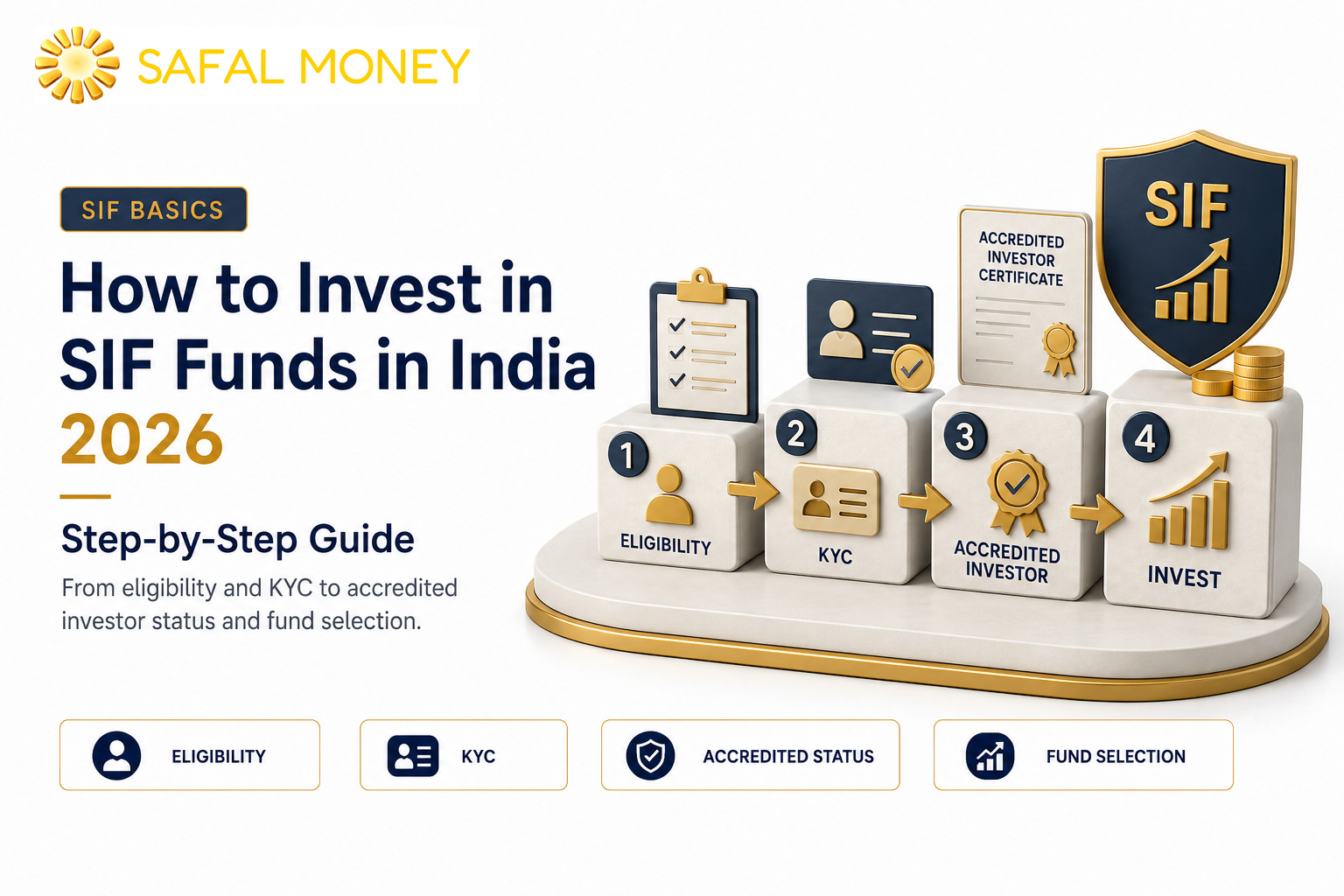
You have done your research. You understand what SIF is, why it fits your portfolio, and which fund you want to invest in. Now comes the practical question that most guides gloss over — how do you actually invest in a Specialised Investment Fund in India?
The process is different from investing in a regular mutual fund. There are additional eligibility requirements, a specific accredited investor verification process, and documentation steps that do not exist for conventional mutual fund investments. Getting any of these steps wrong delays your investment or results in the application being rejected.
This guide walks you through every step — from checking your eligibility to receiving your SIF account statement — with precise instructions and no jargon.
Step 1: Check Your SIF Eligibility — Are You an Accredited Investor?
The first and most important step is confirming that you meet SEBI's eligibility criteria for investing in a Specialised Investment Fund. Unlike regular mutual funds — which are open to any Indian resident with a PAN card — SIF is restricted to accredited investors.
SEBI defines an accredited investor under its 2021 Accredited Investor Framework as an investor who meets at least one of the following criteria:
Individual investors (including HUFs and sole proprietors):
- Annual income of ₹2 crore or more in the previous financial year, OR
- Net worth of ₹7.5 crore or more (of which at least ₹3.75 crore must be in financial assets), OR
- Annual income of ₹1 crore or more AND net worth of ₹5 crore or more
For the purpose of SIF investment specifically, SEBI has set a lower bar than the full accredited investor definition above. For SIF, the eligibility threshold is:
- Net worth of at least ₹2 crore (excluding the value of your primary residence), OR
- Annual income of at least ₹50 lakh
This SIF-specific eligibility threshold is meaningfully lower than the full accredited investor definition — designed to make SIF accessible to the upper HNI segment without requiring the ultra-HNI thresholds of the full accreditation framework.
What counts toward the ₹2 crore net worth calculation? Financial assets (equity portfolios, mutual funds, fixed deposits, PPF, NPS, gold ETFs, bonds) and real estate (other than your primary residence). Your primary residence is explicitly excluded from the net worth calculation.
What does NOT count? Your primary residence, personal vehicles, jewellery beyond investment-grade holdings, and other personal assets.
If you are uncertain whether you meet the threshold, the simplest approach is to add up your financial assets and real estate assets (excluding your home) and check against the ₹2 crore threshold. Most HNI investors who have been systematically investing for 5+ years will meet this criterion.
Step 2: Complete Your KYC — Central KYC (CKYC) Verification
If you are already investing in mutual funds, you are almost certainly KYC-compliant. Your existing mutual fund KYC — validated through any SEBI-registered intermediary — is sufficient for SIF investment through the same intermediary.
If you are new to mutual fund investing or your KYC is not current, complete the Central KYC (CKYC) process:
Documents required for CKYC:
- PAN card (mandatory)
- Aadhaar card (for address proof and identity verification)
- Passport-size photograph
- Bank account details (cancelled cheque or bank statement)
- Income proof for SIF eligibility verification — see Step 3
The CKYC process can be completed online through most AMC websites or mutual fund platforms, or in person at an AMC or distributor office. For online completion, a video-based KYC (VKYC) call with a representative typically takes 10–15 minutes.
Important note: if your KYC was completed several years ago and you have not updated it recently, verify that your address, bank account, and income details are current. Outdated KYC information can delay SIF investment processing.
Step 3: Obtain Your Accredited Investor Certificate
This step is unique to SIF — it does not exist for regular mutual fund investments. Before investing in any SIF, you must obtain a formal Accredited Investor Certificate from a SEBI-recognised accreditation agency.
As of 2026, the designated accreditation agencies in India include:
- NSE Emerge (National Stock Exchange)
- BSE (Bombay Stock Exchange)
- CDSL Ventures Limited
Documents required for accreditation:
For the income criterion (₹50 lakh annual income):
- Latest ITR (Income Tax Return) — Form 26AS or ITR-V showing income above ₹50 lakh
- OR latest salary slip if salaried (showing CTC above ₹50 lakh)
- OR CA-certified income certificate for self-employed individuals
For the net worth criterion (₹2 crore net worth):
- CA-certified net worth certificate (the most commonly used document)
- The net worth certificate must be dated within 6 months of the accreditation application
- It must specifically state that the net worth excludes the value of your primary residence
The accreditation process: Go to the NSE Emerge Accreditation Portal or the BSE equivalent, upload the required documents, pay the nominal processing fee (typically ₹500–₹1,000), and wait for verification. Processing typically takes 3–7 business days.
Once approved, you receive a digital Accredited Investor Certificate with a unique accreditation number and validity period (typically 1 year, renewable annually).
SafalMoney's Assistance
If you invest in SIF through SafalMoney, our team guides you through the accreditation process step by step — helping you prepare the documents, select the right accreditation agency, and submit the application correctly to minimise processing delays.
Step 4: Calculate Your Ideal SIF Allocation Using SafalScore™
Before choosing a specific SIF fund, calculate your ideal SIF allocation using SafalZenith. This 3-minute tool evaluates your 8-factor profile — age, wealth, existing debt percentage, volatility tolerance, investment horizon, risk profile, annual income, and existing SIF exposure — and outputs:
- Your SafalScore™ (0–208)
- Your recommended SIF allocation percentage
- Your recommended SIF strategy type (Equity Long-Short, Hybrid Long-Short, or Debt Long-Short)
This step prevents the most common SIF investment mistake — allocating too much or too little based on a generic recommendation rather than your specific financial profile.
If your SafalScore™ places you in the red zone (0–60), SIF is not currently appropriate for your profile. Address the limiting factors first — build your corpus, extend your horizon, or reassess your risk tolerance — before proceeding.
Step 5: Select Your SIF Fund Using SafalCheck™
With your SafalScore™ and strategy type recommendation in hand, evaluate specific SIF funds using SafalCheck™. SafalCheck™ applies an 8-factor fund evaluation framework to every available SIF — rolling returns, Sharpe ratio, Sortino ratio, fund manager tenure, portfolio concentration, expense ratio, AUM capacity, and maximum drawdown — and generates a SafalScore™ for each fund.
Key selection criteria at this stage:
- Match strategy type to recommendation — if SafalZenith recommends Hybrid Long-Short, do not invest in an Equity Long-Short strategy because it looks more exciting. The recommendation is based on your risk profile.
- Check the track record length — as of July 2026, the oldest SIF (Edelweiss Altiva Hybrid) has approximately 10 months of live performance. Newer funds have less. Factor track record length into your confidence level for each fund.
- Compare expense ratios within strategy type — a 0.5% difference in expense ratio between two similar SIF strategies compounds significantly over 5 years. Always compare direct plan expense ratios, never the regular plan.
- Review the March 2026 crash performance — the February–April 2026 market crash was the first real stress test for Indian SIF funds. How each fund performed during this period, relative to its category, is the most informative single data point available for fund evaluation.
For a full comparison framework, see How to Choose the Right SIF in India.
Step 6: Choose Your Investment Route — Direct or Through SafalMoney
You have two routes to invest in a SIF fund:
Route 1: Direct Investment Through the AMC. Go directly to the AMC's SIF website, create an account, upload your KYC and accredited investor certificate, and invest directly. This route gives you the direct plan (lowest expense ratio) without any intermediary. It requires you to manage the investment yourself — monitoring performance, handling redemptions, and making rebalancing decisions independently.
Route 2: Through SafalMoney (AMFI-Registered MFD). Invest through SafalMoney as your AMFI-registered Mutual Fund Distributor. SafalMoney handles accredited investor certificate assistance, fund selection guidance through SafalCheck™ analysis, end-to-end investment processing (KYC verification, application submission, account setup), ongoing monitoring and portfolio review, and redemption and rebalancing coordination with the fortnightly window in mind.
SafalMoney charges a regular plan commission — disclosed transparently as required by SEBI — rather than a separate advisory fee. For investors who want expert guidance on SIF selection, portfolio architecture, and ongoing management, this is typically the more appropriate route.
Step 7: Complete the SIF Application
Whether investing directly or through SafalMoney, the application process involves:
For online applications:
- Log in to the AMC's SIF portal or platform
- Enter your PAN, accredited investor certificate number, and bank account details
- Upload KYC documents if not already on record
- Select the investment strategy, plan (Direct or Regular), and option (Growth)
- Enter the investment amount (minimum ₹10,00,000)
- Confirm the application and make the payment through net banking or RTGS/NEFT
For offline applications:
- Obtain the Investment Strategy Information Document (ISID) — the SIF equivalent of a Scheme Information Document — from the AMC website
- Fill out the physical application form
- Attach self-attested copies of PAN, address proof, and accredited investor certificate
- Submit with a cheque or DD for the investment amount payable to the SIF fund
Important: The ₹10 Lakh Minimum Is Per PAN Per AMC
SEBI mandates that the minimum aggregate investment across all SIF strategies from the same AMC must be ₹10,00,000 per PAN. This means if you invest ₹6 lakh in one strategy and ₹5 lakh in another strategy from the same AMC, your total ₹11 lakh across the two strategies satisfies the minimum — you do not need ₹10 lakh separately in each strategy. However, if you invest in SIF strategies from different AMCs, the ₹10 lakh minimum applies separately to each AMC.
Step 8: Understand the Redemption Process Before You Invest
This step is critical — and most investors skip it until they actually need to redeem, at which point it is too late to be surprised.
SIF funds do not offer daily redemption like regular mutual funds. Instead, they have fortnightly redemption windows — typically twice a month on specified dates.
How fortnightly redemption works:
- Check the fund's specific redemption dates (published in the ISID and on the AMC website)
- Submit your redemption request before the cut-off time on or before the redemption date
- Your redemption is processed on the redemption date, and proceeds are credited to your bank account within T+3 business days
What happens if you miss a redemption window? You must wait until the next fortnightly window — typically 10–14 days later. This means in an urgent situation, you may wait up to two weeks to access your SIF investment.
Exit load considerations: exit loads vary by fund — typically 0.5–1% within the first 3–12 months. Check the specific exit load structure of your chosen fund before investing and factor it into your horizon planning.
Step 9: Set Up Monitoring and Annual Review
Once invested, set up a monitoring rhythm for your SIF portfolio:
- Monthly: Check the fund's NAV and compare it to the benchmark return for the same period.
- Quarterly: Review the fund's portfolio disclosure (published monthly by most SIF AMCs) — check AUM growth, portfolio concentration, and any significant position changes.
- Annually: Recalculate your SafalScore™ (your financial situation changes over time), review the fund's rolling returns and Sharpe ratio against category peers using SafalCheck™, and assess whether the original allocation percentage is still appropriate.
Rebalancing trigger: if your SIF allocation drifts more than 8–10 percentage points from the SafalZenith recommendation, consider rebalancing — either by adding to underweight categories or by redeeming (at the next fortnightly window) from overweight ones.
Common SIF Investment Mistakes to Avoid
- Investing without obtaining the accredited investor certificate first. The most common process error. Many first-time SIF investors begin the application and only then discover they need the certificate — causing a 7–15 day delay. Always obtain accreditation first.
- Investing the SIF minimum in a corpus that cannot support it. If your total investable corpus is ₹15 lakh and you invest ₹10 lakh in SIF, 67% of your total portfolio is in a single fortnightly-liquid alternative strategy. This is dangerous over-concentration regardless of how good the fund is.
- Choosing a SIF fund based on recent 1-month or 3-month returns. SIF strategies require a full market cycle to evaluate. A fund that performed well in a recent 3-month period may have done so due to specific market conditions that will not repeat.
- Forgetting the fortnightly redemption window in your financial planning. If you invest SIF money that you might need within 2 weeks for an urgent expense, you may find yourself unable to access it at the exact moment you need it. Always maintain an adequate liquid fund emergency corpus completely separate from your SIF investment.
- Not reading the Investment Strategy Information Document (ISID). The ISID contains the specific investment mandate, risk factors, redemption terms, and fee structure. Read it before investing, not after.
Free, 2 minutes
Frequently Asked Questions
How do I invest in SIF funds in India?
To invest in a SIF fund in India, follow these steps: first, verify you meet the SIF eligibility criteria (net worth of Rs 2 crore excluding primary residence, or annual income of Rs 50 lakh); second, complete your KYC through CKYC if not already done; third, obtain an Accredited Investor Certificate from NSE Emerge, BSE, or CDSL Ventures; fourth, calculate your ideal SIF allocation using SafalZenith; fifth, select a specific SIF fund using SafalCheck; sixth, apply through the AMC website or through an AMFI-registered distributor like SafalMoney; and seventh, invest a minimum of Rs 10,00,000.
What documents do I need to invest in SIF?
The documents required for SIF investment are: PAN card, Aadhaar card (for KYC), bank account details with cancelled cheque, income proof (latest ITR or CA-certified income certificate for income above Rs 50 lakh) or net worth certificate (CA-certified, excluding primary residence, showing net worth above Rs 2 crore), Accredited Investor Certificate from a SEBI-recognised agency, and the completed SIF application form from the AMC.
Can I invest in SIF through a distributor?
Yes. SIF funds are distributed through AMFI-registered Mutual Fund Distributors - the same distribution channel as regular mutual funds. SafalMoney is an AMFI-registered MFD with a specific focus on SIF. Investing through a distributor simplifies the process - they assist with accreditation, document preparation, fund selection, application processing, and ongoing portfolio monitoring. Distributors earn a commission from the AMC (disclosed transparently) rather than charging a separate fee.
What is the minimum investment for SIF?
The minimum aggregate investment in SIF is Rs 10,00,000 (ten lakh rupees) per PAN per AMC. This means your total investment across all SIF strategies from a single AMC must be at least Rs 10 lakh. For example, if investing in two strategies from the same AMC, you can split Rs 10 lakh between them, subject to each strategy's own minimum, which may be lower than Rs 10 lakh in some cases. If investing in SIF strategies from multiple AMCs, the Rs 10 lakh minimum applies separately to each AMC.
How long does the SIF investment process take?
For investors who have all documents ready, the SIF investment process typically takes 5-10 business days from start to completion. The longest step is usually obtaining the Accredited Investor Certificate (3-7 business days at NSE Emerge or BSE). If your KYC is already current and your accredited investor certificate is in hand, the application itself can be completed in 1-2 business days. SafalMoney typically completes the end-to-end process in 7-10 business days for first-time SIF investors.
Last updated: 10 July 2026