Mirae Asset Platinum SIF Review 2026: Global DNA, Indian Execution
A complete review of Mirae Asset's Platinum Hybrid Long-Short SIF - three-layer strategy, fund manager Gaurik Shah, quantitative approach, and SafalMoney's honest assessment for 2026.
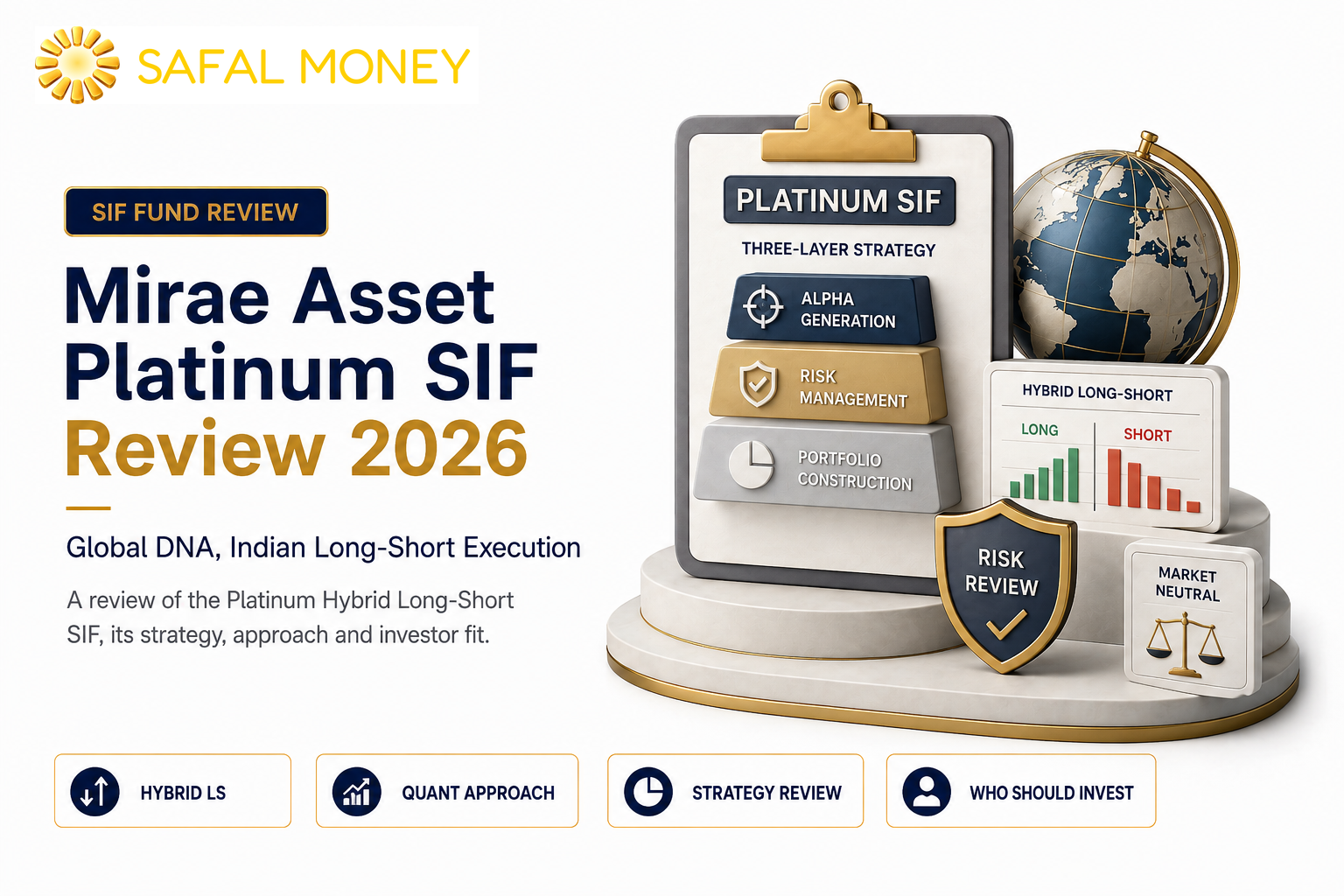
This is the seventh article in SafalMoney's SIF Fund Review series. After reviewing ITI AMC, Edelweiss, SBI, Tata, 360 ONE, and ICICI Prudential, we now turn to one of India's most globally-connected asset managers — Mirae Asset Mutual Fund — and its Platinum SIF platform.
Mirae Asset is part of the Mirae Asset Financial Group, a South Korean global financial services giant with approximately USD 600 billion in AUM across 14 countries. In India, Mirae Asset Mutual Fund has established itself as one of the most respected growth-oriented AMCs since entering the market in 2007 — known for its disciplined research process, global perspective, and strong equity fund performance.
The Platinum SIF platform is Mirae Asset's dedicated SIF identity — a brand designed to signal a premium, differentiated investment experience beyond conventional mutual funds. As of July 2026, Mirae Asset has launched one strategy under Platinum SIF: the Platinum Hybrid Long-Short Fund, with its NFO running from May 20 to June 3, 2026.
Mirae Asset Mutual Fund: The Global Perspective Advantage
What makes Mirae Asset's entry into SIF particularly interesting is the global context its parent brings. The Mirae Asset Group runs long-short and alternative strategies across its global platforms — in South Korea, the US, Hong Kong, and Australia — giving Mirae Asset India access to institutional knowledge of multi-asset long-short strategy construction that most domestic AMCs simply do not have.
Neelesh Surana, CIO at Mirae Asset Investment Managers India, articulated the platform vision clearly: the SIF framework aims to provide investors access to specialised strategies with the transparency and regulatory safeguards associated with mutual funds.
Vaibhav Shah, Head of Products and Business Strategy at Mirae Asset India, added that the SIF category is intended to bridge the gap between conventional mutual funds and sophisticated AIF products — and Mirae Asset's Platinum SIF is positioned squarely in that bridge role.
The SIF Category Is Growing Fast
Total SIF AUM surged to ₹12,329 crore in April 2026 from just ₹2,010 crore in October 2025 — a remarkable 6x growth in 6 months, reflecting strong HNI adoption of the category. Mirae Asset is entering a rapidly growing market with genuine institutional credentials.
Fund Snapshot: Platinum Hybrid Long-Short Fund
| Parameter | Details |
|---|---|
| Fund Name | Platinum Hybrid Long-Short Fund |
| AMC | Mirae Asset Mutual Fund |
| SIF Platform | Platinum SIF |
| Fund Type | SIF — Hybrid Long-Short |
| NFO Period | May 20 to June 3, 2026 |
| Benchmark | Nifty 50 Hybrid Composite Debt 50:50 Index |
| Minimum Investment | ₹10,00,000 (₹5,00,000 for accredited investors) |
| Additional Purchase | ₹10,000 and multiples |
| Exit Load | 1% within 90 days; nil after |
| Maximum TER | Up to 2.25% of daily net assets |
| Risk Rating | Very High |
| Fund Manager | Gaurik Shah (SVP — Equity Investments) |
| Investment Horizon | 1–2 years (stated by AMC) |
The Three-Layer Investment Strategy: What Makes Platinum SIF Different
The Platinum Hybrid Long-Short Fund's investment architecture is built on three simultaneous and distinct return engines — a structure that is more explicitly articulated than most hybrid SIF peers.
Layer 1: Controlled Equity Exposure (5–70% of portfolio). The equity portion uses controlled exposure strategies — specifically collar strategies and selective participation in special situations — to capture upside while limiting downside risk. A collar strategy involves holding an equity position while simultaneously buying a protective put (downside hedge) and selling a covered call (upside cap and premium income). This is more sophisticated than simple long equity exposure — it is a structured equity participation that explicitly limits both the maximum gain and maximum loss from the equity component.
Layer 2: Fully Hedged Arbitrage (5–70% of portfolio). The arbitrage component runs fully hedged cash-futures positions — exploiting the spread between equity prices in the cash market and futures market. This component generates relatively stable, market-neutral income regardless of equity market direction. The arbitrage spread in Indian markets currently yields approximately 7–8% annualised — above liquid fund returns with comparable liquidity.
Layer 3: Accrual Debt (25–35% of portfolio). High-quality debt instruments — government securities, AAA-rated corporate bonds, certificates of deposit — providing fixed income returns and NAV stability. The debt component is the portfolio's anchor, ensuring a minimum income floor regardless of equity market behaviour.
The three-layer architecture is designed to generate returns that are less dependent on market direction than a conventional equity fund and less volatile — positioned by Mirae Asset as delivering relatively stable returns over a 1–2 year investment horizon with lower drawdowns compared to traditional hybrid funds with unhedged directional equity exposure.
This is the most explicitly conservative strategy positioning of any SIF reviewed in this series — Mirae Asset is not promising alpha from aggressive long-short stock picking. It is promising stability and downside protection through structured, systematically managed multi-layer exposures.
The Quantitative Foundation: Gaurik Shah's Investment Philosophy
The Platinum Hybrid Long-Short Fund is managed by Gaurik Shah, Senior Vice President of Equity Investments at Mirae Asset Investment Managers India.
Shah brings nearly two decades of experience across public markets and alternative strategies, with specific expertise in quantitative investing, market-neutral frameworks, and derivatives-based portfolio strategies. His background is notably different from most other SIF fund managers reviewed in this series — who are primarily fundamental equity stock pickers who have added derivatives capability.
Gaurik Shah's primary expertise is in quantitative and systematic approaches — rules-based, model-driven investment strategies rather than discretionary fundamental stock selection. This is reflected directly in the Platinum Hybrid strategy's design: the collar strategy, arbitrage execution, and debt allocation are all inherently more systematic than discretionary — reducing dependence on individual stock-picking judgment and making the strategy more replicable and robust across different market conditions.
This quantitative orientation is one of Platinum SIF's most distinctive characteristics. Where DynaSIF (360 ONE) runs a fundamental + quantitative blend, and Altiva (Edelweiss) runs a primarily arbitrage + income approach, Platinum SIF's collar strategy specifically introduces options-based structured payoffs that are more explicitly quantitative in nature.
Mirae Asset's global platform also means Shah can draw on the group's institutional knowledge of quantitative long-short strategies from its global investment teams — a resource no purely domestic AMC can match.
The Accredited Investor Threshold: A Competitive Differentiator
One of the most investor-friendly features of the Platinum SIF is its minimum investment threshold for accredited investors: ₹5,00,000 — half the standard SIF minimum of ₹10 lakh.
This is a significant structural advantage for investors who qualify as accredited investors (net worth above ₹2 crore or income above ₹50 lakh) but want to start with a smaller initial SIF allocation. It allows:
- First-time SIF investors to test the strategy with ₹5 lakh before committing a larger allocation
- Portfolio construction flexibility — investors can split their SIF budget more precisely across multiple strategies
- Lower barrier for investors whose total SIF allocation is between ₹5 lakh and ₹10 lakh
No other major SIF platform currently offers a ₹5 lakh accredited investor threshold — making Platinum SIF uniquely accessible for HNI investors building a diversified SIF allocation across multiple funds.
The 1–2 Year Investment Horizon: What This Means for Investors
Mirae Asset explicitly positions the Platinum Hybrid Long-Short Fund as suitable for a 1–2 year investment horizon — significantly shorter than the 3–5 year minimum typically associated with Equity Long-Short SIF strategies.
This shorter horizon positioning is consistent with the fund's strategy architecture. The three-layer approach — controlled equity with collar protection, arbitrage income, and accrual debt — creates a return profile more similar to an enhanced arbitrage or short-duration debt fund than a pure equity long-short strategy. The downside is structurally limited by the collar protection; the upside is similarly capped.
For investors who want SIF participation over a 1–2 year horizon — perhaps as part of a medium-term parking strategy for money that will eventually be deployed elsewhere — this positioning makes Platinum Hybrid the most appropriate SIF option among those reviewed.
However, investors should understand what the 1–2 year horizon implies for returns. A structured, low-volatility hybrid strategy designed for downside protection is unlikely to deliver equity-like returns even in a bull market. Realistic return expectations for this strategy over 1–2 years are in the range of 8–10% — better than FDs for HNI investors in high tax brackets, but not the alpha-generation play that pure Equity Long-Short strategies are targeting.
How Platinum SIF Compares to Peers in the Hybrid Long-Short Category
| Metric | Mirae Platinum Hybrid | Edelweiss Altiva Hybrid | SBI Magnum Hybrid | Tata Titanium Hybrid |
|---|---|---|---|---|
| Strategy Core | Collar + Arbitrage + Debt | Arbitrage + Income + Selective Equity | Covered Calls + Arbitrage + Debt | Directional Equity + Debt + Derivatives |
| Net Equity Range | 5–70% | Not specified (arbitrage heavy) | 65–75% directional | 65–75% directional |
| Stated Horizon | 1–2 years | 2–5 years | 3+ years | 3+ years |
| Fund Manager Style | Quantitative/Systematic | Multi-specialist team | Equity analyst background | PM from Canara Robeco |
| Global Parent Advantage | Yes — Mirae Global Group | No (domestic AMC) | Partial (SBI group) | No (domestic AMC) |
| March 2026 Crash | Too new to assess | Best in category | Below average vs Altiva | Fell near benchmark |
| Min. Invest (Accredited) | ₹5,00,000 | ₹10,00,000 | ₹10,00,000 | ₹10,00,000 |
| Track Record | Weeks old | ~10 months | Available from Jul 2026 | Available from Jul 2026 |
The Platinum Hybrid's key differentiators versus peers: the explicitly quantitative collar strategy (unique in the category), the ₹5 lakh accredited investor threshold (lowest in the category), and the 1–2 year investment horizon positioning (most conservative in the category).
Its primary limitation versus Edelweiss Altiva: zero track record as of this review. The Altiva Hybrid has 10 months of live performance including the March 2026 stress test — invaluable data that Platinum Hybrid simply cannot yet provide.
The Collar Strategy Explained: What It Means for Your Returns
The collar strategy — the most distinctive element of Platinum Hybrid's approach — deserves a plain-English explanation because it determines how the equity portion of this fund behaves.
A collar involves three simultaneous positions on the same underlying equity:
- Long the stock — you own the stock and participate in its upside
- Buy a put option — you pay a premium to protect yourself if the stock falls below a certain price (the put strike)
- Sell a call option — you collect premium from someone who wants to profit if the stock rises above a certain price (the call strike)
The net effect: your gains are capped at the call strike, and your losses are capped at the put strike. The premium collected from selling the call partially offsets the cost of buying the put — making the downside protection relatively cheap.
For the Platinum Hybrid, this means:
- In a rising market: the equity component participates up to a cap — giving some upside but not the full equity market gain
- In a falling market: the equity component is protected below a floor — limiting the loss from a market crash
- In a flat market: the arbitrage and debt components deliver steady income, and the collar's net premium income adds a small additional yield
This is a genuinely sophisticated options-based strategy that is well-suited to the current market environment — where upside is uncertain and downside risks (geopolitical, rate-related) remain elevated.
SIF Category Data: Where Platinum SIF Enters the Market
The SIF category has grown rapidly. Total AUM surged to ₹12,329 crore in April 2026 from ₹2,010 crore in October 2025 — a remarkable 6x growth in six months. Monthly net inflows stood at ₹1,219 crore in April, with hybrid long-short funds leading at ₹651 crore of inflows.
The average folio size across the SIF category stands at ₹24.6 lakh — confirming that HNI investors are committing meaningful capital rather than token investments. Active asset allocator long-short funds show even higher average folio sizes of ₹47.5 lakh — reflecting the genuinely high-net-worth investor base that these strategies are attracting.
Platinum SIF enters this growing market with the advantage of the Mirae Asset brand — one of India's most trusted AMC names — and the disadvantage of being among the later entrants, with Edelweiss Altiva already having established a 10-month track record and ₹3,500+ crore AUM lead.
Who Should Consider Platinum SIF?
- Conservative HNI investors who want SIF participation with maximum downside protection — the collar strategy explicitly limits potential losses in a way that no other SIF strategy does
- Investors with a 1–2 year horizon for SIF — the only SIF platform that explicitly targets this shorter horizon with an appropriate strategy design
- Quantitatively-minded investors who appreciate a rules-based, systematic approach to the hybrid long-short mandate rather than discretionary stock picking
- First-time SIF investors with ₹5–10 lakh to allocate — the ₹5 lakh accredited investor threshold makes Platinum SIF the most accessible entry point in the category
- Investors who want Mirae Asset's global platform advantage — access to the global group's quantitative and derivatives expertise applied to Indian markets
Who Should NOT Choose Platinum Hybrid SIF?
- Aggressive investors seeking maximum alpha — the collar strategy caps upside; this is not a high-return strategy but a risk-managed return strategy
- Investors with zero track record tolerance — as of July 2026, Platinum Hybrid has been available for only weeks and has no meaningful live performance data
- Investors who want pure equity long-short exposure — Platinum Hybrid's 1–2 year positioning and conservative collar approach is fundamentally different from the pure equity long-short alpha strategies of DynaSIF or iSIF Ex-Top 100
- Investors who specifically want established track records — Edelweiss Altiva's 10-month track record through the March 2026 stress test remains the gold standard for demonstrated Hybrid Long-Short SIF performance
SafalMoney Verdict: The Most Conservative and Accessible SIF Entry
Platinum SIF is a thoughtfully constructed platform that fills a specific and previously unmet need in the Indian SIF landscape — a genuinely conservative, structured, downside-protected hybrid strategy with a 1–2 year horizon and the lowest minimum investment (₹5 lakh for accredited investors) in the category.
The strategy's collar-plus-arbitrage-plus-debt architecture is the most explicitly conservative in the SIF category — more so than even Edelweiss Altiva, which runs meaningful arbitrage but still has higher directional equity exposure than the collar-constrained Platinum approach.
The limitations are clear: no track record, the stated 1–2 year horizon implies lower return expectations than longer-horizon equity SIF strategies, and Gaurik Shah's team — while strong in quantitative strategy — has not yet demonstrated live SIF execution results.
SafalMoney's recommendation: Platinum Hybrid Long-Short is the most appropriate SIF entry point for conservative first-time SIF investors, particularly those with a medium-term horizon of 1–2 years. For aggressive investors seeking maximum long-short alpha over 5+ years, DynaSIF Equity Long-Short or the more established equity-oriented strategies are better fits.
Use SafalCheck™ to compare Platinum SIF's SafalScore™ as performance data accumulates. Use SafalZenith to determine whether your profile calls for a conservative hybrid SIF (Platinum or Altiva) or an aggressive equity long-short SIF.
Free, no login required
Frequently Asked Questions
What is Mirae Asset Platinum SIF?
Platinum SIF is Mirae Asset Mutual Fund's dedicated Specialised Investment Fund platform. Its first strategy - the Platinum Hybrid Long-Short Fund - launched via NFO from May 20 to June 3, 2026. The fund uses a three-layer approach: controlled equity exposure through collar strategies (5-70%), fully hedged arbitrage (5-70%), and accrual debt (25-35%). It targets relatively stable returns over a 1-2 year horizon with lower drawdowns than traditional hybrid funds. Minimum investment is Rs 10 lakh (Rs 5 lakh for accredited investors).
Who manages the Mirae Asset Platinum Hybrid Long-Short SIF?
Gaurik Shah, Senior Vice President of Equity Investments at Mirae Asset Investment Managers India, manages the Platinum Hybrid Long-Short Fund. He brings nearly two decades of experience across public markets and alternative strategies, with specific expertise in quantitative investing, market-neutral frameworks, and derivatives-based portfolio strategies. His quantitative background is reflected in the fund's use of collar strategies - a structured options approach to equity exposure management.
What is a collar strategy in mutual funds?
A collar strategy involves simultaneously holding a long equity position, buying a put option (which protects against losses if the stock falls below a certain price), and selling a call option (which caps gains above a certain price while generating premium income). The net effect is that both the maximum gain and maximum loss from the equity position are limited - creating a bounded return profile that is more predictable and less volatile than unconstrained equity exposure. In the Platinum Hybrid SIF, the collar strategy is used on the equity portion to explicitly limit downside risk while allowing participation in moderate equity market gains.
How does Platinum SIF compare to Edelweiss Altiva?
Both are Hybrid Long-Short SIFs but with meaningfully different strategies. Edelweiss Altiva uses an arbitrage-heavy approach with multi-specialist management and has approximately 10 months of live track record, including strong performance through the March 2026 crash. Mirae Platinum uses a structured collar-plus-arbitrage-plus-debt approach managed by a quantitative specialist, with a more conservative 1-2 year horizon and the lowest accredited investor minimum in the category (Rs 5 lakh). Platinum has no live track record as of July 2026. For investors prioritising demonstrated performance, Altiva leads. For conservative investors wanting systematic structured protection and shorter horizons, Platinum is more appropriate.
What returns should I expect from Platinum Hybrid Long-Short SIF?
SafalMoney does not make return projections for any SIF fund. However, Mirae Asset's stated objective - relatively stable returns over a 1-2 year horizon with lower drawdowns than traditional hybrid funds - implies a conservative return profile. The collar strategy caps equity upside, and the dominant arbitrage and debt components yield approximately 7-8% and 7-7.5% respectively. Realistic expectations for this strategy in a flat-to-moderate market environment are in the 8-10% annualised range - above well-managed short-duration debt funds but below pure equity long-short strategies in strong bull markets. This is not a projection. Actual returns depend on market conditions, strategy execution, and the specific collar parameters chosen by the fund manager.
Last updated: 11 July 2026