Long-Short Strategy Explained: How SIF Fund Managers Go Both Long and Short
What exactly is a long-short strategy? This plain-English guide explains how SIF fund managers go long and short, what derivatives they use, how short selling works in India, and why it matters for your portfolio.
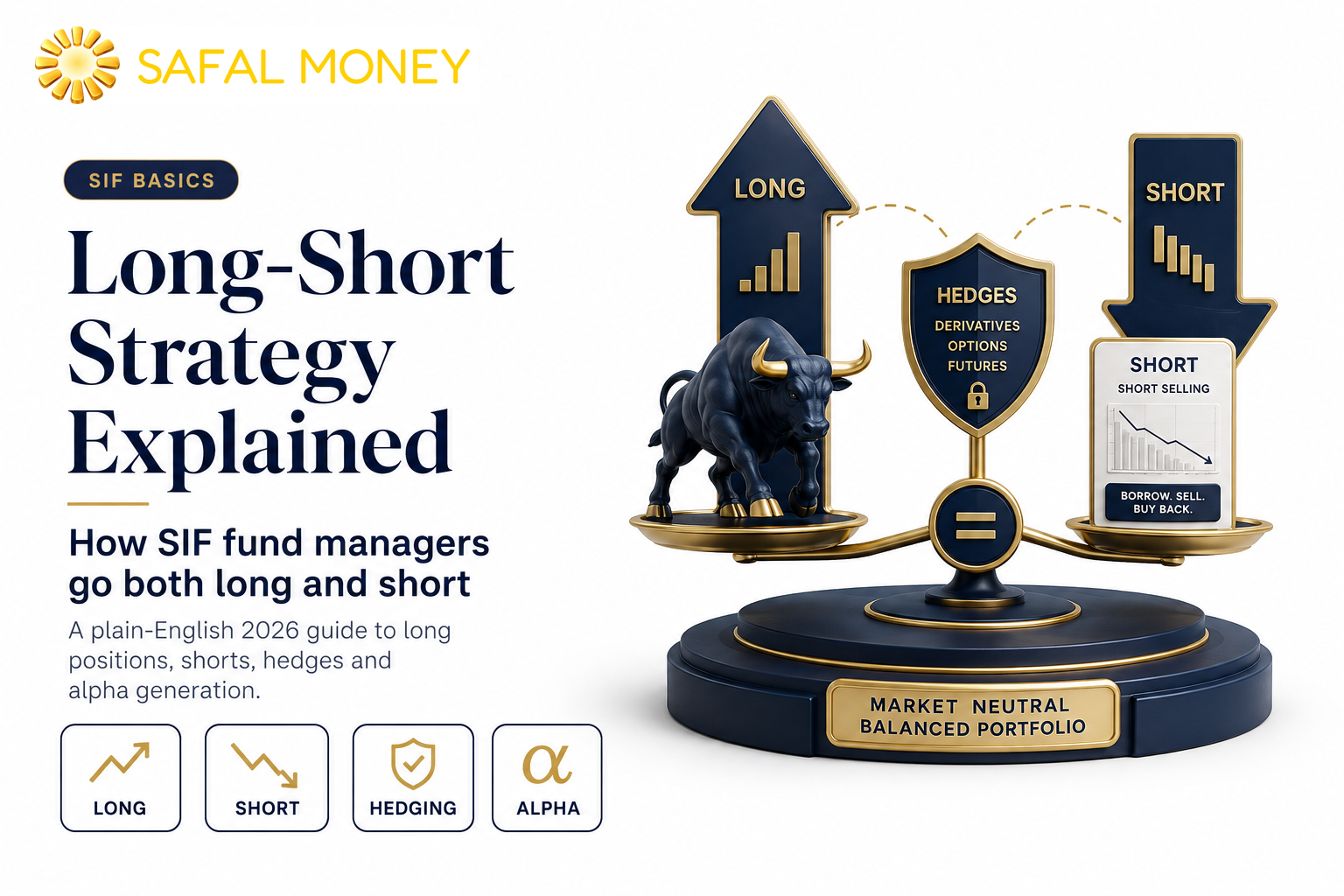
"Long-short" is one of those investment terms that sounds technical but describes something surprisingly intuitive once you strip away the jargon. Every investor instinctively understands making money when something goes up. The long-short strategy simply adds the ability to also make money when something goes down.
This article explains exactly how SIF fund managers execute long-short strategies in Indian markets — the mechanics of going long, the mechanics of going short via derivatives, what net exposure means and why it matters, how alpha is generated from both sides of the book, and what risks are unique to this strategy type that do not exist in conventional mutual funds.
By the end, you will have a clear, precise understanding of what you are actually investing in when you allocate to a long-short SIF.
The Foundation: What Does "Long" Mean in a Fund Context?
Going long is the most basic investment action — and it is what every conventional mutual fund does exclusively.
When a SIF fund manager goes long on a stock, they buy shares of that company in the cash market — exactly the same way a regular mutual fund would. If the stock price rises, the value of that position increases and the fund's NAV benefits. If the stock price falls, the position loses value and the fund's NAV declines for that holding.
A long position in a stock means:
- The fund owns the shares
- The fund benefits when the share price rises
- The fund loses when the share price falls
- The maximum gain is theoretically unlimited (prices can keep rising)
- The maximum loss is the amount invested (the price can only fall to zero)
Every mutual fund in India builds its portfolio exclusively through long positions. A Nifty 50 index fund is 100% long the 50 stocks of the Nifty. A flexi cap fund is 100% long whatever stocks the manager has selected. There is no mechanism within conventional mutual funds to profit from falling stock prices.
What Does "Short" Mean? The Intuitive Explanation
Going short is the opposite of going long. A short position profits when a price falls and loses when it rises.
Think of it this way. Imagine you believe the price of a company's stock — currently at ₹100 — is going to fall to ₹70. If you own the stock and it falls, you lose ₹30 per share. But if you could somehow sell shares you do not own at ₹100 today, and then buy them back at ₹70 when the price falls, you would profit ₹30 per share.
This is conceptually what a short position does — it allows the investor to profit from a price decline rather than a price increase.
The key risk of a short position is asymmetric relative to a long position:
- Maximum gain on a short: the price can only fall to zero — so the maximum profit per share is the price at which you sold short
- Maximum loss on a short: theoretically unlimited — if the stock price rises from ₹100 to ₹200 or ₹500, the loss on a short position keeps growing
This asymmetric risk profile is why short positions require active management and strict risk controls. It is also why SEBI caps unhedged short derivative exposure in SIF at 25% of the portfolio — ensuring that the short book cannot overwhelm the long book even in an adverse scenario.
How Do SIF Fund Managers Go Short? The Derivatives Mechanism
Individual investors in India cannot short-sell individual stocks directly in the cash market without holding them. But SIF fund managers can take short positions through equity derivatives — specifically futures and options contracts — which is what SEBI's SIF framework permits.
Short Position via Futures
A futures contract is an agreement to buy or sell a security at a predetermined price on a future date. To take a short position in a stock through futures:
- The fund manager sells a futures contract on the stock — committing to sell the stock at the current futures price on the expiry date
- If the stock price falls below the futures price before expiry, the contract profits — the fund sells at the higher futures price and can close the position by buying the actual stock at the lower market price
- If the stock price rises above the futures price, the contract loses value — the fund manager has committed to sell at a lower price than the market
Worked Example: Shorting via Futures
Stock XYZ is trading at ₹500. The fund manager believes XYZ will fall to ₹380 due to deteriorating business fundamentals. The manager sells XYZ futures at ₹505 (the futures premium over spot is normal and reflects carrying costs). Three months later, XYZ falls to ₹390. The manager closes the futures position by buying at ₹390.
Profit: ₹505 − ₹390 = ₹115 per share — approximately 22.7% return from the short position.
Short Position via Options (Put Options)
Buying a put option gives the fund manager the right — but not the obligation — to sell a stock at a predetermined price (the strike price) before a certain date. If the stock falls below the strike price, the put option becomes valuable.
Put options are a more risk-controlled way to express a short view — because the maximum loss on a purchased put option is limited to the premium paid, unlike a futures short where losses are theoretically unlimited.
Most SIF strategies use a combination of futures-based shorts and put option purchases depending on the conviction level and risk tolerance for each short position.
The Long Book and the Short Book — How a SIF Portfolio Is Structured
A long-short SIF portfolio has two distinct components that are managed simultaneously:
The Long Book: A collection of long equity positions — stocks the fund manager believes will appreciate in value. This is identical in structure to a conventional equity mutual fund's portfolio. The long book may contain 20–50 individual stock positions across sectors and market caps.
The Short Book: A collection of short derivative positions — futures or put options on stocks or indices the manager believes will decline or underperform. The short book may contain 10–30 individual positions. It is typically smaller in number than the long book because short positions require more active monitoring and carry higher per-position risk.
The interaction between long and short books: the two books do not operate independently — they interact to create the fund's overall risk and return profile. A well-constructed long-short SIF:
- Goes long companies with the strongest business quality metrics — high return on capital, improving margins, strong competitive positioning
- Goes short companies with the weakest metrics — deteriorating returns, governance concerns, structural competitive disadvantages
- Sizes positions such that the short book provides meaningful alpha without dominating the portfolio's risk
What Is Net Exposure and Why Does It Matter?
Net exposure is one of the most important numbers in a long-short SIF — and one of the least discussed.
Net Exposure = Long Book (% of portfolio) − Short Book (% of portfolio)
For example:
- Long book = 90% of portfolio
- Short book = 20% of portfolio
- Net exposure = 90% − 20% = 70%
A 70% net exposure means the fund behaves like a 70% long equity fund from a market direction perspective — it captures approximately 70% of the upside when markets rise, and approximately 70% of the downside when markets fall, from pure market direction. The remaining performance comes from the alpha generated by the specific stock selection on both the long and short sides.
Key Takeaway
A fund with 95% net exposure is almost entirely directional — it moves very closely with the overall market, and its alpha must come almost entirely from stock picking rather than hedging. A fund with 30% net exposure is nearly market-neutral — it makes most of its money from the spread between long and short returns, largely independent of overall market direction. Most Indian equity long-short SIF funds currently operate with net exposure in the 50–80% range — providing some directional market participation while using the short book to add alpha and moderate downside.
This is an appropriate structure for the Indian SIF category, which is positioned as an alternative strategy within a mutual fund framework rather than a pure hedge fund.
The Four Sources of Alpha in a Long-Short Strategy
Alpha — returns above the benchmark — can come from four distinct sources in a long-short SIF:
- Long Book Stock Selection (Long Alpha). The fund's long positions outperform the overall market. This is the same alpha source as a conventional active mutual fund — picking the right stocks. If the long book contains stocks that rise 18% while the market rises 12%, the long book generates 6% alpha.
- Short Book Stock Selection (Short Alpha). The fund's short positions underperform the overall market. If the short book contains stocks that fall 15% while the market rises 12%, the short book has effectively generated 27% of relative outperformance — which translates to meaningful absolute alpha when translated back to the fund's P&L.
- Market Timing Through Net Exposure Management. By adjusting net exposure — increasing it when the fund manager expects markets to rise, reducing it when they expect markets to fall — the fund generates alpha from market timing. If the manager reduces net exposure from 70% to 30% before a 20% market correction, the fund loses only 6% instead of 14% — generating 8% of relative outperformance.
- Spread Between Long and Short Positions. Even in a flat market where the broad market delivers 0% return, a long-short fund can generate positive alpha if its long positions rise while its short positions fall. This is the most powerful and differentiated alpha source — completely independent of market direction.
How Do Short Positions Work Through Monthly Expiries?
Indian equity futures and options expire on the last Thursday of each month. This creates an important operational consideration for SIF fund managers that does not exist for conventional mutual funds.
When a SIF fund manager takes a short futures position, it has a specific expiry date — typically the current month's last Thursday or the next month's. If the manager wants to maintain the short position beyond expiry, they must "roll" the position — closing the expiring contract and opening a new contract for the next month.
Rolling involves a small cost — the difference in price between the near-month and far-month futures contract — which is typically 0.1–0.3% per month. This rolling cost is effectively an ongoing expense of maintaining short positions that erodes the gross return from the short book.
Understanding roll costs is important because they are invisible in fund NAV disclosures but represent a real, ongoing cost of the long-short strategy. A fund that maintains heavy short positions for extended periods incurs meaningful roll costs — which is one reason the short book is typically sized conservatively relative to the long book.
What Happens to a SIF's Long-Short Book During a Market Crash?
The Iran war market crash of February–April 2026 was the first major stress test for India's SIF category — and the results were illuminating about how different long-short structures behave in extreme market conditions.
In a fast, geopolitically-driven market crash:
- The long book falls with the market. All equity positions lose value when sentiment collapses — regardless of business quality. Even the strongest companies fall in a panic-driven selloff.
- The short book may or may not offset. If the short book contains positions in genuinely weak companies, they may fall faster than the overall market — generating profits that partially offset long book losses. But if the crash is driven by sudden, broad-based selling (as the Iran war crash was), correlations converge — strong and weak companies fall together — limiting the short book's offsetting power.
- Net exposure matters most in crashes. The most reliable protection in a fast crash comes from low net exposure — having a smaller overall market-directional position — rather than from individual short position alpha. This is why funds with 30–50% net exposure fared better in the March 2026 crash than funds running 80–90% net exposure.
Data from the March 2026 crash confirmed this: funds that outperformed during the crash had either very low net exposure or specifically constructed defensive short books that captured the sector-specific declines that accompanied the geopolitical shock.
Three Types of Short Positions SIF Managers Use
Not all short positions are the same. SIF fund managers in India typically use three distinct types of short exposure:
Type 1: Individual Stock Shorts (Highest Alpha Potential, Highest Risk)
Short positions in specific individual stocks where the manager has high conviction on fundamental deterioration. These have the highest alpha potential if the thesis plays out but also the highest risk — a single company can receive a takeover bid or positive surprise that causes a short squeeze, generating significant losses on that position.
Type 2: Sector Shorts (Medium Alpha, Medium Risk)
Short positions on sector-level indices or a basket of stocks within a sector the manager believes will underperform. For example, shorting the Nifty IT index when the fund manager believes US IT spending will slow due to a global recession. Sector shorts diversify the idiosyncratic risk of individual stock shorts while still expressing a directional sector view.
Type 3: Index Shorts (Lowest Alpha, Lowest Risk — Pure Hedging)
Short positions on broad market indices — Nifty 50 or Nifty 500 futures — that reduce overall net market exposure without expressing a specific stock or sector view. Index shorts are used primarily as a hedging tool rather than an alpha generation tool. They reduce the portfolio's sensitivity to overall market direction, providing downside protection at the cost of reducing upside participation.
Most well-managed equity long-short SIFs use all three types in varying proportions — individual stock shorts for alpha, sector shorts for thematic expression, and index shorts for portfolio-level hedging.
What Does This Mean for Your SIF Investment?
Understanding the long-short mechanism helps you calibrate expectations correctly before investing. For a full breakdown of category-wide performance across market phases, see SIF Performance Across Market Cycles.
Bull Markets
A long-short SIF will typically underperform a comparable long-only fund — because the short book loses money when prices rise. This is the structural tradeoff. If Nifty rises 30% and your SIF returns 20%, this may not be underperformance — it may be exactly the expected outcome given the short book drag and lower net exposure.
Sideways Markets
This is where long-short SIF has the highest potential for alpha that is genuinely independent of market direction — the spread between long and short book performance drives returns without needing the overall market to cooperate.
Bear Markets
A long-short SIF should outperform a comparable long-only fund significantly — because the short book profits when prices fall, partially offsetting long book losses. If Nifty falls 25% and your SIF falls only 12%, the long-short structure has delivered exactly its value proposition.
The evaluation horizon: given this structure, you should never evaluate a long-short SIF over a short period or a single market phase. The strategy needs a full market cycle — ideally 3–5 years including both rising and falling phases — to demonstrate its genuine risk-adjusted return advantage.
Use SafalCheck™ to evaluate specific SIF funds' SafalScore™ — which incorporates Sharpe ratio, Sortino ratio, and drawdown metrics that are more appropriate for long-short strategy evaluation than simple return rankings. Use SafalZenith to determine what percentage of your portfolio should be allocated to long-short SIF strategies.
Free, 2 minutes
Frequently Asked Questions
What is a long-short strategy in SIF?
A long-short strategy in a Specialised Investment Fund combines two types of positions: long positions (buying stocks expected to rise in value, exactly like a conventional mutual fund) and short positions (taking derivative positions that profit when specific stocks or indices fall in value). The combination allows the fund to generate returns from both rising and falling securities simultaneously - creating a return stream that is less dependent on overall market direction than a long-only fund. Indian SIF regulations permit unhedged short derivative exposure of up to 25% of the portfolio.
How does short selling work in Indian SIF?
SIF fund managers cannot short-sell individual stocks directly in the cash market - they take short positions through equity derivatives, specifically futures contracts and put options. A short futures position profits when the underlying stock or index falls below the futures contract price before expiry. Since futures expire monthly in India, managers must roll short positions each month to maintain them - incurring small roll costs of approximately 0.1-0.3% per position per month. SEBI caps unhedged short derivative exposure in SIF at 25% of the portfolio.
What is net exposure in a long-short SIF?
Net exposure is the difference between the long book percentage and the short book percentage of a long-short SIF portfolio. A fund with 85% long positions and 20% short positions has 65% net exposure - meaning it captures approximately 65% of broad market returns from directional exposure, with the remaining performance coming from individual position alpha. Lower net exposure means less market-direction sensitivity and more dependence on stock-picking skill for returns. Most Indian equity long-short SIF funds operate with 50-80% net exposure.
Can a long-short SIF make money when markets fall?
Yes - this is one of the primary value propositions of a long-short SIF. When markets fall, the short book generates positive returns (positions profit as prices decline) that partially or fully offset the decline in long book positions. The degree of downside protection depends on the net exposure level, the quality of short position selection, and how correlated individual stock movements are with the overall market during the selloff. In the March 2026 Iran war crash, the best-performing SIF funds significantly outperformed the Nifty through their short book positioning.
Why does a long-short SIF sometimes underperform in a bull market?
A long-short SIF's short book loses money when stock prices rise - as happens in a sustained bull market. If the fund maintains significant short exposure during a strong rally, the losses from the short book reduce the overall NAV gain relative to a long-only fund. This is the expected structural tradeoff: the short book provides downside protection in falling markets at the cost of reduced upside participation in rising markets. Investors who choose long-short SIF must understand and accept this tradeoff - evaluating the strategy over a full market cycle rather than over a single bull market phase.
Last updated: 15 July 2026