SIF and MF Tax-Loss Harvesting: The Smart HNI Strategy to Reduce Your Capital Gains Tax
Tax-loss harvesting in SIF and mutual funds - how India's smartest HNI investors legally reduce capital gains tax every year. Step-by-step guide with worked examples, timing rules, and the wash sale consideration.
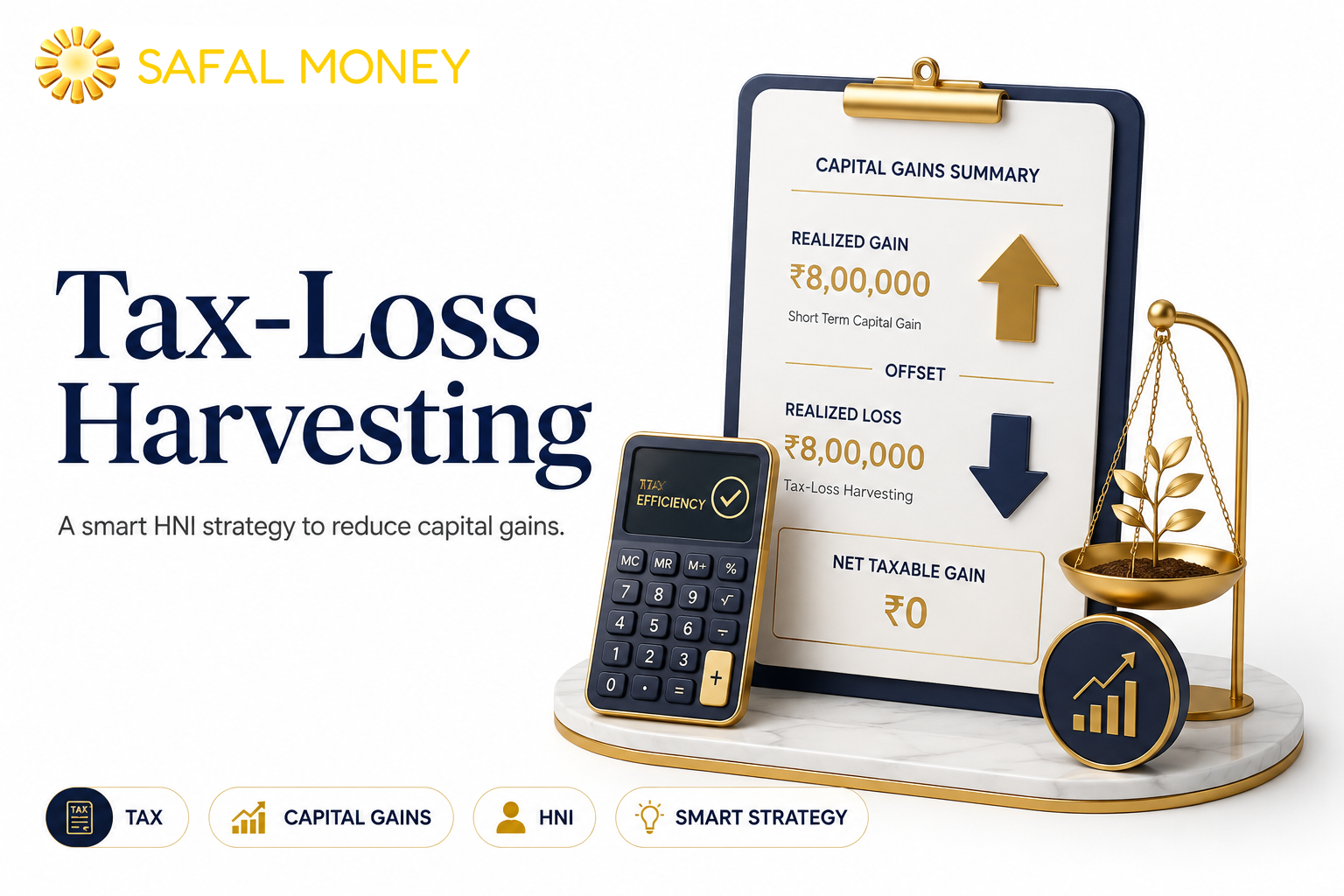
Every financial year, Indian HNI investors collectively pay crores in capital gains tax that could have been legally, legitimately reduced - not through offshore structures, not through aggressive tax planning that courts regulatory risk, but through a straightforward portfolio management technique called tax-loss harvesting.
Tax-loss harvesting is the practice of deliberately selling investments that are sitting at a loss to crystallise those losses, then using those losses to offset capital gains elsewhere in the portfolio - reducing your net taxable capital gains and therefore your tax liability.
It is entirely legal. It is SEBI-compliant. It requires no special structure or offshore account. And it is remarkably underused by Indian HNI investors - primarily because most investors and even many advisors do not think about tax optimisation as an active, year-round portfolio management activity.
This guide explains exactly how tax-loss harvesting works in the Indian mutual fund and SIF context - the mechanics, the rules, the worked examples, and the practical implementation framework for HNI investors.
The Foundation: How Capital Gains Tax Works for MF and SIF in India
Before understanding tax-loss harvesting, you need a clear picture of how capital gains tax applies to mutual funds and SIF in India's current tax framework.
Equity mutual funds and SIF (held 12+ months): Long-Term Capital Gains (LTCG) at 12.5% on gains above ₹1.25 lakh per financial year. Below the ₹1.25L threshold - tax-free.
Equity mutual funds and SIF (held less than 12 months): Short-Term Capital Gains (STCG) at 20% on all gains - no exemption threshold.
Debt mutual funds (purchased after April 1, 2023): All gains - regardless of holding period - taxed at the investor's income tax slab rate. For HNI investors in the 30% bracket, this means 30% plus cess on all debt fund gains.
Debt mutual funds (purchased before April 1, 2023): Grandfathered under old rules - LTCG (held 36+ months) taxed at 20% with indexation benefit; STCG at slab rate. These legacy units are increasingly rare as old positions are redeemed.
Capital loss set-off rules:
This is the critical framework for tax-loss harvesting:
- Short-term capital losses can be set off against both short-term capital gains and long-term capital gains from any asset class.
- Long-term capital losses can only be set off against long-term capital gains - not against short-term capital gains.
- Unadjusted capital losses can be carried forward for 8 assessment years - so losses not fully utilised in the current year are not wasted.
What Is Tax-Loss Harvesting and How Does It Work?
Tax-loss harvesting is the deliberate realisation of capital losses from underperforming investments to offset capital gains realised elsewhere - reducing net taxable capital gains in the current financial year.
The key word is "deliberate." You are not waiting for losses to disappear naturally - you are actively crystallising them at a strategically chosen time to generate a tax benefit. Immediately after selling the loss-making investment, you typically buy it back (or a similar investment) - so your portfolio exposure is unchanged but you have generated a tax-saving loss on paper.
The basic mechanics:
Step 1 - Identify holdings with unrealised losses. Review your CAS statement for mutual fund or SIF positions where current NAV is below your purchase NAV.
Step 2 - Sell the loss-making units. This crystallises the loss - it is now a realised capital loss that can be used to offset gains.
Step 3 - Immediately reinvest in the same fund or a similar fund. You maintain your market exposure - the portfolio position is effectively unchanged. The loss has been "harvested" for tax purposes without changing your investment thesis.
Step 4 - Use the harvested loss to offset capital gains. The realised loss reduces your net taxable capital gains for the financial year, directly reducing your tax liability.
The LTCG Harvesting Companion: The ₹1.25L Annual Exemption
Tax-loss harvesting has a natural companion strategy that every HNI investor should run simultaneously - LTCG harvesting of the annual ₹1.25L exemption.
SEBI permits ₹1.25 lakh of LTCG on equity mutual funds and SIF to be realised completely tax-free each financial year. Beyond ₹1.25L, LTCG is taxed at 12.5%.
The LTCG harvesting strategy: if your equity and SIF portfolio has unrealised long-term gains, consider redeeming units to crystallise up to ₹1.25L in LTCG annually - and immediately reinvesting in the same fund at the current (higher) NAV. This resets your cost basis upward. When you eventually sell these units in a future year, the taxable gain is calculated from the new (higher) cost basis - permanently reducing the future tax liability.
Why this matters over time: an investor who systematically harvests ₹1.25L of LTCG every year for 15 years has reduced their future taxable gains by ₹18.75L - which at 12.5% LTCG tax translates to ₹2.34L of tax permanently avoided. On a larger portfolio, these numbers scale significantly.
Combining loss harvesting with LTCG harvesting: the most sophisticated tax strategy combines both. Use tax-loss harvesting to generate losses that offset STCG above 20%. Use LTCG harvesting to crystallise ₹1.25L of gains tax-free annually. The combination minimises the current year tax bill while simultaneously optimising the future cost basis.
Tax-Loss Harvesting in Practice: The Step-by-Step Process
Step 1: Run the portfolio tax inventory (October–January)
The optimal window for tax-loss harvesting is October to January - early enough to identify opportunities and act before the March 31 financial year end, but late enough that the year's gains picture is reasonably clear.
From your CAS statement, list every mutual fund and SIF position with: current value, purchase cost, unrealised gain or loss, holding period (short-term or long-term), and tax character of the gain or loss.
Separately list all capital gains already realised in the current financial year - from redemptions, switches, or SIF exits - with their short-term or long-term classification.
Step 2: Calculate the net tax position
Add up your realised STCG and LTCG for the year. Calculate the tax liability on each - STCG at 20%, LTCG at 12.5% on the amount above ₹1.25L. This is your current year tax exposure before any harvesting.
Step 3: Identify harvesting opportunities
Scan the unrealised loss positions in your portfolio. Identify short-term losses (held less than 12 months) that can offset STCG - most valuable because they offset gains taxed at 20% - and long-term losses (held more than 12 months) that can offset LTCG - valuable because they offset gains taxed at 12.5%.
Step 4: Execute the harvest
Redeem the loss-making units. This creates a realised capital loss. Immediately - same day or next trading day - reinvest the proceeds in the same fund or a substantially similar fund to maintain portfolio exposure.
Step 5: Verify the tax offset
Confirm the realised loss is sufficient to offset the target gain. For losses that exceed current year gains, the excess is carried forward for up to 8 years - it is not wasted.
Worked Example: Tax-Loss Harvesting Saving ₹51,250 in Tax
Priya Sharma is an HNI investor in the 30% tax bracket. Her portfolio situation in January 2027 (for FY2026–27):
Realised gains in FY2026–27:
| Transaction | Type | Gain |
|---|---|---|
| SIF Equity LS redemption | LTCG | ₹4,50,000 |
| Flexi Cap MF redemption | STCG | ₹1,20,000 |
| Mid Cap MF redemption | STCG | ₹80,000 |
| Total realised gains | ₹6,50,000 |
Current tax liability (before harvesting): LTCG: ₹4,50,000 − ₹1,25,000 (exemption) = ₹3,25,000 × 12.5% = ₹40,625. STCG: ₹2,00,000 × 20% = ₹40,000. Total tax: ₹80,625.
Unrealised losses identified in portfolio:
| Fund | Unrealised Loss | Holding Period |
|---|---|---|
| Small Cap Fund A | ₹1,80,000 | Short-term (8 months) |
| International Fund | ₹90,000 | Long-term (14 months) |
| Sector Fund (IT) | ₹60,000 | Short-term (5 months) |
| Total harvestable losses | ₹3,30,000 |
Harvesting strategy: harvest ₹2,00,000 of short-term losses (Small Cap Fund A ₹1,80,000 + Sector Fund ₹60,000 partially) to offset ₹2,00,000 of STCG → STCG tax eliminated entirely. Harvest ₹90,000 of long-term losses (International Fund) to partially offset LTCG → taxable LTCG reduced from ₹3,25,000 to ₹2,35,000.
Tax liability after harvesting: LTCG: ₹2,35,000 × 12.5% = ₹29,375. STCG: ₹0 (fully offset). Total tax after harvesting: ₹29,375.
Tax saved: ₹51,250 - from a simple, legal portfolio management exercise.
Immediately after the harvest, Priya reinvests in the same funds (or similar funds) to maintain her portfolio exposure. Her investment thesis is unchanged. Her tax bill is significantly reduced.
The Wash Sale Consideration in India: What Indian Investors Need to Know
In the United States, the "wash sale rule" prevents investors from claiming a tax loss if they buy back the same security within 30 days before or after the sale. This rule is designed specifically to prevent tax-loss harvesting from being used as a pure tax avoidance mechanism.
India does not have a formal wash sale rule for mutual funds. Indian income tax law does not prohibit buying back the same mutual fund units immediately after selling them at a loss. The loss is crystallised for tax purposes even if you immediately repurchase the same units.
This makes tax-loss harvesting in India more straightforward than in the US - you can sell a loss-making fund and buy back the identical fund the next day without any restriction on claiming the loss.
However, a practical consideration applies: the SEBI exit load on mutual funds means that selling and immediately buying back the same fund within the exit load period results in a charge - typically 1% for redemptions within 12 months for equity funds. This exit load cost must be weighed against the tax benefit of the harvested loss.
The calculation: if the tax saving from harvesting a ₹1L loss is ₹20,000 (20% STCG rate) and the exit load on repurchase is ₹1,000 (1% of ₹1L), the net benefit is ₹19,000. The harvest is clearly worthwhile.
If the exit load period has expired (more than 12 months), there is no exit load cost and the full tax saving is retained.
For SIF specifically: SIF exit loads are typically 1–2% for redemptions within 12 months. The same exit load vs tax saving calculation applies - and for most meaningful SIF loss harvesting scenarios, the tax saving exceeds the exit load cost. However, SIF's fortnightly redemption window means timing the harvest requires forward planning - you cannot redeem SIF units on the same day you decide to harvest.
Tax-Loss Harvesting for SIF: Specific Considerations
SIF introduces two unique considerations for tax-loss harvesting that differ from conventional mutual fund harvesting.
The fortnightly window constraint: SIF redemptions are only processed during fortnightly windows - not daily like mutual funds. This means tax-loss harvesting decisions for SIF must be made at least 2 weeks in advance of the desired redemption date. For year-end harvesting (targeting redemption in February–March), begin planning in January at the latest.
SIF classification for capital gains: SIF Equity Long-Short funds are classified as equity funds for capital gains tax purposes - LTCG at 12.5% (above ₹1.25L) for units held 12+ months, STCG at 20% for units held less than 12 months. This means SIF losses can be used to offset equity fund gains, and vice versa. A loss harvested from a SIF fund can offset gains from an equity mutual fund redemption.
Partial redemption for harvesting: SIF's minimum investment is ₹10L per scheme - but partial redemptions are permitted. If a SIF investment of ₹15L is currently worth ₹13L (₹2L unrealised loss), the investor can redeem the full ₹13L to harvest the ₹2L loss. The repurchase - if the investment thesis remains valid - would require a new ₹10L minimum, so the investor would redeploy ₹10L back into the same or different SIF scheme, with ₹3L redeployed elsewhere.
Strategy switch as a harvesting mechanism: if an investor wants to harvest a loss from SIF Scheme A while maintaining SIF exposure, redeeming from Scheme A (harvesting the loss) and reinvesting in SIF Scheme B from a different AMC achieves tax-loss harvesting while maintaining SIF strategy exposure. This is particularly useful where the minimum investment constraint makes immediate full reinvestment in the same scheme impractical.
The Annual Tax Optimisation Calendar for HNI Investors
Tax-loss harvesting is most effective as a year-round awareness combined with a structured year-end process.
April–June (Q1): Note any large capital gains realised from redemptions or switches. These set the benchmark for how much loss harvesting may be valuable at year end.
July–September (Q2): Mid-year portfolio review. Identify positions with significant unrealised losses. Note holding periods - positions approaching the 12-month mark will cross from short-term to long-term loss classification.
October–December (Q3): Primary tax-loss harvesting window. Execute harvests with sufficient time before year-end. For SIF, plan SIF redemptions now to ensure processing through the fortnightly window schedule before March 31.
January–March (Q4): January - final harvest opportunities. Confirm net tax position for the year. Adjust for any remaining STCG/LTCG that can still be offset. February - SIF redemption planning, allowing for the fortnightly window cycle. A redemption request in late February processes through a window that may fall in early March - ensure this is within the financial year. March 31 - financial year end. All redemptions must be processed - not just submitted - before this date to count for the current financial year. For SIF, this means planning the final harvest no later than mid-March to ensure the fortnightly window processing falls before March 31.
April 1 (new financial year): immediately reinvest any harvested loss positions that were redeemed. The new financial year gives a fresh ₹1.25L LTCG exemption - begin planning the year's LTCG harvesting from the first week of April for the full-year benefit.
Frequently Asked Questions
What is tax-loss harvesting in mutual funds?
Tax-loss harvesting is the practice of selling mutual fund or SIF units that are sitting at a loss to crystallise those losses as realised capital losses. These realised losses are then used to offset capital gains from other redemptions - reducing the net taxable capital gains for the financial year and therefore the capital gains tax liability. After selling the loss-making units, investors typically repurchase the same or similar fund to maintain portfolio exposure. The technique is entirely legal under Indian income tax law.
Can short-term capital losses offset long-term capital gains in India?
Yes. Under Indian income tax rules, short-term capital losses can be set off against both short-term capital gains and long-term capital gains from any asset class. This makes short-term losses particularly versatile for tax optimisation - a short-term mutual fund loss can offset both 20% STCG and 12.5% LTCG from other investments. Long-term capital losses, however, can only be set off against long-term capital gains - not short-term gains.
How long can capital losses be carried forward in India?
Capital losses that cannot be fully utilised in the year of realisation can be carried forward for up to 8 assessment years from the year in which the loss was incurred. Both short-term and long-term capital losses are eligible for carry-forward - provided the investor has filed their income tax return on time in the year the loss was realised. This 8-year carry-forward window means even large losses that exceed current year gains are not wasted - they reduce future years' tax liability.
Is there a wash sale rule in India for mutual funds?
India does not have a formal wash sale rule equivalent to the US rule - which prevents loss claims if the same security is repurchased within 30 days. Indian investors can sell a loss-making mutual fund and repurchase the identical fund the next day while still claiming the loss for tax purposes. The primary practical consideration in India is the exit load - selling within the exit load period (typically 12 months for equity funds) incurs a 1% charge that should be weighed against the tax saving. For most meaningful harvesting scenarios, the tax saving exceeds the exit load cost.
How does tax-loss harvesting work for SIF specifically?
SIF tax-loss harvesting follows the same principles as mutual fund harvesting - realised losses offset capital gains, reducing tax liability. The key SIF-specific considerations are: the fortnightly redemption window requires planning at least 2 weeks ahead; SIF exit loads (typically 1-2% within 12 months) must be factored into the net harvesting benefit calculation; partial SIF redemptions are permitted for harvesting; and strategy switches between SIF schemes at different AMCs can achieve harvesting while maintaining SIF exposure. Begin planning SIF tax-loss harvesting in October for the relevant financial year - not in March.
Last updated: 29 July 2026