SIF Tax Guide 2026: How Are Specialised Investment Funds Taxed in India?
Complete SIF tax guide for 2026 - LTCG, STCG, dividend taxation, TDS, tax on SIF vs PMS vs AIF, and smart tax planning strategies for HNI investors in Specialised Investment Funds.
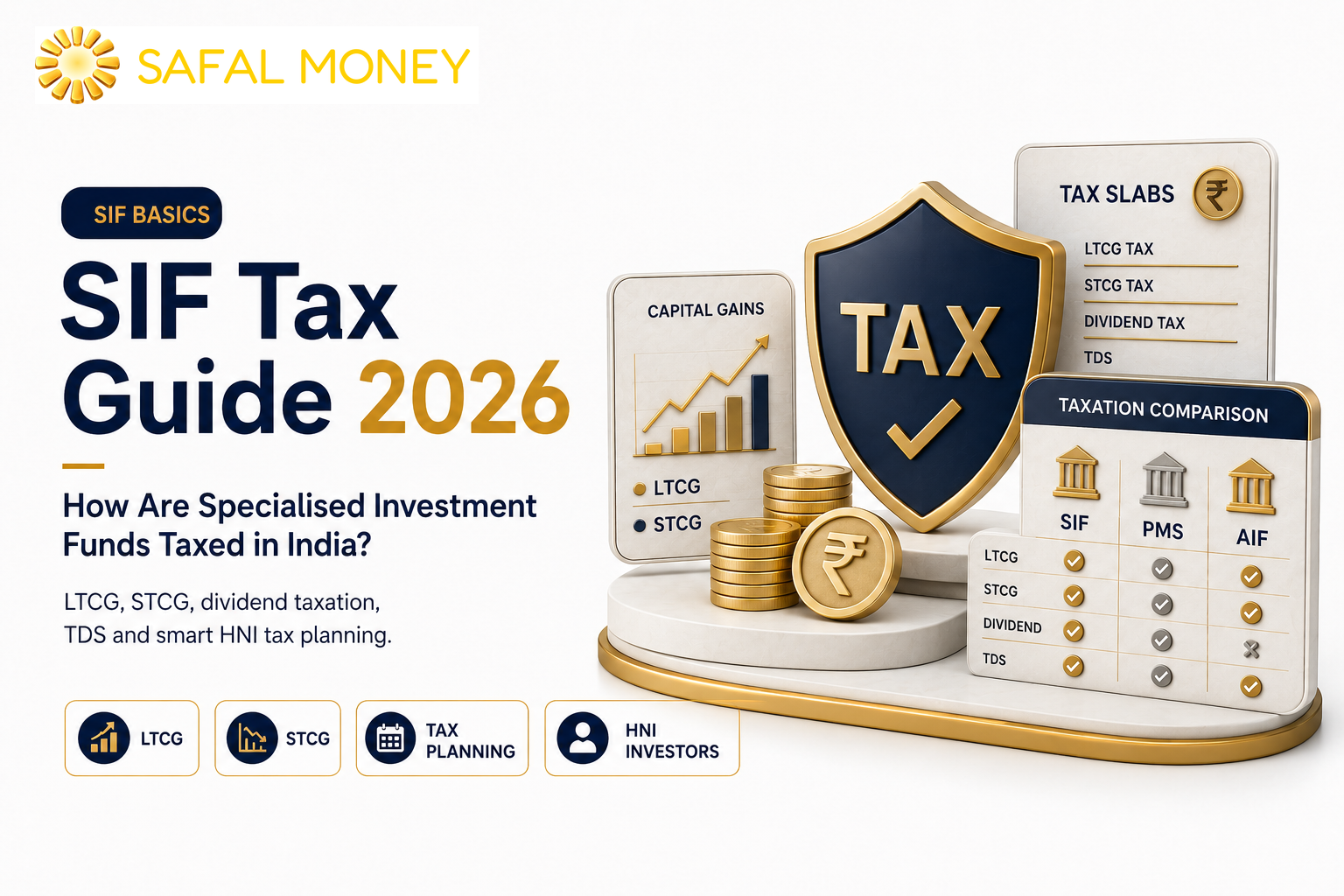
One of the most frequently asked questions about Specialised Investment Funds among HNI investors is not about returns or risk — it is about tax. How are SIF gains taxed? Is SIF more or less tax-efficient than mutual funds? What about compared to PMS or AIF? And what tax planning strategies are available for SIF investors?
These are the right questions to ask before investing — because the tax treatment of an investment vehicle can meaningfully affect post-tax returns, particularly for HNI investors in the 30%+ bracket.
The good news: SIF taxation closely mirrors mutual fund taxation — one of the most investor-friendly tax frameworks in Indian financial markets. The key variable, as with mutual funds, is the asset class composition of the specific SIF strategy you are investing in.
This guide gives you the complete, accurate picture of SIF taxation for 2026 — from basic capital gains treatment to TDS rules, dividend taxation, and tax-efficient investment strategies specific to SIF. As always, consult your chartered accountant or tax advisor for guidance specific to your individual situation.
The Foundation: How SIF Taxation Is Determined
The most important principle in SIF taxation is this: the tax treatment of a SIF fund is determined by its equity exposure — exactly as it works for regular mutual funds.
SEBI and the Income Tax Act treat SIF redemptions as capital gains from mutual fund investments. The applicable tax rate depends on whether the SIF is classified as an equity fund or a non-equity fund — and this classification is determined by the fund's average equity holding over the financial year.
- Equity-oriented SIF (65%+ equity exposure): Taxed as an equity mutual fund — the most favourable tax treatment available for financial investments in India.
- Non-equity-oriented SIF (below 65% equity exposure): Taxed as a debt or hybrid fund — income tax slab-based taxation for short-term gains, and 12.5% for long-term gains (without indexation benefit) after 24 months under the current Finance Act 2024 framework.
This classification-based approach means that the tax treatment of your specific SIF investment depends on which type of SIF you hold — Equity Long-Short, Hybrid Long-Short, or Debt Long-Short.
Tax Treatment: Equity Long-Short SIF (65%+ Equity)
Most Equity Long-Short SIF strategies — including DynaSIF Equity Long-Short, iSIF Equity Ex-Top 100 Long-Short, Tata Titanium Equity Long-Short, and ITI Diviniti — maintain equity exposure of 65% or more in their portfolios, classifying them as equity-oriented funds.
- Short Term Capital Gains (STCG) — held under 12 months: Gains taxed at 20% (flat rate, effective from July 23, 2024 Budget amendments).
- Long Term Capital Gains (LTCG) — held 12 months or more: Gains taxed at 12.5% on the total gain amount, with an exemption of ₹1.25 lakh per financial year.
The 12.5% LTCG rate applies to the entire gain — there is no indexation benefit for equity-oriented funds. However, the flat 12.5% rate is significantly lower than the 30%+ income tax slab that applies to many other investment instruments.
Practical Illustration for an HNI Investor
Assume you invest ₹20 lakh in an Equity Long-Short SIF in July 2025 and redeem in August 2026 (13 months later) for ₹24 lakh. Your gain is ₹4 lakh.
- LTCG tax: 12.5% on (₹4,00,000 − ₹1,25,000 exemption) = 12.5% on ₹2,75,000 = ₹34,375
- Post-tax proceeds: ₹24,00,000 − ₹34,375 = ₹23,65,625
- Effective post-tax return: approximately 18.3% on your original ₹20 lakh investment
These are illustrative calculations only. Actual tax liability depends on your total LTCG across all equity investments in the financial year. Consult your tax advisor for precise calculations.
Tax Treatment: Hybrid Long-Short SIF (Variable Equity Exposure)
Hybrid Long-Short SIF strategies — including Edelweiss Altiva Hybrid, SBI Magnum Hybrid, and Tata Titanium Hybrid — maintain equity exposure typically between 50% and 75%. Whether they are classified as equity-oriented or non-equity-oriented depends on the specific fund's average equity holding over the financial year.
- If the Hybrid SIF maintains 65%+ equity on average: Taxed as equity-oriented — same as above (STCG 20%, LTCG 12.5% after 12 months).
- If the Hybrid SIF maintains below 65% equity on average: Taxed as a non-equity fund — income tax slab rate for gains under 24 months, and 12.5% LTCG after 24 months without indexation.
The classification can change year to year depending on how the fund manager manages equity exposure. The AMC publishes the equity holding percentage annually, and AMFI certifies whether each fund qualifies as equity-oriented.
For the Edelweiss Altiva Hybrid Long-Short specifically: the fund's mandate (65–75% equity) suggests it should qualify as equity-oriented and receive equity fund tax treatment. However, periods when the arbitrage component reduces the directional equity holding below 65% may affect this classification. Check the fund's AMFI certificate annually.
Tax Treatment: Debt Long-Short SIF (Below 65% Equity)
Debt Long-Short SIF strategies maintain below 65% equity exposure by design — they are primarily debt-focused strategies with a derivatives overlay. These are classified as non-equity-oriented funds.
- Short Term Capital Gains (STCG) — held under 24 months: Added to your total income and taxed at your applicable income tax slab rate. For HNI investors in the 30% bracket, this means 30% + surcharge + cess — potentially 34.32% or higher at very high income levels.
- Long Term Capital Gains (LTCG) — held 24 months or more: Taxed at 12.5% without indexation benefit (as per Finance Act 2024 amendments).
This makes Debt Long-Short SIF significantly less tax-efficient than Equity Long-Short SIF for investors with short holding periods. However, for investors holding for 24+ months, the 12.5% LTCG rate is still substantially lower than the income slab rate — making Debt SIF more tax-efficient than FDs or liquid funds for long-horizon debt investors in high brackets.
The SIF vs MF Tax Comparison: Are They Identical?
For the most part, yes — SIF taxation mirrors mutual fund taxation because SIF units are treated as mutual fund units for income tax purposes. The key variable in both cases is equity exposure percentage.
| Investment | STCG Rate | LTCG Rate | LTCG Holding Period | LTCG Exemption |
|---|---|---|---|---|
| Equity MF / Equity SIF (65%+ equity) | 20% | 12.5% | 12 months | ₹1.25L per year |
| Hybrid MF / Hybrid SIF (if 65%+ equity) | 20% | 12.5% | 12 months | ₹1.25L per year |
| Debt MF / Debt SIF (below 65% equity) | Slab rate | 12.5% | 24 months | None |
| Arbitrage Fund | 20% | 12.5% | 12 months | ₹1.25L per year |
The tax treatment is essentially identical to mutual funds in the same equity exposure category. This is one of the most important advantages of SIF over alternative structures like AIF and PMS — it retains the investor-friendly mutual fund tax framework while offering institutional-grade strategies.
SIF Tax vs PMS Tax: The Key Difference
For HNI investors comparing SIF to Portfolio Management Services (PMS), the tax treatment difference is significant and consistently favours SIF.
PMS taxation: In a PMS, you directly own individual stocks and securities. Every time the portfolio manager sells a stock within your portfolio — whether you requested it or not — you incur a taxable capital gains event. Active PMS portfolios can generate 20–40 taxable transactions per year. Each short-term sale (under 12 months) is taxed at 20%, and each long-term sale is taxed at 12.5%. But the frequency of taxable events in an actively traded PMS is much higher than in a SIF.
SIF taxation: In a SIF, you own units of a pooled fund. The fund's internal buying and selling of securities does not directly create taxable events for you. You only pay tax when you redeem your own SIF units. This means the internal portfolio turnover within a SIF — including the short book transactions — generates no direct tax liability for unitholders.
For an HNI investor in the 30% bracket with ₹50 lakh in PMS generating 25 taxable transactions per year, the annual tax drag from internal portfolio churn can be substantial. A comparable SIF investment generates zero tax until you redeem — allowing the full gross return to compound without annual tax leakage.
SIF Tax vs AIF Tax: Another Key Difference
AIF (Alternative Investment Fund) Category III funds — hedge funds — have a complex and often less favourable tax treatment than SIF.
AIF Category III taxation: Under current tax rules, Category III AIF gains are taxed at the fund level rather than the investor level in many structures. The fund pays tax on its trading gains — both short-term and long-term — and distributes after-tax proceeds to investors. This fund-level taxation can result in effective tax rates higher than 30% on short-term trading gains within the fund, significantly reducing the net returns received by investors.
SIF taxation: As discussed, SIF is taxed at the investor level only upon redemption of units — not at the fund level on internal transactions. This pass-through taxation structure is far more efficient than AIF's fund-level taxation.
This is one of the most financially significant reasons why SEBI introduced SIF as a distinct category — to provide institutional-grade strategies with more investor-friendly tax treatment than existing AIF structures.
Dividend Taxation in SIF
SIF funds, like regular mutual funds, may declare dividends (technically called Income Distribution cum Capital Withdrawal — IDCW — under SEBI's 2021 reclassification).
Dividend taxation for SIF: Dividends received from SIF funds are added to the investor's total income and taxed at their applicable income slab rate. For an HNI investor in the 30% bracket, dividends from SIF are taxed at 30% + surcharge + cess — making them highly tax-inefficient compared to the Growth option.
Always Choose Growth, Never IDCW
SafalMoney's recommendation: always choose the Growth option for SIF investments, never the IDCW (Dividend) option. In the Growth option, there is no dividend distribution — all returns compound within the fund and are only taxed as capital gains when you redeem. This is significantly more tax-efficient for HNI investors in high tax brackets.
TDS on SIF Redemption — Is There Any?
A common concern among first-time SIF investors is whether TDS (Tax Deducted at Source) applies on redemption proceeds, as it does for some financial products.
The answer: for resident Indian investors, there is no TDS on SIF redemption proceeds — exactly as with regular mutual fund redemptions. You receive the full redemption amount in your bank account and are responsible for reporting the capital gain in your income tax return for the relevant financial year.
For NRI investors, TDS does apply on SIF redemption. For equity-oriented SIF (65%+ equity): 20% on short-term capital gains (under 12 months) and 12.5% on long-term capital gains (12+ months), plus applicable surcharge and cess. For non-equity SIF: 30% on short-term capital gains (under 24 months) and 12.5% on long-term capital gains (24+ months), plus surcharge and cess. See the complete NRI SIF investment guide for FEMA routing, DTAA, and repatriation details.
Tax Planning Strategies for SIF Investors
Strategy 1: Use the ₹1.25 Lakh LTCG Exemption Annually. Each financial year, ₹1.25 lakh of LTCG from equity-oriented investments is exempt from tax. For SIF investors who redeem equity-oriented SIF units, plan partial redemptions to utilise this exemption each year — harvesting gains up to ₹1.25 lakh annually without any tax liability. For example, if you have ₹8 lakh in accumulated LTCG from equity SIF units, you can redeem ₹1.25 lakh of gains per year over 6+ years, paying zero tax on each tranche. This requires discipline and advance planning but can eliminate significant tax liability over a long horizon.
Strategy 2: Tax-Loss Harvesting Within the SIF Allocation. If you hold multiple SIF funds and one has generated a loss while another has generated a gain, you can redeem the loss-making fund to crystallise the capital loss. Under Indian tax law, capital losses from equity investments can be set off against capital gains from other equity investments in the same financial year, reducing your overall tax liability. For example, if one SIF has generated a ₹1.5 lakh STCG while another has generated a ₹0.8 lakh STCL (short-term capital loss), you can set off the loss against the gain and pay tax only on the net ₹0.7 lakh gain. Plan any loss harvesting redemptions at the next fortnightly redemption window.
Strategy 3: Hold Beyond 12 Months for Equity SIF. The difference between STCG (20%) and LTCG (12.5%) for equity-oriented SIF is 7.5 percentage points. On ₹5 lakh of gains, this is a tax saving of ₹37,500. Always ensure you hold equity SIF units for at least 12 months before redeeming unless there is a compelling non-tax reason to exit earlier.
Strategy 4: Split Investments Across Financial Years. If you plan to invest a large lump sum in SIF — say ₹50 lakh — consider splitting across two or more financial years. This ensures that when you eventually redeem across a period of years, the annual LTCG exemption (₹1.25 lakh) can be used for each tranche rather than being overwhelmed by a single large redemption.
Strategy 5: Coordinate SIF Redemption With Overall Tax Planning. SIF redemptions should be coordinated with your overall annual tax planning — particularly if you have other LTCG sources (equity mutual fund redemptions, listed equity sales, real estate). The ₹1.25 lakh LTCG exemption applies across all equity investments in a financial year, not separately to each investment type.
The Gift of SIF to Spouse or Children: Tax Implications
A question that sometimes arises for HNI family offices: can you gift SIF units to a spouse or children to reduce tax liability?
Gifting SIF units to spouse: Gifts to spouse are generally not subject to gift tax for the recipient, but the clubbing provisions under Section 64 of the Income Tax Act apply. Income and capital gains from investments gifted to a spouse are clubbed with the transferor's income for tax purposes — so this strategy does not reduce the family's overall tax liability.
Gifting SIF units to major children (above 18): Gifts to adult children are not subject to clubbing. If you gift SIF units to an adult child who has a lower income and tax bracket, the subsequent redemption gains are taxed at the child's (potentially lower) slab rate. However, the gift itself must be documented properly, and the original cost basis is carried over — the child pays LTCG or STCG on gains computed from the original investment date and cost.
Always consult a chartered accountant before executing any gift-based tax planning strategy. The rules are nuanced and individual circumstances vary significantly.
Free, 2 minutes
Frequently Asked Questions
How is SIF taxed in India?
SIF taxation mirrors mutual fund taxation. Equity Long-Short SIF funds that maintain 65%+ equity are taxed as equity-oriented mutual funds: short-term capital gains (under 12 months) at 20% and long-term capital gains (12 months or more) at 12.5% with a Rs 1.25 lakh annual exemption. Hybrid Long-Short SIF funds may be equity-oriented or non-equity-oriented depending on their average equity exposure. Debt Long-Short SIF funds are taxed as non-equity funds: gains under 24 months at the income slab rate and gains over 24 months at 12.5% without indexation.
Is SIF more tax-efficient than PMS?
Yes, significantly. In PMS, every internal portfolio transaction - every stock sale within your portfolio - creates a taxable event for you personally, generating frequent tax liabilities throughout the year. In SIF, internal fund transactions do not create taxable events - you only pay tax when you redeem your SIF units. This structure allows the full gross return to compound without annual tax leakage, making SIF considerably more tax-efficient than PMS for most HNI investors.
What is the LTCG tax on SIF?
For equity-oriented SIF funds (65%+ equity): LTCG is taxed at 12.5% on gains above Rs 1.25 lakh per financial year, after holding the investment for 12 months or more. For non-equity SIF funds (below 65% equity): LTCG is taxed at 12.5% without indexation benefit after holding for 24 months or more. There is no exemption threshold for non-equity LTCG. Always verify the equity orientation status of your specific SIF fund annually through the AMC's AMFI certification.
Is there TDS on SIF redemption for resident Indians?
No. For resident Indian investors, there is no TDS (Tax Deducted at Source) on SIF redemption proceeds - exactly as with regular mutual fund redemptions. You receive the full redemption amount and must self-report the capital gain in your income tax return for the relevant assessment year. For NRI investors, TDS does apply - rates depend on whether the SIF qualifies as equity-oriented and the applicable DTAA provisions with the NRI's country of residence.
Should I choose Growth or IDCW option for SIF?
Always choose the Growth option for SIF investments. In the Growth option, no dividends are distributed - all returns compound within the fund and are only taxed when you redeem, as capital gains at 12.5% LTCG rate (for equity-oriented SIF held 12+ months). In the IDCW option, dividends are distributed and taxed at your income slab rate - which for HNI investors in the 30%+ bracket means significantly higher tax on each distribution. The Growth option is more tax-efficient in almost every scenario for HNI investors.
Last updated: 18 July 2026