SIF vs Mutual Fund vs PMS vs AIF: Which HNI Investment Vehicle Wins?
Confused between SIF, Mutual Fund, PMS and AIF? This definitive 10-criteria comparison helps Indian HNI investors choose the right investment vehicle for their portfolio in 2026.
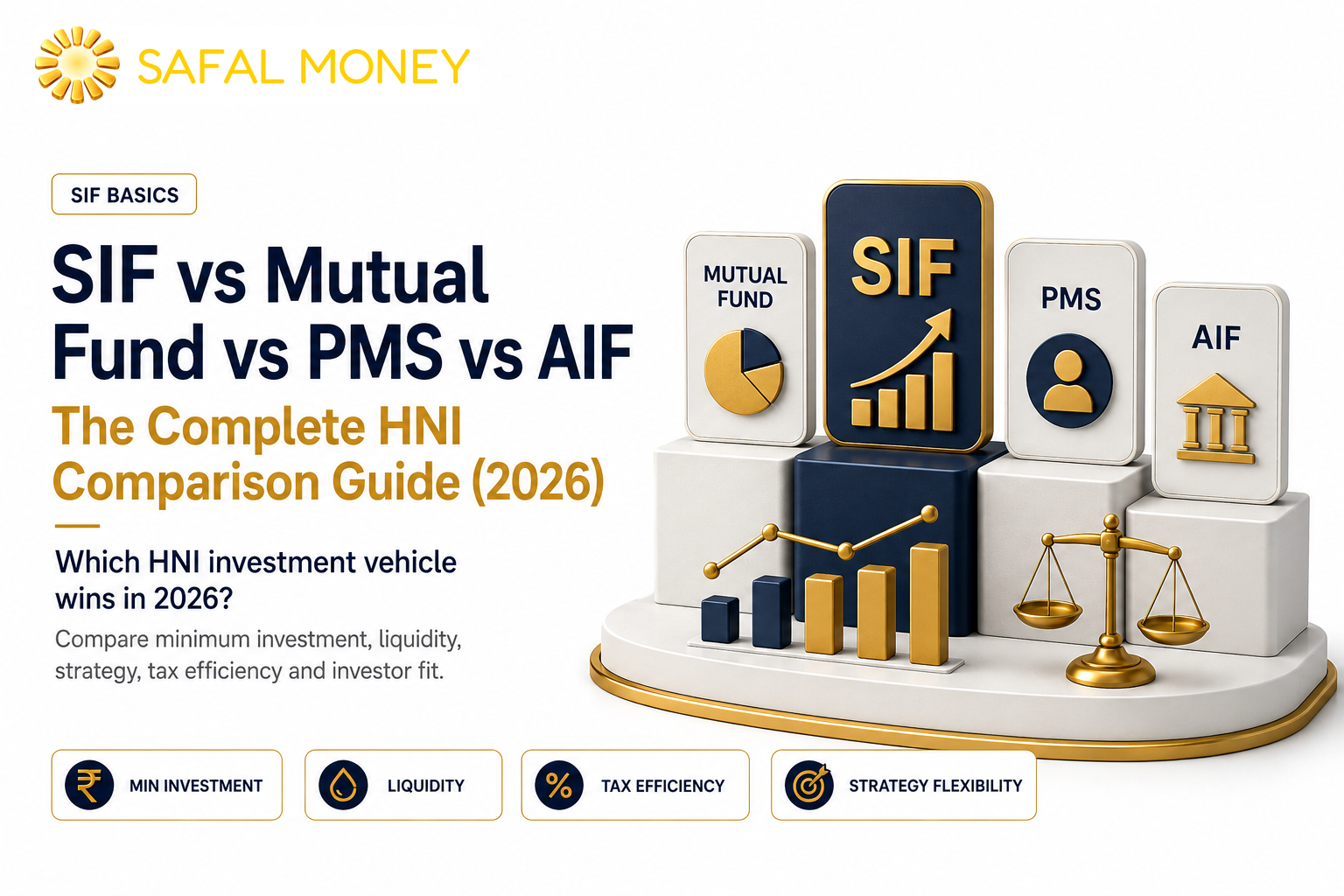
If you are an HNI investor with a corpus between ₹10 lakh and ₹5 crore, you have probably faced this question at some point — should I go with a mutual fund, explore PMS, look at AIF, or is this new SIF category worth considering?
The honest answer is: it depends on your corpus size, investment horizon, risk tolerance, and how much complexity you are comfortable managing. There is no universal winner. But there is a right answer for your specific situation — and this article gives you the framework to find it.
We compare all four vehicles across 10 dimensions so you can make an informed, confident decision.
What Is the HNI Investment Universe at a Glance?
Before diving into the comparison, here is a quick orientation of where each vehicle sits:
| Vehicle | Minimum Investment | Who Regulates | Who Distributes |
|---|---|---|---|
| Mutual Fund | ₹500 (SIP) | SEBI | AMFI-registered distributors |
| SIF | ₹10,00,000 | SEBI | AMFI-registered distributors |
| PMS | ₹50,00,000 | SEBI | SEBI-registered portfolio managers |
| AIF (Cat III) | ₹1,00,00,000 | SEBI | Private placement |
All four are SEBI-regulated. The differences lie in strategy, structure, cost, liquidity, and who they are designed for.
The 10-Dimension Comparison: SIF vs MF vs PMS vs AIF
Dimension 1: Minimum Investment — The Entry Barrier
| Vehicle | Minimum Investment |
|---|---|
| Mutual Fund | ₹500 (SIP); ₹1,000 (lumpsum) |
| SIF | ₹10,00,000 |
| PMS | ₹50,00,000 |
| AIF (Cat III) | ₹1,00,00,000 |
The minimum investment ladder is the most important filter. If your investable corpus is ₹10–50 lakh, SIF is the only vehicle that gives you access to alternative strategies. PMS is not accessible, AIF is far out of reach, and mutual funds — while accessible — cannot offer long-short strategies.
This is the gap SIF was specifically designed to fill.
Dimension 2: Investment Strategy — What Can the Manager Actually Do?
| Vehicle | Strategy Allowed |
|---|---|
| Mutual Fund | Long-only (buy and hold) |
| SIF | Long + Short via derivatives |
| PMS | Long + limited derivatives; direct stock ownership |
| AIF (Cat III) | Hedge fund-like; long, short, leverage, complex derivatives |
This is the most consequential difference. Mutual funds can only profit when markets rise. SIF, PMS (to a limited extent), and AIF can potentially profit in falling markets too — through short positions. AIF has the broadest toolkit but also the highest complexity and minimum investment.
Dimension 3: Regulation and Transparency — Which Is Most Investor-Protected?
All four vehicles are SEBI-regulated, but the degree of standardisation and transparency differs significantly.
Mutual funds have the most standardised disclosure regime — daily NAV, monthly portfolio disclosure, standardised category definitions, and AMFI oversight. Every mutual fund investor gets the same information in the same format.
SIF follows a similar disclosure regime to mutual funds — SEBI has mandated standardised reporting, regular portfolio disclosure, and AMFI distribution oversight. This makes SIF far more transparent than PMS or AIF.
PMS provides portfolio statements and performance reports, but the format and frequency can vary across portfolio managers. Benchmarking is less standardised.
AIF has the least standardised disclosure regime. Reporting requirements exist but are less granular, and many AIF structures involve complex legal entities that can be difficult for individual investors to fully understand.
For investor protection, mutual fund and SIF are the gold standard. PMS and AIF offer less standardised transparency.
Dimension 4: Liquidity — When Can You Get Your Money Back?
| Vehicle | Liquidity |
|---|---|
| Mutual Fund | Daily (most open-ended funds) |
| SIF | Fortnightly redemption windows |
| PMS | Typically quarterly; varies by manager |
| AIF (Cat III) | Lock-in periods of 1–5 years typically |
Liquidity is where mutual funds have a clear advantage. If you need your money urgently, a mutual fund can be redeemed on any business day with T+2 or T+3 settlement.
SIF offers fortnightly liquidity — better than PMS and far better than AIF, but not as flexible as mutual funds.
AIF lock-ins can be 3–5 years in many structures. Once you commit, your capital is deployed for that period. This is appropriate for patient capital but not for money that might be needed sooner.
Dimension 5: Tax Efficiency — Which Structure Is Most Tax-Optimal?
| Vehicle | Tax Treatment |
|---|---|
| Mutual Fund (Equity) | LTCG 12.5% (above ₹1.25L, after 12 months); STCG 20% |
| SIF (Equity LS, 65%+ equity) | Same as equity mutual fund |
| PMS | Each stock transaction taxed individually — can be less efficient |
| AIF (Cat III) | Taxed at fund level; pass-through taxation complexity |
SIF enjoys the same tax treatment as equity mutual funds when the fund maintains 65% or more equity exposure — which most Equity Long-Short SIF funds do. This is a significant advantage over PMS, where every stock sold in your portfolio generates a taxable event regardless of whether you asked for it.
AIF taxation is the most complex and should always be reviewed with a chartered accountant before investing.
Always consult your tax advisor for your specific situation, as tax laws are subject to change.
Dimension 6: Cost Structure — What Are You Actually Paying?
| Vehicle | Typical Cost |
|---|---|
| Mutual Fund (Direct) | 0.1%–1.0% expense ratio |
| SIF (Direct) | 1.0%–2.0% expense ratio |
| PMS | 1.5%–2.5% management fee + 10–20% profit sharing |
| AIF (Cat III) | 1.5%–2.5% management fee + 20% profit sharing (2/20 structure) |
Mutual funds are the most cost-efficient. SIF costs more than mutual funds but significantly less than PMS or AIF, which charge both a management fee and a performance fee on profits. Over a 10-year period, the cost difference between SIF and AIF can amount to several percentage points of annual return.
Dimension 7: Ownership Structure — Who Owns the Securities?
This is a detail that matters more than most investors realise.
In a mutual fund or SIF, you own units of a pooled fund. You do not directly own the underlying securities. The AMC manages the pool on behalf of all unitholders.
In PMS, you directly own the individual stocks and securities in your demat account. The portfolio manager operates under a power of attorney. This means you see exactly which stocks you own, can see every transaction, and have complete transparency at the individual security level.
In AIF, you typically invest in a fund vehicle (often an LLP or trust) that owns the securities. You are a beneficial owner, not a direct owner.
For investors who want to see and control exactly which stocks they own, PMS is the only vehicle that delivers this.
Dimension 8: Customisation — Can the Strategy Be Tailored to You?
| Vehicle | Customisation |
|---|---|
| Mutual Fund | None — same portfolio for all investors |
| SIF | None — same fund for all investors |
| PMS | High — can be customised to exclude certain stocks or sectors |
| AIF | Moderate — fund-level strategy; some co-investment options |
If you have specific requirements — you cannot hold tobacco stocks for ethical reasons, or you already own large positions in certain companies and need the portfolio manager to avoid them — only PMS can accommodate this at the individual investor level.
Mutual funds and SIF are pooled vehicles with no individual customisation.
Dimension 9: Ideal Investor Profile — Who Is Each Vehicle For?
| Vehicle | Ideal For |
|---|---|
| Mutual Fund | All investors; core of any portfolio regardless of wealth |
| SIF | HNI investors with ₹10L–₹5Cr seeking alternative strategies |
| PMS | HNI/UHNI investors with ₹50L+ wanting direct stock ownership and customisation |
| AIF | UHNI investors with ₹1Cr+ comfortable with lock-ins and complex strategies |
Dimension 10: Can You Hold All Four Together?
Yes — and for sufficiently large portfolios, this is actually the optimal approach. A well-constructed UHNI portfolio might look like this:
- Mutual Funds: 40% — core equity and debt allocation (liquid, low cost, well-diversified)
- SIF: 20% — alternative strategy layer (long-short equity for alpha and hedging)
- PMS: 25% — direct equity ownership with customised mandate
- AIF: 15% — high-conviction alternative strategies with locked-in patient capital
For investors with total portfolio size below ₹1 crore, mutual funds and SIF are the practical combination. PMS becomes relevant at ₹50 lakh corpus and AIF at ₹1 crore plus.
When Should You Choose SIF Over PMS?
Choose SIF over PMS when:
- Your investable corpus is between ₹10 lakh and ₹50 lakh — PMS is not available to you yet
- You want the regulatory transparency and AMFI distribution framework of a mutual fund
- You are comfortable with a pooled structure rather than direct stock ownership
- Tax efficiency is a priority — SIF's equity fund tax treatment is simpler than PMS
- You want fortnightly liquidity rather than quarterly
When Does PMS Beat SIF?
Consider PMS over SIF when:
- Your corpus exceeds ₹50 lakh and you want direct ownership of individual stocks
- You need customisation — sector exclusions, stock exclusions, concentrated bets
- You want complete visibility into every transaction in your portfolio
- Your relationship with the portfolio manager is a key part of the value proposition
When Is AIF the Right Call?
AIF makes sense when:
- Your corpus is ₹1 crore or more and you can commit to a multi-year lock-in
- You want hedge-fund-like strategies — complex derivatives, leverage, credit strategies — that are not available in SIF
- You are working with a sophisticated advisor who can evaluate AIF structures carefully
- You understand and accept that AIF transparency and liquidity are the most constrained of all four vehicles
Frequently Asked Questions
What is the difference between SIF and PMS?
SIF is a pooled fund vehicle with a minimum investment of ₹10 lakh, regulated by SEBI and distributed through AMFI-registered distributors. PMS is a direct stock ownership vehicle with a minimum of ₹50 lakh, managed under a power of attorney. SIF offers better liquidity (fortnightly vs quarterly), simpler tax treatment, and lower minimum investment. PMS offers customisation and direct ownership that SIF cannot provide.
Is SIF better than AIF for HNI investors?
For investors with corpus below ₹1 crore, SIF is the practical choice — AIF is not accessible. For investors above ₹1 crore, SIF and AIF serve different purposes and can be held together. SIF offers better liquidity, lower cost, and simpler tax treatment. AIF offers more complex strategies and potentially higher return potential with commensurately higher risk and lock-in.
Which has a lower minimum: SIF or PMS?
SIF has a significantly lower minimum investment of ₹10,00,000 compared to PMS which requires a minimum of ₹50,00,000. For HNI investors with corpus between ₹10 lakh and ₹50 lakh, SIF is the only alternative strategy vehicle accessible.
Is SIF more liquid than PMS?
Yes. SIF offers fortnightly redemption windows with T+3 settlement after the redemption date. PMS liquidity varies by manager but is typically quarterly, and some PMS strategies have lock-in periods. For investors who want alternative strategy exposure with reasonable liquidity, SIF has a clear advantage over PMS.
Can I hold SIF and mutual funds together?
Absolutely. In fact, this is the recommended approach for most HNI investors. Mutual funds form the core — providing daily liquidity, broad diversification, and low cost. SIF adds the alternative strategy layer — long-short exposure, potential downside hedging, and uncorrelated returns. The two complement each other and are both distributed through AMFI-registered platforms like SafalMoney.
Last updated: 2 July 2026