Direct Plan vs Regular Plan Mutual Funds: The Real Cost of Convenience
Direct plan or regular plan - the difference is bigger than most investors realise. This 2026 guide shows the exact rupee cost of choosing regular over direct, with real compounding calculations.
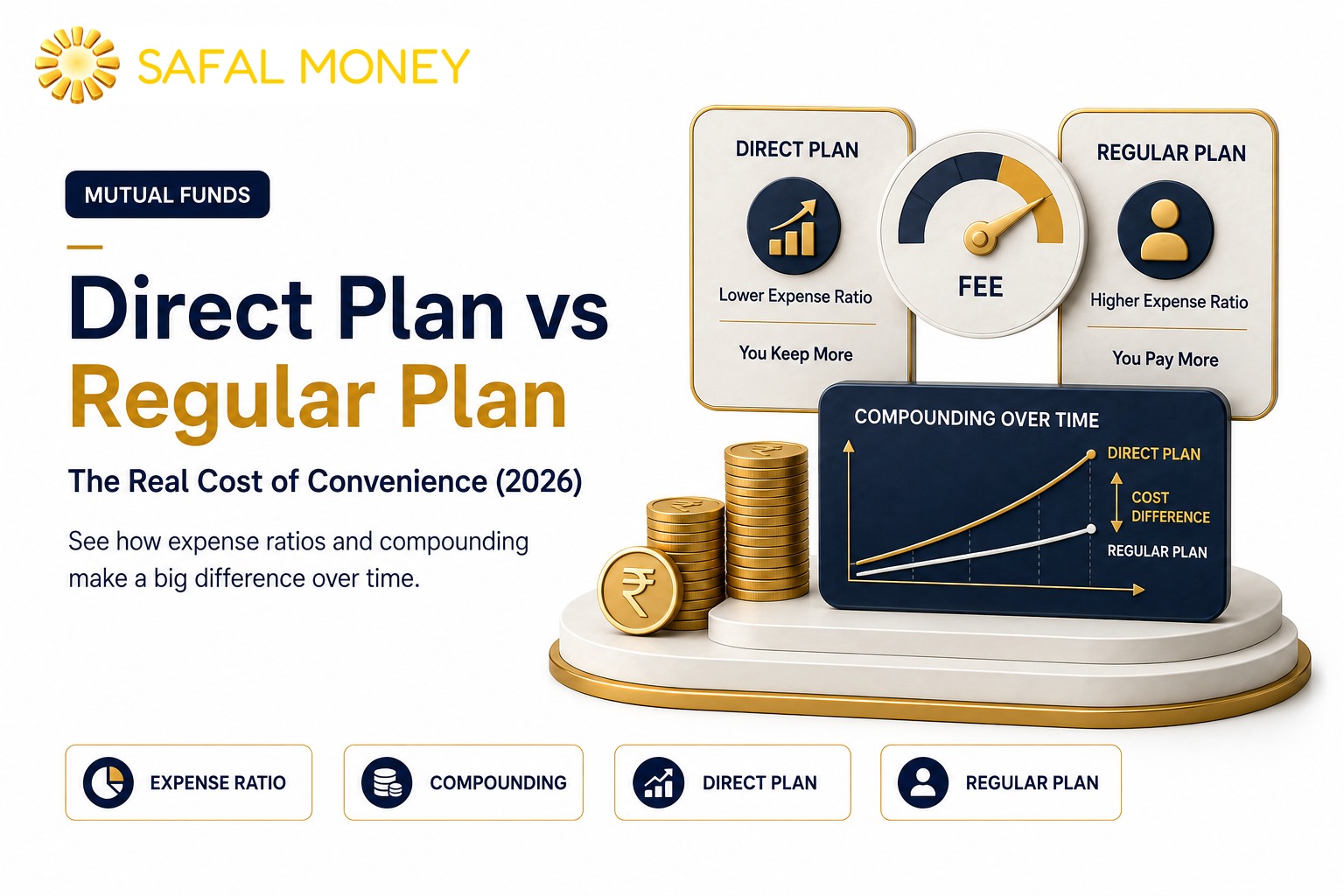
Every mutual fund in India exists in two versions — a Direct Plan and a Regular Plan. They invest in exactly the same portfolio. They are managed by exactly the same fund manager. They follow exactly the same investment mandate. The only difference is the expense ratio — and that difference, compounded over years and decades, creates a wealth gap that most investors significantly underestimate.
This is not a theoretical argument. It is arithmetic. And for HNI investors with large corpus sizes, the arithmetic is particularly unforgiving.
This guide gives you the complete picture: what the difference actually is, how much it costs in rupees over different time horizons, when regular plans are genuinely justified, and how the choice applies differently to SIF investments.
What Is the Difference Between Direct and Regular Plans?
When SEBI mandated the creation of Direct Plans in January 2013, it made a structural change to how mutual funds are distributed in India. Every fund house was required to offer two variants of each scheme:
Regular Plan: The fund pays a commission — typically 0.5% to 1.5% per year — to the distributor (bank, broker, or mutual fund distributor) who sold the investment to the investor. This commission is embedded in the expense ratio and deducted from the fund's NAV daily. The investor does not write a separate cheque for it, which is why it is easy to overlook.
Direct Plan: There is no distributor involved. No commission is paid. The expense ratio is therefore lower by exactly the commission amount — which ranges from 0.3% to 1.2% depending on the fund category. The investor invests directly with the AMC or through a platform that does not charge commission.
Both plans are investing in the same securities, managed by the same team. The NAV difference compounds over time as the direct plan NAV grows faster by the commission margin each year.
How Large Is the Expense Ratio Gap in Practice?
The commission gap varies significantly by fund category:
| Fund Category | Typical Regular Plan TER | Typical Direct Plan TER | Annual Gap |
|---|---|---|---|
| Liquid Fund | 0.20–0.30% | 0.10–0.15% | 0.10–0.15% |
| Short Duration Fund | 0.50–0.80% | 0.20–0.35% | 0.30–0.45% |
| Corporate Bond Fund | 0.60–0.90% | 0.25–0.40% | 0.35–0.50% |
| Large Cap Active Fund | 1.50–1.80% | 0.70–1.00% | 0.70–0.90% |
| Mid Cap Fund | 1.60–2.00% | 0.70–1.10% | 0.80–1.00% |
| Small Cap Fund | 1.70–2.10% | 0.80–1.20% | 0.80–1.00% |
| Flexi Cap Fund | 1.50–1.90% | 0.70–1.00% | 0.70–0.90% |
| Index Fund (Nifty 50) | 0.20–0.50% | 0.10–0.20% | 0.10–0.30% |
| ELSS Fund | 1.50–1.90% | 0.70–1.00% | 0.70–0.90% |
For the most common investment categories — actively managed equity funds — the gap is typically 0.70–1.00% per year. This is the annual cost of convenience when choosing regular plans over direct.
The Rupee Impact: What the Gap Actually Costs You
This is where most investors get their wake-up call. The expense ratio gap seems small in percentage terms — 0.75% per year does not sound alarming. Over 20 years on a large corpus, it is devastating.
Illustration 1: ₹10 Lakh in a Mid Cap Fund Over 20 Years
Assume gross fund return of 14% per year. Direct plan TER 0.90%, Regular plan TER 1.80%.
| Plan | Net Annual Return | Value After 20 Years |
|---|---|---|
| Direct (0.90% TER) | 13.10% | ₹1,10,81,000 |
| Regular (1.80% TER) | 12.20% | ₹93,35,000 |
| Difference | ₹17,46,000 |
₹17.46 lakh on a ₹10 lakh investment — purely from the expense ratio gap. This is not money you paid upfront. It is money that was silently deducted from your portfolio every day through the NAV difference, compounding against you for 20 years.
Illustration 2: ₹1 Crore in a Flexi Cap Fund Over 15 Years
Assume gross fund return of 13% per year. Direct plan TER 0.80%, Regular plan TER 1.60%.
| Plan | Net Annual Return | Value After 15 Years |
|---|---|---|
| Direct (0.80% TER) | 12.20% | ₹5,81,00,000 |
| Regular (1.60% TER) | 11.40% | ₹5,10,00,000 |
| Difference | ₹71,00,000 |
₹71 lakh on a ₹1 crore investment. For an HNI investor, this is not an abstraction — it is a car, a foreign holiday, or a significant charitable contribution that was effectively transferred to the distribution ecosystem rather than staying in the portfolio.
Illustration 3: ₹5 crore portfolio (₹3 crore in equity, ₹2 crore in debt) over 20 years. Equity portion: Direct at 0.85% TER, Regular at 1.70% TER. Debt portion: Direct at 0.30% TER, Regular at 0.65% TER. Total additional wealth in direct plans after 20 years (assuming 13% equity gross return and 7.5% debt gross return): approximately ₹3.5–₹4 crore.
For a ₹5 crore portfolio, the choice between direct and regular plans is effectively worth ₹3.5–4 crore over 20 years. This is not a marginal difference — it is a life-changing amount.
All calculations above are illustrative only, assuming consistent returns which cannot be guaranteed in practice.
Why Do Regular Plans Still Exist — and Who Justifies Them?
Given the mathematical case above, why do regular plans exist at all? And why do most retail investors in India still invest through regular plans?
The answer is distribution economics and investor behaviour.
The distribution economics argument: The commission paid to distributors in regular plans funds the distribution infrastructure that brings mutual fund investments to investors who might otherwise never access the market. A retired schoolteacher in Jabalpur investing ₹2,000 per month through her local bank branch is accessing wealth creation through the commission-funded distribution model. Without it, her investment would not happen.
The behaviour management argument: Research consistently shows that investors who invest through advisors and distributors stay invested longer, panic-sell less during corrections, and achieve better actual returns than self-directed investors — even after the commission cost. A regular plan investor who stays the course for 15 years may outperform a direct plan investor who switches funds frequently, panics during corrections, and makes poor timing decisions.
When regular plans are genuinely justified:
- Investors who genuinely need ongoing advice, hand-holding through market volatility, and portfolio management support
- Investors accessing a specialised distributor with demonstrated expertise in a specific category (such as SafalMoney for SIF)
- Investors whose investment corpus is small enough that the absolute commission amount is less material than the value of the service received
- First-time investors who need structured guidance to avoid costly behavioural mistakes
When Direct Plans Are Clearly the Right Choice
Direct plans are the unambiguous choice when:
- You are a self-directed investor comfortable with fund research and selection
- Your corpus is above ₹25 lakh — at this scale, the annual commission savings (₹18,750–₹25,000 on ₹25 lakh at 0.75% gap) are material and worth the self-management effort
- You are using an independent fee-based financial advisor (RIA) who charges a transparent fee rather than commission — in this case, you pay the advisor directly and take the lower direct plan expense ratio
- You are investing in index funds — where there is almost no ongoing advisory value to justify the regular plan cost, since the portfolio never changes
- You have the discipline to stay invested through corrections without an advisor's hand-holding
The Direct vs Regular Decision for HNI Investors: The Nuanced Truth
For HNI investors specifically, the decision is more nuanced than a simple "always choose direct."
The mathematical case for direct plans is strongest for:
- Conventional equity mutual funds — large cap, mid cap, flexi cap — where the commission gap is 0.70–1.00% and the advisory value is limited if you have already done good fund selection
- Index funds — where there is no active management decision for an advisor to support
- Debt funds where you understand duration and credit quality
The case for regular plans (through a specialist distributor) is justified for:
- Specialised Investment Funds (SIF) — where the complexity of fund selection, accredited investor process, portfolio construction, and fortnightly redemption management genuinely benefits from expert distributor support
- Alternative fund categories where the advisor's role in preventing behavioural mistakes is worth the commission
- Investors with complex multi-asset portfolios where ongoing rebalancing guidance, tax coordination, and annual review support has genuine value
The SIF-Specific Dimension: Regular or Direct for SIF?
SIF investments occupy a unique position in the direct vs regular debate.
Unlike a Nifty 50 index fund — where choosing regular plan means paying 0.3% extra annually for no additional service — SIF investment involves:
- Accredited investor certification assistance
- Fund selection across 20+ available SIF strategies using sophisticated evaluation frameworks like SafalCheck™
- Portfolio architecture decisions (how much SIF, which strategy type, how to split across funds)
- Fortnightly redemption window management
- Tax coordination with the rest of the portfolio
- Annual portfolio review and rebalancing guidance
These services have genuine value — particularly for first-time SIF investors. An HNI investor who makes a poor SIF fund selection or mismanages their allocation based on generic advice could easily lose far more than the regular plan commission in suboptimal investment outcomes.
SafalMoney's approach: we act as an AMFI-registered Mutual Fund Distributor and earn regular plan commissions for SIF investments — but we provide specific, quantified value through SafalScore™ (your personalised allocation), SafalCheck™ (fund evaluation), and ongoing portfolio monitoring. The commission is transparent, SEBI-mandated in disclosure, and justified by the specialist value delivered.
For conventional equity and debt mutual funds — where the fund selection process is simpler and ongoing advisory value is lower — we encourage direct plan investing where investors are comfortable doing it themselves.
The Platform Question: How to Access Direct Plans
For investors who choose direct plans, several platforms facilitate direct mutual fund investing:
- AMC websites directly: Every AMC website allows direct plan investment. For investors holding a handful of funds from 2–3 AMCs, this is perfectly manageable.
- MF Central: SEBI and AMFI's official consolidated mutual fund platform — allows investors to view, purchase, and manage direct plans across all AMCs from one interface.
- Zerodha Coin, Groww, Paytm Money (direct plan platforms): These platforms offer direct plan investments with no commission — they earn revenue from other services. Suitable for self-directed investors comfortable with digital platforms.
- SEBI-registered Investment Advisors (RIAs): Fee-based advisors who charge a transparent fee (typically 0.5–1% of AUM annually or a fixed fee) and recommend direct plans. The total cost (advisor fee + direct plan TER) may be similar to regular plan TER — but the advisor is accountable to you, not to the AMC.
The Switching Question: Should You Switch From Regular to Direct?
If you have been investing in regular plans and are now considering switching to direct plans, the process involves redeeming your regular plan units and reinvesting in direct plan units — which is a redemption and fresh purchase, triggering capital gains tax.
Before switching, calculate whether the long-term expense ratio savings justify the immediate tax cost:
- If your holding period is under 12 months for equity funds: Switching now means paying 20% STCG tax. Usually not worth it — wait for the 12-month LTCG threshold.
- If your holding is older than 12 months: You pay 12.5% LTCG. Calculate whether the future expense ratio savings over your remaining investment horizon exceed this one-time tax cost.
- For large corpus and long remaining horizons: Switching almost always makes mathematical sense despite the tax cost. On ₹50 lakh in equity funds with 15+ years remaining, saving 0.80% annually creates far more wealth than the one-time 12.5% LTCG cost.
- For smaller corpus or shorter remaining horizons: The break-even point may be 3–5 years. Calculate before switching.
Always consult your chartered accountant before executing a switch — the tax implications are individual and depend on your specific cost basis, holding period, and overall LTCG position for the year.
Free tool, no login required
Frequently Asked Questions
What is the difference between direct and regular plan in mutual funds?
Direct plans and regular plans invest in identical portfolios managed by the same fund manager. The only difference is the expense ratio. Regular plans include a distributor commission - typically 0.5-1.5% per year depending on fund category - which is paid to the bank, broker, or distributor who sold the investment. Direct plans have no distributor commission, resulting in a lower expense ratio and higher NAV growth over time. Over 15-20 years on large corpus sizes, the compounding difference in NAV creates a substantial wealth gap in favour of direct plans.
How much more do direct plans return vs regular plans?
The return difference between direct and regular plans equals the commission gap - typically 0.70-1.00% per year for actively managed equity funds. On Rs 10 lakh invested for 20 years in a mid cap fund at 14% gross return, this translates to approximately Rs 17 lakh more in the direct plan. On Rs 1 crore for 15 years, the difference is approximately Rs 71 lakh. The compounding effect grows larger with higher corpus sizes and longer time horizons.
Should HNI investors always choose direct plans?
For conventional equity and debt mutual funds where the fund selection process is manageable and ongoing advisory value is limited, direct plans are the mathematically superior choice for most HNI investors. However, for Specialised Investment Funds - where fund selection across 20+ strategies, accredited investor certification, portfolio architecture, and fortnightly redemption management add genuine complexity - investing through a specialist AMFI-registered distributor like SafalMoney can be justified despite the regular plan commission.
What is the expense ratio of direct plans in India?
Direct plan expense ratios vary by fund category. Nifty 50 index funds in direct plan charge as little as 0.10%. Actively managed large cap direct plans typically charge 0.70-1.00%. Mid and small cap direct plans charge 0.80-1.20%. Short duration debt direct plans charge 0.20-0.35%. Corporate bond direct plans charge 0.25-0.40%. Always check the current TER for the specific fund and plan on the AMC website or AMFI India's TER disclosure page.
Can I switch from regular to direct plan without tax?
No. Switching from a regular plan to a direct plan of the same mutual fund scheme is treated as a redemption of regular plan units and a fresh purchase of direct plan units for tax purposes. This triggers capital gains tax - 20% STCG if held under 12 months, or 12.5% LTCG if held 12 months or more for equity-oriented funds. Despite this one-time tax cost, switching often makes financial sense for investors with large corpus and long remaining investment horizons, as the future expense ratio savings typically exceed the switching tax cost. Calculate your specific break-even point before switching and consult your tax advisor.
Last updated: 10 July 2026