Index Fund vs Active MF in India 2026: The Evidence-Based Verdict
Index fund or active mutual fund - which wins in India? This evidence-based 2026 guide uses SPIVA data, TER maths, and category-wise analysis to give you the honest, data-driven verdict.
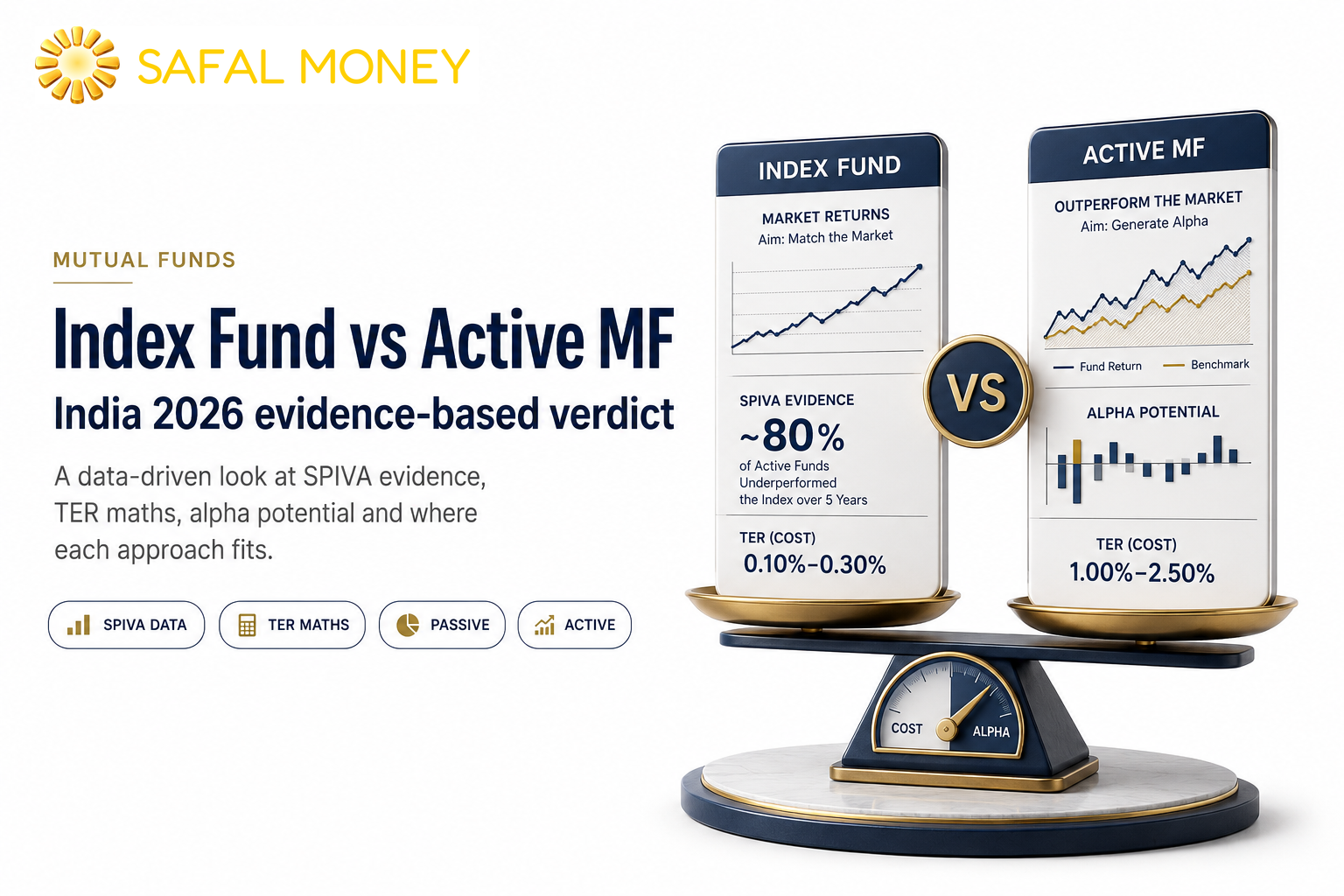
This is the most debated question in personal finance — globally and in India. Should you invest in a Nifty 50 index fund that simply tracks the market at minimal cost? Or should you back an active fund manager to outperform the market through research, skill, and conviction?
The global answer — backed by decades of data — is clear: most active managers underperform their benchmark over long periods after fees. This is why index funds have captured trillions of dollars in assets globally over the past two decades.
But India is different from the US — and understanding exactly how and why it is different is what separates a genuinely informed answer from a borrowed one. The India-specific evidence is more nuanced than the global headline suggests. In some categories, active management in India has added genuine, consistent value. In others, it has not. And in the category that no mutual fund — active or passive — can replicate, SIF has entered as the third option that changes the conversation entirely.
This article gives you the evidence-based, India-specific verdict — by category, by time period, and with a clear practical recommendation for what most Indian investors should actually do with this information.
The Global Case for Passive Investing — and Why It Started in the US
The case for index funds was made most powerfully by John Bogle, founder of Vanguard, who launched the first retail index fund in 1976. His argument was simple and mathematically airtight: the stock market as a whole must return the market return. Active managers as a group must also return the market return — before costs. After costs, the active manager group must underperform the market by exactly the amount of their collective fees.
This is not a prediction or a theory — it is an arithmetic identity. It is always true, by definition.
The implication: for every active manager who outperforms the index, another active manager must underperform by the same amount. When you add fees — which are always negative — the average active manager must always underperform the index net of costs.
The data has consistently borne this out in the US market. The SPIVA US Scorecard — which tracks active vs passive performance across all US fund categories — shows that over 15–20 year periods, 85–92% of active US large cap funds underperform the S&P 500 index.
Why India Is Genuinely Different — The Three Structural Reasons
Directly applying the US evidence to India leads to incorrect conclusions. India's market structure creates meaningful differences from the US that affect the active vs passive debate significantly.
Reason 1: India's market is less efficient than the US. Market efficiency — the degree to which prices reflect all available information — is significantly lower in India than in developed markets. The US market has thousands of professional analysts covering every major stock, algorithmic trading executing millions of trades per second, and decades of pricing history to learn from. India has fewer analysts per stock, significantly less institutional participation in the mid and small cap segments, more retail investor-driven price movements, and meaningful information asymmetries that persist because research coverage is thin outside the top 100 stocks. This lower efficiency creates genuine alpha opportunities for skilled active managers — particularly in the mid and small cap segments — that do not exist to the same degree in the highly efficient US large cap market.
Reason 2: India's index composition is more concentrated. The Nifty 50 index is heavily concentrated in a small number of sectors and companies. The top 10 stocks typically represent 55–65% of the index weight. Financial services alone accounts for 30–35% of the Nifty 50. This concentration means that buying a Nifty 50 index fund is not the same as buying a diversified exposure to the Indian economy — it is primarily buying financial services, IT, and energy. Active fund managers have the flexibility to invest across a much broader universe, which in a growing economy like India where manufacturing, healthcare, chemicals, and consumption themes are driving significant wealth creation outside the top 10 stocks, is a meaningful structural advantage.
Reason 3: India's mid and small cap segments are genuinely inefficient. The information asymmetry argument is strongest in the mid and small cap segments, where research coverage is thin and institutional participation is lower. In these segments, the alpha available to skilled active managers is real and has been demonstrated consistently over long periods — unlike the large cap segment where the evidence is more mixed.
The SPIVA India Evidence — What the Data Actually Shows
SPIVA (S&P Indices Versus Active) produces annual scorecards for India that compare active fund performance to their benchmarks. The India data is more nuanced than the global headline:
Large Cap Funds vs Nifty 50: the SPIVA India data consistently shows that the majority of active large cap funds underperform the Nifty 50 or S&P BSE 100 index over 5 and 10-year periods. Over a 10-year period, approximately 70–75% of Indian active large cap funds have underperformed their benchmark after costs. This is consistent with the global passive investing argument — the large cap space in India is becoming increasingly efficient, and active managers struggle to consistently overcome the expense ratio hurdle.
Mid Cap Funds vs Nifty Midcap 150: the picture is meaningfully better for active mid cap managers. Over 10-year periods, approximately 50–55% of active mid cap funds have outperformed the Nifty Midcap 150 index after costs. This is closer to a coin flip — not a ringing endorsement of active management, but a meaningful improvement over the large cap data. It suggests that skilled active mid cap managers do exist and do add value, but identifying them in advance remains difficult.
Small Cap Funds vs Nifty Smallcap 250: active small cap management shows the strongest case for active over passive. Over 10-year periods, 55–65% of active small cap funds have outperformed the Nifty Smallcap 250 index. The thinner research coverage and higher information asymmetry in small caps creates the clearest opportunity for skilled active managers to add genuine value.
The verdict from the data: passive wins on average in large caps, active has a fighting chance in mid caps, and active has a genuine edge in small caps — for investors who can identify the skilled managers in advance.
The TER Mathematics — The Compounding Cost of Active Management
The expense ratio argument is mathematically precise and deserves to be understood in rupee terms before any other consideration.
A Nifty 50 direct index fund charges approximately 0.10% per year. A well-regarded active large cap direct fund charges approximately 0.80–1.20% per year. The gap is 0.70–1.10% per year.
For an active fund to justify this cost, it must generate 0.70–1.10% additional return per year — year after year, over a full market cycle. This is the hurdle rate for active management. It does not sound large. Over 20 years it is enormous.
The Rupee Impact on ₹10 Lakh Over 20 Years at 12% Gross Return
| Fund Type | Expense Ratio | Net Return | ₹10L After 20 Years |
|---|---|---|---|
| Nifty 50 Index Fund (Direct) | 0.10% | 11.90% | ₹91.9L |
| Active Large Cap (Direct) | 1.00% | 11.00% | ₹80.6L |
| Active Large Cap (Regular) | 1.80% | 10.20% | ₹71.3L |
The difference between a Nifty 50 index fund and a regular plan active large cap fund — both generating the same gross return — is approximately ₹20.6 lakh over 20 years, purely from the expense ratio gap. This is illustrative only, assuming consistent returns which cannot be guaranteed.
For the active fund to close this gap, it must generate approximately 0.70% additional gross return per year relative to the index — consistently, over 20 years. The SPIVA data suggests most active large cap funds fail to achieve this.
Where Active Management Genuinely Adds Value in India — The Category-by-Category Verdict
| Category | Active vs Passive Verdict | Reason | Recommendation |
|---|---|---|---|
| Large Cap | Passive wins (for most investors) | Market increasingly efficient; expense ratio hurdle too high for most active managers | Nifty 50 + Nifty Next 50 index funds as core |
| Flexi Cap | Active preferred | Manager flexibility to rotate across market caps adds genuine value; hard to replicate with indices | Select for manager quality and track record |
| Multi Cap | Active preferred | Mandatory 25-25-25 SEBI allocation means active stock selection within each segment matters | Select for stock picking quality |
| Mid Cap | Active slightly preferred | Meaningful alpha opportunity exists; but manager selection is critical | Select top-quartile rolling return funds only |
| Small Cap | Active clearly preferred | Highest information asymmetry; research edge matters most; passive indices less representative | Active only; strict AUM check |
| ELSS | Active preferred | Same logic as flexi cap; 3-year lock-in removes redemption pressure, supporting long-term positioning | Select for long-term track record |
| Debt (all categories) | Active preferred | Credit research and duration management are genuinely skill-dependent | Active debt management justified |
The Core-Satellite Approach: How to Use Both Active and Passive
The most practically useful resolution of the active vs passive debate is not a binary choice — it is a structured combination called the core-satellite approach.
The Core (60–70% of equity allocation): low-cost index funds that provide reliable, benchmark-matching exposure to the large cap market. Nifty 50 index fund as the primary core. Nifty Next 50 index fund as a secondary core for the next tier of large and upper-mid cap companies. The core is designed to be held permanently, reviewed annually, and never traded based on market calls. Its job is to ensure that a significant portion of your portfolio tracks India's economic growth efficiently and cheaply — without the risk of active manager underperformance or departure.
The Satellite (30–40% of equity allocation): actively managed funds in categories where active management has demonstrated a genuine edge — mid cap, small cap, and flexi cap funds from managers with strong long-term rolling return track records. The satellite is where you back skilled managers and accept the additional manager risk and expense ratio in exchange for the potential for meaningful alpha. Because it is only 30–40% of equity allocation, even if the active managers underperform in a specific period, the portfolio impact is contained.
This approach captures the best of both worlds — the cost efficiency and reliability of passive for the core, the alpha potential of skilled active management for the satellite.
The Direct Plan Advantage — Why It Changes the Active vs Passive Calculus
One of the most important and underappreciated facts about active mutual funds in India: the performance gap between active and passive funds is significantly smaller in direct plans than in regular plans.
Regular plan expense ratios include distributor commissions of typically 0.5–1.5% per year. When SPIVA and other studies compare active vs passive in India, they often include regular plan performance — which is what most retail investors historically used.
In direct plans — which HNI investors and self-directed investors should always use — active large cap fund expense ratios are typically 0.8–1.2% rather than 1.5–2.5%. This narrows the expense ratio gap versus index funds from approximately 1.5% to approximately 0.7–1.0%, meaningfully improving the odds that a skilled active manager can clear the hurdle.
This does not reverse the fundamental advantage of index funds in large caps — but it does mean the active vs passive debate for direct plan investors is closer than the headline SPIVA numbers (which include regular plan performance) suggest.
Smart Beta — The Hybrid Middle Ground Emerging in India
Between pure passive (Nifty 50 index fund) and pure active (stock-picking fund manager) lies a growing third category: Smart Beta or Factor-Based investing.
Smart Beta funds track an index — which keeps costs low and removes individual stock-picking risk — but the index is constructed using factors rather than pure market capitalisation weighting. Factors include Momentum (investing in stocks that have shown strong recent price performance), Quality (investing in stocks with strong balance sheets, high return on equity, and stable earnings growth), Low Volatility (investing in stocks with below-average price volatility), and Value (investing in stocks trading below their estimated intrinsic value).
Smart Beta funds in India — including Nifty 200 Momentum 30, Nifty 100 Quality 30, and Nifty Low Vol 50 index funds — offer a middle path: factor-based systematic exposure at lower cost than active management, with more sophistication than pure market-cap-weighted indexing.
The evidence on Smart Beta in India is promising but limited — most of these funds are less than 5–7 years old. Momentum and Quality factors in particular have shown strong historical performance in the Indian market based on backtested data. For investors who want to go beyond the Nifty 50 index but are not convinced by traditional active management, Smart Beta is the emerging middle ground worth understanding.
Tax Efficiency — The Underappreciated Advantage of Index Funds
Beyond the expense ratio, index funds have a structural tax efficiency advantage over active funds that is frequently overlooked.
Active fund managers trade frequently — buying and selling stocks as their views change, as fund flows require, and as market conditions evolve. Each sale of a stock held for less than 12 months generates Short Term Capital Gains (STCG) tax at the fund level (passed through to investors via NAV impact). Frequent trading within the fund creates a higher tax drag.
Index funds, by contrast, only trade when the index composition changes — which happens a few times per year at most. This low turnover means significantly lower tax drag within the fund, allowing more of the gross return to compound for investors.
For HNI investors in high tax brackets who are sensitive to tax efficiency across their portfolio, this additional advantage of index funds — lower turnover, lower internal tax drag — adds to the cost efficiency argument for passive investing in the large cap segment.
The Practical Recommendation: What Should Indian Investors Actually Do?
Given all the evidence above, here is SafalMoney's practical recommendation by investor type:
For investors with total portfolio below ₹25 lakh: keep it simple. Two or three funds maximum. A Nifty 50 direct index fund as the equity core (60–70%), one active mid cap fund with strong 5-year rolling return track record as a satellite (20–25%), and a short duration fund for the debt allocation (10–15%). Do not overthink this. Complexity does not equal sophistication.
For investors with total portfolio ₹25 lakh to ₹1 crore: core-satellite approach. Nifty 50 + Nifty Next 50 index funds as the core (45–50% of equity). One active flexi cap and one active mid cap fund as active satellite (35–40% of equity). Optional small cap allocation (10–15% of equity) for investors with genuine 10+ year horizon. Debt allocation in short and medium duration funds per the horizon analysis.
For HNI investors with total portfolio above ₹1 crore: core-satellite-alternative approach. Nifty 50 and index core (35–40% of equity). Active mid, small, and flexi cap satellite (35–40% of equity). International fund for geographic diversification (5–10% of equity). And SIF as the alternative layer — long-short strategies that transcend the active vs passive debate entirely by operating in both directions simultaneously.
Beyond Active vs Passive: Where SIF Fits as the Third Option
The entire active vs passive debate assumes one thing: you are only investing in long-only strategies. Active funds pick stocks they think will go up. Index funds own all stocks according to market weights. Both make money when markets rise and lose money when markets fall.
SIF — Specialised Investment Fund breaks this assumption. Through a long-short structure, SIF fund managers can profit from both rising and falling stocks simultaneously. This is not active vs passive — it is an entirely different category of strategy that makes the active vs passive debate feel somewhat incomplete for HNI investors with the corpus to access it.
For investors with ₹10 lakh or more to allocate beyond the core-satellite framework, SIF adds a genuinely new dimension to the portfolio that neither index funds nor active funds can replicate. Use SafalZenith to assess whether SIF belongs in your portfolio, and SafalCheck™ to evaluate specific SIF strategies.
Free tool, no login required
Frequently Asked Questions
Is an index fund better than an active MF in India?
It depends on the category. In the large cap segment, the majority of active funds have underperformed the Nifty 50 index over 10-year periods after costs, making index funds the better default choice for most investors. In mid cap and small cap segments, skilled active managers have shown a more meaningful ability to outperform their benchmarks - because these markets are less efficient and research coverage is thinner. The practical recommendation for most investors is a core-satellite approach: index funds for the large cap core, carefully selected active funds for the mid and small cap satellite.
Which active funds consistently beat the Nifty 50?
Very few active large cap funds have consistently beaten the Nifty 50 over 10-year periods after costs. Those that have tend to share common characteristics: experienced fund managers with long tenure, disciplined investment processes that have not changed with market trends, moderate portfolio concentration (not closet indexers), and consistent top-quartile rolling return rankings rather than occasional spectacular single-year performance. SafalMoney evaluates funds on 8-factor frameworks including rolling returns and Sharpe ratio - use SafalCheck to assess specific funds.
What is the expense ratio of a Nifty 50 index fund?
The best Nifty 50 index funds in direct plans charge expense ratios of 0.10-0.20% per year - making them among the lowest-cost investment products available in India. Regular plan Nifty 50 index funds charge slightly higher due to distributor commissions. Always choose direct plans for index fund investments. The 0.10% expense ratio of a direct plan Nifty 50 index fund versus the 0.80-1.20% of an active large cap direct plan fund represents the primary mathematical basis for the passive investing argument.
Should I invest in index fund or active MF?
For most Indian investors, the most practical answer is both - through a core-satellite approach. Use a Nifty 50 direct index fund (and optionally a Nifty Next 50 index fund) as the core of your equity allocation, providing low-cost, reliable, benchmark-matching returns for the majority of your equity exposure. Use carefully selected active mid cap and small cap funds as satellites for the portion of your portfolio where active management has the best chance of adding genuine value. This approach captures the cost efficiency of passive investing while maintaining exposure to the alpha potential of skilled active managers in less efficient market segments.
What is smart beta investing in India?
Smart Beta funds track a rules-based index constructed using investment factors - such as momentum, quality, low volatility, or value - rather than pure market capitalisation weighting. They offer a middle ground between pure passive index funds and traditional active management: more sophisticated than market-cap-weighted indices, lower cost than active funds, and without the manager-specific risk of a fund dependent on one person's decisions. In India, Smart Beta funds like the Nifty 200 Momentum 30 Index Fund and Nifty 100 Quality 30 Index Fund are relatively new but have shown promising early track records. They are most suitable for investors who want systematic factor exposure without relying on active stock picking.
Last updated: 13 July 2026