Top Mutual Fund Categories in India 2026: Which One Fits Your Goal?
Which mutual fund category fits your goal? This complete 2026 guide matches every SEBI mutual fund category to specific investor goals, time horizons, and risk profiles - with a clear decision table.
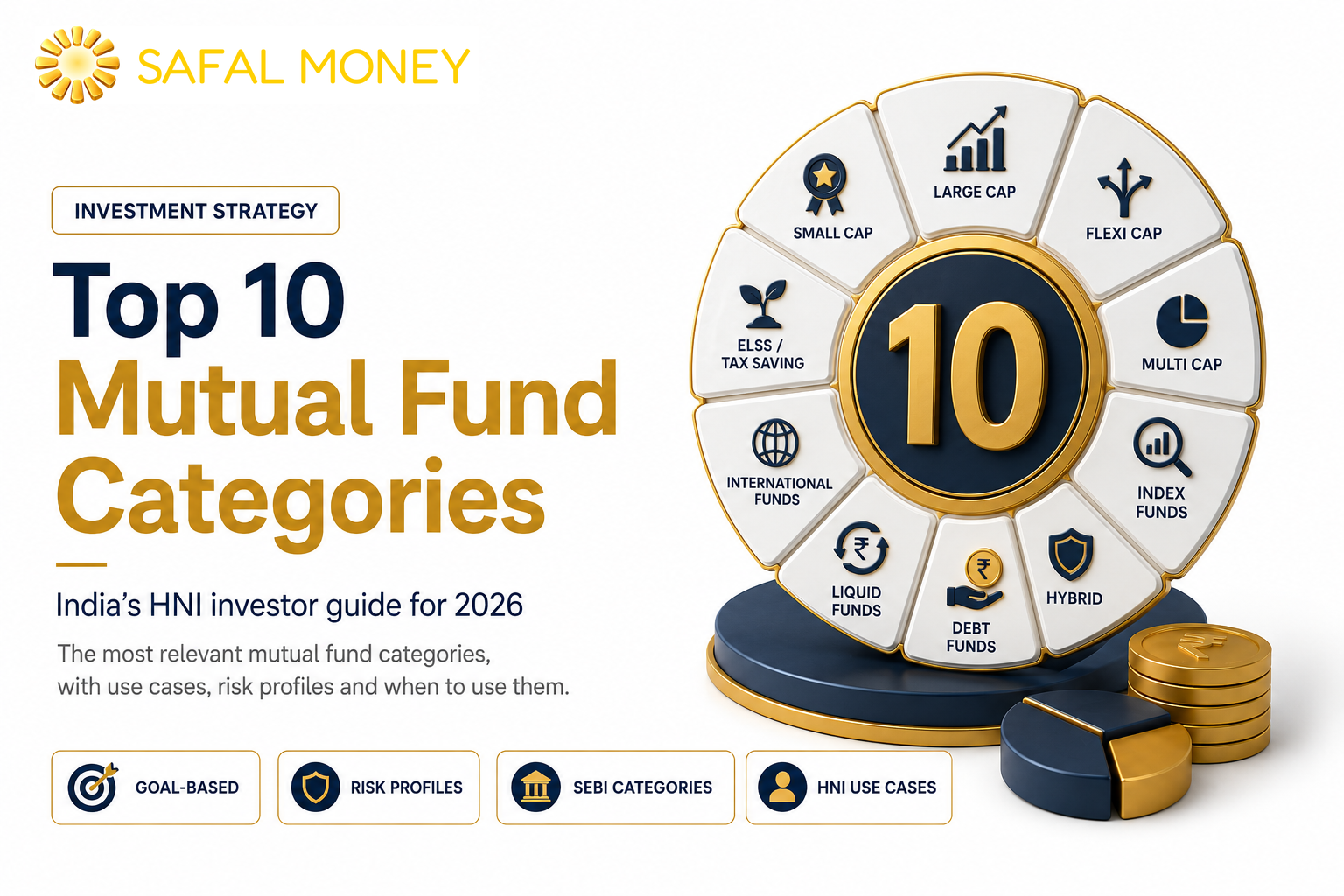
Most investors pick mutual funds the wrong way. They search for the "best mutual fund," find a list of top performers, pick the one with the highest return, and invest. Six months later they are disappointed — either because the fund has corrected, because they did not understand what they were investing in, or because the fund's mandate did not match what they actually needed.
The correct starting point is not "which fund?" It is "which category?" SEBI's mutual fund categorisation framework — introduced in 2017 and refined since — ensures that every fund within a category follows the same mandate. Once you know which category fits your goal, finding a good fund within that category becomes a much simpler exercise. This guide maps every major SEBI mutual fund category to a specific investor goal, time horizon, and risk profile.
How Does SEBI Organise India's Mutual Fund Universe? The 5 Buckets
SEBI has classified mutual funds into five broad buckets:
- Equity Schemes — invest primarily in stocks. Designed for long-term wealth creation. Higher risk, higher potential return. Sub-categories include large cap, mid cap, small cap, flexi cap, multi cap, ELSS, sectoral, and thematic.
- Debt Schemes — invest in fixed income instruments. Designed for capital preservation, income generation, and short-to-medium term parking. Sub-categories include liquid, overnight, short duration, corporate bond, gilt, and dynamic bond.
- Hybrid Schemes — invest in a combination of equity and debt. Designed for moderate risk-takers who want one-fund solutions or smoother equity exposure. Sub-categories include aggressive hybrid, balanced advantage, arbitrage, and conservative hybrid.
- Solution-Oriented Schemes — designed for specific life goals like retirement or children's education. Come with lock-in periods.
- Other Schemes — index funds, ETFs, fund of funds, and international funds.
Understanding which bucket your goal belongs to is step 1. Choosing the right sub-category within that bucket is step 2. Choosing a specific fund is step 3 — and it is the last step, not the first.
Goal 1: Build Long-Term Wealth Over 10+ Years
Best category: Flexi Cap Fund or Multi Cap Fund
If your goal is simply to build as much wealth as possible over a 10-year-plus horizon without worrying too much about which market cap segment does best, flexi cap and multi cap funds are the most appropriate starting points.
A flexi cap fund gives the fund manager complete freedom to move across large, mid, and small cap stocks in any proportion. When large caps are expensive, the manager can tilt toward mid caps. When small caps are in a correction, the manager can rotate to safety. This flexibility is valuable over long cycles.
A multi cap fund is the more structured version — SEBI mandates at least 25% each in large, mid, and small cap stocks. This removes the manager's ability to go completely defensive, but it also ensures you always have meaningful small cap exposure, which is where significant long-term alpha has historically been generated in India.
Who should use this: Investors aged 25–45 with a 10+ year horizon, high savings rate, and the ability to stay invested through corrections without panic.
Who should NOT use this: Anyone who needs the money in under 7 years, or who cannot psychologically handle watching their portfolio fall 30–40% in a sharp correction.
Goal 2: Save Tax Under Section 80C While Building Wealth
Best category: ELSS (Equity Linked Savings Scheme)
ELSS is the only mutual fund category that qualifies for tax deduction under Section 80C of the Income Tax Act — up to ₹1.5 lakh per financial year. For an investor in the 30% tax bracket, this translates to a tax saving of up to roughly ₹46,800 per year (including cess).
What makes ELSS compelling versus other 80C options like PPF and NSC is the combination of equity exposure and the shortest lock-in period among all 80C instruments — just 3 years per SIP instalment, compared to 15 years for PPF.
The 3-year lock-in is actually a behavioural advantage. Investors cannot panic-sell during a correction — they are forced to stay invested, which is often exactly what they should do anyway.
The honest caveat: ELSS invests in equity, which means the value of your investment can go down in the short term. If your primary concern is capital safety and guaranteed returns, PPF is more appropriate for that portion of your 80C allocation. But if you have a 5+ year horizon and want the best combination of tax benefit and long-term return potential, ELSS is the most efficient 80C vehicle available.
Who should use this: Salaried and self-employed investors with remaining 80C capacity, 5+ year horizon, and moderate-to-high risk tolerance.
Who should NOT use this: Investors who will need their money back in under 3 years or who need capital guarantees on their 80C investment.
Goal 3: Invest Passively and Beat Most Active Fund Managers
Best category: Index Fund (Nifty 50, Nifty Next 50, or Nifty 500)
The case for index funds in India has grown significantly stronger in recent years. Multiple SPIVA India studies have consistently shown that the majority of actively managed large cap funds underperform their benchmark over 5 and 10-year periods, after adjusting for expense ratios.
The reason is straightforward: the large cap universe in India is heavily researched by hundreds of analysts. It is difficult for any individual fund manager to have a consistent informational edge over the market in this segment. When you add the expense ratio of 1–1.5% for an active large cap fund, the hurdle to outperform becomes even higher.
Index funds — particularly Nifty 50 index funds — charge as little as 0.1% expense ratio in direct plans. Over 20 years, this cost difference alone compounds into meaningful additional wealth.
The right combination: a Nifty 50 index fund for the core large cap exposure, a Nifty Next 50 index fund for the next tier, and an actively managed flexi cap or mid cap fund for the satellite portion where active management has a better chance of adding value.
Who should use this: Investors who want to keep portfolio management simple, minimise costs, and are comfortable with market-matching returns in the large cap segment.
Who should NOT use this: Investors who want to outperform the market meaningfully — though the evidence suggests that most active fund managers struggle to do this consistently over the long term in the large cap space.
Goal 4: Participate in India's Growth Story at Mid and Small Cap Level
Best category: Mid Cap Fund or Small Cap Fund
India's growth story is disproportionately driven by companies in the mid and small cap segment — businesses that are growing fast, taking market share, and in many cases, graduating from mid cap to large cap over the next decade. Investing in this segment early is how many of India's most successful long-term investors have built wealth.
Mid cap funds invest at least 65% in companies ranked 101–250 by market capitalisation — India's fastest-growing established businesses. These companies typically have proven business models but significant growth runway ahead. Mid cap funds have historically delivered higher returns than large cap funds over long periods — at the cost of higher volatility.
Small cap funds invest at least 65% in companies ranked 251 and beyond. The potential here is the highest in the equity universe — but so is the risk. Small cap stocks can fall 50–60% in a sharp correction and take 3–4 years to recover. AUM size matters enormously in this category — large AUM limits the fund manager's ability to invest meaningfully in small companies.
Position Sizing Matters
Mid cap should never be more than 25–30% of your equity allocation. Small cap should not exceed 10–15%. These are satellite positions within a larger, diversified equity portfolio — not the core.
Who should use this: Investors with a 7–10+ year horizon, genuine high risk tolerance, and the discipline to not check their portfolio every week.
Who should NOT use this: Investors approaching retirement, those with a horizon below 5 years, or those who cannot emotionally absorb watching a significant portion of their portfolio decline sharply.
Goal 5: Get Equity Exposure With a Built-In Cushion
Best category: Aggressive Hybrid Fund
Aggressive hybrid funds maintain 65–80% in equity and 20–35% in debt. The debt component serves as a natural cushion — when equity markets fall sharply, the debt portion moderates the overall portfolio decline, and the fund manager can rebalance by selling debt and buying equity at lower prices.
This rebalancing advantage — systematically buying more equity when markets are lower — is a genuine structural benefit that most investors cannot replicate through their own behaviour. Most investors do the opposite: they buy more equity when markets are high and sell when they are low.
For investors who want a single-fund equity-heavy portfolio without the full volatility of pure equity funds, aggressive hybrid is one of the most sensible choices available.
Returns expectation: Aggressive hybrid funds will typically underperform pure equity funds in strong bull markets, because 20–35% of the portfolio is always in debt. But they will typically outperform in falling markets. Over a full cycle, the risk-adjusted returns are often competitive with pure equity funds.
Who should use this: First-time equity investors, moderate-risk investors, investors who prefer a simpler portfolio with automatic rebalancing built in, 5+ year horizon.
Who should NOT use this: Aggressive investors who want maximum equity exposure and can handle the full volatility of pure equity funds.
Goal 6: Let a Professional Manage Your Asset Allocation
Best category: Balanced Advantage Fund (Dynamic Asset Allocation)
Balanced Advantage Funds — also called Dynamic Asset Allocation Funds — give the fund manager complete freedom to move between equity and debt from 0% to 100% in either direction, based on a proprietary valuation model. When equity is expensive (high PE, high PB), the fund reduces equity and increases debt. When equity is cheap, it moves aggressively into equity.
This is the fund manager doing what most individual investors know they should do but cannot execute due to behavioural biases — systematically selling expensive assets and buying cheap ones.
The quality of a BAF depends entirely on the quality of its valuation model. Different AMCs use different models — PE-based, PB-based, or proprietary combinations. Before investing, understand the model the fund uses and how it has performed across at least two market cycles.
Important reality check: In a sustained bull market, BAFs can lag pure equity funds significantly because their model will often reduce equity exposure before the bull run ends. Investors who expect a BAF to match equity fund returns in good times will be disappointed. The fund is designed to deliver smoother, lower-volatility returns — not maximum returns.
Who should use this: Conservative-to-moderate investors, investors who want professional asset allocation management, those approaching or in retirement, 3–5+ year horizon.
Who should NOT use this: Aggressive investors who want maximum market participation, or those with a horizon below 3 years.
Goal 7: Park Short-Term Money Tax-Efficiently
Best category: Arbitrage Fund
Arbitrage funds exploit the price difference between a stock in the cash market and the same stock in the futures market — buying in one and simultaneously selling in the other to lock in a risk-free spread. Because they maintain over 65% in equity (through these positions), they are taxed as equity funds.
This creates a significant tax advantage for investors in the 30%+ bracket. Returns from arbitrage funds are typically 6.5–7.5% before tax — similar to liquid funds. But after tax, the advantage for high-bracket investors is substantial:
On ₹50 lakh parked for 12 months at a 7% return:
- Liquid fund (taxed at the income tax slab rate of 30%): post-tax return approximately 4.9%
- Arbitrage fund (taxed at LTCG 12.5% after 12 months): post-tax return approximately 6.1%
On ₹50 lakh, this difference is approximately ₹60,000 in additional post-tax wealth — purely from choosing the right parking vehicle.
Who should use this: HNI investors in the 30% tax bracket parking money for 3–12 months, investors waiting to deploy into equity or SIF, those wanting a liquid fund alternative with better post-tax returns.
Who should NOT use this: Investors in lower tax brackets where the advantage narrows, or those who need daily redemption certainty — arbitrage fund redemptions can occasionally take T+3 or longer.
Goal 8: Generate Income From Debt With Minimal Risk
Best category: Corporate Bond Fund or Banking and PSU Fund
For HNI investors who want their debt allocation to generate better returns than a savings account or FD — without taking significant credit risk — corporate bond funds and banking and PSU funds are the most appropriate choices.
Corporate bond funds invest at least 80% in the highest-rated corporate bonds (AAA and AA+). These offer a small yield premium over government securities — typically 30–80 basis points — because even highest-rated corporate bonds carry marginally more risk than sovereign debt. Over a 2–4 year horizon, this yield premium compounds meaningfully.
Banking and PSU funds invest at least 80% in bonds issued by banks and public sector undertakings — entities that are either government-owned or heavily regulated. Credit risk is minimal. These funds offer better yields than pure gilt funds while maintaining very high safety standards.
Both categories work best in a relatively stable interest rate environment. In a rate-rising environment, their NAVs can dip — but the moderate duration means the impact is limited and typically recovers within 6–12 months.
Who should use this: Investors with a 2–5 year horizon for the debt portion of their portfolio, those who want better returns than FD without meaningful credit risk, HNI investors building a debt ladder alongside their equity allocation.
Who should NOT use this: Investors who need their money within 6 months (use a liquid or overnight fund instead), or those seeking capital guarantees — debt funds are not capital-protected.
Goal 9: Add Global Diversification to an India-Heavy Portfolio
Best category: International Fund or Fund of Funds (Overseas)
Most Indian HNI investors have 95–100% of their investment portfolio in Indian assets. This creates a single-country concentration risk — if India faces a prolonged economic slowdown, a currency crisis, or a severe market correction, the entire portfolio is affected simultaneously.
International funds — investing in US equities, global ETFs, or emerging market baskets — add genuine geographic diversification. The US technology sector in particular contains companies with no direct Indian equivalent and represents the global leaders in artificial intelligence, cloud computing, and consumer technology.
Currency is both a risk and a benefit. When the rupee weakens against the dollar — which it has done historically at a rate of approximately 3–4% per year — international fund returns for Indian investors include this currency gain. When the rupee strengthens, returns are reduced.
Important regulatory note: SEBI has periodically imposed limits on overseas fund investments. Always check the current investment status of any international fund before investing — some funds have been closed to fresh investment when industry-wide overseas limits have been reached.
Who should use this: HNI investors with ₹1 crore+ portfolios who want to reduce India-concentration risk, 7+ year horizon, 5–10% satellite allocation within a larger diversified portfolio.
Who should NOT use this: Investors with small portfolios where the minimum investment makes the allocation meaningless, or those who are uncomfortable with currency risk.
Goal 10: Access Institutional-Grade Strategies Beyond the MF Universe
Best category: Specialised Investment Fund (SIF)
Every category above is long-only — the fund can only profit when the securities it holds go up in value. In flat markets, long-only funds deliver flat returns. In falling markets, they deliver losses. There is no mechanism within the traditional mutual fund framework to hedge, to profit from falling stocks, or to generate returns that are meaningfully independent of market direction.
SIF — SEBI's Specialised Investment Fund category, introduced in 2024, adds this capability. Through a long-short structure using equity derivatives, SIF fund managers can simultaneously hold long positions in stocks expected to rise and short positions in stocks expected to fall. This creates a return stream that is structurally different from every mutual fund category above.
SIF is not a replacement for mutual funds. It is the premium layer that sits above the traditional MF universe — appropriate for HNI investors with ₹10 lakh or more to invest, a minimum 3-year horizon, and the risk tolerance to understand and accept the additional complexity of long-short strategies.
To find out whether SIF belongs in your portfolio, use SafalZenith to calculate your SafalScore™ — India's first SIF allocation intelligence tool. To evaluate specific SIF funds, use SafalCheck™.
The Master Goal-to-Category Decision Table
| Your Goal | Time Horizon | Risk Level | Best MF Category |
|---|---|---|---|
| Long-term wealth creation | 10+ years | High | Flexi Cap / Multi Cap |
| Tax saving under 80C | 5+ years | Moderate-High | ELSS |
| Low-cost passive investing | 10+ years | Moderate | Nifty 50 Index Fund |
| India growth story | 7–10+ years | Very High | Mid Cap / Small Cap |
| Equity with cushion | 5+ years | Moderate | Aggressive Hybrid |
| Professional asset allocation | 3–5+ years | Moderate | Balanced Advantage |
| Tax-efficient short parking | 3–12 months | Low | Arbitrage Fund |
| Debt income, minimal risk | 2–5 years | Low-Moderate | Corporate Bond / Banking PSU |
| Global diversification | 7+ years | Moderate | International Fund |
| Institutional-grade alpha | 3+ years | High | SIF |
How Many Mutual Fund Categories Should You Hold?
This is one of the most common portfolio questions — and the answer surprises most investors: fewer than you think.
A well-constructed HNI portfolio does not need 12–15 different mutual funds across every SEBI category. What it needs is:
- A core equity allocation — 2 to 3 funds maximum, across index, flexi cap or multi cap, and possibly a mid cap fund for those with the right horizon.
- A debt allocation — 1 to 2 funds, matched to your horizon and the current interest rate cycle.
- A tax-efficiency layer — an ELSS if you have remaining 80C capacity, an arbitrage fund for short-term parking.
- A diversification layer — optionally an international fund and a balanced advantage or aggressive hybrid.
- A SIF allocation — if your corpus and profile are right, the alternative strategy layer.
More funds create the illusion of diversification without the substance. A portfolio with 15 funds is almost certainly holding overlapping positions across multiple funds — paying multiple expense ratios for exposure you could achieve with 4 or 5 well-chosen funds.
Use SafalZenith to model your ideal allocation across these categories, and browse the Knowledge Hub for deeper reviews of each category.
Free tool, no login required
Frequently Asked Questions
What are the top mutual fund categories in India in 2026?
The top mutual fund categories for Indian investors in 2026, based on SEBI's classification framework, include Flexi Cap and Multi Cap funds for long-term wealth creation, ELSS for tax saving under Section 80C, Nifty 50 Index Funds for low-cost passive investing, Mid Cap funds for growth-oriented investors with 7+ year horizons, Balanced Advantage Funds for dynamic asset allocation, Arbitrage Funds for tax-efficient short-term parking, Corporate Bond and Banking PSU Funds for conservative debt allocation, and International Funds for geographic diversification. Specialised Investment Funds (SIF) sit above the traditional MF universe for HNI investors seeking long-short strategies.
Which mutual fund category is best for long-term wealth in India?
For long-term wealth creation (10+ years), Flexi Cap and Multi Cap funds have historically delivered strong returns by investing across large, mid, and small cap stocks. Mid Cap funds have also delivered compelling long-term returns for investors with genuine 7-10 year horizons and high risk tolerance. For investors who prefer passive investing, Nifty 50 and Nifty Next 50 index funds offer market-matching returns at very low cost. The best category depends on your specific risk tolerance, horizon, and whether you prefer active or passive management.
Which MF is best for tax saving under 80C?
ELSS (Equity Linked Savings Scheme) is the best mutual fund option under Section 80C. It offers a tax deduction of up to Rs 1.5 lakh per year, invests in equity for long-term growth potential, and has the shortest lock-in period among all 80C instruments - just 3 years per SIP instalment. For investors in the 30% tax bracket, the annual tax saving can be up to approximately Rs 46,800. ELSS should be evaluated like any other equity fund - on rolling returns, Sharpe ratio, and fund manager track record - not chosen purely for the tax benefit.
What is a Balanced Advantage Fund?
A Balanced Advantage Fund (also called a Dynamic Asset Allocation Fund) can freely move its allocation between equity and debt - from 0% to 100% in either direction - based on a proprietary valuation model. When equity markets are expensive, the fund reduces equity and increases debt. When equity is cheap, it increases equity. This dynamic allocation is designed to deliver smoother, lower-volatility returns than pure equity funds. BAFs are suitable for moderate investors with a 3-5+ year horizon who want professional asset allocation management rather than managing it themselves.
Where does SIF fit in the mutual fund category framework?
SIF - Specialised Investment Fund - is a SEBI-regulated investment vehicle that sits above the traditional mutual fund universe. Unlike all conventional mutual fund categories, which are long-only, SIF allows fund managers to take short positions via equity derivatives alongside long positions. This creates a return stream that is less correlated to overall market direction, potentially generating returns in flat or falling markets where long-only funds struggle. SIF is appropriate for HNI investors with Rs 10 lakh or more, minimum 3-year horizon, and high risk tolerance. It is not a replacement for mutual funds but a complementary layer that adds long-short strategy capability to a diversified portfolio.
Last updated: 6 July 2026