The Macro Trinity in 2026: How Oil, Inflation and Interest Rates Connect for Indian Investors
Oil, inflation, and interest rates form India's macro trinity - understand how these three forces interact in 2026 and how to position your MF and SIF portfolio for each scenario.
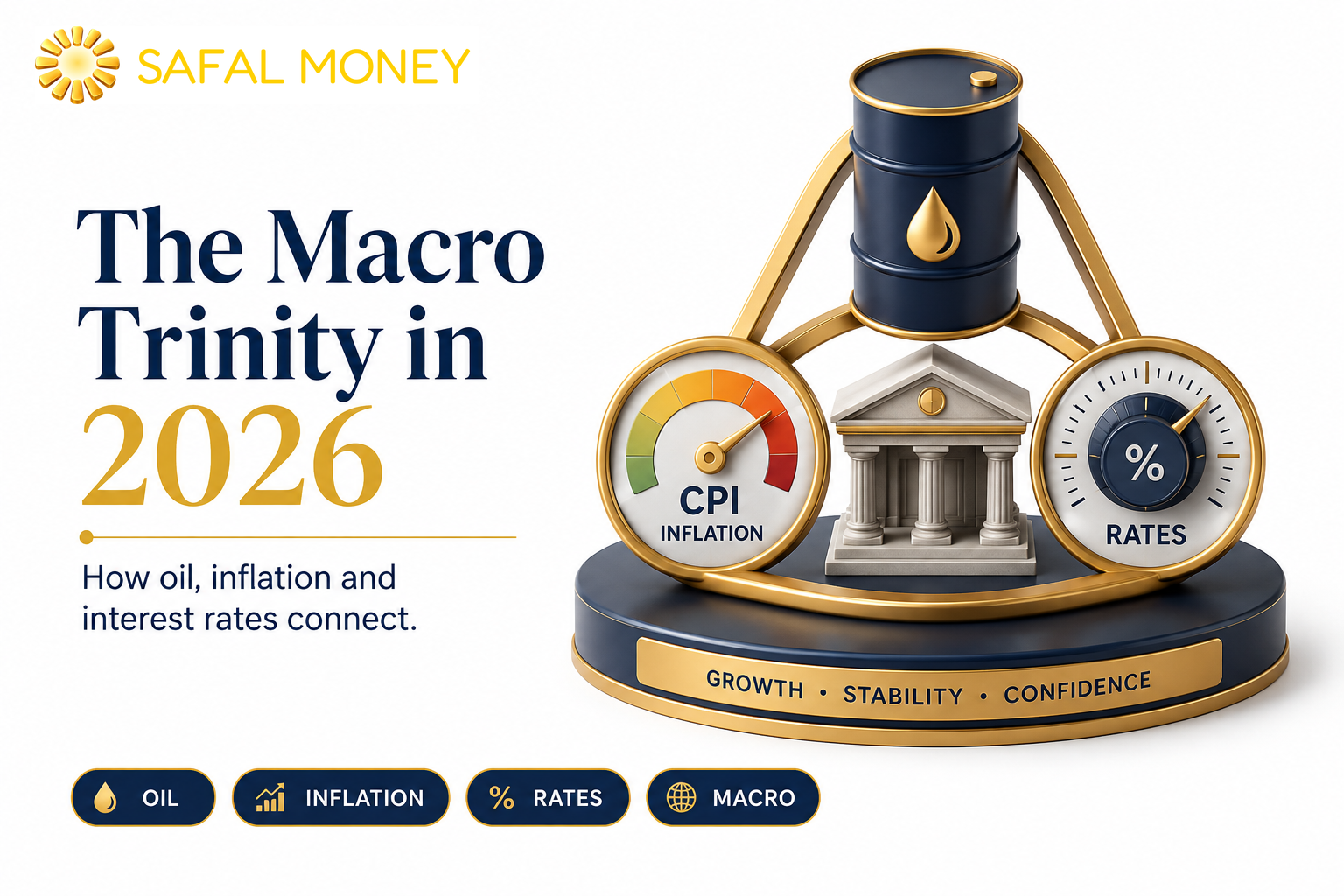
India's economy runs on three macro variables above all others: oil prices, inflation, and interest rates. These three forces do not operate independently - they form a connected system where a shift in one triggers predictable ripple effects through the other two, and ultimately through every asset class in your portfolio.
Most investors track these variables in isolation. They read that oil prices fell, note that the RBI cut rates, observe that inflation is at a certain level - but fail to connect the chain of causation that links all three into a coherent picture of where markets are heading and how portfolios should be positioned.
This article builds that picture for 2026 - explaining the mechanics of the macro trinity, how the three forces interact in India's specific economic context, and what the current configuration means for your mutual fund and SIF allocation.
Why Oil, Inflation, and Interest Rates Form India's Macro Trinity
India imports approximately 85% of its crude oil requirements. This single fact makes oil the most powerful external variable in India's macro equation - more impactful than any other global commodity, more consequential than most geopolitical developments, and more directly connected to the daily lives of Indian citizens than virtually any policy decision.
The chain of causation is direct and well-established:
Oil price → Inflation: India's fuel prices - petrol, diesel, LPG, aviation turbine fuel - are directly linked to global crude prices. When oil rises, transport costs rise, which raises the cost of moving every good across India. Food prices rise because agricultural inputs (fertiliser, diesel for tractors and irrigation pumps) become more expensive. Manufactured goods prices rise because energy is an input to every production process. The cumulative effect: oil price increases translate into broad-based inflation across the Indian economy within 2–4 months.
Inflation → Interest rates: The Reserve Bank of India's primary mandate is inflation control, targeted at 4% CPI with a ±2% band. When inflation rises above the upper tolerance of 6%, the RBI raises the repo rate to cool demand and reduce price pressures. When inflation falls below 4% - particularly when driven by falling oil prices - the RBI has room to cut rates to stimulate growth.
Interest rates → Asset prices: Lower interest rates reduce the cost of borrowing for businesses and consumers, stimulating economic activity. They also make fixed income instruments less attractive relative to equity - pushing capital toward equity markets. Bond prices rise when rates fall (duration benefit). Real estate borrowing costs fall. The entire asset price complex responds to the interest rate level.
The complete chain: Oil → Inflation → Interest Rates → Asset Prices → Your Portfolio.
Understanding this chain - not as separate observations but as a single connected system - is what separates macro-aware investors from those who react to each development in isolation.
The Oil Price Transmission Mechanism in India
India's relationship with oil is unique among major economies because of the degree to which domestic fuel prices are administered rather than purely market-determined. The government periodically revises petrol and diesel prices through oil marketing companies - creating a partial buffer between global oil price movements and domestic inflation.
This administered pricing creates an important nuance for investors: the inflation impact of oil price changes in India is not immediate or linear. A sharp spike in Brent crude from $70 to $90 per barrel may not immediately raise petrol prices in India if the government chooses to absorb the difference through reduced excise duty or OMC margin compression. Conversely, a sustained high oil price environment eventually forces the government's hand.
The fiscal dimension: When global oil is expensive and the government holds domestic fuel prices artificially low, the fiscal deficit widens - either through direct subsidy expenditure or through reduced dividend receipts from OMCs. This has secondary consequences: government borrowing rises, bond yields come under pressure, and the RBI's ability to cut rates may be constrained even when inflation appears manageable.
The current 2026 oil context: The Iran-US deal normalisation and OPEC+ production adjustments in early 2026 have contributed to a Brent crude price range of approximately $68–$78 per barrel - meaningfully below the $85–$95 range that characterised much of 2023–2024. This lower oil price environment is a significant positive for India's macro equation, reducing the inflation pressure that previously constrained RBI rate cuts.
Inflation in India 2026: The Components That Matter for Investors
India's CPI (Consumer Price Index) inflation has two distinct components that behave very differently - and investors must track both separately.
Food inflation accounts for approximately 46% of India's CPI basket. It is driven primarily by domestic agricultural conditions - monsoon quality, crop output, supply chain efficiency, and seasonal patterns. Food inflation is largely independent of global oil prices (though oil affects agricultural input costs at the margin). The 2026 monsoon outlook is a critical variable for food inflation in the second half of the year - a normal monsoon supports lower food prices; a deficient monsoon creates upward pressure.
Core inflation (CPI excluding food and fuel) is where the oil transmission mechanism primarily operates. Higher oil raises transport and logistics costs, which feed into core goods inflation. In 2026, core inflation has remained relatively contained - benefiting from lower oil prices, RBI's inflation-targeting credibility built over the 2022–2024 tightening cycle, and moderating global goods price pressures.
The investor implication: when food inflation is elevated but core inflation is low, the RBI faces a difficult decision - the food inflation component may be supply-side driven (not responsive to rate changes) while core conditions would support a cut. Investors should track core inflation separately from headline CPI when assessing RBI rate trajectory. A headline CPI number driven by food alone does not necessarily delay rate cuts.
Current 2026 inflation picture: CPI has moderated toward the 4–4.5% range in mid-2026, supported by lower oil, a satisfactory 2025 monsoon carryover effect on food prices, and disciplined fiscal policy. This is the most supportive inflation environment for rate cuts since 2019 - and the RBI has begun to act accordingly.
The RBI Rate Cycle in 2026: Where We Are and Where We Are Going
India's interest rate cycle is the most directly actionable macro variable for mutual fund and SIF investors. Understanding where the RBI is in the cycle - and where it is likely to go - determines which asset classes and fund categories should be overweighted.
The cycle context: the RBI began its tightening cycle in May 2022 in response to post-COVID inflation and rupee pressure. The repo rate peaked and was held at elevated levels through much of 2024. With inflation moderating and growth risks becoming more salient in 2025, the RBI shifted to a cautious easing stance. In 2026, the easing cycle is underway - with rate cuts having been delivered and further cuts likely depending on oil and monsoon outcomes.
The three-phase rate cycle framework for investors:
Phase 1 - Peak rates (Hold/No change): Short-duration debt funds and liquid funds are optimal. Long-duration funds are risky - further rate increases would cause NAV losses. This phase is now behind us.
Phase 2 - Early easing (First 2–3 cuts): The current phase in mid-2026. Dynamic bond funds and gilt funds begin to outperform as rates fall and bond prices rise. Equity markets typically rally as the rate cut cycle begins - financial sector benefits from lower cost of funds, consumption stocks benefit from lower EMI burden, capex-sensitive sectors benefit from cheaper corporate borrowing.
Phase 3 - Late easing (Sustained low rates): Long-duration gilt funds deliver the highest total returns as rates reach their trough. Equity valuations expand (lower discount rates justify higher P/E multiples). Credit funds see improving asset quality as borrower repayment pressure reduces.
Where we are in mid-2026: firmly in Phase 2. The appropriate portfolio positioning is dynamic bond funds and medium-to-long duration debt for the fixed income allocation, with a tilt toward rate-sensitive equity sectors in the equity portfolio.
How the Macro Trinity Connects to Equity Sector Performance
The oil-inflation-interest rate chain has different implications for different equity sectors - and understanding these sector effects helps HNI investors evaluate their mutual fund category exposures.
Sectors that benefit from lower oil:
- Aviation: Jet fuel (ATF) is the largest operating cost for Indian airlines. Lower oil directly expands airline margins and can support fare reductions that increase passenger volumes. Mutual funds with aviation sector exposure benefit from an oil tailfall.
- Paint companies: Crude derivatives are key raw materials for paints. Asian Paints, Berger, and Kansai Nerolac see margin expansion when oil falls. Many large cap and flexi cap funds hold these names.
- Tyre companies: Synthetic rubber - an oil derivative - is the primary raw material. MRF, Apollo Tyres, and CEAT benefit from falling oil through input cost reduction.
- FMCG: Packaging materials and many product inputs are petroleum-derived. Lower oil reduces FMCG input costs, supporting margin expansion across large FMCG names widely held in Indian equity funds.
- OMCs (Oil Marketing Companies): Counter-intuitively, lower oil can benefit OMCs when the government allows retail prices to follow crude downward - improving marketing margins. However, this is government policy-dependent.
Sectors that benefit from lower interest rates:
- Banking and NBFCs: Lower rates reduce the cost of funds for banks, improving net interest margins. Lower rates also improve borrower repayment capacity, reducing NPAs. Financial sector is typically the largest single sector in most Indian large cap and flexi cap funds.
- Real estate: Lower home loan rates stimulate housing demand. Real estate companies and housing finance companies directly benefit.
- Capital goods and infrastructure: Lower borrowing costs for project finance and corporate capex stimulate order flows for capital goods companies - L&T, Siemens, ABB.
- Consumer discretionary: Lower EMIs stimulate purchases of cars, consumer durables, and other big-ticket items financed through credit.
Sectors relatively insulated from the macro trinity:
- IT services: Revenue is dollar-denominated and growth is driven by global tech spending, not domestic oil and rates. Useful portfolio diversifier precisely because of this independence.
- Healthcare and pharma: Demand is relatively inelastic. Portfolio anchor during macro uncertainty.
Portfolio Positioning for the 2026 Macro Trinity Configuration
The current 2026 macro trinity configuration - moderate oil, declining inflation, early easing rate cycle - creates a specific optimal portfolio positioning.
Equity allocation - tilt toward rate-sensitive and oil-sensitive beneficiaries:
Within your equity mutual fund allocation, funds with higher exposure to financials, consumer discretionary, paints, tyres, and FMCG are well-positioned in the current environment. Large cap and flexi cap funds - which typically hold significant financial sector weights - benefit from the rate cut tailwind.
Avoid over-concentration in upstream oil and gas (ONGC, Oil India) which face revenue pressure from lower oil prices, and export-oriented sectors that may face demand headwinds from global growth uncertainty.
Debt allocation - extend duration:
The rate cut cycle is the signal to extend duration in the debt portfolio. Dynamic bond funds and medium-to-long duration funds outperform in falling rate environments. Gilt funds - zero credit risk, high duration - are the most direct beneficiary of rate cuts.
Reduce liquid fund and overnight fund allocation to the minimum required for liquidity needs - these short-duration instruments see the least benefit from rate cuts and may even see yield compression that reduces returns.
SIF allocation - long-short opportunity from sector divergence:
The macro trinity creates clear sector divergence - winners (financials, consumption, paints, tyres) and losers (upstream oil, rate-insensitive defensives in an equity market rally). SIF Equity Long-Short fund managers who correctly identify this divergence can construct portfolios that simultaneously benefit from the winners rising and the losers underperforming.
This is one of the cleanest long-short opportunity sets the Indian market has seen in several years - and it is driven by macro fundamentals, not short-term sentiment, making it more durable for the multi-quarter SIF position horizon.
The Four Macro Scenarios and Portfolio Response
Because we cannot know with certainty how oil, inflation, and rates will evolve, disciplined investors prepare for multiple scenarios rather than betting on a single outcome.
Scenario 1 - Soft landing (Base case, 50% probability): Oil stays in the $65–$80 range, inflation remains at 4–4.5%, RBI delivers 2–3 more rate cuts in 2026–2027. Equity markets grind higher driven by earnings growth and modest multiple expansion. Debt markets deliver 8–9% returns from duration. SIF long-short generates alpha from sector divergence.
Portfolio response: current positioning is optimal. Maintain equity allocation, hold dynamic bond funds and gilts in debt, keep SIF allocation per SafalScore™.
Scenario 2 - Oil spike (20% probability): A geopolitical event (Middle East escalation, supply disruption) drives Brent crude above $95. Indian inflation re-accelerates above 6%. RBI pauses or reverses rate cuts. Equity markets correct - especially rate-sensitive sectors. Rupee weakens.
Portfolio response: reduce duration in debt (shift from gilt to short-duration). Oil sector MF benefits marginally. Aviation and FMCG hurt. SIF short book on oil-sensitive consumer stocks partially protects. Gold ETF hedge becomes active.
Scenario 3 - Global recession (15% probability): Global growth weakens significantly, dragging commodity prices (including oil) sharply lower. Deflation risk rather than inflation. RBI cuts aggressively. Equity markets volatile but eventually supported by very low rates.
Portfolio response: long duration debt outperforms dramatically. Defensive equity (healthcare, FMCG, IT) outperforms cyclicals. SIF provides partial portfolio protection through short cyclical positions.
Scenario 4 - India stagflation (15% probability): Domestic supply shocks (failed monsoon, structural food inflation) push CPI above 6% despite weak growth. RBI cannot cut rates. Equity earnings disappoint. Bonds underperform.
Portfolio response: gold ETF is the primary beneficiary. Reduce equity allocation toward lower end of target band. Agricultural input companies (fertiliser, agrochemicals) benefit. SIF defensive positioning protects.
The correct response to scenario uncertainty is not to bet on one outcome - it is to build a portfolio that performs adequately across all scenarios rather than maximising performance in just one. Diversification across equity, debt, SIF, and gold achieves this resilience.
Frequently Asked Questions
How do oil prices affect Indian mutual funds?
Oil prices affect Indian mutual funds through multiple channels. Lower oil reduces input costs for paint, tyre, FMCG, and aviation companies - benefiting large cap and flexi cap funds holding these sectors. Lower oil reduces India's import bill, improving the current account deficit and supporting the rupee. Lower oil lowers inflation, giving the RBI room to cut rates - which benefits both debt funds (duration gains) and equity funds (lower discount rate, higher valuations). The net effect of lower oil on a diversified Indian equity mutual fund portfolio is typically positive.
What happens to debt mutual funds when RBI cuts rates?
When the RBI cuts the repo rate, bond prices rise - because existing bonds paying higher coupon rates become more valuable relative to new bonds issued at lower rates. The price increase is proportional to the bond's duration - longer duration bonds rise more. Gilt funds (long duration, government securities) benefit the most from rate cuts, followed by dynamic bond funds and medium duration funds. Short-duration funds and liquid funds benefit least. The current RBI easing cycle in 2026 is supportive for long-duration debt fund allocations.
Should I change my mutual fund portfolio based on oil price movements?
Not reactively - oil prices are volatile and short-term movements are difficult to predict. The right approach is to ensure your portfolio is appropriately positioned for the broad oil environment rather than trading around individual price moves. In a structurally lower oil environment (as in mid-2026), a modest tilt toward oil-sensitive consumer and industrial sectors is reasonable. Avoid making large tactical sector bets based on short-term oil moves - maintain diversification as the primary risk management tool.
How does inflation affect SIF Equity Long-Short funds?
Inflation affects SIF long-short funds through its impact on sector performance divergence. High inflation hurts consumption-oriented businesses (margins compress as input costs rise faster than pricing) and creates winners (commodity producers) and losers (high-input-cost manufacturers) within the equity universe. A skilled SIF long-short manager can exploit this divergence - going long commodity beneficiaries and short margin-compressed businesses. Falling inflation, as in 2026, creates a different set of winners and losers that the long-short strategy can similarly exploit.
What is the best mutual fund category when oil is low and rates are falling?
In a low oil, falling rate environment - the current 2026 configuration - the best performing mutual fund categories historically have been: gilt funds and dynamic bond funds (direct duration beneficiaries of rate cuts), banking and financial sector funds (lower cost of funds, improving credit quality), consumption-oriented funds (lower input costs, improved consumer spending power from lower EMIs), and balanced advantage funds (automatically tilt toward equity as rate cuts support equity valuations). A diversified portfolio across these categories captures the macro tailwind without concentration risk.
Last updated: 27 July 2026