SIF Redemption Guide: Fortnightly Windows, T+3 Payout and Everything You Need to Know
Complete guide to SIF redemption in India - how fortnightly windows work, T+3 settlement, exit loads, partial redemption, emergency access, and smart redemption planning for HNI investors.
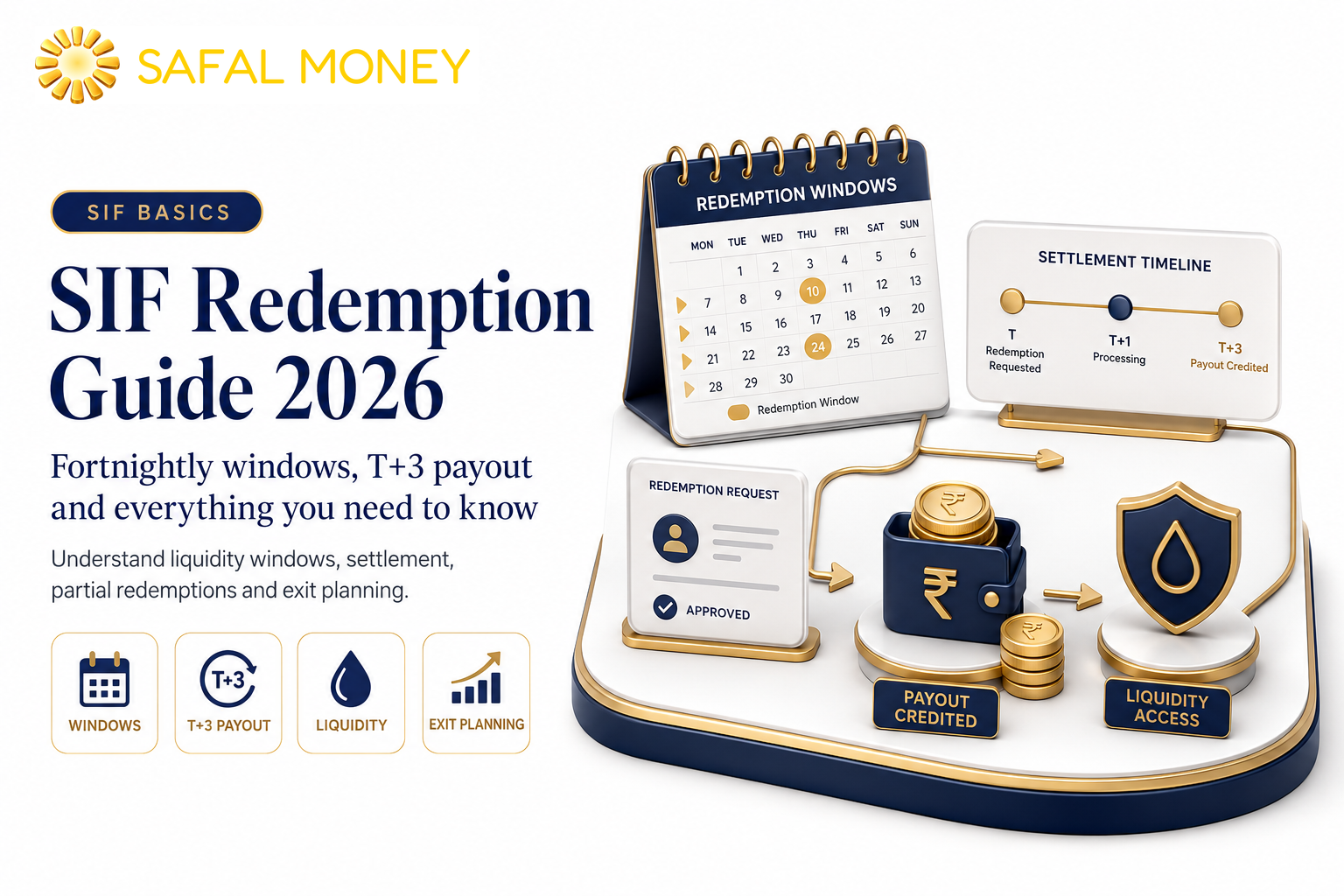
When investors first learn about Specialised Investment Funds, one question consistently comes up before almost any other: "How do I get my money out when I need it?"
It is exactly the right question to ask before investing. SIF's redemption mechanism is fundamentally different from regular mutual funds — and misunderstanding it can create genuine problems if you need money urgently and do not know how the fortnightly window works.
This guide covers everything about SIF redemption — how fortnightly windows work, what T+3 settlement means in practice, how exit loads are applied, what happens when you miss a window, partial redemption mechanics, and how to plan your SIF redemption intelligently so that the fortnightly structure never becomes a problem.
Why SIF Has Fortnightly Redemption Instead of Daily
Before the mechanics, it helps to understand why SEBI designed SIF with fortnightly rather than daily redemption.
Conventional mutual funds offer daily redemption because their portfolios are liquid — equity mutual funds hold large-cap and mid-cap stocks that can be sold in the market on any trading day without significantly affecting the price. The fund can always convert holdings to cash to meet daily redemptions.
SIF's long-short strategy creates a different liquidity profile. The short book — derivatives positions that may have monthly expiry dates — cannot always be unwound instantaneously without cost. Individual stock shorts may have limited derivatives liquidity on any given day. Portfolio managers need time to exit positions in an orderly manner that does not disadvantage remaining unitholders.
Fortnightly redemption solves this by batching redemption requests — all investors who want to redeem do so on the same date, allowing the fund manager to plan portfolio adjustments in advance rather than reacting to ad hoc daily redemption requests. This protects the interests of remaining investors who should not bear the cost of another investor's urgent redemption.
This is also why SEBI positions the category the way it does — SIF is explicitly designed as a 3-year-plus investment horizon instrument, and the fortnightly window is a structural signal that investors should not be treating SIF as a short-term parking vehicle.
How Fortnightly Windows Work: The Precise Mechanics
Each SIF fund has specific redemption dates — typically twice per calendar month, on predetermined dates that are published in the Investment Strategy Information Document (ISID) and on the AMC's website.
The typical fortnightly schedule: most SIF funds have redemption dates on two fixed days per month — for example, the 1st and 15th of each month, or the first and third Monday of the month. The specific dates vary by AMC and strategy. Always check your specific fund's redemption calendar.
The cut-off time: redemption requests must be submitted before a specific cut-off time on or before the redemption date to be processed in that cycle. The cut-off time is typically 3:00 PM IST on the redemption date — the same standard cut-off that applies to mutual fund transactions.
If you submit your redemption request at 4:00 PM on the redemption date, it will be processed in the next fortnight's window — not the current one.
What happens after you submit a request before the cut-off:
- Your units are redeemed at the NAV applicable on that redemption date
- The proceeds are credited to your registered bank account within T+3 business days
- T+3 means three business days after the redemption date — so a redemption on Monday is settled by Thursday (assuming no holidays)
A Practical Timeline Example
- Redemption date: Monday, July 28, 2026
- Cut-off time: 3:00 PM on July 28
- You submit request: 11:00 AM on July 28
- NAV applied: July 28, 2026 NAV
- Settlement: July 31, 2026 (T+3, assuming no holidays)
- Money in your account: July 31, 2026
What Happens if You Miss a Redemption Window?
This is the most important practical consideration for SIF investors — what happens when you need money between two redemption windows?
The answer is straightforward but requires planning: you wait for the next redemption window.
If the fund has redemption dates on the 1st and 15th of each month and you submit a redemption request on the 3rd, your request will be processed on the 15th — 12 days later. If you miss the 15th cut-off (submit after 3 PM on the 15th), you wait until the 1st of the following month.
The maximum wait between redemption windows is typically 14–16 calendar days. In an emergency, this waiting period can feel very long.
The Emergency Corpus Imperative
This is precisely why SafalMoney consistently emphasises that SIF should only be funded with money you genuinely do not need for 3+ years — and that your emergency corpus must be maintained separately in liquid funds before any SIF investment is made. Before investing a single rupee in SIF, ensure you have at least 6 months of living expenses in a liquid fund or overnight fund — accessible immediately at any time. This emergency buffer means you will almost never be in a position of needing to access your SIF investment urgently.
T+3 Settlement: What It Means and How to Plan Around It
T+3 means the redemption proceeds are credited to your bank account three business days after the redemption date (T).
In practice:
- T = Redemption date (when your units are redeemed at the applicable NAV)
- T+1 = First business day after redemption — funds are in transit
- T+2 = Second business day — processing continues
- T+3 = Third business day — funds credited to your bank account
Holidays affect T+3: if any of the three business days after your redemption date is a public holiday or bank holiday, the settlement extends accordingly. A redemption on Wednesday before a three-day long weekend would settle on the following Tuesday rather than the following Monday.
Planning around T+3 for large transactions: if you are planning to use SIF proceeds for a significant financial commitment — buying property, making a large investment, paying a large tax demand — factor in both the fortnightly window timing and the T+3 settlement. Start the redemption process at least 18–20 calendar days before you need the funds, to account for:
- Time to reach the next redemption window (up to 14 days)
- T+3 settlement (3 business days)
- Buffer for unexpected delays
Exit Loads: What You Pay to Redeem Early
Exit loads vary by SIF fund and are specified in each fund's ISID. Based on the SIF funds reviewed in this series, here is the range of exit load structures currently in use:
| Fund | Exit Load Structure |
|---|---|
| Edelweiss Altiva Hybrid Long-Short | 0.50% within 90 days; nil after |
| SBI Magnum Hybrid Long-Short | 0.50% within 90 days; nil after |
| Tata Titanium Equity Long-Short | 1% within 1 month; nil after |
| Tata Titanium Hybrid Long-Short | 1% within 365 days; nil after |
| 360 ONE DynaSIF Equity Long-Short | 0.50% within 3 months; nil after |
| ICICI Prudential iSIF Hybrid Long-Short | Not prominently disclosed — check ISID |
| Quant qSIF Equity Long-Short | 1% within 15 days; nil after |
| Mirae Platinum Hybrid Long-Short | 1% within 90 days; nil after |
| Bandhan Arudha Equity Long-Short | Check ISID at arudhasif.com |
Key observations:
- Most SIF funds have nil exit load after 90 days (3 months) — significantly shorter than many equity mutual funds which charge exit load for 1 year
- The Tata Titanium Hybrid's 1% within 365 days is the most restrictive — investors planning redemptions in the first year should factor this in
- Quant qSIF's 1% within only 15 days is investor-friendly — the window before exit load applies is very short
Worked Example: Calculating an Exit Load
Exit load is applied on the redemption amount. If you redeem ₹12 lakh from an Edelweiss Altiva SIF within 90 days of investment, the exit load is 0.50% of ₹12 lakh = ₹6,000. You receive ₹11,94,000 in your account (before tax).
The 10% exemption rule: several SIF funds — following the mutual fund convention — allow up to 10% of units to be redeemed without exit load even within the exit load period. This means if you have ₹20 lakh in a SIF fund, you can redeem ₹2 lakh (10%) without any exit load regardless of when you invested. Check the specific fund's ISID for this provision.
Partial Redemption: Can You Redeem Only a Portion?
Yes — SIF funds allow partial redemptions. You can redeem a specific rupee amount or a specific number of units without redeeming your entire holding.
When submitting a redemption request through the AMC portal or your distributor, specify either:
- A rupee amount (e.g., "Redeem ₹5,00,000")
- A number of units (e.g., "Redeem 500 units")
The remaining units continue to be invested and grow at the fund's NAV.
The minimum redemption amount: most SIF funds do not specify a minimum redemption amount for partial redemptions — but check your fund's ISID for any minimum specified. After partial redemption, the remaining investment must typically not fall below a minimum threshold (usually ₹10,000 or equivalent units).
Tax implications of partial redemption: each partial redemption is treated as a separate tax event. The capital gain is calculated as (Redemption amount − Cost of units redeemed). The applicable tax rate depends on whether the units being redeemed qualify as long-term (12 months+ for equity-oriented SIF) or short-term. The first-in-first-out (FIFO) method applies — units purchased earliest are deemed redeemed first.
SIP Redemption in SIF: Each Instalment Has Its Own Redemption Lock
For investors who have invested in SIF through SIPs (where available), each monthly SIP instalment has its own independent holding period for exit load and LTCG purposes.
This means:
- Your January 2026 SIP instalment may be eligible for nil exit load and LTCG treatment by January 2027 (after 12 months)
- Your June 2026 SIP instalment would not qualify for LTCG treatment until June 2027
When redeeming from a SIP-funded SIF investment, the FIFO method ensures earliest instalments are redeemed first — which typically means the oldest, most tax-efficient units are redeemed before newer, short-term units.
Switch Between SIF Strategies: Is It Possible?
A common question from investors who hold multiple SIF strategies within the same AMC platform: can I switch directly from one strategy to another without redeeming and reinvesting?
The answer depends on the AMC. Some SIF platforms allow switch transactions — moving units directly from one strategy to another within the same AMC platform — similar to switch transactions in regular mutual funds. Others require a redemption from the source strategy followed by a fresh purchase in the destination strategy.
Tax implications of a switch: whether processed as a switch or a redemption-and-purchase, the transaction is treated as a redemption from the source strategy for tax purposes — triggering capital gains tax if the units have appreciated. A switch does not avoid the capital gains tax event.
Always confirm with your AMC or SafalMoney advisor whether switch transactions are available within your specific SIF platform, and always check the tax implications before executing any switch.
How to Submit a SIF Redemption Request: Step by Step
Through the AMC's SIF portal (direct):
- Log in to the AMC's SIF platform (e.g., altivafunds.com for Edelweiss, arudhasif.com for Bandhan, 360.one/dyna-sif for 360 ONE)
- Navigate to "Redemption" or "Transactions" section
- Select the specific strategy from which you want to redeem
- Choose redemption type — full or partial (specify amount or units)
- Confirm bank account for proceeds (must be the registered account)
- Review and submit before the cut-off time on or before the redemption date
- Note your transaction reference number for tracking
Through SafalMoney: contact your SafalMoney relationship manager or submit through the SafalMoney platform. Your manager will coordinate the redemption request submission, confirm the applicable redemption window, and track settlement to ensure funds arrive in your account on T+3.
Smart Redemption Planning: 5 Principles for HNI Investors
Principle 1: Plan redemptions at least 20 calendar days in advance. Never assume you can access SIF funds immediately. Build a 20-day buffer (14 days to next window + T+3 settlement + holiday buffer) whenever you plan to use SIF proceeds for a specific purpose.
Principle 2: Use the LTCG threshold planning. For equity-oriented SIF held 12+ months, LTCG is taxed at 12.5% on gains above ₹1.25 lakh per financial year. Plan partial annual redemptions to utilise this exemption — redeeming ₹1.25 lakh of gains per year tax-free rather than a large single redemption.
Principle 3: Avoid redemption during market corrections if possible. The most common mistake SIF investors make is redeeming during a market correction when the short book should be working for them. If you redeem during a correction, you crystallise paper losses and miss the recovery. Plan redemptions in advance — during normal or rising markets — rather than reactively during corrections.
Principle 4: Keep emergency corpus completely separate from SIF. This cannot be emphasised enough. Your liquid fund emergency corpus (6 months of expenses) must be entirely separate from your SIF investment. If your emergency corpus is inadequate, add to it before adding to SIF — not the other way around.
Principle 5: Check exit load status before submitting. Before every redemption, check whether your units are within or beyond the exit load period. Waiting even a few additional days past the exit load threshold can save meaningful money on large SIF investments. On ₹25 lakh, a 0.50% exit load is ₹12,500 — worth waiting a week to avoid.
Free, 2 minutes
Frequently Asked Questions
How does SIF redemption work in India?
SIF redemption works through fortnightly windows - specific dates twice a month when the AMC processes all pending redemption requests. You submit your redemption request before the cut-off time (typically 3 PM) on or before the redemption date. Your units are redeemed at the NAV of the redemption date and proceeds are credited to your registered bank account within T+3 business days. If you miss the cut-off, your request is processed at the next fortnightly window - typically 10-14 days later.
When can I redeem my SIF investment?
You can submit a redemption request at any time - but it will only be processed at the next available fortnightly redemption window. Most SIF funds have two redemption dates per month. After the redemption is processed, your money arrives in your bank account within T+3 business days. Exit loads may apply if you redeem within the exit load period - typically 90 days to 1 year depending on the specific fund. After the exit load period, there is no cost to redeem.
What is the exit load on SIF funds?
Exit loads vary by fund. Most SIF funds charge 0.50-1.0% if redeemed within 90 days to 1 year of investment, and nil exit load thereafter. Some funds allow up to 10% of units to be redeemed without exit load even within the exit load period. Always check your specific fund's ISID for the exact exit load structure. Calculate the exit load before submitting a redemption request - waiting a few days past the exit load threshold can save significant money on large investments.
Can I do a partial redemption from SIF?
Yes. SIF funds allow partial redemptions - you can specify either a rupee amount or number of units to redeem while keeping the remainder invested. Each partial redemption is a separate tax event, with capital gains calculated on the units redeemed. The FIFO (first-in-first-out) method applies - earliest purchased units are redeemed first. After partial redemption, your remaining investment must typically not fall below a minimum threshold specified in the fund's ISID.
What if I need money urgently from my SIF investment?
If you need money urgently, submit your redemption request immediately - even if a window has just passed. Your request will be queued for the next fortnightly window (within 14 days), and proceeds will arrive T+3 after that. The maximum wait is typically 14-18 calendar days. This is why SafalMoney consistently recommends maintaining a separate liquid fund emergency corpus of at least 6 months of expenses before investing in SIF. If you frequently need immediate access to invested funds, SIF is not an appropriate vehicle - keep that portion in daily-liquid instruments.
Last updated: 16 July 2026