Multicap vs Flexicap vs Largecap: Which Equity Category Should You Choose?
Multicap, flexicap, and largecap are three distinct equity categories with different mandates, risk profiles, and ideal investor types. Here's the definitive 2026 comparison — with a 3-question decision flowchart to find your best-fit category.
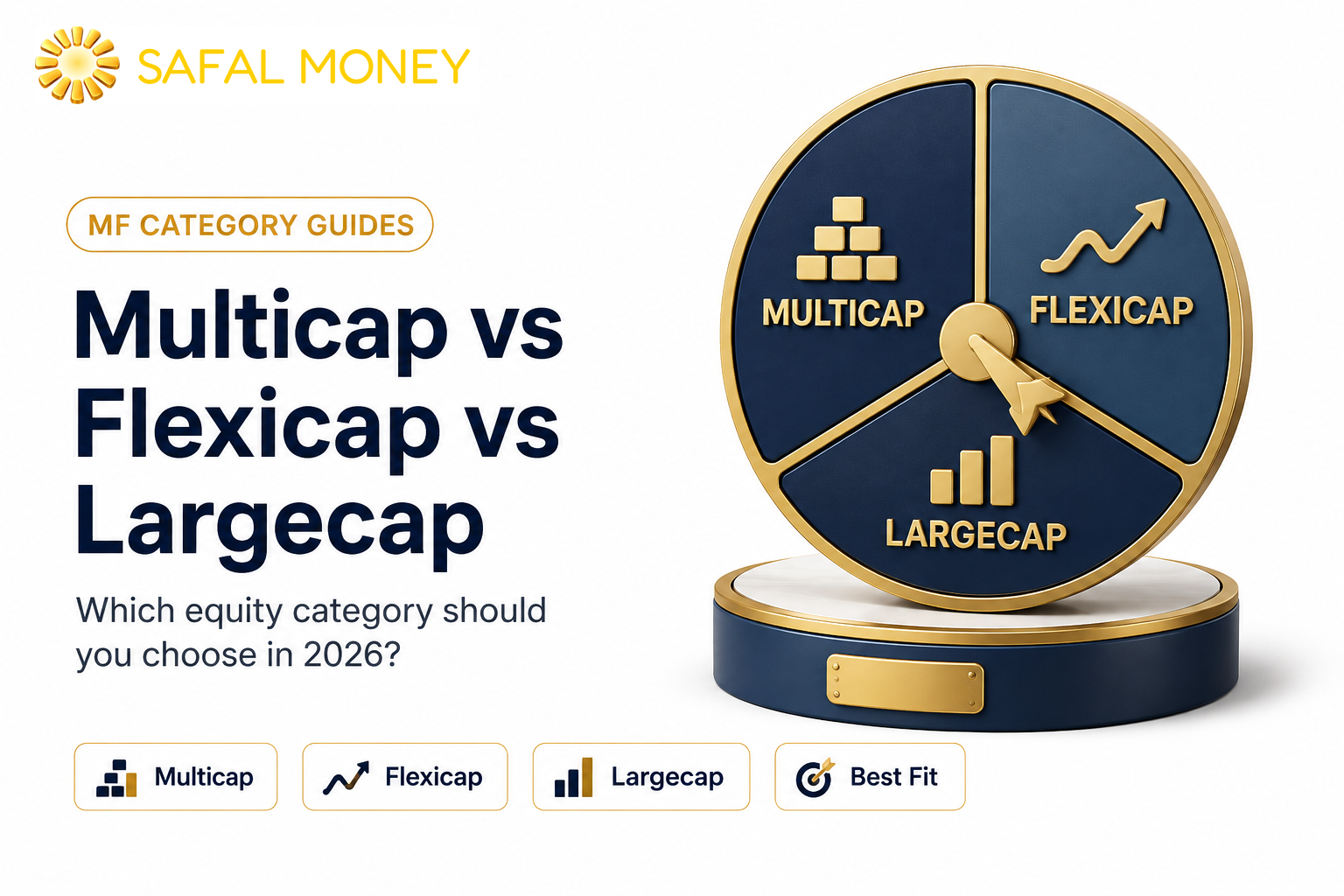
The one-line distinction between all three: a largecap fund must invest 80% in India's top 100 companies and stays close to the index; a multicap fund must invest 25% each across large, mid, and small-cap stocks with regulatory certainty at every market condition; a flexicap fund can invest anywhere in the equity market with complete freedom but no mandatory structure. The choice between them is not about which category returns more — all three deliver long-term equity returns over 7+ year horizons. The choice is about which structure best suits your investment philosophy, temperament, and the specific role you want this fund to play in your portfolio.
Flexicap is now India's single-largest equity mutual fund category at ₹5.53 lakh crore, roughly 2 times the size of multicap at ₹2.2 lakh crore. Yet over the last 3, 5, and 10 years, multicap has quietly delivered higher returns. And largecap — when accessed through the right vehicle — is increasingly a case for the Nifty 50 index fund over the active fund manager. Understanding why these three coexist, and which belongs in your portfolio, is one of the most practically useful equity investing decisions you can make in 2026.
The Allocation Rules Compared: Fixed vs Flexible vs Mandated-Index
The structural difference between the three categories is entirely about how each is regulated to deploy your capital across market capitalisations:
Largecap fund: Must invest a minimum of 80% in the top 100 companies by full market capitalisation as defined by SEBI's semi-annual AMFI list. The remaining 20% is at the fund manager's discretion — typically deployed in a mix of additional largecap names or selected mid-cap stocks for incremental alpha. The 80% mandate keeps the fund anchored to India's most researched, most liquid, and most efficiently priced companies.
Multicap fund: Must invest a minimum of 25% each in large-cap, mid-cap, and small-cap stocks at all times — the mandatory 25-25-25 rule that SEBI introduced in September 2020. The 25-25-25 mandate is always-on. It does not matter whether small caps are at a valuation peak or a decade low — the fund must maintain at least 25% exposure. The remaining 25% is at the fund manager's discretion across any of the three segments.
Flexicap fund: Must invest a minimum of 65% in equity, with no restriction on the allocation between large-cap, mid-cap, and small-cap. The fund manager has the flexibility to increase or reduce exposure to different market segments based on market conditions and investment opportunities. A flexicap fund manager can hold 85% in large-cap one quarter and 50% in mid-cap the next — driven entirely by their assessment of relative opportunity.
This structural difference explains most of the performance divergence between the three categories across different market cycles — and it is the starting point for understanding which category suits which investor.
Risk and Volatility: How the Three Categories Actually Behave
The risk profile of each category flows directly from its allocation mandate:
Largecap funds: The most stable and the lowest-volatility of the three. India's top 100 companies are the most liquid, most researched, and most efficiently priced segment of the equity market. Institutional coverage is comprehensive; price discovery is efficient; daily trading volumes are deep. In a market correction, largecap stocks typically fall less than mid and smallcap stocks — and recover faster, because buyers return to liquid largecap names first. In the 2024–25 correction, the Nifty 50 fell approximately 15–16% from peak to trough; midcap indices fell 20–25% and smallcap indices fell further. The largecap mandate's lower volatility is the structural consequence of investing in the market's most liquid and most researched segment.
Multicap funds: More volatile than largecap, less volatile than pure midcap or smallcap funds. Flexicap funds typically exhibit lower volatility, particularly during market downturns or dips, because they contain a greater proportion of large-cap equities. Multicap funds are typically more volatile than they appear due to their greater mandatory exposure to small and mid-cap stocks, especially during market downturns. The mandatory 25% smallcap floor is the primary driver of multicap's additional volatility versus flexicap. A multicap fund must maintain its 25% small cap exposure even as those stocks are falling; there is no escape clause. If small caps drop 45% and large caps drop 20%, the multicap fund will suffer disproportionately.
Flexicap funds: A skilled flexicap fund manager can significantly reduce small-cap and mid-cap exposure ahead of or during a correction, moving capital into large-cap safety. The best flexicap managers have demonstrated exactly this, tactically reducing risk in deteriorating markets and then re-entering the small and mid-cap space aggressively as valuations recover. This defensive flexibility means flexicap funds, on average, experience lower drawdowns than multicap funds in bear markets — at the cost of potentially lower returns in broad-based bull markets when small and midcap stocks outperform significantly.
Flexicap defends better in corrections because managers can shift to large caps when the market turns. The 1-year flip where flexicap was ahead of multicap is exactly this defence playing out in FY26's weak equity market.
Return Potential: Which Category Has Historically Delivered More?
The return data across the three categories over long periods reveals a consistent pattern — with important nuance:
Multicap has delivered the highest long-term returns among the three. Multicap funds delivered an average 5-year return of around 21%, versus 18% for flexicap funds over the same period. The mandatory mid and smallcap allocation in multicap funds provides structural exposure to faster-growing companies that drives the return premium over flexicap. When mid and smallcap markets outperform — as they did in the 2020–2024 bull cycle — multicap's forced allocation benefits fully.
Flexicap returns sit between largecap and multicap in most market cycles. The flexicap category's defensive capability reduces drawdowns relative to multicap in corrections, but also means less mid and smallcap exposure during bull phases — producing a return profile that is less extreme in both directions than multicap.
Largecap returns are the most constrained by the efficiency of the underlying market. India's top 100 stocks are too well-researched for most active managers to consistently generate meaningful alpha after expenses. SPIVA data shows 80%+ of active large-cap funds underperform the Nifty 100 TRI over 10 years after expenses. This makes the active largecap category the strongest case for a passive index fund — not because active management is useless, but because the efficiency of the largecap market makes alpha generation genuinely difficult and a 0.1–0.2% index fund TER is the most cost-efficient route to largecap returns.
The honest return comparison for August 2026: If your investment philosophy accepts manager-dependent returns and you are comfortable with multi-year cycles of either category outperforming the other — multicap and flexicap are both appropriate choices for a 7–10 year horizon, with multicap offering higher structural return potential at higher structural volatility. If you want largecap exposure specifically and are not confident in any particular active manager's ability to beat the index net of costs, the Nifty 50 index fund is the most financially sound vehicle.
Key Takeaway
None of the three is universally "best" — multicap trades higher structural return potential for mandatory volatility, flexicap trades that discipline for manager judgment, and largecap trades upside for the market's most liquid, lowest-drama segment. Pick based on which trade-off you actually want, not last year's returns.
Which Category Suits a First-Time Equity Mutual Fund Investor?
Mid-cap, multicap, and flexicap are different types of equity schemes that invest money in different styles and allocations. For a first-time equity mutual fund investor choosing their initial equity allocation, the category decision should be guided by one principle: start with the category that will survive your first significant market correction without causing you to exit.
The case for largecap or Nifty 50 index fund as the first investment: The top 100 companies are recognisable household names — HDFC Bank, Infosys, Reliance, TCS. When the NAV falls 15% in a correction, the investor can read about these companies in the news, understand that their business models remain intact, and more easily resist the urge to exit. The psychological anchoring to familiar businesses makes the emotional experience of holding through a correction more manageable for first-time investors.
The case for flexicap as the first investment (with an experienced manager): A high-quality flexicap fund from a quality-oriented manager — Parag Parikh Flexi Cap Fund's standard deviation of 8.86% relative to the category average is a concrete example — can provide better downside protection than the category average while maintaining the flexibility to capture mid and smallcap growth opportunities over time. The key is selecting a consistently managed, quality-first flexicap fund rather than a high-momentum flexicap that can fall further than the index in corrections.
The case for multicap for first-time investors: proceed with caution. The mandatory 25% smallcap allocation in multicap funds means the portfolio will experience significant volatility in corrections — more than a largecap or conservatively managed flexicap fund. For investors who have not experienced a significant drawdown before, understanding that 25% of their multicap portfolio is in the market's most volatile segment is an important pre-investment disclosure.
Which Category Suits an Investor Already Holding Largecap Via Index Funds?
An investor who has already established a Nifty 50 or Nifty 100 index fund as their largecap core has a specific additional investment question: what category best complements the largecap exposure they already have?
The answer is multicap or flexicap — but not another largecap fund. Adding a second largecap fund or a second index fund to a portfolio that already has a Nifty 50 index fund creates significant overlap. The second fund's top holdings will closely mirror the first fund's top holdings — providing the illusion of diversification with minimal incremental exposure to different market dynamics.
Multicap as a complement to largecap: The multicap fund's mandatory 25% mid and 25% smallcap floors add genuine market cap diversification to the largecap core. The portfolio's combined equity exposure becomes: largecap dominated (through index fund) + structured all-cap diversification (through multicap) — a combination that provides both stability and growth exposure in a disciplined structure.
Flexicap as a complement to largecap: A quality-managed flexicap fund provides genuine all-cap flexibility to complement the index fund's index-replicating strategy. The flexicap manager's ability to identify quality businesses across market caps — including emerging mid-cap leaders before they enter the top 100 — can generate alpha that the index fund, by definition, cannot pursue.
The recommendation for this investor in August 2026: One multicap fund for structured all-cap diversification, or one quality flexicap fund for unconstrained all-cap opportunity — but not both. Running a multicap and a flexicap alongside a largecap index fund creates meaningful overlap in the large-cap component (all three have significant large-cap exposure) without proportionate benefit. Choose one all-cap complement and size it to represent 30–40% of the total equity allocation alongside the index fund core.
Can You Hold All Three Together? When It Makes Sense
Holding all three categories simultaneously is not automatically wrong — but it requires a clear portfolio architecture rationale rather than accumulation by default.
The legitimate case for holding all three: a carefully structured equity portfolio with deliberate weighting across each category, where:
- Largecap/Index fund (30–40% of equity allocation): The portfolio's stability anchor. Tracks India's most resilient businesses. Minimal cost (0.1–0.2% TER for index fund). Reduces overall portfolio volatility.
- Multicap (25–30% of equity allocation): The structured all-cap diversification layer. Regulatory-enforced mid and smallcap exposure that does not depend on any single manager's market cap rotation judgment. Higher return potential over full market cycles.
- Flexicap (25–30% of equity allocation): The active conviction layer. A quality manager with genuine stockpicking ability across market caps, using the full flexibility of the mandate to construct a portfolio different from both the index and the mandated multicap structure.
What makes this combination work: The three funds have genuinely different return drivers — the index fund tracks the market mechanically, the multicap fund delivers regulatory-enforced all-cap diversification, the flexicap fund delivers active manager conviction across any market cap. Each is doing something different.
What makes this combination fail: Choosing the three categories but filling them with funds that are effectively all large-cap-heavy. If your flexicap fund is essentially 80% large-cap, your multicap fund has its 25% smallcap reluctantly (buying smallcap index ETFs to comply), and your index fund is Nifty 50 — you have three funds all doing approximately the same thing, generating overlap with minimal diversification benefit.
The test: can you articulate why each fund is doing something meaningfully different from the other two? If yes — the three-category combination is working. If the answer is uncertain, consolidate to two funds across two distinct categories and select each with a clear mandate rationale.
The Decision Flowchart: 3 Questions to Find Your Category Match
Answer these three questions in order to identify your best-fit equity category:
Question 1: Do you want your portfolio's market cap allocation to depend on a fund manager's judgment, or be regulatory-enforced?
- If you want regulatory-enforced allocation and don't want to rely on a single manager's market cap rotation call → Multicap fund. The 25-25-25 mandate ensures mid and smallcap exposure regardless of the manager's short-term market view.
- If you want to trust a skilled manager to allocate flexibly across market caps based on opportunity → Flexicap fund. The manager's quality and track record become the primary investment thesis.
- If you want purely large-cap exposure without mid or smallcap risk → Largecap fund or Nifty 50 index fund.
Question 2: Is active management vs passive a consideration for the large-cap component?
- If you are satisfied that your chosen active fund manager has a demonstrated, long-term record of outperforming the Nifty 100 after expenses → Active largecap or flexicap fund.
- If you are not confident any active manager can consistently beat the large-cap index net of costs → Nifty 50 or Nifty 100 index fund for the largecap allocation, alongside an active flexicap or multicap for the all-cap component.
Question 3: What is your most recent bear market experience and how did it feel?
- If you have experienced a 20–30% portfolio drawdown and held through it → Multicap (structurally more volatile due to mandatory smallcap) is appropriate.
- If you have experienced a correction and it was psychologically difficult — you checked the portfolio daily and felt real distress → Flexicap (with a defensively managed, quality-first fund like Parag Parikh) is more appropriate — the manager's ability to shift toward large-cap safety in corrections reduces the emotional severity of drawdowns.
- If you have not yet experienced a significant correction → Start with largecap or Nifty 50 index fund and add multicap or flexicap after you have lived through one correction and know your emotional response.
How SafalCheck™ Keeps the Comparison Fair Across Categories
One of the most common mistakes in category comparison articles is ranking multicap, flexicap, and largecap funds on the same absolute return metric — which produces meaningless comparisons because the categories have structurally different return potential and risk profiles.
SafalCheck™ evaluates every fund exclusively within its own SEBI category peer group. A SafalCheck™ score of 72 in the multicap category and 72 in the largecap category both mean above-average structural quality within their respective peer groups — they do not mean the two funds are equivalent or that multicap is better because its long-term returns are higher.
When comparing multicap vs flexicap vs largecap for your portfolio, use SafalCheck™ to identify the best fund within each category you are considering. Do not use SafalCheck™ scores to compare across categories — the comparison framework is category-relative by design. The category choice comes first (which category fits your philosophy and risk profile?). The fund choice within that category comes second (which specific fund scores highest within the chosen category?).
The right mutual fund for you depends on your risk appetite and goals: opt for multicap if you value disciplined exposure across segments and can tolerate moderate volatility; choose flexicap if you are comfortable with manager discretion and need responsiveness in volatile markets. And choose largecap — specifically the Nifty 50 index fund — if you want India's most stable equity category at the lowest possible cost.
The August 2026 Context: Which Category Is Most Appropriately Positioned?
In the specific market environment of August 2026 — with equity markets having recovered from the 2024–25 correction, RBI on hold at 5.25%, and mid and smallcap valuations no longer at the distressed levels seen in early 2025 — the three categories have specific contextual positions:
Largecap/Index fund: Well-positioned. The Nifty 50 index offers competitive valuations relative to mid and smallcap following the recovery that brought mid and smallcap indices back toward fair value. The index fund's passive, low-cost structure has no timing risk — appropriate for SIP or lump-sum deployment.
Flexicap: Well-positioned, particularly quality-first, defensively managed funds. Following significant corrections in the small-cap and mid-cap segments, a growing number of investors are reallocating their portfolios towards large-cap, flexicap, and multicap funds. A flexicap fund with a quality manager who maintained defensive large-cap positioning through the correction and is now selectively re-entering mid-cap opportunity is well-aligned with the current market environment.
Multicap: Appropriate for SIP deployment, but exercise caution on lump-sum deployment. The mandatory 25% smallcap allocation means lump-sum entry in a smallcap market that has recovered from correction lows (but is no longer distressed) introduces timing risk in the smallcap component. SIP over 12 months is the preferred entry mode for fresh multicap allocation in August 2026.
Free, no login required
Free, 2 minutes
Frequently Asked Questions
What is the difference between multicap, flexicap, and largecap funds?
A largecap fund must invest at least 80% in India's top 100 companies. A multicap fund must invest at least 25% each in large-cap, mid-cap, and small-cap stocks simultaneously. A flexicap fund must invest at least 65% in equity with complete freedom over the large-cap/mid-cap/small-cap split. The key distinction: largecap is index-anchored, multicap has regulatory-enforced all-cap diversification, and flexicap has complete manager flexibility.
Which is better — multicap or flexicap?
Opt for multicap if you value disciplined exposure across segments and can tolerate moderate volatility. Choose flexicap if you are comfortable with manager discretion and need responsiveness in volatile markets. Over the long term, multicap has historically delivered slightly higher returns. In corrections, flexicap funds with defensive managers tend to fall less. The choice depends on whether you prefer regulatory-enforced diversification or manager-driven allocation flexibility.
Should a beginner start with largecap or multicap?
A beginner should start with a largecap index fund (Nifty 50 Direct Plan) or a defensively managed, high-quality flexicap fund (such as one with a long-tenured manager and low standard deviation relative to category peers). Multicap's mandatory 25% smallcap allocation introduces volatility that is more manageable after the investor has experienced a market correction and understands their own emotional risk tolerance.
Can I hold multicap, flexicap, and largecap funds together?
Yes - but only if each fund is doing something genuinely different. An index fund for the largecap core, a multicap fund for regulatory-enforced all-cap diversification, and a quality flexicap fund for active conviction across market caps is a coherent combination. Avoid combinations where all three funds end up heavily weighted to large-cap stocks, which creates overlap without proportionate diversification benefit.
Which category has the highest long-term return potential?
Multicap has historically delivered the highest average returns among the three categories - driven by the mandatory mid and smallcap exposure that provides structural access to faster-growing companies. Multicap funds delivered an average 5-year return of around 21%, versus 18% for flexicap funds over the same period. Largecap and index funds typically deliver the lowest returns among the three - appropriate for their lower volatility and more stable return profile.
Last updated: 28 August 2026