Largecap Mutual Funds: Stability Meets Steady Compounding
Largecap mutual funds invest at least 80% in India's top 100 companies by market cap. Here's who should invest, what to look for, and how active largecap funds compare to index funds in 2026.
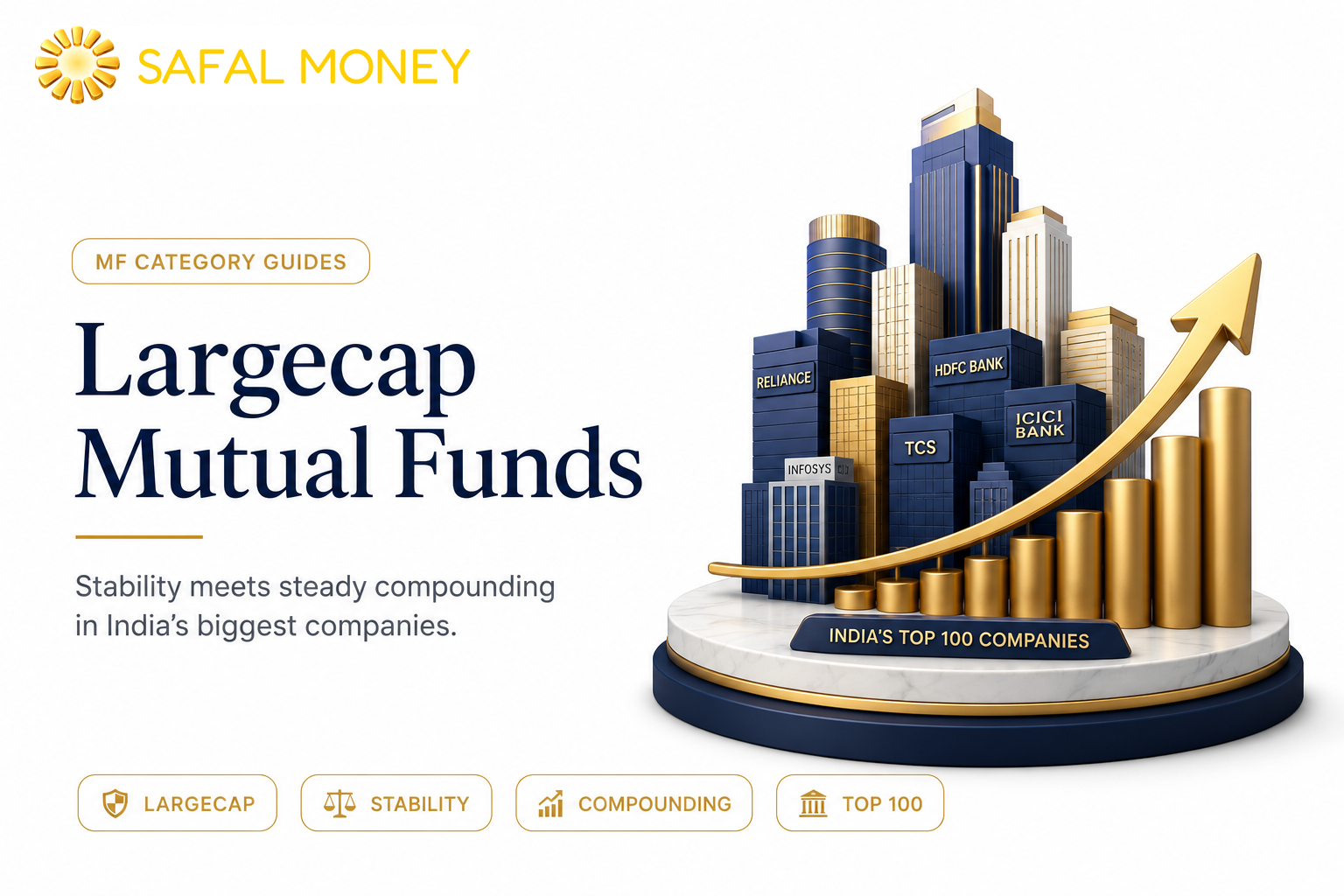
A largecap mutual fund is a SEBI-regulated equity fund that must invest a minimum of 80% of its assets in the top 100 companies by full market capitalisation in India - companies like HDFC Bank, Reliance Industries, Infosys, ICICI Bank, and TCS that sit at the apex of India's listed equity market. In India, SEBI defines large-cap stocks as the top 100 companies ranked by full market capitalisation, and a large-cap mutual fund must invest a minimum of 80% of its assets in these companies at all times. The remaining 20% gives the fund manager tactical flexibility - typically deployed in a mix of mid-cap stocks for incremental return, cash equivalents, or short-term instruments depending on market conditions.
Largecap funds occupy a distinct place in the Indian mutual fund landscape: they are the most stable and liquid equity category, the one most suitable for investors approaching or in retirement, and simultaneously the most competitive category for active fund managers - because beating a largecap index populated by the country's most researched, most efficiently priced companies consistently over time is genuinely difficult.
What Makes a Company "Large Cap" by SEBI's Definition?
SEBI's definition of large cap is precise and updated twice a year by AMFI. The top 100 companies by full market capitalisation - calculated as price per share multiplied by total outstanding shares - constitute the large-cap universe. This list is published by AMFI in January and July each year, and all mutual funds are required to comply with the resulting reclassifications within 30 days.
As of the July 2026 AMFI list, the large-cap universe includes India's most prominent corporate names across sectors: financial services leaders (HDFC Bank, ICICI Bank, SBI, Kotak Mahindra Bank), information technology majors (TCS, Infosys, Wipro, HCL Technologies), consumer businesses (ITC, Hindustan Unilever, Asian Paints), energy companies (Reliance Industries, ONGC, NTPC), and manufacturing and infrastructure names (L&T, Maruti Suzuki, Bajaj Auto).
The threshold market capitalisation to be in the top 100 changes with market movements - in a bull market where mid-cap stocks have rallied significantly, the 100th company's market cap may be meaningfully higher than in a bear market, meaning the "large cap" universe contracts and expands in size but consistently represents the market's most established and liquid businesses.
The 80% Mandate: What It Actually Means for Your Portfolio
Large cap mutual funds invest at least 80% of their assets in the top 100 companies by market capitalisation as mandated by SEBI regulations. These funds target large-cap stocks, which are typically well-established, financially stable businesses with a strong track record - often referred to as blue-chip companies.
The 80% mandate has two important practical consequences. First, it means largecap funds are fundamentally constrained in their ability to generate returns by owning the "right" stocks - most of the fund's return comes from how much the top 100 companies grow in aggregate, with only 20% discretion for managers to differentiate. This is why largecap funds as a category are closely correlated with the Nifty 50 or Nifty 100 index performance.
Second, it means largecap funds are the most liquid mutual fund category in the equity universe. The top 100 companies are by definition the most traded, most researched, and most liquid stocks in India. A fund manager running a largecap portfolio can buy and sell positions of any size without moving the market - which matters for large funds and for investors who may need to exit during a market disruption.
The Core Tension in Largecap Funds: Active Management vs Index Funds
The most important discussion in the largecap category is not which active fund to choose - it is whether to choose an active largecap fund at all.
Large-cap stocks are the most efficiently priced segment of the Indian equity market. They are covered by hundreds of analysts at domestic and international brokerages. Every material development - a quarterly result, a management change, a regulatory decision - is immediately reflected in the price by thousands of informed market participants. This efficiency makes it structurally difficult for any active fund manager to maintain a consistent information advantage and generate alpha (returns above the benchmark index) after costs.
The evidence reflects this difficulty: over any 5-year period, the majority of actively managed largecap funds in India have underperformed their benchmark largecap index after accounting for expense ratios. This is not an indictment of the fund managers - it is the structural consequence of managing active portfolios in an efficient market segment where the cost drag of active management is difficult to overcome with stockpicking skill alone.
This makes the Nifty 50 Index Fund or Nifty 100 Index Fund a genuinely compelling alternative to active largecap funds for many investors. An index fund tracking the Nifty 50 typically has a direct plan TER of 0.1% or less - compared to 0.8–1.2% for an active largecap fund. Over 20 years, that 0.7–1.1% annual cost difference compounds into a very significant gap in final corpus.
SafalCheck™'s evaluation of active largecap funds explicitly accounts for this benchmark context - a fund must demonstrate consistent category-relative outperformance (not just absolute returns) to score well on the risk-adjusted performance factor in a category where the index itself is a strong competitor.
Key Takeaway
Largecap is the only equity category where the passive alternative (a Nifty 50/100 index fund at ~0.1% TER) genuinely competes with active management on a like-for-like basis. Choose active only if the fund has a proven multi-cycle record of beating its benchmark net of costs.
When Does an Active Largecap Fund Make Sense?
Despite the efficiency challenge, active largecap funds can still make sense in specific situations:
When the fund has a proven, long-track-record manager with a demonstrable edge. A handful of active largecap funds in India have delivered consistent benchmark outperformance over 10+ year periods. This consistency, where it exists, reflects a genuine investment process - not luck. Identifying these funds requires looking at rolling return periods rather than point-to-point returns, using tools like SafalCheck™'s consistency factor analysis.
When the 20% non-largecap allocation is used intelligently. The 20% flexibility can be a meaningful alpha generator if deployed into quality mid-cap stocks before they are reclassified to large-cap - capturing the re-rating premium that accompanies a company's graduation into the top 100. Funds that use this 20% thoughtfully rather than as a cash management buffer can generate meaningful alpha from this portion of the portfolio.
When the investor has a tax or legacy reason to continue in an active fund. Investors who have built significant unrealised gains in an existing active largecap fund face a capital gains tax event if they switch to an index fund. In this situation, the tax cost of switching often exceeds the efficiency benefit of the index fund for the medium term, making it rational to continue in the active fund while evaluating whether its quality warrants the ongoing TER difference.
Who Should Invest in a Largecap Mutual Fund?
These funds are good for long-term investments because of their stability. If you are looking for safe and reliable growth, large-cap mutual funds could be a good option. The average returns of good large-cap mutual funds range between 12–15% per annum, and they have moderate risk, giving more stable returns compared to small caps.
Largecap funds are most suitable for:
- Conservative equity investors who want equity growth without smallcap/midcap volatility. The 80% mandate in the country's most established companies means largecap funds experience significantly lower drawdowns during bear markets than mid or smallcap funds. In the 2022 bear market, the Nifty 100 fell approximately 18% from peak to trough - while the Nifty Smallcap 250 fell over 35%.
- Investors in or approaching retirement who still need equity growth. A retiree with a 10–15 year time horizon on their corpus needs equity growth to outpace inflation and maintain purchasing power - but cannot afford a 40% drawdown that may take 3 years to recover. Largecap funds offer equity returns with materially lower drawdown risk than the broader market.
- First-time equity investors. The psychological challenge of seeing a mutual fund NAV fall 25% in a bear market is most manageable in the largecap category, where the portfolio consists of familiar brand names and the drawdowns are less severe than in mid or smallcap categories. Starting with a largecap fund or index fund allows first-time investors to develop the emotional discipline of staying invested through a correction before taking on midcap or smallcap exposure.
- Investors who want a stable core within a multi-fund portfolio. Even for investors with high risk tolerance who hold midcap and smallcap satellites, a largecap fund or index fund as the portfolio core provides a stability anchor that cushions overall portfolio volatility.
How to Evaluate a Largecap Fund Before Investing
- Benchmark-adjusted performance over 5 years. Compare the fund's 5-year return against its benchmark (Nifty 50 or Nifty 100 TRI, not just the price index) and against a direct plan Nifty index fund. If the active fund has not outperformed the index fund net of costs over 5 years, that is the single most important data point in the evaluation.
- Expense ratio vs index fund alternatives. The HDFC Large Cap Fund manages a corpus of INR 37,659 crore as of February 2026 - a fund of this scale should be passing cost savings to investors as AUM grows. A direct plan TER above 0.9% in an active largecap fund is difficult to justify given the efficiency of the segment and the ready availability of index alternatives at under 0.2%.
- Fund manager tenure and process. In a category where the benchmark is the hardest to beat, the consistency of the investment process matters more than the identity of individual stocks held. A manager who has maintained a consistent quality-growth or quality-value philosophy across multiple market cycles is more credible than one who has rotated between styles.
- Tracking error vs the benchmark. A very low tracking error in an active largecap fund means the fund is essentially indexing - charging active management fees for index-like returns. A high tracking error indicates meaningful active bets. SafalCheck™ evaluates whether the tracking error is accompanied by proportionate alpha - a high-tracking-error fund that is not generating alpha is paying manager conviction premiums without investor benefit.
- The 20% non-largecap allocation. Read the latest factsheet to understand how the fund is using its 20% flexibility. Is it in quality mid-caps with a growth rationale? Is it in cash? Is it used as a buffer? The 20% allocation can be the difference between above-benchmark and below-benchmark performance in a given year.
Largecap Fund Tax Treatment
Largecap funds are equity mutual funds for tax purposes, qualifying for equity fund capital gains tax treatment. Short-term capital gains (under 12 months) are taxed at 20%. Long-term capital gains (12 months or more) are taxed at 12.5% under Section 112A, with a ₹1.25 lakh annual exemption on LTCG. This treatment applies identically to largecap funds and Nifty index funds - the choice between them is a pre-tax decision, as both vehicles have the same tax treatment on the same holding period.
Free, no login required
Free, 2 minutes
Frequently Asked Questions
What is a largecap mutual fund in India?
A largecap mutual fund is a SEBI-regulated equity fund that must invest a minimum of 80% of its assets in the top 100 companies by full market capitalisation in India. These companies are India's most established, most liquid, and most researched businesses.
Is a largecap fund better than a Nifty 50 index fund?
Not universally. The majority of active largecap funds underperform their benchmark index after costs over long periods, because the large-cap segment is efficiently priced and active management costs are difficult to overcome. A Nifty 50 or Nifty 100 direct plan index fund at a TER of 0.1% is a strong alternative to active largecap funds for most investors. Choose active only if you can identify a fund with a proven 10-year history of consistent benchmark outperformance.
What are the best largecap funds in India in 2026?
Leading active largecap funds evaluated by SafalCheck™ in August 2026 include Mirae Asset Large Cap Fund, Nippon India Large Cap Fund, and HDFC Large Cap Fund. For index exposure, the SBI Nifty 50 Index Fund and UTI Nifty 50 Index Fund are among the lowest-cost options in the direct plan. Run any fund through SafalCheck™ for a full 7-factor analysis before investing.
Who should invest in largecap mutual funds?
Conservative equity investors, investors in or approaching retirement, first-time equity investors, and those who want a stable core within a diversified portfolio are the ideal investors for largecap funds. Investors with long horizons and high risk tolerance who seek higher returns should consider adding midcap or flexicap exposure alongside largecap.
What is the minimum investment in a largecap fund?
Most largecap mutual funds have SIP minimums starting at ₹100 per month and lump-sum minimums of ₹1,000 or less. Direct plan investing is available on all major platforms without a minimum investment premium over regular plans.
Last updated: 6 August 2026