Multicap Mutual Funds Explained: The Complete India Guide 2026
Multicap mutual funds must invest at least 25% each in large, mid, and small cap stocks by SEBI mandate. Here's everything you need to know before investing in 2026.
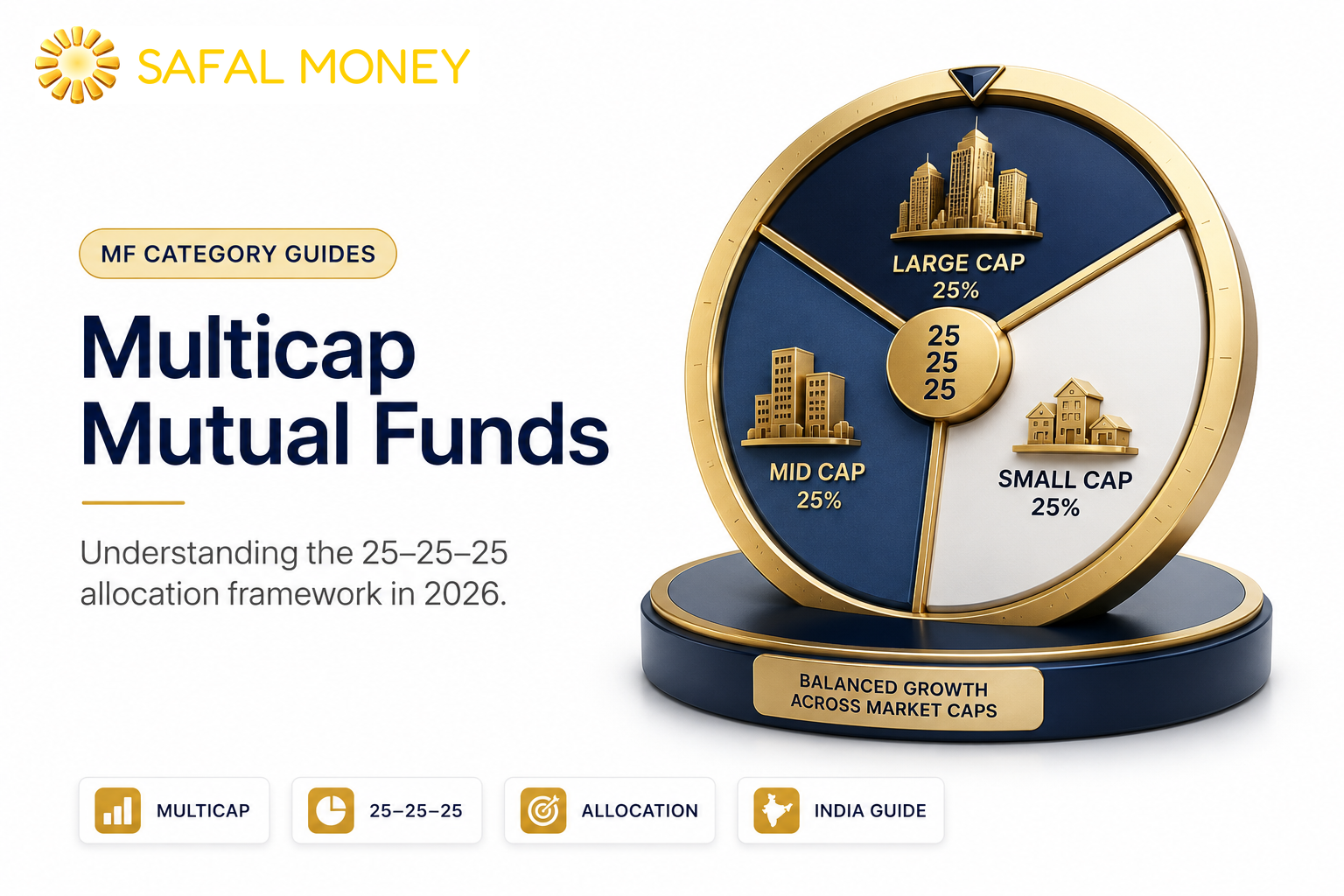
A multicap mutual fund is a SEBI-regulated equity fund that must invest a minimum of 25% each in large-cap stocks (top 100 companies by market cap), mid-cap stocks (101st to 250th by market cap), and small-cap stocks (251st and below) at all times. This mandatory 75% floor allocation across all three market cap segments - often called the 25-25-25 mandate - is the defining structural feature of the multicap category, and it is what distinguishes a multicap fund from every other diversified equity fund in India. The remaining 25% of the portfolio can be deployed at the fund manager's discretion across any of the three segments, giving the fund a measured degree of active management flexibility while maintaining the enforced diversification.
As of August 2026, the multicap category has approximately ₹2.23 lakh crore in AUM across all fund houses - representing about 7% of total equity mutual fund AUM in the country, and growing approximately 56% from ₹1.43 lakh crore in 2021.
What Is the 25-25-25 Mandate and What Does It Actually Mean for Your Money?
Under the 25-25-25 rule, multicap funds are required to maintain a minimum of 25% exposure each in large-cap, mid-cap, and small-cap stocks at all times, meaning at any given point, at least 75% of the portfolio is locked into these three specific market segments.
In practical terms, this means a multicap fund cannot become a closet largecap fund during a bear market, even if the fund manager believes smallcap stocks are overvalued. The minimum 25% in smallcap and 25% in midcap are non-negotiable - SEBI monitors compliance with this mandate and fund houses are required to report category-wise allocations monthly.
This is very different from how India's mutual fund landscape worked before September 2020, when diversified equity funds could freely shift their allocation between market caps at the fund manager's discretion. Many funds that called themselves "diversified" were effectively 80–90% largecap portfolios - stable, but not genuinely diversified. SEBI's 2020 circular mandating the 25-25-25 rule for multicap funds fundamentally changed this, creating a category with true market-cap diversification baked in by regulatory requirement rather than fund manager preference.
How SEBI Defines Large, Mid, and Small Cap for the Multicap Mandate
SEBI's definitions of market cap segments are precise and updated twice a year by AMFI:
- Large Cap - the top 100 companies by full market capitalisation on a six-monthly rolling basis. These are India's largest, most liquid, and most researched companies. HDFC Bank, Reliance Industries, Infosys, ICICI Bank, and TCS are perennial largecap constituents.
- Mid Cap - the 101st to 250th company by full market capitalisation. This segment includes established businesses that have grown past the smallcap phase but have not yet reached the scale of the top 100. It is the segment historically associated with the highest return potential among the three, along with higher volatility.
- Small Cap - the 251st company onwards by full market capitalisation. This is the broadest and least researched segment. It includes over 4,000 listed companies, ranging from genuinely high-growth emerging businesses to speculative or illiquid names. For a multicap fund, this segment provides the portfolio's highest-risk, highest-reward component - capped at a minimum of 25% of the total portfolio.
The semi-annual AMFI list update (typically in January and July each year) means that a company reclassified from mid-cap to large-cap requires all funds to rebalance their holdings within 30 days to restore category-wise compliance.
Multicap vs Flexicap: The Most Important Comparison for Indian Investors
The multicap vs flexicap question is the most common category confusion among Indian investors - because both categories are marketed as "diversified equity funds" and both invest across market caps. The distinction is fundamental:
Multicap funds have a mandated minimum floor: 25% in largecap, 25% in midcap, 25% in smallcap, always. The fund manager has discretion over the remaining 25% and can tilt within each segment, but cannot go below the floor allocation in any segment.
Flexicap funds have a single mandate: a minimum 65% in equity. Within that 65%, the fund manager has complete discretion over the largecap/midcap/smallcap split. A flexicap fund manager can hold 80% largecap and 20% mid/smallcap if they believe that allocation is right. Or they can hold 60% midcap and 40% largecap and smallcap. The category name "flexicap" reflects this flexibility - the fund manager is not constrained by a market cap floor.
| Feature | Multicap Fund | Flexicap Fund |
|---|---|---|
| Minimum equity allocation | 75% (25% each in large/mid/small) | 65% (any split) |
| Market cap floors | Mandatory 25% each segment | None - fund manager discretion |
| Bear market flexibility | Cannot reduce mid/smallcap below 25% | Can rotate fully to largecap |
| Diversification source | Regulatory mandate | Fund manager judgment |
| Typical volatility | Higher (forced mid/smallcap exposure) | Variable (depends on manager stance) |
The consequence of this difference: in a market correction or bear phase, a flexicap fund manager can rotate toward largecaps for safety. A multicap fund manager cannot - the 25% floors are always binding. This means multicap funds carry more structural mid and smallcap exposure across all market conditions, which produces more volatility in the short term but potentially more diversified return over long horizons.
For a long-horizon investor (10+ years) who wants built-in exposure to all three market cap segments without relying on a fund manager's tactical allocation call, a multicap fund is structurally the more appropriate vehicle. For an investor who wants a skilled manager to navigate market cap rotation actively, a flexicap fund is the better fit.
Who Should Invest in a Multicap Mutual Fund?
- Investors who want all-cap exposure without monitoring it themselves. The 25-25-25 mandate automatically ensures the portfolio always has mid and smallcap exposure. Investors who want midcap growth potential but do not want to manage separate midcap and smallcap fund allocations benefit from the structural simplicity of a multicap fund.
- Long-horizon investors (7+ years). The mandatory smallcap and midcap floors mean multicap funds will experience meaningful NAV volatility in market corrections. Investors with shorter horizons - under 5 years - may find this volatility uncomfortable and should consider largecap or flexicap funds instead.
- Investors starting SIPs in their 30s for retirement or long-term wealth building. A multicap fund as a core holding allows rupee cost averaging across all three market cap segments simultaneously. The small and midcap components, which are most volatile, benefit most from the averaging effect of regular monthly SIPs over a decade.
- Investors who want regulatory-enforced diversification. Unlike flexicap mandates, which depend on the fund manager's judgment for diversification, multicap diversification is enforced by SEBI. For investors who prefer a rule-based structure over manager-discretion-dependent allocation, this is a meaningful difference.
Who Should Not Invest in a Multicap Fund?
- Investors with a horizon under 5 years. The mandatory 25% minimum in smallcaps introduces volatility that is difficult to absorb in a short time frame. Debt funds, hybrid funds, or largecap equity funds are more appropriate for 3–5 year horizons.
- Investors in or near retirement who need capital stability. The smallcap and midcap components of a multicap fund can experience 30–50% drawdowns in a severe bear market. Investors who cannot wait for recovery should not have significant exposure to multicap funds.
- Investors who already hold separate largecap, midcap, and smallcap funds. A multicap fund duplicates the market cap exposure that already exists in a diversified multi-fund portfolio. Adding a multicap fund to an existing 4-fund equity portfolio typically increases complexity without adding genuine diversification.
What Are the Key Risks in a Multicap Fund?
Forced smallcap allocation in bear markets. The biggest structural risk in the multicap category is that the 25% smallcap floor is maintained regardless of market conditions. In a severe bear market where smallcap stocks fall 40–50%, a multicap fund cannot reduce its smallcap exposure below 25% - which means the NAV absorbs smallcap drawdowns in full for at least 25% of the portfolio.
Fund manager concentration risk within the 25% discretionary allocation. The 25% of the portfolio that sits outside the mandatory floors is where fund manager judgment has the most impact - and where mistakes are most costly. A fund manager who consistently concentrates the discretionary allocation in one sector or theme introduces concentration risk that the mandatory diversification of the other 75% does not offset.
Rebalancing costs from AMFI reclassification. When the semi-annual AMFI market cap list reclassifies companies between segments, multicap funds must rebalance within 30 days. Frequent reclassifications - particularly in periods of market volatility - generate transaction costs and can force the sale of holdings at unfavourable prices.
Tax Treatment of Multicap Mutual Funds
Multicap funds are classified as equity mutual funds for tax purposes, because they maintain a minimum 65% allocation in Indian equity at all times (the mandatory 75% across three segments, less any derivative or cash exposure within SEBI limits, consistently keeps equity above 65%).
The tax treatment as of August 2026: Short-term capital gains (holding period under 12 months) are taxed at 20%. Long-term capital gains (holding period 12 months or more) are taxed at 12.5%, with an exemption on the first ₹1.25 lakhs of LTCG per financial year under Section 112A of the Income Tax Act.
This tax treatment is identical to other equity mutual fund categories - largecap, midcap, flexicap, and ELSS (with ELSS having the additional Section 80C deduction benefit and a 3-year lock-in).
What to Check Before Investing in a Multicap Fund
- Actual small and midcap allocation. Verify that the fund's latest factsheet shows compliance with the 25-25-25 mandate. Some funds were late to comply when the mandate was introduced - checking the current allocation confirms the fund is genuinely multicap rather than a legacy diversified fund with a renamed mandate.
- Direct plan expense ratio. Among leading multicap funds, direct plan TERs range from 0.5% (Kotak Multicap) to 0.9% (ICICI Prudential Multicap). Over a 15-year investment horizon, the difference in compounding between a 0.5% and a 0.9% TER is substantial. Always invest in the direct plan unless you are receiving ongoing advisory services from a SEBI-registered investment advisor.
- Fund manager tenure and track record. The multicap category requires a fund manager who is comfortable navigating all three market cap segments - the research and portfolio management demands are different from a pure largecap or pure smallcap mandate. Check how long the current manager has been running the fund and whether their track record predates the 2020 mandatory allocation rule.
- Benchmark. Since 2021, SEBI requires multicap funds to benchmark against the Nifty 500 Multicap 50:25:25 TRI - an index that mirrors the 25-25-25 mandate structure. A fund that consistently underperforms this benchmark is failing to generate alpha despite the active management it charges for.
- AUM size and smallcap liquidity. Nippon India Multi Cap Fund has an AUM of approximately ₹54,585 crore as of July 2026 - among the largest in the category. Very large AUM creates liquidity constraints in the smallcap portfolio: buying and selling smallcap positions becomes increasingly difficult and expensive as the fund grows. For the mandatory 25% smallcap allocation, a fund with very high AUM faces structural challenges in deploying and exiting smallcap positions efficiently.
Key Takeaway
The 25-25-25 mandate is what makes a multicap fund different from every other diversified equity category - the mid and smallcap floors are non-negotiable in every market condition, which is the source of both its structural diversification and its short-term volatility.
Before investing in any specific multicap scheme, run it through SafalCheck™ to see its risk-adjusted performance, cost efficiency, and manager stability scored against the rest of the category.
Free, no login required
Frequently Asked Questions
What is a multicap mutual fund in India?
A multicap mutual fund is an equity fund regulated by SEBI that must invest a minimum of 25% each in large-cap, mid-cap, and small-cap stocks at all times. The 25-25-25 mandate ensures genuine diversification across all three market cap segments and distinguishes multicap funds from other diversified equity categories like flexicap funds.
What is the 25-25-25 rule in multicap funds?
SEBI guidelines mandate multicap funds to allocate a minimum of 25% each to large-cap, mid-cap, and small-cap companies, with a minimum 75% total allocation to equity and equity-related instruments. The remaining 25% of the portfolio is at the fund manager's discretion.
Is a multicap fund better than a flexicap fund?
Neither is universally better. Multicap funds offer regulatory-enforced all-cap diversification with mandatory mid and smallcap exposure. Flexicap funds offer greater manager flexibility to navigate market cap rotation. Long-horizon investors who want structural all-cap diversification favour multicap; investors who want active allocation management favour flexicap.
What is the minimum investment in a multicap fund?
Minimum SIP amounts in leading multicap funds start at ₹100 per month. Lump-sum minimums vary by fund house but are typically ₹1,000-₹5,000.
Are multicap funds safe?
Multicap funds are equity funds with a moderately high to very high risk rating per SEBI's product labelling framework. They carry market risk, including the risk of significant NAV decline during bear markets - particularly in the mandatory smallcap allocation. They are appropriate for long-term investors (7+ years) with higher risk tolerance, not for capital preservation or short-term goals.
Last updated: 4 August 2026