Flexicap Funds Explained: Why Fund Managers Love the Freedom
Flexicap mutual funds invest at least 65% in equity with no market cap restrictions - giving fund managers complete freedom to rotate across large, mid, and small cap based on opportunity. Here's everything investors need to know.
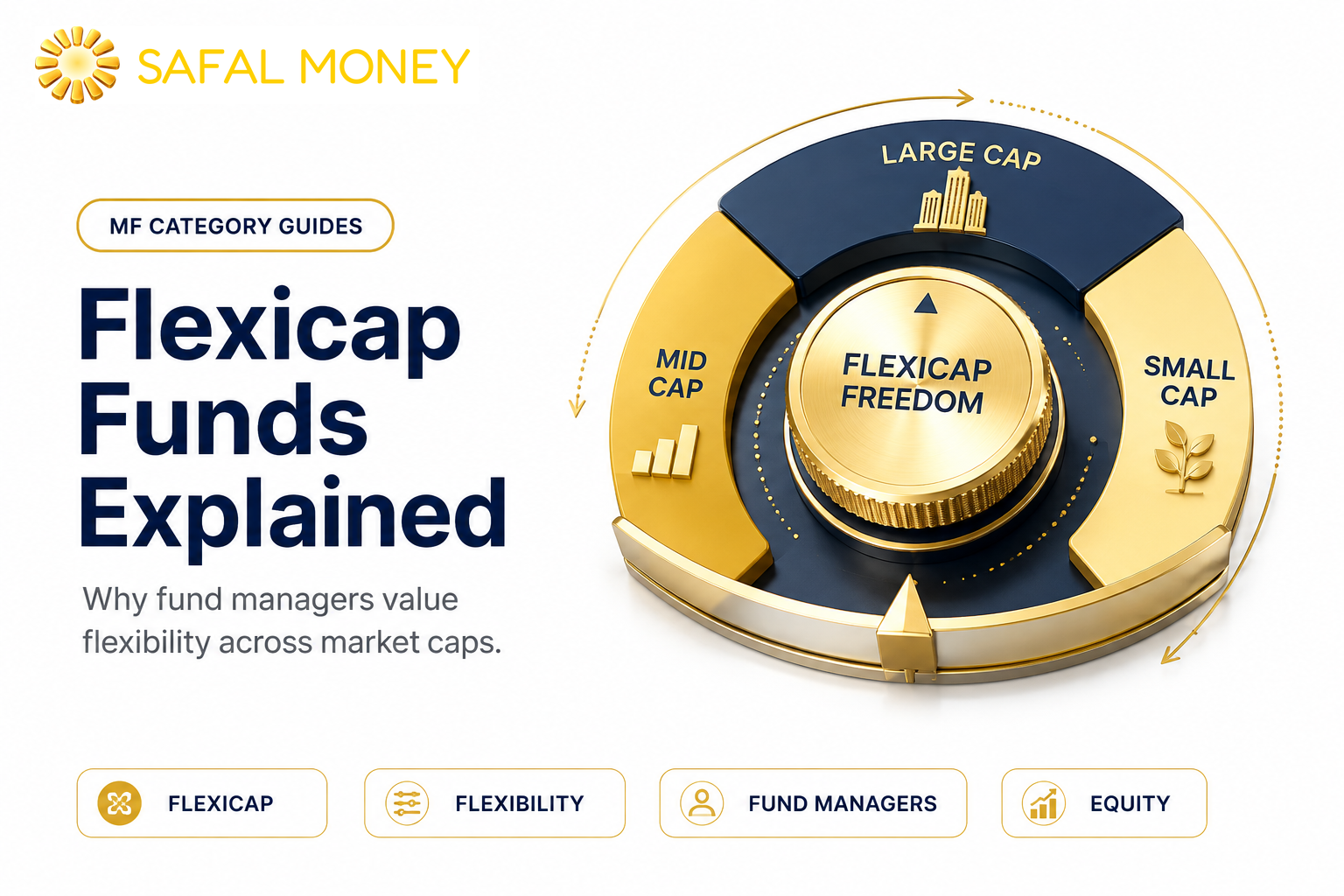
A flexicap mutual fund is a SEBI-regulated open-ended equity fund that must invest a minimum of 65% of its assets in equity and equity-related instruments, with no restriction on how that equity exposure is distributed across large-cap, mid-cap, and small-cap stocks. Unlike multi-cap funds, there is no fixed percentage allocation for each market cap segment - the fund manager can increase exposure to large-caps in volatile markets for stability or shift toward mid and small caps when upcoming market leaders show growth opportunities. This complete allocation flexibility - the ability to be 80% largecap one quarter and 50% midcap the next, driven entirely by the fund manager's conviction - is why the flexicap category has become both the most popular equity category by AUM in India and the most consequential one to choose carefully.
The freedom that makes flexicap funds attractive is also the freedom that makes them the most manager-dependent equity category available to Indian investors. In no other equity category does the fund manager's skill, conviction, and market cycle judgment matter more to the outcome.
What Is a Flexicap Fund? The SEBI Definition Explained
According to SEBI categorisation of mutual funds, a flexi-cap fund is an open-ended equity fund scheme that can invest in large-cap, mid-cap, and small-cap stocks, provided that the total investment in equity and related assets must be at least 65%. While SEBI instructs a flexi-cap to have at least 65% equity allocation, it does not specify particular limits for large-cap, small-cap, and mid-cap stocks - fund managers have greater flexibility to move investments depending on the state of the market.
The 65% equity floor is the only mandatory constraint. The remaining 35% can be in debt, money market instruments, gold ETFs, REITs, or other permissible instruments at the fund manager's discretion. In practice, most actively managed flexicap funds run equity allocations significantly above 65% - often 90–95% - because the fund mandate is fundamentally equity-oriented.
The flexicap category was formally created by SEBI in November 2020, when it separated the "multi-cap" mandate (creating the mandatory 25-25-25 rule for that category) and designated "flexicap" as the unconstrained all-cap equity category. Before that separation, most funds now classified as flexicap operated as "diversified equity funds" without a formal category definition.
Why Do Fund Managers Love Flexicap? The Freedom Advantage
Ask any actively managed equity fund manager in India what their ideal mandate would be, and most would describe something close to a flexicap mandate: the ability to own any quality business in India, regardless of its market cap classification, at whatever allocation they believe is appropriate at any given time.
This freedom translates into three specific advantages that only the flexicap mandate provides:
- Full opportunity set. A largecap fund manager cannot buy a quality midcap company even if it is the best business in the sector. A midcap fund manager must sell a holding when it gets reclassified to largecap, potentially exiting at exactly the point where the business has proven its quality. A flexicap fund manager faces neither constraint - they can own the best business in each sector regardless of its market cap classification and hold it as it grows from midcap to largecap without a forced exit.
- Counter-cyclical positioning. When smallcap and midcap valuations reach extreme levels - as they did in late 2024 - a flexicap fund manager can defensively rotate toward largecaps without violating the fund's mandate. A multicap fund manager cannot take the same step - the 25% floor in smallcap remains binding even when the fund manager believes smallcap is severely overvalued.
- Style expression. Value investors can build concentrated value portfolios across market caps. Growth investors can run quality growth portfolios without market cap constraints. Momentum investors can rotate across the entire market. The flexicap mandate accommodates every active equity investment philosophy - which is why the category contains such wide performance dispersion between the best and worst funds.
The Freedom Paradox: Why Flexicap Requires the Most Careful Fund Selection
The same freedom that makes flexicap the most versatile equity category also creates its most significant investor challenge: performance dispersion in the flexicap category is wider than in any other SEBI equity category.
Funds with stronger recent performance, like Quant Flexi Cap and Motilal Oswal Flexicap, tend to carry higher exposure to mid-cap and small-cap names and higher concentration in their top 10 holdings, which amplifies both upside and downside. Because flexi cap funds can swing allocations between large, mid, and small caps, one-year returns can be misleading in either direction.
The consequence: a flexicap fund that delivered 45% in 2024 may be the same fund that delivers -5% in 2025 - because the high-conviction, concentrated, mid-and-smallcap positioning that generated the 2024 return reverses sharply when the market cycle turns. The fund manager's freedom to concentrate also means freedom to be wrong in a concentrated way.
This is precisely why SafalCheck™'s evaluation of flexicap funds emphasises consistency across multiple market cycles rather than peak-year performance. A flexicap fund with a Sharpe ratio of 0.85 maintained across 5 years of varying market conditions is a more structurally robust choice than a fund with a 1.2 Sharpe in one strong year and 0.3 in the two years before and after.
Flexicap vs Multicap: The Definitive Comparison
The flexicap vs multicap question is the most common category comparison SafalMoney investors ask. The structural difference is clear; the investment implication is subtler.
Structural difference: A multicap fund has mandatory 25% floors in each of the three market cap segments. A flexicap fund has no market cap allocation constraints - only a 65% equity floor. Under SEBI regulations, multi-cap mutual funds must invest at least 25% each in large-cap, mid-cap, and small-cap stocks. Flexi-cap funds do not have such restrictions - fund managers can allocate investments freely across market capitalisations depending on market opportunities.
Investment implication: In practice, many flexicap funds run portfolios that look similar to multicap funds in terms of market cap allocation - because quality businesses exist across all market caps, and most conviction-driven equity managers naturally diversify across large, mid, and small companies. The difference shows most clearly in two situations: (1) when a flexicap manager takes a significant overweight in one market cap segment based on strong conviction, and (2) during bear markets when a flexicap manager rotates defensively toward largecaps while a multicap manager is constrained by the mandatory floors.
For an investor choosing between the two: multicap funds offer built-in regulatory diversification that does not depend on the fund manager's allocation judgment. Flexicap funds offer superior manager flexibility but require the investor to trust that the manager's judgment on market cap rotation will add value rather than destroy it. Both are legitimate long-term investment vehicles - the choice depends on whether you believe active market cap allocation (flexicap) adds value, or whether you prefer structural enforced diversification (multicap).
Who Should Invest in a Flexicap Fund?
- Long-horizon investors who believe in active management. If your investment thesis is that skilled fund managers can identify quality businesses across market caps and rotate between them to generate alpha, the flexicap mandate gives them the most complete toolkit to do so. This thesis requires a 7–10 year minimum horizon to evaluate whether the manager's active decisions are generating genuine alpha rather than being flattered by a favourable market cycle.
- Investors who want a single all-cap equity fund. A well-selected flexicap fund can serve as the equity core of a portfolio, providing exposure to large, mid, and small cap opportunities through a single mandate. This simplicity has genuine value - one fund, one manager evaluation, one tax event at redemption, one monitoring task.
- Investors comfortable with manager-concentration risk. Some of the highest-performing flexicap funds run significantly concentrated portfolios - top 10 holdings above 60% of the portfolio, with strong sector or thematic convictions. These funds deliver exceptional returns in favourable cycles and meaningful drawdowns in unfavourable ones. Investors who understand this dynamic and have the temperament to hold through a difficult phase can benefit from this concentration.
Who Should Not Invest in a Flexicap Fund?
Investors with a horizon under 5 years. A 5-year-plus horizon is generally recommended for this category, as one-year returns can be misleading in either direction. Flexicap funds can experience significant NAV swings based on the fund manager's allocation decisions and market cycle timing.
Investors who cannot evaluate fund manager quality. The flexicap mandate makes the fund manager more important than in any other equity category. An investor who does not have the tools or interest to evaluate a fund manager's track record, consistency, and allocation philosophy should consider the structurally constrained multicap mandate instead, where regulatory requirements do part of the diversification work.
Investors who want to avoid manager-change risk. Because performance is so manager-dependent in the flexicap category, a manager change in a well-performing flexicap fund is a more significant event than the same change in a largecap index-hugging fund. SafalCheck™'s manager stability factor is particularly important when evaluating flexicap funds.
What SafalCheck™ Looks for in a Flexicap Fund
SafalCheck™ applies the standard 7-factor model to flexicap funds, but the relative weighting of factors shifts for this category:
Consistency carries extra weight in flexicap, because the manager's freedom means that one-year performance numbers are particularly susceptible to being driven by a single concentrated bet rather than structural quality. A flexicap fund's calendar-year category-relative performance over 5 years is more informative than the same metric for a largecap fund.
Manager stability is more consequential in flexicap than in any other category. The portfolio's construction - its market cap tilt, sector concentrations, and style characteristics - is a direct expression of one person's (or team's) investment philosophy. A manager change in a flexicap fund often means a portfolio that looks significantly different within 12–18 months.
Portfolio quality and concentration is evaluated carefully - SafalCheck™ flags flexicap funds where the top 10 holdings exceed 65% of the portfolio, because this level of concentration in an unconstrained mandate can indicate a level of manager conviction that introduces binary risk.
Downside protection is evaluated across both market cycle types: broad equity corrections (where largecap-tilted flexicap funds should outperform midcap-tilted peers) and prolonged bear markets (where the manager's ability to rotate defensively should show up as smaller drawdowns).
Key Takeaway
Flexicap has no market cap floor - only a 65% equity floor. That freedom is the category's biggest advantage and its biggest risk: manager stability and multi-cycle consistency matter more here than in any other equity category.
Top Flexicap Funds to Watch in August 2026
Based on SafalCheck™ analysis as of July 2026 month-end data, three flexicap funds stand out for structural quality across the 7 factors:
Parag Parikh Flexi Cap Fund (Direct)
The standout performer on consistency and manager stability. The fund's value-oriented philosophy, genuine international diversification (a unique feature in the Indian flexicap category, with up to 35% in international equities), low portfolio turnover, and stable management team have produced consistent results across multiple market cycles. SafalCheck™ scores this highly on the consistency, manager stability, and downside protection factors.
HDFC Flexi Cap Fund (Direct)
The largest fund in the category by AUM, with a track record spanning over two decades. The fund's longstanding manager, Roshi Jain (from 2022), has maintained the fund's quality-growth orientation. The high AUM creates some constraints on agility in mid and smallcap positioning, but the fund's quality-first approach scores well on portfolio quality and downside protection.
Bank of India Flexi Cap Fund (Direct)
Bank of India Flexi Cap Fund tops data-driven rankings on nearly every count that matters: the highest 3-year return of 22.71% in its peer set, the highest 5-year return of 18.68%, and a Sharpe ratio of 0.85 that is bettered by only two other funds. At a smaller AUM, the fund has more flexibility to deploy in mid and smallcap names. SafalCheck™ scores this strongly on risk-adjusted performance and category-relative ranking; the consistency and manager stability factors merit individual review before investing.
Free, no login required
Free, 2 minutes
Frequently Asked Questions
What is a flexicap mutual fund?
A flexicap mutual fund is a SEBI-regulated open-ended equity fund that must invest at least 65% in equity with no restriction on the allocation between large-cap, mid-cap, and small-cap stocks. The fund manager has complete freedom to determine the market cap split based on market conditions and investment conviction.
What is the difference between a flexicap and a multicap fund?
A multicap fund has mandatory minimum allocations of 25% each in large-cap, mid-cap, and small-cap stocks - these floors are non-negotiable. A flexicap fund has no such caps - the manager can allocate freely across all market caps as long as total equity is above 65%.
Is a flexicap fund good for long-term investment?
Yes, for investors with a 7-10 year horizon who can evaluate and trust the fund manager's approach. Flexicap funds give fund managers the most complete toolkit for generating alpha across market cycles. However, performance is heavily manager-dependent, which makes careful fund selection essential.
Which is better, flexicap or largecap fund?
Flexicap funds offer broader opportunity and potential for higher long-term returns, with higher volatility. Largecap funds offer more stability, lower volatility, and better downside protection - but also more limited upside in bull markets. The choice depends on your investment horizon and risk tolerance.
What makes Parag Parikh Flexi Cap Fund different from other flexicap funds?
Parag Parikh Flexi Cap Fund uniquely invests up to 35% of its portfolio in international equities - providing genuine global diversification that no other Indian flexicap fund offers. Combined with a value-oriented investment philosophy, low portfolio turnover, and stable management, it has delivered consistent results across multiple market cycles.
Last updated: 6 August 2026