Midcap Mutual Funds: The Sweet Spot Between Growth and Risk
Midcap mutual funds invest at least 65% in companies ranked 101–250 by market cap - India's fastest-growing category by AUM. Here's everything you need to know before investing in 2026.
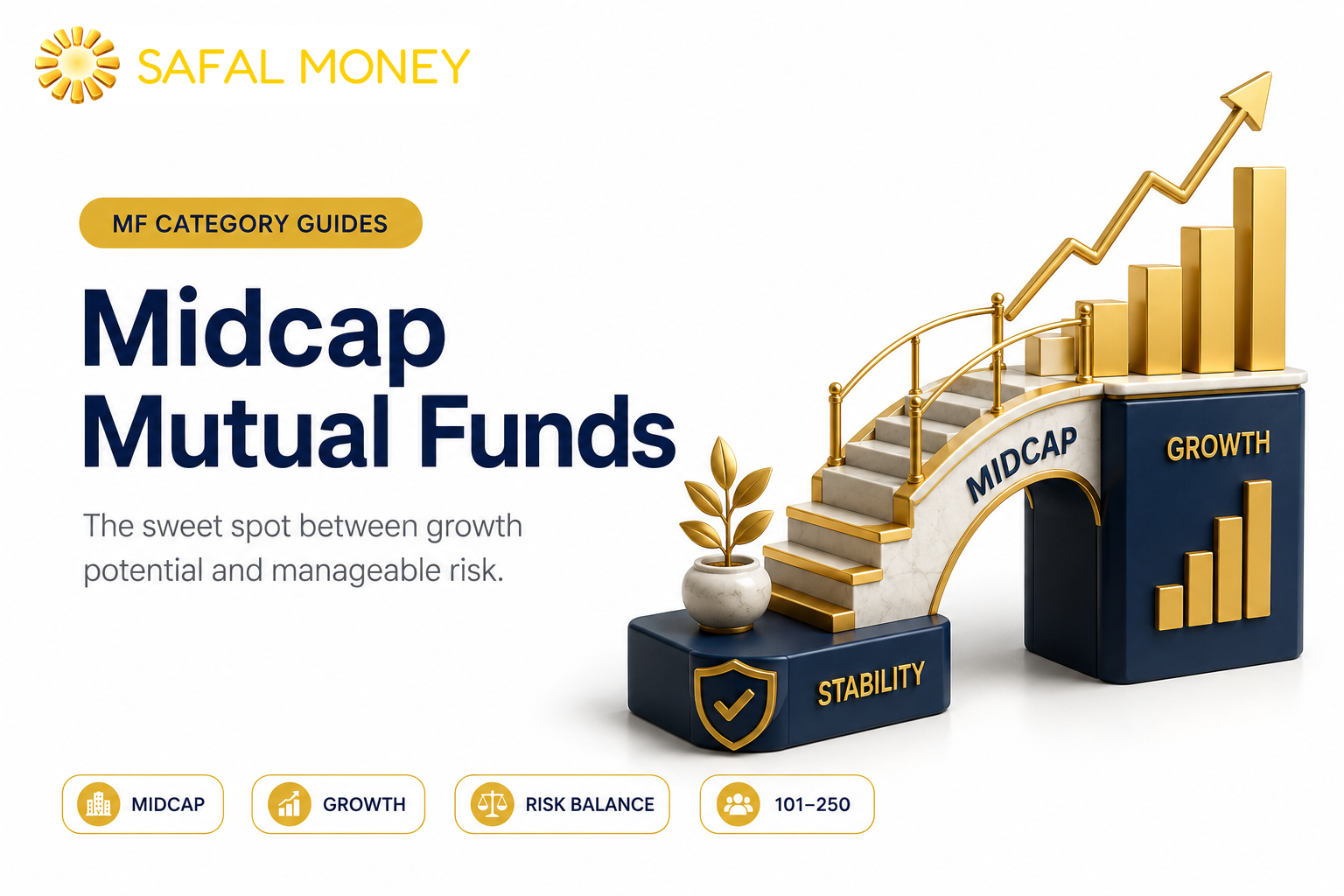
A midcap mutual fund is a SEBI-regulated equity fund that must invest a minimum of 65% of its assets in mid-cap companies - defined as companies ranked 101st to 250th by full market capitalisation among all listed Indian companies. Mid-cap companies are ranked 101 to 250 on the stock exchange by market capitalisation and have the potential to become the next large-cap companies in the future. The midcap category earns its "sweet spot" reputation from a structural characteristic: these companies are established enough to have proven business models and some institutional research coverage - reducing the extreme uncertainty of the smallcap universe - yet young enough in their growth trajectories to deliver meaningfully higher returns than the blue-chip large-cap segment over long horizons.
As of February 2026, the midcap mutual fund category collectively manages over ₹4.96 lakh crore in assets under management - reflecting the growing conviction among Indian investors in this wealth-creating asset class. The midcap category has become the largest equity category by AUM in India - a signal of how central mid-cap exposure has become to the mainstream Indian investor's portfolio.
What Is a Midcap Fund? The SEBI Definition and What It Means
As per SEBI's classification, mid-cap mutual funds are equity funds that invest a minimum of 65% of their total assets in mid-cap stocks. These companies are in the growth phase, offering potential capital appreciation - they are expanding, gaining market share, and building competitive moats in sectors where the growth opportunity is not yet fully reflected in large-cap valuations.
The SEBI definition is precise and updated twice a year through the AMFI market cap list. The companies in the 101–250 rank change as markets move - in a strong bull market, some mid-cap companies graduate to large-cap as their market cap rises. When this happens, midcap fund managers must rebalance: they are required to reduce their holding in the promoted company (which is no longer mid-cap) and deploy into other mid-cap names within 30 days of the AMFI reclassification.
This mandatory rebalancing is one of the defining structural features of active midcap fund management - and one of the sources of both additional return and additional cost in the category. A skilled midcap manager who owns a company before it graduates from mid-cap to large-cap has captured the re-rating premium; the forced exit at large-cap prices crystallises that return but also closes the position.
Why Midcap Is Called the Sweet Spot of Indian Equity Investing
Mid-cap funds are often called the "sweet spot" of equity investing - offering higher growth than large caps with lower risk than small caps. This positioning is structural, not accidental.
Higher growth potential than large caps. India's top 100 companies are the country's most mature, most researched, and most efficiently priced businesses. Their growth rates - while strong in absolute terms - are constrained by the sheer scale of what they have already built. A company with ₹5 lakh crore of revenues cannot double its revenues in 3 years. Many midcap companies can - and do - because they are operating in earlier stages of their growth curves, in faster-growing sub-sectors, or with business models that are beginning to achieve scale advantages.
More analytical coverage than smallcap. Small-cap companies (ranked 251 and below) are frequently under-researched - many have no institutional analyst coverage, limited public disclosure, and governance quality that ranges from excellent to concerning. Mid-cap companies typically have some analyst coverage, more established governance, better balance sheets, and higher liquidity - making the risk of fundamental misvaluation lower than in the smallcap universe.
The graduation premium. When a mid-cap company graduates to large-cap - crossing the top 100 threshold in the semi-annual AMFI list - it is re-rated upward by the market as large-cap funds are required to buy it and it enters indices like the Nifty 100 and Nifty 500. Midcap funds that have identified future large-cap graduates early benefit from this re-rating premium, which is a source of alpha not available to fund managers constrained to the large-cap universe.
The Risk Side of Midcap Investing: What Investors Must Understand
Mid cap funds have high volatility but are less risky than Small Cap Funds. The best recommended time for investment is 5+ years. The volatility profile of midcap funds deserves clear-eyed understanding before investing:
Sharper corrections in bear markets. Midcap stocks fall more severely than largecap stocks in bear markets - and recover more slowly. The liquidity of midcap stocks is lower than large-cap names, meaning institutional sellers cannot exit without moving the price significantly. In the 2022 bear market, the Nifty Midcap 150 TRI fell approximately 25–30% from peak to trough, while the Nifty 50 fell approximately 17–18%. The midcap drawdown was meaningfully deeper, and the recovery path was longer.
Valuation cycles are more pronounced. Mid-cap valuations swing between extremes more dramatically than large-cap valuations. At peak bull market sentiment - as seen in late 2024 - mid-cap stocks were trading at significant premiums to their historical valuation averages. Investors who entered at peak valuations experienced extended periods of underperformance as those valuations normalised. SafalCheck™'s downside protection factor captures this - funds that protected downside in valuation correction periods score higher than those that fell with the market.
Manager skill matters more. Because many mid cap companies receive limited analyst coverage, skilled fund managers have a genuine opportunity to identify mispriced companies. This means that in the midcap category - unlike the large-cap segment - active management can genuinely add value. But it also means that poor stock selection is fully visible in the returns, without a market-efficient price discovery mechanism to bail out a weak thesis. The dispersion between top and bottom midcap fund managers over any 5-year period is substantially larger than in the large-cap category.
Who Should Invest in a Midcap Mutual Fund?
Midcap funds are appropriate for investors who:
- Have a minimum 7-year investment horizon. To benefit from their growth potential, investors should ideally have an investment horizon of 8–10 years. The midcap category requires patience - not just to ride through bear market drawdowns, but also to allow the compounding of quality mid-cap businesses to work at full force. Investors with 5-year or shorter horizons are better served by largecap funds or flexicap funds with a conservative allocation.
- Can tolerate 25–35% drawdowns without panic-selling. The psychological test of a midcap fund is more demanding than a largecap fund. If seeing a 30% decline in your portfolio value would cause you to exit - thereby locking in the loss and missing the recovery - the midcap category is not the right fit. SafalMoney advisors consistently recommend investors experience a market correction in a midcap fund before increasing allocation, so they know their own emotional response to drawdowns.
- Are investing via SIP rather than lump sum in the current environment. The midcap category in August 2026 has returned significantly from 2022 lows and mid-to-late 2024 saw elevated valuations in the category. SIP remains the recommended entry mode - rupee cost averaging across multiple market conditions is particularly valuable in a category with pronounced valuation cycles.
- Want a meaningful growth allocation beyond their largecap core. For investors who have already established a largecap or index fund core, midcap allocation adds a growth kicker that is structurally uncorrelated with large-cap performance over shorter periods, while remaining correlated over full market cycles.
Who Should Not Invest in a Midcap Fund?
Investors with a horizon under 5 years. Midcap funds can remain in drawdown for extended periods - in the 2018–2019 bear phase, many midcap funds took 3–4 years to recover to previous peaks. A 5-year investor who entered at the wrong point in the cycle may exit with returns well below what the long-term track record suggests.
Conservative investors or those approaching retirement. The volatility profile of midcap funds - both in absolute terms and relative to large-cap alternatives - is inappropriate for capital preservation goals or investors who cannot absorb a significant short-term portfolio decline.
Investors with no largecap or index fund base. Midcap should be a satellite allocation, not a core holding in a well-constructed portfolio. Investors who jump directly to midcap without first establishing a stable large-cap or balanced core are taking concentrated category risk that the midcap category's higher expected returns do not fully compensate for in every market cycle.
Key Takeaway
Midcap earns its "sweet spot" reputation structurally: more analyst coverage and governance than smallcap, more growth runway than largecap. But the volatility is real - a 7-10 year horizon and the discipline to hold through 25-35% drawdowns are prerequisites, not optional extras.
What SafalCheck™ Evaluates in a Midcap Fund
SafalCheck™ applies all 7 standard factors to midcap funds, with two factor emphases particularly important in this category:
Consistency carries elevated weight because midcap performance is more susceptible to style cycles than large-cap performance. A midcap fund that scores in the top half of its category in 4 out of 5 calendar years - even if it never leads the table - is demonstrating the kind of repeatable process that compounds reliably over a 10-year SIP. A fund that tops the category in one great year and sits in the bottom quartile in two others is showing the concentrated-bet pattern that creates headline returns but unreliable compounding.
AUM size relative to category liquidity is evaluated informally as part of the portfolio quality factor. A midcap fund with ₹50,000+ crore AUM faces structural challenges in buying and selling mid-cap positions without moving prices - the category's lower liquidity compared to large-cap means AUM size becomes a meaningful constraint on alpha generation as a fund grows.
Top Midcap Funds to Watch in August 2026
Based on SafalCheck™ analysis of July 2026 data, the midcap funds scoring most consistently across all 7 factors include Kotak Emerging Equity Fund (Direct), Nippon India Growth Fund (Direct), and HDFC Mid-Cap Opportunities Fund (Direct) - three funds with long track records, experienced management, and demonstrated consistency across multiple market cycles. Each has maintained competitive expense ratios in the direct plan relative to category peers.
The compounded annual growth rate (CAGR) of top-performing midcap mutual funds ranges between 15–18% over long periods - representing a meaningful premium over large-cap category returns - but this premium comes with the volatility premium described above. Run any midcap fund through SafalCheck™ before investing for the full 7-factor breakdown.
Free, no login required
Free, 2 minutes
Frequently Asked Questions
What is a midcap mutual fund?
A midcap mutual fund invests a minimum of 65% of its assets in companies ranked 101-250 by full market capitalisation, as defined by SEBI. These companies are in active growth phases - larger and more stable than smallcap firms but growing faster than the top 100 large-cap companies.
Is a midcap fund better than a largecap fund?
Midcap funds have historically delivered higher long-term returns than large-cap funds, but with significantly higher volatility and deeper drawdowns in bear markets. The right choice depends on your investment horizon (7+ years recommended for midcap) and risk tolerance.
What is the ideal investment horizon for a midcap fund?
At least 5-7 years is the minimum. Mid caps require patience to ride out cycles and capture compounding. SafalMoney recommends 8-10 years as the optimal horizon for midcap exposure to allow full-cycle return capture.
Should I invest lump sum or SIP in a midcap fund?
SIP is strongly recommended for midcap funds, because the category's pronounced valuation cycles mean lump-sum entry at elevated valuations can result in extended underperformance. Monthly SIPs average the entry price across different market conditions, which is particularly valuable in the midcap category.
How are midcap fund gains taxed in India in 2026?
Midcap funds are equity funds for tax purposes. Gains on units held for 12 months or more are long-term capital gains (LTCG) taxed at 12.5%, with a ₹1.25 lakh annual exemption. Gains on units held for under 12 months are short-term capital gains (STCG) taxed at 20%.
Last updated: 7 August 2026