India's Economic Outlook 2026-2027: What HNI Investors Need to Know
The IMF projects India at 6.4% growth in FY27 and 6.7% in FY28. This complete economic outlook guide covers GDP, inflation, RBI policy, sectors, and how to position your HNI portfolio for India's next two years.
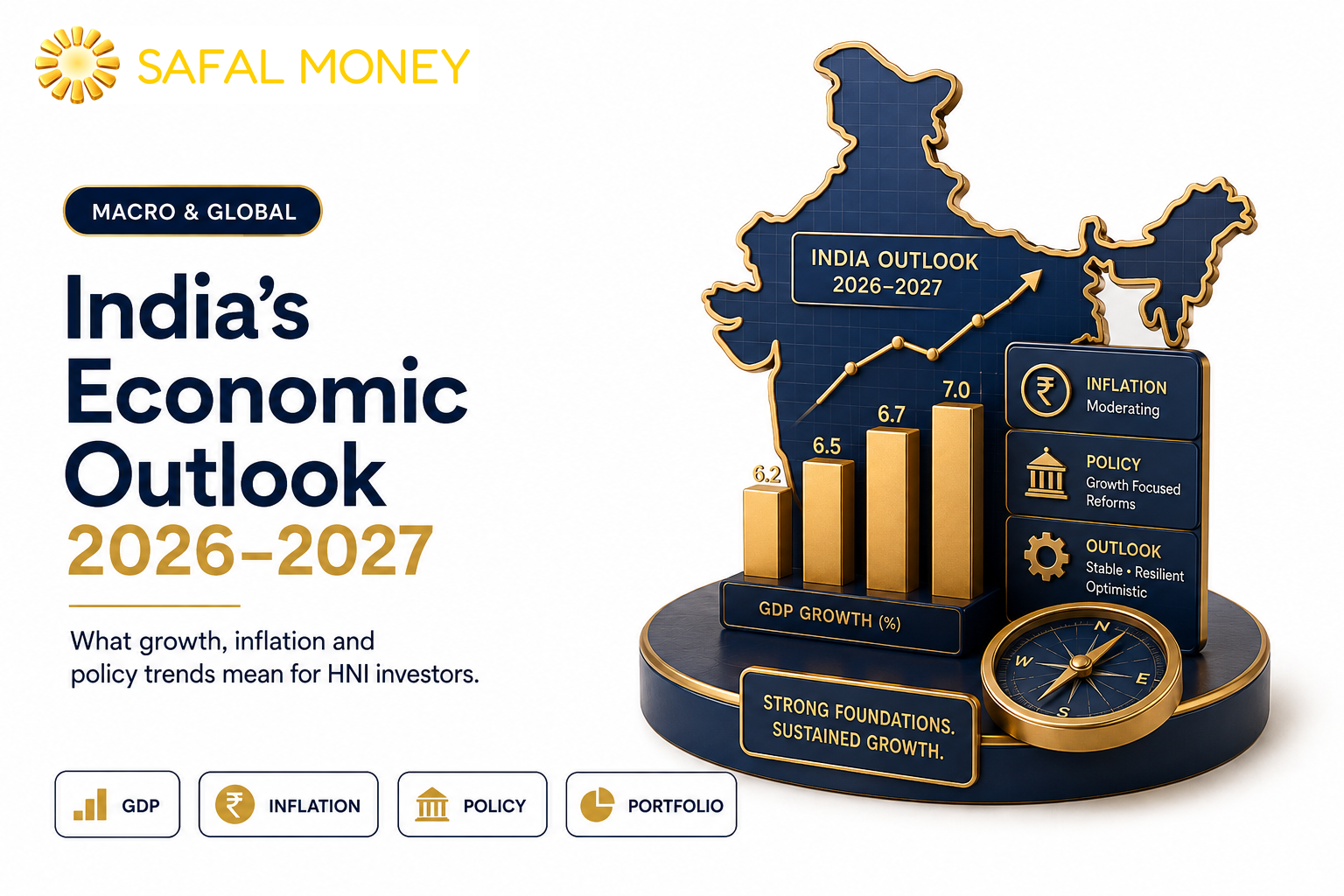
India entered 2026 on the back of its strongest growth year in recent memory - FY2026 delivered revised growth of 7.7%, driven by strong domestic consumption, public capital expenditure, and a services export boom. Then the Iran war changed the trajectory.
The closure of the Strait of Hormuz in March 2026, the resulting oil price spike, and the global economic uncertainty that followed have moderated - though not derailed - India's growth story for FY2026-27.
The International Monetary Fund has marginally lowered India's real GDP growth forecast for 2026 to 6.4%, down by 0.1 percentage point from its April projection, citing a more challenging global environment marked by geopolitical tensions and trade uncertainty. At the same time, the Fund upgraded India's 2027 growth forecast to 6.7%, signalling confidence in the country's medium-term economic prospects.
The RBI cut its FY27 GDP growth forecast to 6.6% from 6.9%, citing risks from the ongoing West Asia conflict, elevated energy prices, supply disruptions, and weather-related uncertainties.
The message from every major institution is consistent: India is slowing from a peak but remains the world's fastest-growing major economy with structural momentum intact. For HNI investors, understanding the nuances of this outlook - what is slowing, what is accelerating, and what the transition from FY27 to FY28 looks like - is the foundation for intelligent portfolio positioning.
The FY27 Growth Story: 6.4-6.8% Is Not Weakness
The consensus forecast across major institutions (IMF, ADB, Deloitte, and RBI/SBI) projects India's real GDP growth for FY2026-27 to settle between 6.4% and 6.8%.
To put this in global context: China is expected to grow by 4.6% in 2026, while the United States is forecast to expand by 2.3%. The Euro area is projected to grow by 0.9%, the United Kingdom by 1%, Japan by 0.6%, and Canada by 1.1%.
India at 6.4-6.8% is growing at nearly 3x the US rate and more than double China's rate - at a time when India is already the world's fifth-largest economy. This is not moderate performance - this is exceptional performance in a genuinely difficult global environment.
The marginal downward revision from FY26's 7.7% growth stems from external risks, including elevated crude oil prices ($95/bbl baseline), West Asian geopolitical tensions, higher import bills, and global trade policy uncertainties. The moderation is driven by external volatility rather than internal economic weakness.
The internal drivers of India's growth - private consumption, credit expansion, government capital expenditure, and manufacturing investment - remain robust. It is the external environment (oil, geopolitics, US Fed hawkishness) that is creating the moderation, not any deterioration in India's fundamentals.
The FY28 Recovery Signal: 6.7% Growth Expected
In its World Economic Outlook July 2026 Update, the IMF raised India's growth estimate for FY28 to 6.7%, up from the earlier projection of 6.5%, signalling confidence in a recovery once the effects of higher energy prices begin to fade.
Looking ahead in 2027, the IMF expects a strengthening of the economy with the energy shock dissipating and medium-term growth being estimated at around 6.5%.
This FY28 upgrade is one of the most important signals in the July 2026 IMF update - it tells investors that the current moderation is cyclical (driven by the transitory oil shock) rather than structural. Once oil prices normalise - which the Iran-US ceasefire framework partially enables - India's growth re-accelerates.
For equity investors with a 3-5 year horizon, this FY28 recovery signal is the foundational thesis for staying invested in Indian equities through the current volatility - the medium-term growth story remains intact even as the near-term environment is challenging.
The Five Pillars of India's Structural Growth - What Makes 6.4-6.7% Sustainable
Strong domestic consumption, credit expansion of 13-14%, and public capital expenditure keep India's economic expansion resilient and top-performing globally. These are not one-time tailwinds - they are structural growth drivers that will sustain India's economic expansion well beyond the current Iran war cycle.
Pillar 1: Domestic Consumption Resilience. India's growth is driven overwhelmingly by domestic consumption - not export dependence. With a population of 1.45 billion and rising per-capita income, India's consumption growth is largely insulated from global demand slowdowns. FMCG, healthcare, consumer finance, and discretionary goods benefit from this structural driver.
Pillar 2: Manufacturing and PLI Supercycle. The Production Linked Incentive scheme has triggered meaningful manufacturing investment across 14 sectors. Strong momentum in private consumption and services activity is complemented by the manufacturing investment wave that is positioning India as the global alternative to Chinese manufacturing. Electronics, auto components, pharmaceuticals, and specialty chemicals are at the forefront.
Pillar 3: Credit Expansion. Credit expansion of 13-14% is fuelling both consumption (consumer loans, housing) and investment (working capital, capex lending). India's banking sector's asset quality has improved dramatically from the NPA crisis of 2015-2019 - the current credit cycle is supported by genuinely clean balance sheets.
Pillar 4: Public Capital Expenditure. India's central government has maintained historically high capital expenditure - infrastructure, roads, railways, defence - that provides both employment and demand regardless of global conditions. This public investment backbone reduces growth volatility significantly compared to export-dependent economies.
Pillar 5: Digital and AI Dividend. India's digital economy - UPI, ONDC, account aggregator, digital commerce - is enabling formalisation and efficiency gains across sectors that add to GDP growth in ways that traditional economic models underestimate. The IMF noted that adverse effects of conflict and policy uncertainty are being partly offset by stronger investment linked to artificial intelligence and digital technologies - a trend where India is disproportionately well-positioned.
The US-India Trade Deal: The Emerging Growth Tailwind
One underreported aspect of India's FY28 growth upgrade is the potential US-India trade relationship resolution.
The IMF's 2027 growth forecast improvement is linked in part to a potential major cut in US tariffs on Indian goods from 50% to 10%. India and the United States are negotiating a trade agreement at a time when Washington has imposed a 50% tariff on India, including a 25% penalty linked to imports of Russian oil.
A successful US-India trade deal - reducing tariffs from 50% to 10% on Indian goods - would be one of the most significant economic events for India in the decade. The sectors that would benefit most:
- Pharmaceuticals - India's largest export to the US; lower tariffs would dramatically improve competitiveness
- Textiles and garments - already shifting manufacturing to India from China; tariff relief would accelerate this
- IT and digital services - a trade deal framework could provide additional regulatory clarity for Indian IT companies operating in the US market
- Engineering goods - auto components, industrial machinery, precision engineering
The US-India trade deal is not a certainty - negotiations are complex and tariff politics in the US are unpredictable. But the direction of travel is positive, and the FY28 growth upgrade partially reflects the expected benefits of this improving trade relationship.
The Three Risks to Watch: What Could Disappoint
A complete economic outlook must be honest about the downside risks. Three specific risks could cause India's growth to fall below the 6.4% IMF base case.
Risk 1: Iran War Escalation - Oil Back to $100+. The most dangerous near-term risk. The Iran-US ceasefire framework remains fragile - fresh tanker attacks in July 2026 have already pushed Brent back above $76. A full breakdown of the MOU and return to active hostilities would push crude to $100+, widening India's current account deficit, weakening the rupee, spiking inflation above 5.5%, and forcing the RBI into a growth-damaging rate hike. This scenario could reduce FY27 growth to 5.5-6.0%.
Risk 2: US Recession - IT and Export Headwinds. If a US recession materialises, Indian IT services - the country's largest foreign exchange earner - would face significant revenue headwinds as US corporate IT budgets are cut. An aggregate 3-4% of India's GDP is directly linked to US IT spending. A US recession combined with high oil prices (stagflation) would be the most challenging scenario for India's external sector.
Risk 3: Monsoon Failure - Food Inflation Spiral. India's 2026 monsoon has been uneven. Concentrated deficiency in key agricultural regions - particularly the crucial Kharif sowing belt - could push food inflation above 7-8%, keeping overall CPI above 5.5% through FY27. This would eliminate any prospect of RBI rate cuts and potentially force rate hikes, dampening both consumption and investment.
Sector Outlook: Where India's Economy Will Grow Fastest in FY27-FY28
Fastest growing sectors (FY27-FY28):
Manufacturing and Industrials. The PLI supercycle continues regardless of oil prices - manufacturing investment decisions are long-horizon. Capital goods, defence, electronics assembly, and auto components are executing multi-year growth plans that are largely insulated from quarterly oil volatility.
Financial Services. Credit growth at 13-14% drives banking sector growth. Private banks with clean balance sheets, NBFCs serving the MSME and consumer segment, and insurance companies benefit from rising financial penetration in India's growing middle class.
Healthcare and Pharmaceuticals. A structurally growing sector driven by rising health consciousness, aging population, and increasing health insurance penetration. API manufacturing and pharmaceutical exports benefit from the global supply chain diversification away from China.
Consumer Discretionary (selective). Domestic consumption resilience supports premium consumer brands, quick-service restaurants, organised retail, and consumer electronics. The segment faces short-term headwinds from higher food inflation reducing disposable income but recovers as oil prices moderate.
IT Services (cautious). US recession risk creates near-term headwinds. But structural demand for AI-related IT services, cloud migration, and digital transformation remains intact. Selective exposure to IT companies with high AI services revenue is more defensible than broad IT sector allocation.
Sectors facing FY27 headwinds: upstream oil and gas (lower crude means lower realisations), Gulf-exposed exporters (weaker GCC government spending), consumer discretionary in urban markets (food inflation impact), and real estate (interest rate uncertainty limiting affordability recovery).
The FII Flows Story: When Does the Money Come Back?
One of the most significant implications of the economic outlook for equity investors is the FII flow picture. India experienced record FII outflows in Q1-Q2 2026 - driven by oil shock uncertainty, rupee weakness, and global risk-off sentiment from the Iran war.
The FY28 upgrade signal from the IMF - 6.7% growth with energy shock dissipating - is exactly the kind of medium-term clarity that brings FII capital back to India. Historically, FII re-entry into Indian equities following large-scale exits has driven sharp, fast Nifty rallies as the narrative transitions from uncertainty to recovery.
The trigger conditions for FII re-entry: Iran-US deal stabilises, crude falls sustainably below $80, India's CPI moderates, RBI signals rate cuts, US Fed stops hiking, EM risk appetite improves, then FII buys India. This sequence could play out over 6-18 months. Investors who stay in Indian equities through the current uncertainty phase are positioned to capture this re-entry driven rally.
Portfolio Positioning for India's 2026-2027 Economic Outlook
Equity positioning: Overweight domestic growth themes (consumption, manufacturing, financial services, healthcare) that benefit from India's structural 6.4-6.7% growth regardless of the global environment. Underweight export-dependent sectors facing US recession risk or Gulf headwinds. Use selective mid cap active funds - where skilled managers can identify the specific PLI beneficiaries and manufacturing supercycle winners that are not yet priced into index valuations.
Debt positioning: The current moderation narrative (6.4% growth, 4.38% inflation) argues against aggressive long-duration positioning. The FY28 recovery narrative (6.7% growth, dissipating oil shock, potential rate cuts) argues for building selective medium-duration exposure now, before the rate-cut cycle begins. A barbell of floater plus short duration (defensive) and selective medium duration (opportunistic) reflects both narratives simultaneously.
SIF positioning: The sector divergence created by India's uneven growth environment - some sectors at the leading edge of PLI and manufacturing investment, others facing oil and global headwinds - is precisely the environment where Equity Long-Short SIF can generate meaningful alpha from the spread between winners and losers. Use SafalZenith to determine your SIF allocation and SafalCheck™ to identify which SIF funds are positioning for India's manufacturing and consumption growth themes on the long side.
Gold positioning: India's 6.4% growth scenario combined with 4.38% CPI, negative US real rates, and ongoing Iran war uncertainty supports gold at 8-10% of portfolio - higher than the typical 5% baseline. The FY28 recovery scenario does not necessarily reduce gold's value - it may accelerate RBI rate cuts (supporting gold) while the Iran war tail risk remains.
The China Comparison: Why India's Relative Attractiveness Is Increasing
The contrast between India's 6.4% FY27 growth and China's expected 4.6% is not just a number - it represents a fundamental shift in emerging market portfolio allocation that favours India structurally.
India growing at 6.4% with strong credit expansion, improving manufacturing competitiveness, and a young workforce is at a fundamentally different stage of its growth cycle than China - which is dealing with property crisis, deflation risk, demographic decline, and geopolitical isolation from Western supply chains.
For global institutional investors managing emerging market portfolios, this relative performance gap makes India an increasingly compelling overweight and China an increasingly compelling underweight. The MSCI EM reweighting toward India is a structural tailwind that will drive passive buying regardless of active investment decisions.
For Indian HNI investors, this global capital reallocation narrative reinforces the case for staying invested in Indian equities through the current volatility - the medium-term pull of global capital toward India is a powerful force that works in your portfolio's favour over a 3-5 year horizon.
Free, no login required
Frequently Asked Questions
What is India's GDP growth forecast for FY27 2026-2027?
The consensus forecast across major institutions projects India's real GDP growth for FY2026-27 to settle between 6.4% and 6.8%. The IMF projects 6.4% for FY27, down marginally from its April projection of 6.5%, citing the impact of Iran war energy prices and global trade uncertainty. The RBI projects 6.6% for FY27, cut from its earlier 6.9% estimate. Despite the moderation from FY26's 7.7%, India remains the world's fastest-growing major economy.
What is India's GDP growth forecast for FY28 2027-2028?
The IMF upgraded India's 2027 growth forecast to 6.7%, signalling confidence in a recovery once the effects of higher energy prices begin to fade. Looking ahead in 2027, the IMF expects a strengthening of the economy with the energy shock dissipating. The FY28 upgrade reflects expected stabilisation of oil prices from the Iran war shock and potential benefits from improving US-India trade relations.
How does India's economic outlook compare to China and the US for 2026?
China is expected to grow by 4.6% in 2026, while the United States is forecast to expand by 2.3%. India's 6.4-6.8% growth is nearly 3x the US rate and approximately 1.5x China's - making India the clear global growth leader among major economies. This relative growth advantage is driving increasing MSCI EM weight allocation toward India and away from China, creating a structural FII inflow tailwind for Indian equities over the medium term.
What are the biggest risks to India's economic growth in FY27?
Three key risks: oil price re-escalation from Iran war breakdown (could push CPI above 5.5% and force RBI rate hikes, reducing growth to 5.5-6.0%), US recession impacting IT services exports (3-4% of GDP directly linked to US corporate IT spending), and monsoon failure pushing food inflation above 7% (eliminating rate cut prospects and dampening rural consumption). The base case remains 6.4-6.6% growth - but these risks collectively represent meaningful downside probability that warrants portfolio resilience across multiple scenarios.
Which sectors will benefit most from India's economic growth in FY27-FY28?
The fastest-growing sectors in India's FY27-FY28 economic environment are manufacturing and industrials (PLI supercycle continues), financial services (credit growth 13-14%), healthcare and pharmaceuticals (structural consumption and export growth), consumer staples (domestic resilience), and selective IT (AI services demand). Sectors facing headwinds include upstream oil and gas, Gulf-exposed exporters, and broad consumer discretionary (food inflation pressure on disposable income).
Last updated: 22 July 2026