The Ultimate Mutual Fund Portfolio for Retirement in India: Category-by-Category Guide
The definitive retirement mutual fund portfolio for Indian HNI investors - category-by-category allocation, bucket strategy, inflation protection, SIF role, and three complete case studies across retirement phases.
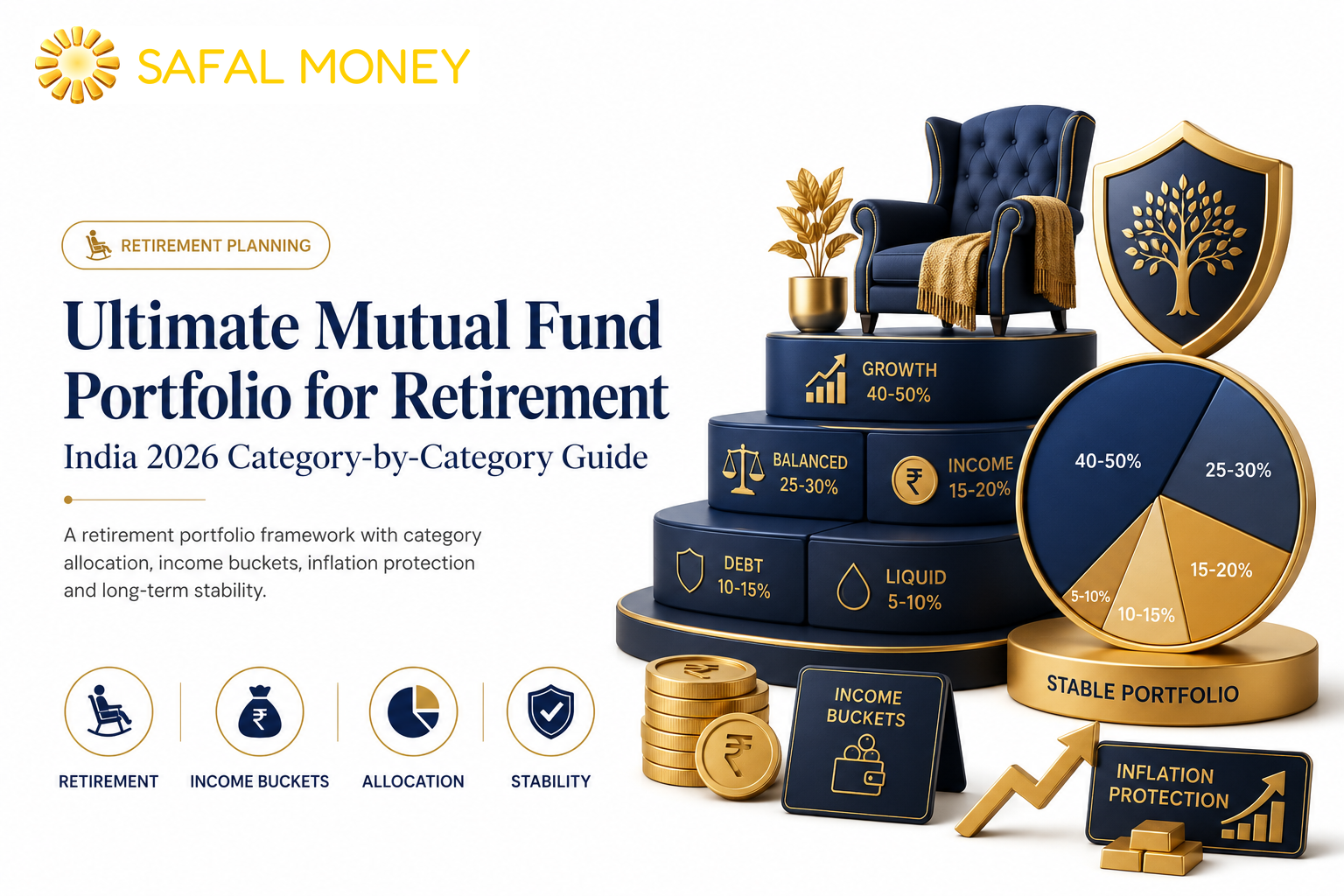
Retirement planning in India has three distinct problems that most standard advice fails to address simultaneously.
The first problem is longevity. A 60-year-old Indian professional today has a realistic life expectancy of 83–87 years. A retirement portfolio must work for 23–27 years — not the 15 years that older planning models assumed. Many Indians are planning for retirement that will end before their money runs out — but the money runs out first.
The second problem is inflation. India's consumer price inflation has averaged 6–7% annually over the past two decades. Healthcare inflation for retirees runs at 10–12%. A retirement portfolio generating 7% in FDs is not preserving wealth — it is slowly losing to inflation after tax.
The third problem is sequence-of-returns risk. A 30% market correction in year 1 of retirement — when the corpus is at its maximum — permanently impairs the portfolio's ability to sustain withdrawals for 25+ years. The same 30% correction in year 20 of retirement is far less damaging.
The only portfolio structure that addresses all three problems simultaneously is one that maintains meaningful growth assets throughout retirement — not just in the accumulation phase. This guide builds that portfolio, category by category, for Indian HNI investors across three retirement phases. For how SIF specifically fits this blueprint, see our dedicated deep-dive.
The Three Retirement Phases and Their Portfolio Requirements
Phase 1: Pre-Retirement Transition (Age 55–65). Primary objective: begin shifting from accumulation to distribution without abandoning growth. Portfolio is at or near peak size. Sequence-of-returns risk begins to matter. The key mistake in this phase: going too conservative too early.
Phase 2: Early Retirement (Age 65–75). Primary objective: sustain withdrawals while maintaining real (inflation-adjusted) corpus value. This is the highest-stakes phase — the decisions made here determine whether the portfolio lasts to age 85 or runs dry at 78.
Phase 3: Late Retirement (Age 75+). Primary objective: capital preservation with sufficient growth to maintain purchasing power. Healthcare costs dominate. Portfolio should be simpler, more liquid, and more conservative — but not entirely in FDs.
The Bucket Strategy: The Foundation of Retirement Portfolio Architecture
Before assigning mutual fund categories, establish the bucket structure that governs how the portfolio is organised and accessed.
Bucket 1 — Immediate Liquidity (0–2 years of expenses). Purpose: day-to-day living expenses and near-term financial obligations. Must be accessible within T+1 — no delay, no redemption windows, no risk. Instruments: liquid funds, overnight funds, savings account. Size: 2 years of annual expenses. On ₹18 lakh annual expenses, this bucket holds ₹36 lakh. Rule: never invest this bucket in anything that cannot be accessed within 24 hours.
Bucket 2 — Near-Term Income (2–7 years of expenses). Purpose: systematically replenish Bucket 1 as it is depleted. Provides the income foundation for years 2–7 of retirement without needing to sell growth assets. Instruments: short duration funds, banking and PSU funds, corporate bond funds. Optional: SWP (Systematic Withdrawal Plan) from balanced/hybrid funds. Size: approximately 5 years of annual expenses — so ₹90 lakh on ₹18 lakh expenses. Rule: deploy with a SWP into Bucket 1 annually — letting compounding do the work between replenishments.
Bucket 3 — Long-Term Growth (remaining corpus). Purpose: grow faster than inflation over a 10–20 year horizon. Replenish Bucket 2 every 3–5 years. Provide legacy corpus. Must maintain meaningful equity and SIF exposure. Instruments: equity index funds, active mid cap funds, Hybrid Long-Short SIF, gold, REITs. Rule: touch this bucket only to replenish Bucket 2 — never for day-to-day needs. Allow it to compound without interruption.
Category-by-Category Role in the Retirement Portfolio
Category 1: Liquid Fund — The Non-Negotiable Emergency Layer
Role: Bucket 1 foundation. Immediate access for all living expenses and emergencies.
Why it belongs: no retirement portfolio should have a single day where the retiree cannot access money for essential expenses. The liquid fund is the bedrock — immune to market conditions, always accessible at T+1.
Sizing: 2 years of expenses minimum. For a couple with ₹1.5 lakh monthly expenses, this is ₹36 lakh in liquid funds.
Which liquid fund: any large, well-managed liquid fund from a top-tier AMC. Choose direct plan. Consider splitting across two liquid funds for large amounts above ₹25 lakh.
The SWP connection: set up a monthly SWP from Bucket 2 into a linked savings account or liquid fund to automatically maintain the Bucket 1 balance — eliminating the need to manually transfer funds each month.
Category 2: Banking and PSU Fund — The Stable Income Core of Bucket 2
Role: the largest component of Bucket 2. Generates steady income while preserving capital.
Why it belongs: banking and PSU funds — with their quasi-sovereign credit backing and predictable 2–4 year duration — are the most appropriate instrument for the 2–5 year expense funding layer in a retirement portfolio. They are significantly more tax-efficient than FDs (12.5% LTCG after 24 months vs 30%+ for FD interest), carry minimal credit risk, and generate steady yield without requiring market timing.
Sizing: 20–25% of total retirement corpus. On a ₹4 crore retirement corpus, approximately ₹80 lakh–₹1 crore.
The SWP strategy: invest a lump sum and set up a SWP to draw ₹1–1.5 lakh monthly — systematically replacing Bucket 1 withdrawals with Bucket 2 income without selling equity or SIF assets.
Category 3: Short Duration Fund — The Tactical Debt Layer
Role: complements banking and PSU fund in Bucket 2. Provides slightly better yield with comparable credit quality and 1–3 year duration.
Why it belongs: short duration funds — invested in 1–3 year instruments across AAA corporate bonds and government securities — add yield above liquid funds without the interest rate sensitivity of longer-duration instruments. In the current rate environment (RBI at 5.25%), short duration funds yielding 7–7.5% direct offer meaningful income for the retirement portfolio.
Sizing: 10–12% of total retirement corpus — complementing the banking PSU allocation in Bucket 2.
Category 4: Balanced Advantage Fund — The Moderate Growth Engine
Role: the bridge between Bucket 2 and Bucket 3. Provides growth with dynamically managed downside protection — making it suitable for money with a 3–7 year horizon in retirement.
Why it belongs: Balanced Advantage Funds are among the most retirement-appropriate equity-containing instruments because their valuation model explicitly reduces equity during expensive markets — precisely when retirees are most vulnerable to a sudden correction. The dynamic allocation reduces sequence-of-returns risk while maintaining meaningful equity participation.
In Phase 1 (pre-retirement transition) and early Phase 2 (retirement 65–72), BAFs serve as the primary growth vehicle — gradually replaced by more conservative instruments as the retiree ages.
Sizing: 15–20% of total retirement corpus in Phase 1. Reducing to 10–12% by Phase 3.
Category 5: Large Cap Index Fund — The Low-Cost Equity Core
Role: the core equity growth engine of Bucket 3. Provides broad India equity market participation at minimal cost.
Why it belongs: in retirement, cost efficiency becomes even more important than in accumulation — because every basis point of expense ratio reduces the portfolio's income-generating capacity. A Nifty 50 direct plan index fund at 0.10% expense ratio delivers market-matching returns at almost no cost, allowing the equity portion of the retirement portfolio to compound efficiently.
Large cap index funds in retirement provide:
- Broad diversification — no single-stock or single-sector risk
- Daily liquidity — can be redeemed at any time if needed for Bucket replenishment
- Inflation-beating returns over 10+ year periods based on historical data
- Minimal management risk — no fund manager departure concern
Sizing: 12–18% of total retirement corpus in Phase 2. Reducing to 8–10% in Phase 3 as equity allocation gradually declines.
Category 6: Hybrid Long-Short SIF — The Growth-with-Protection Layer
Role: the most distinctive component of the retirement portfolio. Provides equity-like growth potential with structural downside protection through the short book — addressing sequence-of-returns risk more directly than any conventional mutual fund category.
Why it belongs in retirement: the core retirement planning challenge — maintaining growth without catastrophic drawdown — is precisely the problem that Hybrid Long-Short SIF is designed for. The short book provides downside cushioning during corrections, while the equity and arbitrage components generate growth and income across market environments.
For retirement portfolios specifically, the Hybrid Long-Short SIF serves as a superior alternative to conventional aggressive hybrid funds — providing similar average return potential with better drawdown management through the derivatives overlay.
Sizing: 12–15% in Phase 1 (pre-retirement). 10–15% in Phase 2 (early retirement). 8–10% in Phase 3 (late retirement, shifting entirely to the most conservative Hybrid Long-Short strategies available).
Only Hybrid Long-Short SIF Belongs in a Retirement Portfolio
Pure Equity Long-Short SIF — which carries Very High volatility and is designed for aggressive 5+ year accumulation investors — is not appropriate for retirees or pre-retirees.
Use SafalZenith to calculate your specific SIF allocation within the retirement context, and SafalCheck™ to evaluate which Hybrid Long-Short SIF funds have the strongest SafalScore™ for conservative retirement use.
Category 7: Gold — The Inflation and Crisis Hedge
Role: portfolio insurance against the two risks that most damage retirees — inflation and systemic financial crisis.
Why it belongs: gold has historically maintained its purchasing power over very long periods — making it a natural inflation hedge for retirees whose most critical risk is purchasing power erosion. Gold also performs well during geopolitical crises (as demonstrated during the 2026 Iran war), currency weakness, and systemic financial stress — exactly the environments that can damage a retiree's equity and debt holdings simultaneously.
For retirees specifically, Sovereign Gold Bonds offer the most attractive gold investment structure:
- 2.5% annual interest paid semi-annually (additional income for the retirement corpus)
- Capital gains tax exemption on maturity (8 years) — no LTCG tax on price appreciation
- Government of India backing — no credit risk
Sizing: 8–12% of total retirement corpus. Higher towards 12% in Phase 1 and 2 when building the inflation hedge, potentially reducing to 8% in Phase 3 as absolute wealth preservation takes priority.
Category 8: REITs and InvITs — The Regular Income Layer
Role: provides a regular income stream from real assets — commercial real estate and infrastructure — that is partially indexed to inflation and diversified from both equity and debt.
Why it belongs: listed Indian REITs — Embassy REIT, Brookfield REIT, Mindspace REIT — currently distribute approximately 7–8% annually from commercial office space rental income. InvITs provide similar yields from infrastructure assets. This income distribution occurs quarterly — providing a reliable income stream that complements the SWP from Bucket 2 debt funds.
REITs also provide indirect real estate exposure without the illiquidity of physical property — allowing retirees to maintain real asset diversification without locking up large amounts in a single property.
Sizing: 5–8% of total retirement corpus. This allocation remains relatively constant across retirement phases — the income generation role makes it valuable at all stages.
Three Complete Retirement Portfolio Case Studies
Case Study 1: Suresh Iyer, Age 62 — Pre-Retirement Transition Phase (₹2 crore corpus)
Profile: 62 years old, retiring at 65, monthly expenses ₹1.2 lakh (₹14.4 lakh annually), pension ₹45,000/month covering 37.5% of expenses, ₹2 crore corpus, conservative-moderate risk profile.
Annual corpus withdrawal needed from portfolio: ₹14.4L − ₹5.4L (pension) = ₹9L per year from portfolio.
| Allocation | Category | Amount | Role |
|---|---|---|---|
| 18% | Liquid + Money Market (Bucket 1) | ₹36L | 4 years of net portfolio expenses |
| 20% | Banking PSU + Short Duration (Bucket 2) | ₹40L | 4-year income reservoir |
| 10% | Hybrid SIF — Altiva Hybrid L/S | ₹20L | Growth with protection |
| 18% | Balanced Advantage Fund | ₹36L | Moderate growth engine |
| 14% | Large Cap Index Fund | ₹28L | Low-cost equity core |
| 10% | Gold SGB | ₹20L | Inflation hedge + income |
| 6% | REITs | ₹12L | Real asset income |
| 4% | Active Mid Cap (reducing) | ₹8L | Residual growth satellite |
| 100% | Total | ₹2 crore |
Key Planning Note
Suresh's pension covers 37.5% of expenses — significantly reducing portfolio withdrawal pressure. His Bucket 1 (₹36L) covers 4 years of net portfolio expenses at ₹9L/year. Bucket 2 (₹40L) covers another 4.4 years. Combined, 8+ years of expenses are covered before needing to touch growth assets — excellent protection against sequence-of-returns risk.
Case Study 2: Rajesh and Priya Mehta, Age 67 — Early Retirement Phase (₹4 crore corpus)
Profile: both 67, no pension, monthly expenses ₹2.2 lakh (₹26.4 lakh annually), ₹4 crore corpus, moderate risk profile, target: portfolio to last to age 90.
Annual withdrawal rate: ₹26.4L / ₹4 crore = 6.6% — above SafalMoney's recommended 3–3.5% Indian withdrawal rate. This is a critical finding: the Mehtas need to immediately reduce expenses or plan for corpus depletion in their early 80s if investment returns do not substantially outpace withdrawals. This case study illustrates why maintaining growth assets is non-negotiable.
| Allocation | Category | Amount | Role |
|---|---|---|---|
| 12% | Liquid Fund (Bucket 1) | ₹48L | 1.8 years of expenses |
| 25% | Banking PSU + Short Duration (Bucket 2) | ₹1 crore | 3.8 years of expenses in income reservoir |
| 13% | Hybrid SIF — Altiva Hybrid L/S | ₹52L | Growth with protection — critical role |
| 15% | Balanced Advantage Fund | ₹60L | Core moderate growth |
| 12% | Large Cap Index | ₹48L | Equity market participation |
| 10% | Gold SGB + ETF | ₹40L | Inflation hedge essential at 6.6% withdrawal |
| 8% | REITs + InvITs | ₹32L | Regular income — reduces equity withdrawal need |
| 5% | Flexi Cap Active Fund | ₹20L | Additional growth at this withdrawal rate |
| 100% | Total | ₹4 crore |
Key Planning Note
The Mehtas' 6.6% withdrawal rate is unsustainable unless portfolio returns significantly exceed this rate. The 13% Hybrid SIF allocation is critical — it is one of the primary mechanisms for achieving better risk-adjusted growth that can sustainably fund above-average withdrawals. The REIT income (₹2.24L annually at 7% yield on ₹32L) directly reduces portfolio withdrawal — effectively replacing nearly one month of expenses from non-portfolio income.
Case Study 3: Nandita Kapoor, Age 74 — Late Retirement Phase (₹3 crore corpus)
Profile: 74 years old, monthly expenses ₹1.8 lakh (₹21.6 lakh annually) including significant healthcare, pension ₹80,000/month covering 44.4% of expenses, ₹3 crore corpus, conservative risk profile, primary concern: healthcare costs and legacy.
Annual portfolio withdrawal needed: ₹21.6L − ₹9.6L (pension) = ₹12L per year from portfolio. Withdrawal rate: 4% — manageable.
| Allocation | Category | Amount | Role |
|---|---|---|---|
| 20% | Liquid + Money Market (Bucket 1) | ₹60L | 5 years of net portfolio expenses |
| 30% | Banking PSU + Short Duration (Bucket 2) | ₹90L | 7.5 years income reservoir — priority at 74 |
| 8% | Hybrid SIF — Altiva Hybrid L/S only | ₹24L | Minimum growth-with-protection layer |
| 12% | Balanced Advantage Fund | ₹36L | Moderate growth with lower volatility |
| 10% | Large Cap Index | ₹30L | Essential equity participation |
| 12% | Gold SGB (maturing over 8 years) | ₹36L | Critical inflation hedge + maturity income |
| 8% | REITs | ₹24L | Regular income: ₹1.68L/year at 7% |
| 100% | Total | ₹3 crore |
Key Planning Note
At 74, Nandita's portfolio is significantly more conservative than at 62 or 67. Bucket 1 + Bucket 2 together cover 12.5 years of net portfolio withdrawals — ensuring she never needs to sell growth assets under market duress through age 86. The 8% Hybrid Long-Short SIF is the minimum growth-with-protection allocation retained — SafalMoney recommends maintaining at least this level of uncorrelated growth even at this stage. Gold SGBs maturing over the next 8 years provide predictable tax-free capital returns that supplement income.
The Retirement Portfolio Checklist: Annual Review Framework
Every retirement portfolio should be reviewed annually against these 8 checkpoints:
- Bucket 1 adequacy. Is the liquid fund still covering 2 years of current expenses? Expenses typically grow 6–8% per year — the absolute amount in Bucket 1 must grow accordingly.
- Bucket 2 SWP calibration. Is the SWP amount from Bucket 2 still appropriate for current expenses after pension and REIT income? Adjust annually.
- SIF performance review. Use SafalCheck™ to review the SafalScore™ of your Hybrid Long-Short SIF fund. If performance has deteriorated relative to peers, consider switching to a higher-rated alternative.
- SIF allocation recalculation. Use SafalZenith annually to recalculate ideal SIF allocation — which should decline as age and horizon change.
- Gold SGB maturity planning. Track SGB maturity dates — plan whether to roll into new SGBs or use proceeds to replenish Bucket 2.
- Healthcare provision adequacy. Does the portfolio have sufficient liquid reserves for potential large healthcare expenses? Consider maintaining a dedicated ₹10–20 lakh healthcare buffer in a short-duration fund separate from Bucket 1.
- Legacy planning. Is the portfolio on track to generate the intended legacy corpus at the end of life? If yes, consider whether expenses can be increased — many retirees underspend due to excessive conservatism.
- Inflation reality check. What is the real (inflation-adjusted) return of the portfolio this year? If nominal return minus actual personal inflation is negative, the portfolio is being depleted in real terms — action required.
Free tool, no login required
Frequently Asked Questions
What is the best mutual fund portfolio for retirement in India?
The best retirement mutual fund portfolio combines a bucket strategy with category-specific allocation across the full retirement horizon. Bucket 1 holds 2 years of expenses in liquid funds for immediate access. Bucket 2 holds 5 years of expenses in banking PSU and short-duration funds for income generation. Bucket 3 holds the growth portfolio - large cap index funds, balanced advantage funds, Hybrid Long-Short SIF, gold SGBs, and REITs - to beat inflation and sustain withdrawals for 20-25 years. The specific allocation within each bucket depends on the retiree's age, pension income, withdrawal rate, and risk profile.
How much equity should a retired HNI investor hold?
A retired HNI investor should maintain meaningful equity exposure throughout retirement - not eliminate it. As a general guideline: 40-50% equity exposure in early retirement (age 60-70), reducing to 25-35% in mid-retirement (age 70-78), and 15-20% in late retirement (age 78+). Eliminating equity entirely creates the real risk of inflation erosion that depletes purchasing power faster than market volatility would. The Hybrid Long-Short SIF allocation is included within the equity exposure calculation - it provides equity-like growth with structural downside protection.
What role does SIF play in a retirement mutual fund portfolio?
Hybrid Long-Short SIF serves a specific and valuable role in the retirement portfolio - providing equity-like growth potential with structural downside protection through the short book. This directly addresses sequence-of-returns risk - the most dangerous risk in early retirement. A 10-15% allocation to Hybrid Long-Short SIF in the retirement portfolio can moderately cushion market corrections that would otherwise permanently impair a portfolio's ability to sustain withdrawals. Use SafalZenith to calculate your specific SIF allocation within the retirement context.
Is a Balanced Advantage Fund good for retirement?
Yes - Balanced Advantage Funds are among the most retirement-appropriate equity-containing instruments because their valuation model explicitly reduces equity during expensive markets. This dynamic allocation reduces the sequence-of-returns risk that is the primary danger in early retirement. BAFs also qualify as equity-oriented funds for tax purposes (LTCG at 12.5% after 12 months), making them more tax-efficient than debt funds for the growth component of the retirement portfolio. They work best as a core holding in Bucket 3 for retirees aged 60-75.
How do I create a SWP for retirement income from mutual funds?
A Systematic Withdrawal Plan (SWP) allows you to automatically redeem a fixed amount from a mutual fund at regular intervals - monthly, quarterly, or annually - into your bank account. For retirement, set up an SWP from your Bucket 2 debt funds (banking PSU or short duration funds) for the monthly income you need after pension and REIT distributions. The SWP should be sized to cover net living expenses not covered by other income sources. Review and adjust the SWP amount annually to account for expense inflation. Avoid setting up SWP from equity or SIF funds - these should compound undisturbed in Bucket 3 until you need to replenish Bucket 2.
Last updated: 17 July 2026