Balanced Advantage Funds vs Aggressive Hybrid Funds: Which HNI Should Choose?
Balanced Advantage Fund or Aggressive Hybrid Fund - which is right for your HNI portfolio? This 2026 guide compares both across dynamic allocation, volatility, returns, tax and the current market environment.
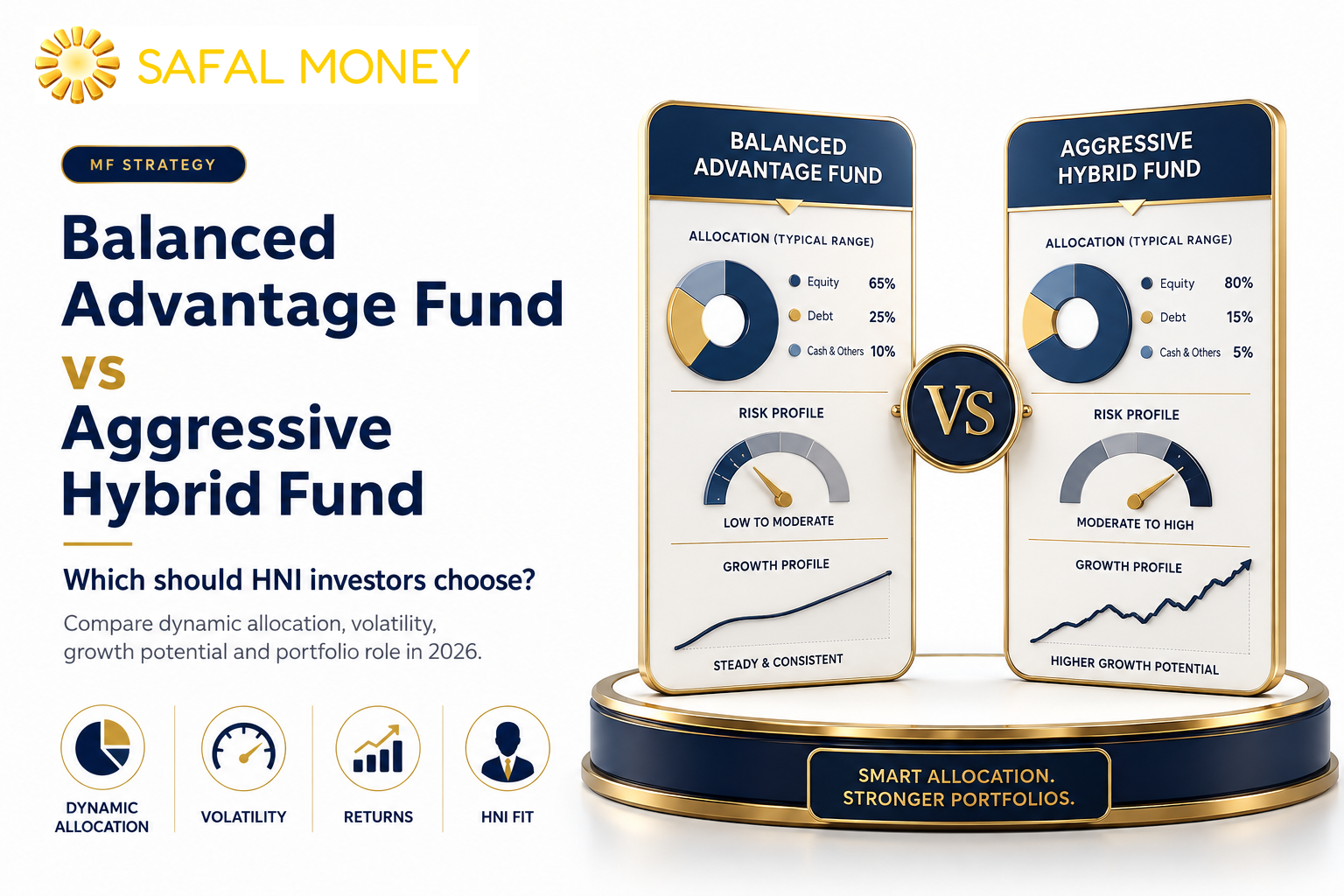
Among India's hybrid mutual fund categories, two stand out as the most practically relevant for HNI investors — the Balanced Advantage Fund (BAF) and the Aggressive Hybrid Fund. Both blend equity and debt. Both are suitable for moderate-to-aggressive investors. Both are used as core holdings in diversified HNI portfolios.
But they are fundamentally different in how they manage the equity-debt mix — and that difference has significant consequences for returns, volatility, and ideal investor fit.
This guide gives you the precise comparison: what each category does, why it does it differently, and which one belongs in your portfolio — or whether you need both.
What Is a Balanced Advantage Fund? The SEBI Definition and Logic
A Balanced Advantage Fund — also called a Dynamic Asset Allocation Fund — has no fixed equity mandate. It can move from 0% to 100% equity in either direction based on a proprietary valuation or allocation model. SEBI does not impose a minimum equity floor on this category.
The defining feature is dynamic allocation — the fund manager (or, more accurately, the model) systematically adjusts the equity-debt mix based on market valuation signals. When equity markets are expensive (high PE, high PB, high market-to-GDP), the model reduces equity and increases debt. When markets are cheap, it increases equity.
In practice, most BAFs maintain equity exposure between 30% and 80% across market cycles — with the specific level at any given time determined by their model's signals. The range varies by fund: some are more aggressive in their shifts, others more conservative.
The tax treatment nuance: BAFs manage their gross equity exposure (hedged + unhedged) to remain above 65% at all times — ensuring they qualify as equity-oriented funds for taxation purposes (LTCG at 12.5% after 12 months). They achieve this by holding equity arbitrage positions when their directional equity allocation falls below 65%. This is the key structural feature that makes BAFs tax-efficient regardless of how defensive their valuation model gets.
What Is an Aggressive Hybrid Fund? The SEBI Definition and Logic
An Aggressive Hybrid Fund must invest 65–80% of assets in equity and equity-related instruments, and 20–35% in debt instruments. These are SEBI-mandated fixed ranges — the fund cannot go below 65% equity or above 80% equity.
The defining feature is the fixed equity band — unlike a BAF which can dramatically reduce equity in expensive markets, an Aggressive Hybrid fund must always maintain at least 65% in equity regardless of market valuations.
The debt component (20–35%) provides two functions: income generation through bond coupons, and a rebalancing buffer — when equity falls, the fund can sell debt and buy more equity at lower prices, automatically buying the dip.
The tax treatment: Aggressive Hybrid funds with 65%+ equity qualify as equity-oriented funds — same as BAF. LTCG at 12.5% after 12 months. STCG at 20%.
The Core Philosophical Difference
This is the most important distinction — and it determines everything else.
BAF philosophy: "Let the valuation model decide how much equity you should hold. When markets are expensive, be defensive. When markets are cheap, be aggressive. The model knows better than your emotions."
Aggressive Hybrid philosophy: "Always stay meaningfully in equity — at least 65%. Let the debt buffer moderate volatility and enable systematic rebalancing, but never exit equity significantly. Markets reward those who stay invested."
These are genuinely different investment philosophies — not just different mandates. A BAF investor is trusting a systematic valuation model to manage asset allocation across cycles. An Aggressive Hybrid investor is trusting that a fixed, permanent equity commitment — moderated by a 20–35% debt buffer — will deliver superior long-term outcomes.
Both philosophies have evidence in their favour. The question is which suits your specific situation.
The Return Comparison: What the Data Shows
Based on historical performance data across multiple market cycles — this is past performance, not a projection:
In sustained bull markets: Aggressive Hybrid funds consistently outperform BAFs. Because Aggressive Hybrid funds cannot reduce equity below 65%, they capture more of a bull market's upside than BAFs which may have significantly reduced their equity allocation based on expensive valuation signals. A BAF that went 40% equity during an expensive market missed significant returns when the market continued rising.
In sharp corrections: BAFs outperform Aggressive Hybrid funds. A BAF that had reduced equity to 30–40% before a major correction protects capital significantly better than an Aggressive Hybrid that was constrained at 65%+ equity through the decline.
Over full market cycles (3–5 years): Performance is more comparable — BAFs' defensive positioning in expensive markets reduces drawdowns, while Aggressive Hybrid's permanent equity commitment captures more upside. The risk-adjusted returns (Sharpe ratio) often favour BAFs slightly because of lower volatility, while absolute returns often favour Aggressive Hybrid over long bull markets.
The 2026 data point: during the February–April 2026 Iran war market crash, Balanced Advantage Funds that had defensively positioned based on expensive pre-war market valuations outperformed Aggressive Hybrid funds. The valuation models of major BAFs — which had correctly identified expensive markets in January 2026 — had reduced equity allocation before the crash, providing meaningful capital protection.
The Volatility Comparison: How Smooth Is the Ride?
This is where the categories diverge most clearly for HNI investors focused on wealth preservation alongside growth.
BAF volatility: Generally lower than Aggressive Hybrid. The dynamic allocation model explicitly aims to reduce equity when markets are expensive and volatile — meaning BAF NAVs typically have lower standard deviations and lower maximum drawdowns than Aggressive Hybrid funds in the same period.
Aggressive Hybrid volatility: Higher than BAF because the 65%+ equity mandate means the fund cannot go defensive even when markets are clearly expensive. In a 30% market correction, an Aggressive Hybrid fund will typically fall 18–22%. A BAF that had 40% equity before the correction might fall only 10–14%.
For HNI investors approaching retirement, the lower volatility of BAFs is particularly valuable. Sequence-of-returns risk — the danger of a large correction early in retirement — is directly mitigated by BAF's defensive positioning capability.
For young HNI investors in accumulation phase, the higher participation of Aggressive Hybrid in bull markets is more valuable. The higher short-term volatility is acceptable when you have 10+ years to recover from corrections.
The Valuation Model Question: Not All BAFs Are Equal
This is the most important fund selection nuance within the BAF category — and one that most investor guides gloss over.
Every BAF uses a different valuation model to decide when to increase or decrease equity. The major approaches:
- PE-based models: Compare the market's current P/E ratio to its historical average. When the market's PE is significantly above average, reduce equity. When it is below, increase equity. Simple and transparent.
- PB-based models: Use Price-to-Book ratio instead of PE. More stable than PE in high-growth environments but less sensitive to earnings changes.
- Market-to-GDP models: Compare total market capitalisation to GDP — the "Buffett indicator." Useful for long-term cycle assessment but less precise for timing short-term allocation changes.
- Proprietary multi-factor models: Many AMCs combine multiple signals — PE, PB, momentum, credit spreads, earnings revisions — into a composite model. More sophisticated but less transparent to investors.
Why this matters for HNI investors: two BAFs that claim to be "dynamic allocation" funds may behave very differently in the same market. ICICI Prudential BAF and Edelweiss BAF — both highly regarded funds — have meaningfully different equity allocation ranges because their models use different signals and calibration.
Before investing in any BAF, understand which model it uses, how it performed in the last two major market cycles (2020 COVID crash and 2026 Iran war crash), and whether the model's equity allocation decisions seem logical in hindsight.
The Rebalancing Advantage: Where Aggressive Hybrid Funds Shine
The 20–35% debt component of Aggressive Hybrid funds creates an automatic rebalancing mechanism that is one of the most underappreciated features of this category.
Worked Example: Automatic Rebalancing in Action
Suppose you invest ₹10 lakh in an Aggressive Hybrid fund — ₹7 lakh in equity, ₹3 lakh in debt (70/30 split). The equity market falls 30%. Your equity portion is now worth ₹4.9 lakh and your total portfolio is ₹7.9 lakh — approximately 62% equity, 38% debt.
To rebalance back to 65–80% equity, the fund manager sells some debt and buys more equity at the lower prices. This systematic buy-the-dip discipline is enforced by the SEBI mandate — the fund cannot stay below 65% equity for long. The result: Aggressive Hybrid funds automatically buy more equity after corrections, improving the average cost of equity holdings and enhancing long-term returns.
This rebalancing advantage is most powerful during repeated market corrections — exactly the kind of volatile environment that India's equity markets have experienced in 2025–2026. The Aggressive Hybrid fund's debt buffer has been repeatedly deployed to buy equity at depressed prices during the Iran war correction — which will benefit long-term unitholders.
The 4-Question Decision Framework
Answer these four questions to determine which category — or combination — is right for you:
Question 1: What is your primary concern — return maximisation or volatility minimisation? If return maximisation with a 7+ year horizon: Aggressive Hybrid or a blend of both. If volatility minimisation with capital preservation priority: BAF.
Question 2: Do you trust systematic valuation models over your own judgment? If yes — you are comfortable with a model telling you to be 30% equity even when you feel anxious about missing a bull run: BAF. If no — you prefer knowing your portfolio is always meaningfully in equity and benefit from automatic rebalancing: Aggressive Hybrid.
Question 3: What is your investment horizon for this specific money? Under 5 years: BAF preferred — lower volatility protects capital in a shorter window. 5–10 years: either or a blend — both appropriate at this horizon. Above 10 years: Aggressive Hybrid slightly favoured — the higher bull market participation compounds more powerfully over very long periods.
Question 4: Are you approaching or in retirement? Approaching retirement (within 5 years): BAF clearly preferred — defensive positioning capability is most valuable when sequence-of-returns risk is highest. In retirement: BAF for the majority; small Aggressive Hybrid allocation for growth maintenance. In accumulation phase: Aggressive Hybrid slightly preferred for maximum long-term compounding.
For HNI Investors: Can You Hold Both?
Yes — and for many HNI investors, holding both makes sense within a structured portfolio architecture.
A practical split for a moderate HNI investor with ₹1 crore in the hybrid allocation:
| Allocation | Component | Amount | Purpose |
|---|---|---|---|
| 60% | Balanced Advantage Fund | ₹60L | Dynamic allocation — defensive when expensive, aggressive when cheap |
| 40% | Aggressive Hybrid Fund | ₹40L | Permanent equity core — automatic rebalancing, long-term compounding |
The BAF provides the defensive flexibility that markets sometimes demand. The Aggressive Hybrid provides the permanent equity participation that long-term wealth creation requires. Together, they create a more complete hybrid allocation than either alone.
How Does SIF Complement Both Categories?
Both BAF and Aggressive Hybrid are long-only strategies — they can only profit from rising markets. Neither provides the downside hedging that a long-short structure offers.
This is where SIF completes the picture for HNI investors. A portfolio that holds a BAF (dynamic equity allocation, lower volatility), an Aggressive Hybrid Fund (permanent equity core, automatic rebalancing), and a Hybrid Long-Short SIF (downside protection through short book) has three genuinely different return drivers — dynamic valuation-based allocation, permanent equity participation, and uncorrelated long-short alpha. This combination covers more market environments than any two of the three alone.
Use SafalZenith to calculate your ideal SIF allocation alongside your BAF and Aggressive Hybrid holdings. Use SafalCheck™ to evaluate the SafalScore™ of specific BAF, Aggressive Hybrid, and Hybrid Long-Short SIF funds before making allocation decisions.
Free tool, no login required
Frequently Asked Questions
What is the difference between Balanced Advantage Fund and Aggressive Hybrid Fund?
A Balanced Advantage Fund (BAF) has no fixed equity mandate - it dynamically adjusts equity allocation between 0% and 100% based on a proprietary valuation model. When markets are expensive, it reduces equity; when cheap, it increases equity. An Aggressive Hybrid Fund must maintain 65-80% equity at all times - the equity range is fixed by SEBI mandate. Both qualify as equity-oriented funds for LTCG tax purposes. BAFs offer lower volatility and better downside protection; Aggressive Hybrid funds offer higher equity participation and automatic rebalancing benefits.
Which gives better returns - BAF or Aggressive Hybrid Fund?
Aggressive Hybrid funds typically deliver higher absolute returns in sustained bull markets because their 65%+ equity floor ensures full participation in rising markets. BAFs may deliver better risk-adjusted returns (Sharpe ratio) over full market cycles because their dynamic allocation reduces drawdowns in corrections. Over a 10-year period including both bull and bear phases, the cumulative returns are often comparable - with BAFs delivering more smoothly and Aggressive Hybrid delivering more in pure bull markets. For HNI investors, the relevant comparison is risk-adjusted return over a full cycle, not absolute return in any single phase.
Is a BAF safe for HNI investors approaching retirement?
BAFs are among the most appropriate equity-containing investment categories for HNI investors approaching retirement. The dynamic allocation model's ability to reduce equity when markets are expensive provides meaningful sequence-of-returns risk protection - the most critical concern in the years immediately before and after retirement. However, BAFs are not capital-protected and can still lose value in market downturns. They should be combined with adequate liquid and short-duration debt holdings and ideally a conservative Hybrid Long-Short SIF for a complete retirement transition portfolio.
Can I invest in both BAF and Aggressive Hybrid Fund?
Yes - and for many HNI investors with Rs 50 lakh or more in the hybrid allocation, holding both makes sense. The BAF provides dynamic, valuation-driven allocation management while the Aggressive Hybrid provides permanent equity participation with automatic rebalancing. Together they create a more resilient hybrid allocation than either alone. A typical split for a moderate HNI investor might be 60% BAF and 40% Aggressive Hybrid within the total hybrid allocation.
How does SIF complement BAF and Aggressive Hybrid in an HNI portfolio?
Both BAF and Aggressive Hybrid are long-only - they cannot profit from falling markets. A Hybrid Long-Short SIF adds a genuinely different return driver - positions that can profit from declining stocks through the short book. Combining a BAF, an Aggressive Hybrid fund, and a Hybrid Long-Short SIF creates three distinct return drivers that behave differently in different market environments. Use SafalZenith to determine your ideal SIF allocation alongside BAF and Aggressive Hybrid holdings, and SafalCheck™ to evaluate specific funds in each category.
Last updated: 15 July 2026