SIF for Retirement Planning: How Long-Short Strategies Fit the Indian HNI Retirement Blueprint
How do Specialised Investment Funds fit India's HNI retirement blueprint? This complete guide covers pre-retirement accumulation, the retirement transition, and post-retirement SIF allocation with case studies.
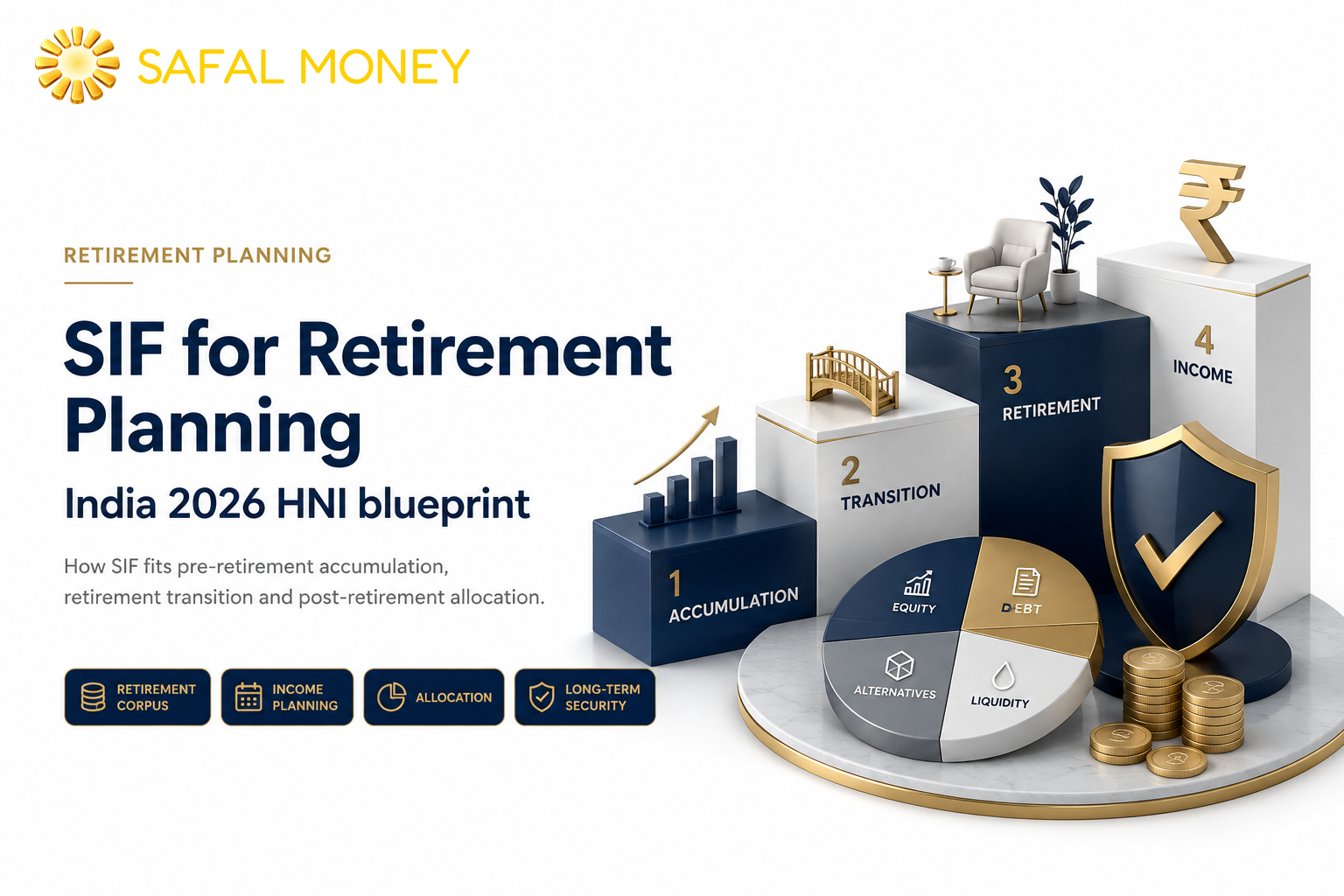
Retirement planning in India has changed fundamentally over the last decade. The old model — accumulate in equity, shift to FDs at 60, live off interest — is broken for two reasons that HNI investors understand intuitively but rarely articulate explicitly.
First, FD interest rates at 6.5–7% do not beat inflation for HNI retirees whose expenses grow at 7–9% annually due to healthcare cost inflation, lifestyle inflation, and the compounding cost of maintaining a large family and household. A portfolio that earns 6.5% in FDs while expenses grow at 8% is a portfolio that is slowly being consumed.
Second, life expectancy has increased dramatically. A 60-year-old Indian professional today has a realistic life expectancy of 83–87 years — a 23–27 year retirement. Planning for only 15 years of retirement, as the old model assumed, risks running out of money in the last decade of life.
The solution to both problems requires maintaining a meaningful growth component — equity exposure — through and beyond retirement. But unhedged equity in a retiree's portfolio creates a different problem: sequence-of-returns risk. A sharp equity correction in the early years of retirement can permanently impair the portfolio's ability to generate income for the full retirement duration.
SIF — specifically Hybrid Long-Short and well-selected Equity Long-Short strategies — offers a structural solution to this dilemma. It provides the growth component a retiree needs while offering a hedging mechanism that mitigates the sequence-of-returns risk that makes unhedged equity dangerous in retirement.
This article maps SIF's role across three retirement phases — pre-retirement accumulation (age 40–60), the retirement transition (age 58–65), and post-retirement distribution (age 65+) — with specific portfolio architectures and case studies for each.
The Three-Phase Indian HNI Retirement Framework
Before addressing SIF's role, let us establish the framework that governs retirement planning for Indian HNI investors.
Phase 1: Pre-Retirement Accumulation (typically age 35–58). The primary objective is corpus building. This phase is characterised by high income, high savings rate, long investment horizon, and ability to take meaningful risk. SIF fits naturally here as an alpha-generating alternative strategy layer alongside core equity and debt — the same logic covered in our FIRE calculator guide for any long-horizon accumulator building toward an early or on-schedule retirement.
Phase 2: Retirement Transition (typically age 55–65). This is the most critical and most mismanaged phase in Indian retirement planning. The investor is approaching retirement, income is peaking, the corpus is at or near its maximum, and the portfolio must begin the transition from growth-oriented to income-oriented without abandoning growth entirely. SIF's role changes significantly in this phase.
Phase 3: Post-Retirement Distribution (age 65+). The portfolio must now generate income while preserving capital for a 20–25 year distribution period. Most conventional advice suggests moving heavily into debt here — but this creates the inflation erosion problem identified above. SIF, specifically conservative Hybrid Long-Short strategies, can serve as a growth-with-protection layer that makes the inflation problem more manageable.
Phase 1: SIF in the Pre-Retirement Accumulation Phase
For investors in their 40s and early 50s — the prime accumulation phase — SIF's role is straightforward: alpha generation and portfolio diversification to maximise corpus growth before retirement.
At this phase, investors typically have 10–20 years of investment horizon remaining before retirement, stable and high income that covers monthly expenses without dependence on the portfolio, a growing corpus that can accommodate SIF's ₹10 lakh minimum at appropriate concentration levels, and sufficient time to experience multiple market cycles through their SIF investment.
Recommended SIF allocation in accumulation phase: for a 45-year-old with ₹1.5 crore corpus, a 10–15 year horizon to retirement, and a moderate-to-aggressive profile, SafalScore™ typically suggests 20–28% SIF allocation — primarily Equity Long-Short to maximise growth potential.
The sequencing principle: in the accumulation phase, SIF allocation should lean toward Equity Long-Short rather than Hybrid Long-Short. The higher alpha potential of Equity Long-Short strategies is most valuable when there are 10+ years for that alpha to compound. The lower volatility of Hybrid Long-Short is more valuable closer to or in retirement.
Accumulation phase portfolio architecture (₹1.5 crore, age 45):
| Allocation | Component | Amount | Purpose |
|---|---|---|---|
| 10% | Liquid + Money Market | ₹15L | Emergency corpus |
| 15% | Debt MF (Short + Medium Duration) | ₹22.5L | Income + stability |
| 25% | Equity Core (Index Funds) | ₹37.5L | Low-cost market participation |
| 18% | Equity Satellite (Active Mid + Small Cap) | ₹27L | Alpha generation |
| 22% | SIF (Equity Long-Short primary) | ₹33L | Alternative alpha + uncorrelated returns |
| 5% | Gold (SGB) | ₹7.5L | Inflation + crisis hedge |
| 5% | REITs + InvITs | ₹7.5L | Real asset income |
Phase 2: The Retirement Transition — The Most Critical Shift
The retirement transition phase — roughly age 55 to 65 — is where most Indian HNI investors make their most consequential portfolio errors. The two most common mistakes:
Mistake 1: Going too conservative too early. Moving heavily into FDs and debt at 57–58 in anticipation of retirement creates a 20+ year problem. The portfolio loses its growth engine precisely when it needs to fund 25+ years of expenses. Inflation erosion begins immediately.
Mistake 2: Staying too aggressive too long. Maintaining high equity exposure with no hedging mechanism through age 62–65 creates severe sequence-of-returns risk. If the Nifty corrects 30% in the year you retire — as it did in 2020 and partially in 2026 — and you have 80% equity with no hedge, your retirement corpus is permanently impaired.
SIF's specific solution in the transition phase: SIF — particularly Hybrid Long-Short SIF — provides a middle path that neither extreme offers. The hybrid long-short structure maintains equity exposure (for growth and inflation protection), uses arbitrage and hedging overlays (to reduce the directional equity risk that creates sequence-of-returns damage), and generates income from the arbitrage spread and debt component (providing partial income without full liquidation).
The transition rebalancing rule: between ages 55 and 65, SafalMoney recommends gradually shifting the SIF allocation from primarily Equity Long-Short toward primarily Hybrid Long-Short — reducing the directional beta while maintaining the alternative return stream.
Transition phase portfolio shift (₹2.5 crore, age 60):
| Allocation | Component | Amount | Change vs Accumulation Phase |
|---|---|---|---|
| 12% | Liquid + Money Market | ₹30L | Increased — more liquidity needed |
| 25% | Debt MF (Short + Medium + Dynamic Bond) | ₹62.5L | Significantly increased |
| 20% | Equity Core (Index Funds, tilt to Large Cap) | ₹50L | Reduced and tilted defensive |
| 10% | Equity Satellite (reduced, quality-focused) | ₹25L | Significantly reduced from accumulation |
| 18% | SIF (Hybrid Long-Short primary, small Equity LS) | ₹45L | Same allocation, shifted to Hybrid |
| 8% | Gold (SGB + ETF) | ₹20L | Increased — inflation hedge priority |
| 7% | REITs + InvITs | ₹17.5L | Maintained — income yield |
The key changes from accumulation to transition phase: debt increased from 15% to 25% (building the income foundation); equity satellite reduced from 18% to 10% (removing highest-volatility exposure); SIF maintained at similar allocation but shifted from Equity Long-Short to Hybrid Long-Short primary; gold increased from 5% to 8% (heightened inflation hedge priority); and the liquidity buffer increased, since near-retirement expenses need accessible funds.
The Sequence-of-Returns Risk — Why It Matters More Than Average Returns
Sequence-of-returns risk is the single most important concept in retirement portfolio management — and the one most commonly overlooked.
The problem: a 25-year retirement with an average equity return of 10% per year can result in very different outcomes depending on when the bad years occur. If the first few years of retirement produce large negative returns — when the portfolio is at its maximum size — the damage is permanent and cannot be recovered through later good years.
An Illustrative Example
Scenario A: Retire with ₹3 crore. Markets fall 30% in year 1 (corpus falls to ₹2.1 crore), then recover 15% annually for years 2–25. Corpus at end of retirement: significantly depleted.
Scenario B: Retire with ₹3 crore. Markets rise 15% annually for years 1–24, then fall 30% in year 25. Corpus at end of retirement: substantially higher.
Both scenarios have the same average return. But the sequence — when the bad return occurs — creates dramatically different outcomes. This is not a mathematical curiosity; it is the defining risk of retirement portfolio management.
How SIF mitigates sequence-of-returns risk: a Hybrid Long-Short SIF with meaningful downside protection can reduce the magnitude of a bad year's return on the retirement corpus. If a long-short SIF loses 8% in a year the Nifty loses 25%, the sequence-of-returns damage is significantly reduced. The portfolio starts year 2 with significantly more capital, allowing the recovery to rebuild wealth more effectively.
This is not a guarantee — no investment strategy guarantees specific outcomes. But the structural mechanism, the short book cushioning drawdowns, is designed precisely for this purpose. A well-chosen Hybrid Long-Short SIF is one of the most appropriate retirement portfolio instruments available to Indian HNI investors.
Phase 3: Post-Retirement Distribution — Maintaining Growth Without Excessive Risk
The post-retirement phase — age 65 and beyond for most HNI investors — requires the most careful portfolio architecture because the stakes are the highest and the margin for error is the smallest.
Three principles govern post-retirement portfolio management for Indian HNI investors:
Principle 1: Maintain 30–40% growth assets through age 80. The long life expectancy reality demands it. A 65-year-old with ₹4 crore who moves entirely to 7% FDs will have ₹9.4 crore at 80 (without withdrawals). But with a 6% annual withdrawal (₹24 lakh/year growing with 7% inflation), the FD portfolio is depleted by age 80–82. Maintaining 30–40% in growth assets (equity + SIF) extends the portfolio's productive life significantly.
Principle 2: Use the bucket strategy for liquidity management. Divide the retirement corpus into three buckets: Bucket 1 (2 years of expenses in liquid + money market) is immediately accessible for living expenses, emergencies, and healthcare costs. Bucket 2 (3–5 years of expenses in debt funds) refills Bucket 1 annually and provides a predictable income stream. Bucket 3 (balance in equity + SIF + gold) is the long-term growth engine, untouched for 5+ years, and refills Bucket 2 as it is depleted. This bucket approach eliminates the need to sell growth assets during market downturns — Buckets 1 and 2 cover 5–7 years of expenses, providing time for growth assets to recover.
Principle 3: Systematically reduce SIF allocation as horizon shortens. At 65, with a 20-year remaining horizon, 15–18% SIF allocation is appropriate. At 75, with a 10-year horizon, 8–10% SIF may still be appropriate (with a full shift to Hybrid Long-Short). At 80+, SIF should generally be below 5% and only the most conservative Hybrid strategies.
Post-retirement portfolio architecture (₹4 crore, age 67):
| Allocation | Component | Amount | Purpose |
|---|---|---|---|
| 10% | Liquid + Money Market (Bucket 1) | ₹40L | 2 years living expenses — immediately accessible |
| 30% | Debt MF Ladder (Bucket 2) | ₹1.2Cr | 5 years of expenses at declining rates; refills Bucket 1 |
| 20% | Equity Core (Large Cap Index + Quality) | ₹80L | Bucket 3 — growth engine, 5+ year horizon |
| 15% | Hybrid Long-Short SIF | ₹60L | Bucket 3 — growth with protection, inflation hedge |
| 12% | Gold (SGB + ETF) | ₹48L | Inflation hedge + crisis protection |
| 8% | REITs + InvITs | ₹32L | Regular income distributions (7–8% yield) |
| 5% | Equity Satellite (quality, low volatility) | ₹20L | Selective growth |
Key post-retirement portfolio features: two years of expenses in Bucket 1 mean no forced selling regardless of market conditions; Hybrid Long-Short SIF is the only SIF strategy used, since pure Equity Long-Short is inappropriate at this stage; gold sits at 12%, higher than the accumulation phase, since inflation protection is the primary post-retirement concern; and REITs provide 7–8% income distribution as a natural complement to the systematic withdrawal strategy.
The SIF-Retirement Tax Efficiency Connection
One of SIF's underappreciated advantages in retirement planning is tax efficiency — which becomes more important in retirement when total income may be lower and tax planning opportunities are more accessible.
For retired investors who are no longer drawing a salary, total annual income may consist of pension (if any), interest from FDs (taxed at slab rate), dividend income from mutual funds (taxed at slab rate), and capital gains from mutual fund redemptions (LTCG at 12.5% for equity-oriented SIF held 12+ months).
For an HNI retiree who has moved from a 30% tax bracket during working years to a 20% or even 5% bracket in retirement (depending on pension and other income), the LTCG taxation on SIF redemptions is particularly efficient. Systematic redemption of SIF units in retirement — timed to utilise the ₹1.25 lakh annual LTCG exemption — can generate meaningful tax-free income from the SIF portfolio year after year.
This tax efficiency makes SIF a superior retirement income instrument compared to FDs (taxed at slab), debt mutual funds (taxed at slab for short-term), or dividend income from equity funds (taxed at slab regardless of holding period).
Case Study: Meena and Rajiv Sharma — Transitioning to Retirement at 62
Profile
Age: Meena 62, Rajiv 64 (joint financial planning). Current corpus: ₹3.2 crore. Monthly expenses: ₹1.8 lakh (rising at approximately 7% annually). Income: Meena still working (₹35 lakh/year); Rajiv retired on a pension of ₹65,000/month. Existing SIF: ₹25 lakh in a Hybrid Long-Short strategy (7.8% of corpus). Investment horizon: 20+ years (targeting corpus longevity to age 85). Risk profile: Conservative-Moderate.
The planning challenge: Rajiv's pension covers ₹65,000 of their ₹1,80,000 monthly need. Meena's income covers the remaining ₹1,15,000 and generates additional savings. When Meena retires at 65 (3 years from now), the couple will need the portfolio to generate approximately ₹1,80,000 per month — ₹21.6 lakh per year — against a backdrop of 7% expense inflation.
SafalScore™ assessment: joint SafalScore™ of 112 → Amber-Moderate zone → 15% SIF allocation recommended. Current SIF at 7.8% — recommend increasing to 15% (₹48 lakh) over the next 3 years as Meena's income continues to build the corpus.
Three-year transition plan (age 62–65, before Meena retires):
- Year 1 (age 62): Maintain existing ₹25L Hybrid Long-Short SIF. Add ₹10L in the most conservative multi-asset SIF strategy available. Total SIF: ₹35L (10.9%).
- Year 2 (age 63): Add another ₹7L to the Hybrid Long-Short holding as corpus grows. Review performance data. Total SIF: ₹42L (12.4%).
- Year 3 (age 64): Add ₹6L to complete the allocation. Total SIF: ₹48L (15%). Simultaneously begin building Bucket 1 (₹45L in liquid funds — 2.5 years of expenses post-retirement).
Post-retirement income architecture (age 65, ₹3.6 crore estimated corpus):
| Source | Annual Income | Notes |
|---|---|---|
| Rajiv's pension | ₹7.8L | Inflation-indexed partially |
| REIT distributions | ₹9.6L | ₹1.2Cr in REITs at 8% yield |
| Debt fund systematic withdrawal | ₹8.4L | From Bucket 2 corpus |
| Gold SGB interest | ₹1.8L | 2.5% on ₹72L SGB |
| Total before SIF | ₹27.6L | Covers first year expenses of ₹21.6L + buffer |
The SIF allocation — ₹54L target at 65 — is not drawn on in the first 5 years, allowing it to compound within Bucket 3. It begins serving as the primary refill mechanism for Bucket 2 from year 5–6 onward, when the initial debt corpus has been partially depleted.
The key insight from Meena and Rajiv's case: SIF in retirement is not primarily an income instrument — it is a growth and protection instrument that extends the portfolio's productive life. By maintaining 15% in conservative Hybrid Long-Short SIF through their 60s and into their 70s, they preserve a growth engine that traditional FD-heavy portfolios would eliminate prematurely.
When SIF Is NOT Appropriate in Retirement
SIF Is Not Right for Every Retiree
SafalMoney believes in complete transparency. SIF in retirement is not appropriate for everyone. Specific situations where SIF should be avoided or minimised in retirement:
- Full portfolio dependency on income. If your monthly expenses are entirely funded from the portfolio with no pension or other stable income source, liquidity is paramount. The fortnightly SIF redemption window is a genuine constraint — do not put more than 10% of a fully income-dependent portfolio in SIF.
- Health uncertainty creating large unpredictable expenses. If you or a spouse has serious health conditions that may require large unexpected capital — surgeries, long-term care, specialist treatment — maintain higher liquid and short-duration allocations rather than SIF. Medical emergencies cannot wait for fortnightly redemption windows.
- Short remaining horizon. Investors above 78–80 with limited remaining investment horizon should have negligible SIF exposure. The time required for SIF strategies to demonstrate their value across a full market cycle exceeds the realistic investment horizon at this stage.
- Psychological stress from NAV volatility. Even Hybrid Long-Short SIF shows quarterly NAV variation. If watching a ₹50 lakh SIF investment fluctuate between ₹47 lakh and ₹53 lakh creates significant anxiety — even knowing the long-term trajectory is positive — SIF is not appropriate for your retirement portfolio regardless of the financial mathematics.
Free, 2 minutes
Frequently Asked Questions
Is SIF suitable for retirement planning in India?
Yes - particularly for HNI investors in the pre-retirement (age 45-58) and early retirement (age 60-72) phases. Hybrid Long-Short SIF provides growth with downside protection that is structurally well-suited to the retirement challenge of maintaining equity exposure while managing sequence-of-returns risk. For accumulation phase investors, Equity Long-Short SIF provides alpha generation over a long horizon. Post-retirement, conservative Hybrid Long-Short SIF serves as a growth-with-protection layer within a bucket-strategy framework. SIF is not appropriate for investors with full income dependency on the portfolio, very short remaining horizons, or low psychological tolerance for NAV volatility.
How much SIF should a retired HNI investor hold?
SafalScore recommendations for retired investors typically range from 8-18% of total portfolio, depending on age, corpus size, pension income, risk profile, and remaining horizon. At 60-65 with adequate pension coverage, 15-18% is often appropriate. At 70-75, 10-12% may be appropriate with full shift to Hybrid Long-Short. Above 78, SIF should generally be below 5% and only the most conservative strategies. Calculate your specific retirement SafalScore on SafalZenith - the model specifically accounts for retirement-phase characteristics including pension income and income dependency on the portfolio.
What is sequence-of-returns risk and how does SIF help?
Sequence-of-returns risk is the risk that large negative returns occurring early in retirement - when the portfolio is at its maximum size - permanently impair the portfolio's ability to generate income for the full retirement period. A 30% market correction in year 1 of retirement causes more permanent damage than the same correction in year 15, because less capital remains to participate in the recovery. Hybrid Long-Short SIF can mitigate sequence-of-returns risk through its short book, which provides partial downside protection during market corrections, reducing the magnitude of negative returns in bad years. This structural mechanism is one of the most compelling arguments for SIF in retirement planning.
What is the bucket strategy for retirement?
The bucket strategy divides the retirement corpus into three buckets based on time horizon. Bucket 1 holds 2 years of expenses in liquid and money market funds - immediately accessible for living expenses. Bucket 2 holds 3-5 years of expenses in debt funds - refills Bucket 1 annually through systematic withdrawals. Bucket 3 holds the balance in growth assets (equity funds, SIF, gold, REITs) - untouched for 5+ years, refills Bucket 2 as it is depleted. This structure eliminates forced selling of growth assets during market downturns, allowing the growth portfolio to recover before it is needed.
Should I shift from Equity Long-Short to Hybrid Long-Short SIF as I approach retirement?
Yes. The retirement transition phase (age 55-65) is the appropriate time to begin gradually shifting from Equity Long-Short SIF (higher alpha potential, higher volatility) to Hybrid Long-Short SIF (lower volatility, better downside protection, income component). This shift should be gradual, not a sudden switch, aligned with the overall portfolio transition from accumulation to distribution. By retirement age, most of the SIF allocation should be in Hybrid Long-Short strategies. Equity Long-Short can be maintained as a small satellite (5-8% of total SIF allocation) through the early retirement years if the investor's overall profile supports it.
Last updated: 12 July 2026