Top 10 Mutual Fund Categories in India - And Which Ones Are Right for HNI Investors
SEBI has 36+ mutual fund sub-categories. This guide identifies the 10 most relevant for HNI investors - with clear use cases, risk profiles, and when to use each category in 2026.
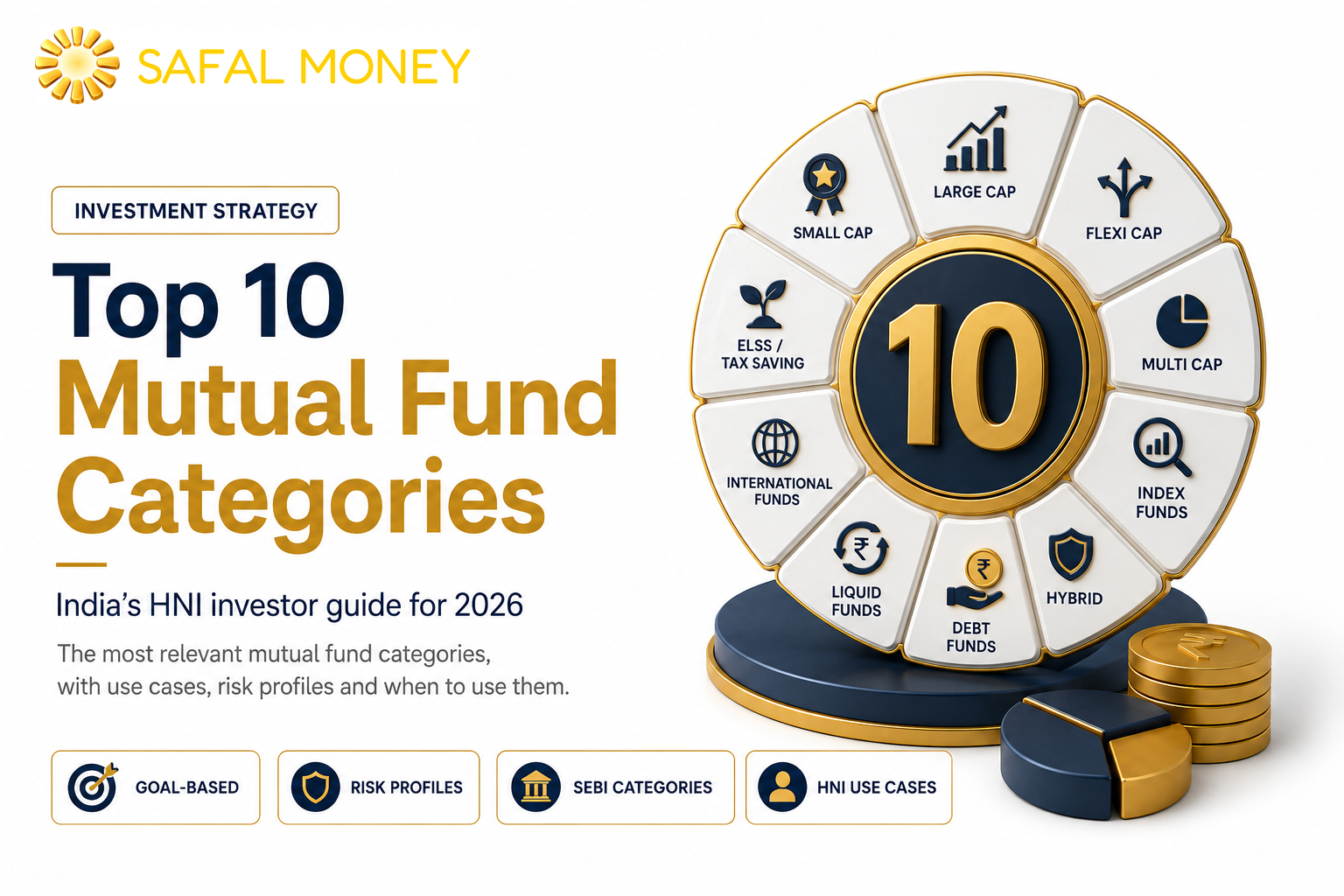
SEBI has defined over 36 mutual fund sub-categories across equity, debt, hybrid, and solution-oriented schemes. For a first-time investor, this is overwhelming. For an experienced HNI investor, it is still easy to get lost - holding too many funds across too many overlapping categories, paying for diversification that does not actually exist.
This guide cuts through the noise. We identify the 10 most relevant mutual fund categories for HNI investors - explaining what each does, what risk profile it carries, when to use it, and how it fits into a larger portfolio. At the end, we introduce SIF as the category that regular mutual funds cannot replicate - the missing piece in most HNI portfolios.
How Does SEBI Categorise Mutual Funds - And Why Does It Matter for HNI Investors?
SEBI's categorisation framework, introduced in 2017 and refined since, ensures that every mutual fund has a clearly defined mandate. A large cap fund must invest at least 80% in the top 100 stocks by market capitalisation. A mid cap fund must invest at least 65% in stocks ranked 101-250. These mandates prevent fund houses from drifting across categories opportunistically - a practice that was widespread before 2017.
For HNI investors, this matters for two reasons. First, it makes within-category comparison meaningful - you can genuinely compare two large cap funds because they follow the same mandate. Second, it helps you avoid duplication - if you hold three flexi cap funds from three different AMCs, their portfolios may overlap by 60-70%, giving you the illusion of diversification without the substance.
Understanding categories is the foundation of intelligent portfolio construction.
Category 1: Large Cap Equity - The Bedrock of Any Equity Portfolio
Large cap funds invest at least 80% of their portfolio in the top 100 companies by market capitalisation - India's largest, most liquid, most researched businesses. Think Reliance, HDFC Bank, Infosys, TCS, ICICI Bank.
Why it matters for HNI investors: Large cap funds provide the stable equity core of a portfolio. They are less volatile than mid or small cap funds, more liquid, and typically recover faster from market corrections. For HNI investors with significant wealth to preserve alongside growing, large cap funds provide the equity exposure that does not keep them up at night.
Watch point: The large cap space is highly efficient - heavily researched by hundreds of analysts. Generating consistent alpha over the Nifty 50 or Nifty 100 index is genuinely difficult. For large cap exposure, consider whether a direct index fund (Nifty 50 or Nifty 100) at 0.1-0.2% expense ratio outperforms an actively managed large cap fund at 1-1.5% expense ratio. The data increasingly favours index funds in this category.
Ideal for: Core equity allocation, conservative-to-moderate equity investors, wealth preservation with growth, 5+ year horizon.
Category 2: Flexi Cap Equity - The Most Flexible Equity Mandate
Flexi cap funds can invest across large, mid, and small cap stocks in any proportion - the fund manager has complete discretion to shift allocation based on market conditions and opportunity.
Why it matters for HNI investors: Flexi cap is the most manager-dependent category. A skilled flexi cap fund manager can be overweight mid and small caps when valuations are attractive and rotate to large caps when markets are expensive - adding genuine dynamic value. A mediocre manager in the same category can destroy value by chasing momentum.
For HNI investors, a strong flexi cap fund managed by a proven stock picker can serve as the single core equity holding - replacing the need for separate large cap, mid cap, and small cap allocations. This simplifies the portfolio without sacrificing exposure.
Watch point: Evaluate the fund manager's track record across multiple market cycles, not just recent performance. Also check portfolio overlap with your other holdings - many flexi cap funds end up holding the same large cap names as your other equity funds.
Ideal for: Core equity allocation for investors who want a single active equity fund with across-capitalisation exposure, 5-7+ year horizon.
Category 3: Multi Cap - The SEBI-Mandated 25-25-25 Rule
Multi cap funds are mandated by SEBI to invest at least 25% each in large cap, mid cap, and small cap stocks - a minimum 75% in equity with the remaining 25% flexible. This is a more rigid, rule-bound version of flexi cap.
Why it matters for HNI investors: Multi cap's mandatory 25% small cap allocation means it will always have meaningful small cap exposure - even when small caps are expensive or risky. This creates automatic diversification but also automatic exposure to the highest-volatility segment of the market.
For HNI investors who want disciplined across-capitalisation exposure without relying on a fund manager's discretion, multi cap is a more structured choice than flexi cap. The mandatory rebalancing across market cap segments also creates a systematic buy-low discipline over time.
Watch point: The mandatory small cap allocation can make multi cap funds significantly more volatile than large cap or flexi cap funds in market downturns. Ensure your risk tolerance accommodates this before allocating heavily.
Ideal for: Investors who want mandatory diversification across all market cap segments, 7+ year horizon, moderate-to-high risk tolerance.
Category 4: Mid Cap Funds - For Investors With a 7+ Year Horizon
Mid cap funds invest at least 65% in companies ranked 101-250 by market capitalisation - businesses that are past the startup phase but not yet large cap giants. This is the segment where many of India's fastest-growing companies spend their most dynamic years.
Why it matters for HNI investors: Mid cap funds have historically been one of the highest-return equity categories over long periods - based on past data, not a guarantee of future performance. The mid cap segment benefits disproportionately from India's economic growth as companies graduate from mid cap to large cap, generating significant returns for early investors.
The catch is volatility. Mid cap funds can fall 40-50% in sharp corrections and take 2-3 years to recover. This means they are only appropriate for money you genuinely will not need for 7+ years.
Watch point: AUM bloat is the biggest risk in this category. When a mid cap fund's AUM exceeds ₹20,000-₹25,000 crore, the fund manager begins struggling to deploy capital efficiently in mid cap stocks without moving prices. Check AUM before investing - and be cautious of the most popular mid cap funds that have attracted disproportionate inflows.
Ideal for: Aggressive HNI investors with a 7-10 year horizon, satellite allocation within a larger equity portfolio, investors with high drawdown tolerance.
Category 5: Small Cap - High Risk, High Potential (Portfolio Satellite Only)
Small cap funds invest at least 65% in companies ranked 251 and below by market capitalisation. This is the most volatile, least liquid, and highest-potential segment of the Indian equity market.
Why it matters for HNI investors: India has thousands of listed small cap companies, most of which are under-researched and inefficiently priced. This information inefficiency creates the potential for genuine alpha - skilled small cap fund managers can identify businesses before they become mainstream.
However, small cap investing requires iron-clad patience. During market corrections, small cap funds can fall 50-60% and take 3-4 years to recover. Liquidity in small cap stocks is also limited - in a sharp selloff, fund managers may struggle to exit positions without significant price impact.
Watch point: Never put more than 10-15% of your total equity allocation in small cap funds. For HNI investors, small cap is a satellite - a high-potential, high-risk supplement to a large cap and multi cap core. Not a core holding in its own right.
Ideal for: Aggressive investors with 10+ year horizon, maximum 10-15% of equity allocation, high risk tolerance and genuine ability to stay invested through severe drawdowns.
Category 6: ELSS - Tax Saving With a 3-Year Lock-In (Section 80C)
Equity Linked Savings Schemes (ELSS) invest at least 80% in equity and qualify for tax deduction under Section 80C of the Income Tax Act - up to ₹1.5 lakh per year. They have a mandatory 3-year lock-in period.
Why it matters for HNI investors: For most HNI investors, Section 80C is already exhausted through EPF contributions, life insurance premiums, and other instruments. If there is remaining 80C headroom, ELSS is generally the most efficient way to fill it - you get equity exposure with a tax deduction, at the cost of 3-year illiquidity.
The 3-year lock-in is actually a behavioural advantage - it prevents panic selling during market corrections, which is one of the biggest destroyers of long-term wealth.
Watch point: Do not choose an ELSS purely for the tax benefit. Evaluate it like any other equity fund - on rolling returns, Sharpe ratio, fund manager tenure, and expense ratio. The tax benefit is worth approximately ₹46,800 per year for someone in the 31.2% tax bracket (on ₹1.5 lakh investment) - meaningful, but not a reason to invest in a mediocre fund.
Ideal for: HNI investors with remaining Section 80C capacity, 3+ year horizon minimum (though 5-7 years is better), tax-efficient equity participation.
Category 7: Aggressive Hybrid - 65-80% Equity With a Debt Buffer
Aggressive hybrid funds maintain 65-80% allocation to equity and 20-35% to debt. The debt component provides a partial buffer during equity market corrections and allows the fund manager to rebalance - selling debt and buying equity when markets fall.
Why it matters for HNI investors: Aggressive hybrid funds are excellent one-fund solutions for investors who want predominantly equity exposure but with lower volatility than pure equity funds. The debt buffer typically reduces maximum drawdown by 5-10 percentage points relative to a comparable pure equity fund.
For HNI investors who are beginning to reduce risk as they approach retirement but are not yet ready for a fully conservative portfolio, aggressive hybrid funds offer a sensible middle ground.
Watch point: The equity and debt allocation within an aggressive hybrid fund is relatively fixed - the fund cannot go below 65% equity even in expensive markets. This limits the fund manager's ability to be truly defensive when equity valuations are stretched. Balanced Advantage Funds (Category 8) solve this problem.
Ideal for: Moderate-to-aggressive investors, 5+ year horizon, investors wanting a single-fund equity-heavy portfolio with lower volatility than pure equity.
Category 8: Balanced Advantage Fund - Dynamic Asset Allocation
Balanced Advantage Funds (BAF), also called Dynamic Asset Allocation funds, can freely move between equity and debt - from 0% to 100% in either direction - based on market valuation models. When markets are expensive (high PE, high PB), the fund shifts to debt. When markets are cheap, it shifts to equity.
Why it matters for HNI investors: BAFs are the most sophisticated hybrid category. They promise to do what most investors cannot do themselves - systematically reduce equity when it is expensive and increase it when it is cheap. For HNI investors who struggle with market timing decisions, a BAF can serve as a managed asset allocation engine.
The quality of a BAF depends entirely on the quality of its asset allocation model. Different AMCs use different models - some price-to-earnings based, some price-to-book based, some proprietary. Evaluate the model's track record across at least two market cycles before trusting it with a large allocation.
Watch point: BAFs can be heavily weighted to debt - sometimes as high as 70-80% - when their model signals expensive markets. This can cause significant underperformance relative to pure equity funds in bull markets. Understand that BAF's job is not to maximise returns but to deliver smoother, better risk-adjusted returns.
Ideal for: Conservative-to-moderate investors, investors who want someone else to manage asset allocation, 3-5+ year horizon, near-retirees reducing equity risk gradually.
Category 9: Arbitrage Funds - Equity Taxation at Near-Debt Returns
Arbitrage funds exploit price differences between the cash market and futures market in the same stock - buying in one and selling in the other simultaneously to lock in a risk-free spread. Because they maintain at least 65% in equity (through these arbitrage positions), they are taxed as equity funds.
Why it matters for HNI investors: Arbitrage funds are one of the most tax-efficient short-term parking vehicles for HNI investors. They deliver returns typically 50-100 basis points above liquid funds but are taxed at equity rates - 20% STCG if held under 12 months (versus income tax slab for liquid funds) and 12.5% LTCG if held above 12 months. For HNI investors in the 30%+ tax bracket, this differential is highly meaningful.
For example, on ₹50 lakh parked for 12 months: if a liquid fund returns 7% and an arbitrage fund returns 7.5%, the post-tax advantage for a 30% bracket investor is not just the 0.5% return differential - it is the full tax efficiency gap, which can amount to ₹1-1.5 lakh in saved tax on the same corpus.
Watch point: Arbitrage returns depend on the spread between cash and futures markets, which fluctuates. In low-volatility markets with low futures premiums, arbitrage returns compress. They are not appropriate as a long-term wealth building tool - they are a short-term parking and tax efficiency instrument.
Ideal for: 3-12 month parking, tax-efficient short-term allocation for high-bracket investors, liquid fund alternative for HNIs.
Category 10: International Funds - Currency and Global Diversification
International mutual funds invest in equity markets outside India - US technology stocks, global ETFs, emerging market funds, and thematic global strategies. They provide both geographic diversification and currency diversification - your returns are partly driven by the performance of the rupee against the dollar.
Why it matters for HNI investors: India's stock market, while one of the world's best performers over long periods, is a single country with specific risks - political, regulatory, monsoon-dependent agricultural cycles, oil price sensitivity. International funds reduce concentration in India and give exposure to global technology, healthcare, and consumer giants that have no direct Indian equivalent.
For HNI investors with portfolios of ₹2 crore and above, a 5-10% allocation to international funds - particularly US-focused funds - adds genuine diversification that cannot be replicated through domestic funds.
Watch point: SEBI has periodically restricted overseas investment limits for mutual funds, affecting the ability of some international funds to deploy fresh capital. Check the current investment status of any international fund before investing. Currency risk is real - a strengthening rupee reduces returns from international funds for Indian investors.
Ideal for: HNI investors with ₹2 crore+ portfolios, 7+ year horizon, 5-10% satellite allocation, investors who want global technology and healthcare exposure.
Which Combination of Categories Makes the Ideal HNI Portfolio?
Here is a practical framework for portfolio construction using these 10 categories - with approximate allocation ranges based on investor profile:
| Category | Conservative HNI | Moderate HNI | Aggressive HNI |
|---|---|---|---|
| Large Cap / Index Fund | 20% | 15% | 10% |
| Flexi Cap | 10% | 20% | 20% |
| Mid Cap | 0% | 10% | 15% |
| Small Cap | 0% | 5% | 10% |
| Balanced Advantage Fund | 25% | 10% | 0% |
| Aggressive Hybrid | 0% | 10% | 5% |
| ELSS (80C) | 5% | 5% | 5% |
| Arbitrage Fund | 15% | 10% | 5% |
| International Fund | 5% | 5% | 5% |
| Debt Funds | 20% | 10% | 5% |
| Total | 100% | 100% | 80% |
The remaining 20% for the aggressive HNI profile? That is where SIF enters.
How SIF Adds the 11th Category Your MF Portfolio Is Missing
Every category above is long-only - the fund can only profit when the securities it holds rise in value. In flat or falling markets, every category above will deliver zero or negative returns.
SIF - Specialised Investment Fund - adds a genuinely different return driver through its long-short structure. By going long on securities expected to rise and short on securities expected to fall, SIF portfolios can potentially generate returns that are less correlated to market direction.
This is not a replacement for any of the 10 categories above. It is an addition - the layer that completes the portfolio by providing exposure that no mutual fund category can replicate.
For HNI investors with investable corpus of ₹25 lakh or more, a 15-30% allocation to SIF (within SafalMoney's recommended caps) alongside a diversified mutual fund portfolio is the architecture that institutional investors have used globally for decades - and that SEBI has now made accessible to Indian HNI investors for the first time.
Use SafalZenith to calculate your ideal SIF allocation within this portfolio framework, and SafalCheck™ to evaluate specific SIF funds before investing.
Free, no login required
Frequently Asked Questions
What are the main categories of mutual funds in India?
SEBI has defined over 36 mutual fund sub-categories across four broad groups: equity schemes (large cap, mid cap, small cap, flexi cap, multi cap, ELSS, sectoral, thematic, and others), debt schemes (liquid, short duration, gilt, corporate bond, dynamic bond, and others), hybrid schemes (aggressive hybrid, balanced advantage, arbitrage, and others), and solution-oriented schemes (retirement and children's funds). The 10 categories most relevant for HNI investors are large cap, flexi cap, multi cap, mid cap, small cap, ELSS, aggressive hybrid, balanced advantage, arbitrage, and international funds.
Which mutual fund category is best for long-term investment?
For long-term wealth creation (7-10+ years), flexi cap, mid cap, and multi cap funds have historically delivered strong returns based on past data - though past performance is not a guarantee of future results. For long-term wealth preservation with growth, large cap index funds and balanced advantage funds offer better risk-adjusted returns. The best category for long-term investment depends on your risk tolerance, investment horizon, and wealth goals - there is no universal answer.
What is a Flexi Cap mutual fund?
A Flexi Cap mutual fund can invest across large, mid, and small cap stocks in any proportion at the fund manager's discretion. Unlike multi cap funds (which have mandatory 25% minimum in each segment) or large cap funds (which must maintain 80% in large caps), flexi cap funds have complete flexibility to shift allocation based on market conditions and stock-specific opportunities. They are the most manager-dependent equity category - the quality of the fund manager determines the quality of the fund.
Is a Balanced Advantage Fund safe?
Balanced Advantage Funds are not capital-protected or risk-free. They carry equity market risk and can decline in value when markets fall. However, their dynamic asset allocation model - which reduces equity exposure when markets are expensive and increases it when markets are cheap - is designed to deliver lower maximum drawdowns than pure equity funds. They are generally considered moderate-risk products, more conservative than pure equity funds but more growth-oriented than pure debt funds. Always read the fund's asset allocation model disclosure before investing.
How many mutual fund categories has SEBI defined?
SEBI has defined over 36 mutual fund sub-categories across equity, debt, hybrid, and solution-oriented schemes. Equity schemes have 10 sub-categories, debt schemes have 16 sub-categories, hybrid schemes have 6 sub-categories, and solution-oriented schemes have 2 sub-categories (retirement and children's funds). Additionally, SEBI introduced the Specialised Investment Fund (SIF) category in 2024 - which adds long-short strategy capabilities that no traditional mutual fund category can offer.
Last updated: 3 July 2026