Short Duration vs Medium Duration Funds: Practical Guide to the 1–5 Year Zone
Short duration or medium duration fund - which is right for your 1-5 year money? This practical guide uses duration, rate environment, and yield need to help you choose correctly in 2026.
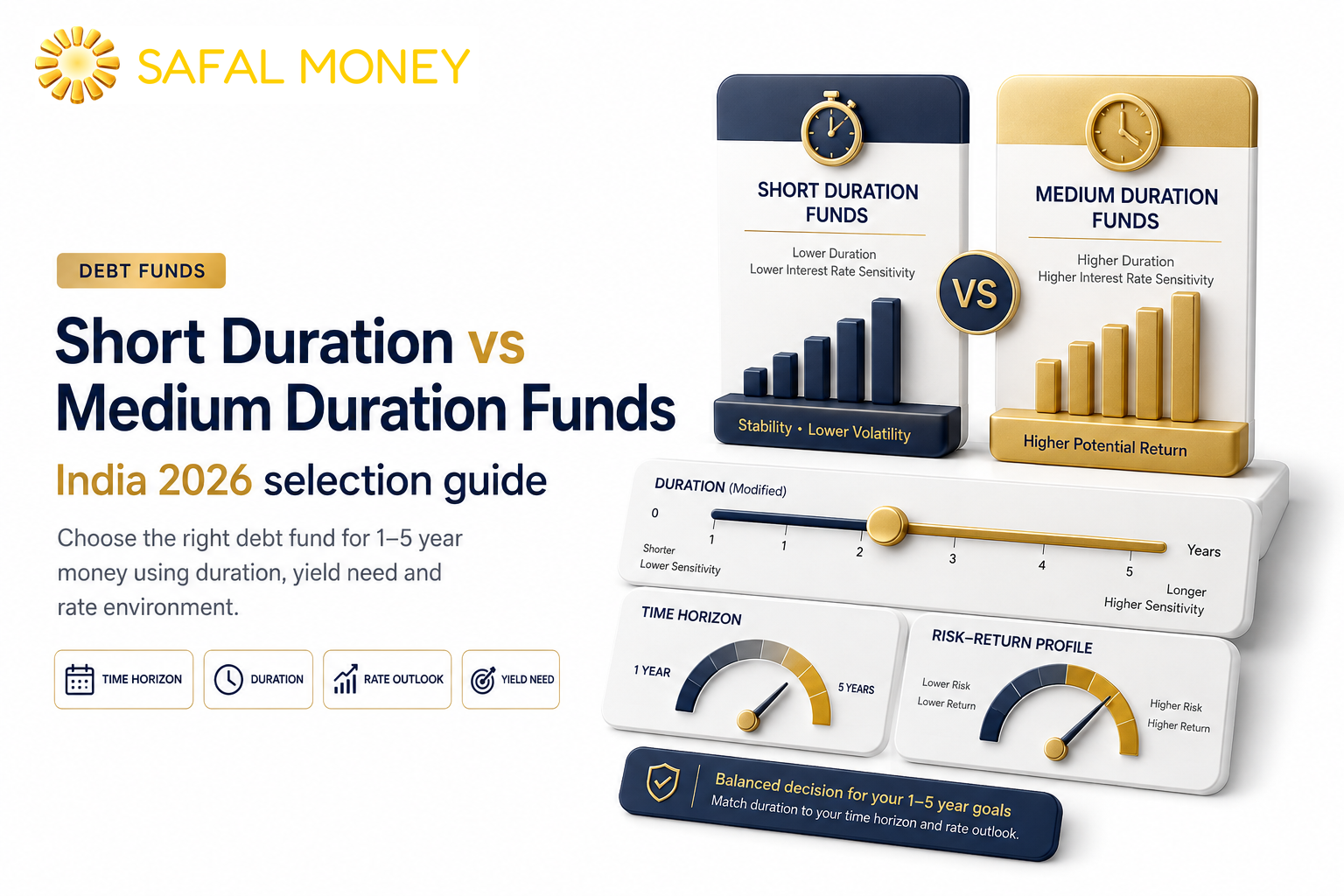
Of all the decisions in debt mutual fund investing, the one that causes the most confusion among Indian HNI investors is this: should I use a short duration fund or a medium duration fund for money I will not need for 2–5 years?
Both categories invest in high-quality debt instruments. Both target AAA and AA+ rated securities. Both are suitable for the medium-term portion of a portfolio. And yet they are meaningfully different — in how they respond to interest rate changes, in the returns they can generate in different environments, and in the specific investor profiles they are best suited for.
Getting this choice wrong is not catastrophic — both categories are relatively conservative debt instruments. But getting it right can add 0.5–1.5% per year in additional return over a 3–5 year period, which on a ₹50 lakh debt allocation compounds to ₹75,000–₹2.25 lakh in additional wealth. For HNI investors managing large debt portfolios, this difference is meaningful.
This guide gives you the complete framework to make this choice correctly — starting with a plain-English explanation of duration, moving through the specific characteristics of each category, and ending with a 3-question decision guide that tells you which one belongs in your portfolio right now.
What Is Duration in a Debt Mutual Fund? The Plain-English Explanation
Duration is the single most important concept in debt fund investing — and the one most commonly misunderstood.
Duration is not the same as maturity. Maturity is when a bond's principal is repaid. Duration measures how long it takes, on average, for an investor to receive all the cash flows from a bond — including both interest payments and the final principal repayment. It is expressed in years.
Here is why this matters: duration is also a precise measure of a bond fund's sensitivity to interest rate changes. If a fund has a modified duration of 3 years and interest rates rise by 1%, the fund's NAV will fall by approximately 3%. If rates fall by 1%, the fund's NAV will rise by approximately 3%. If a fund has a modified duration of 7 years and interest rates rise by 1%, the NAV falls by approximately 7%. If rates fall by 1%, the NAV rises by approximately 7%.
This relationship — longer duration means more sensitivity to rate changes in both directions — is the fundamental rule that determines when short duration funds are better than medium duration funds, and vice versa.
The SEBI definition of the two categories uses Macaulay duration — a slightly different but related duration measure: Short Duration Fund maintains Macaulay duration of 1 to 3 years, and Medium Duration Fund maintains Macaulay duration of 3 to 4 years.
Short Duration Funds: The 1–3 Year Zone
What Short Duration Funds Invest In
Short duration funds invest in a mix of instruments maturing within approximately 1 to 4 years — corporate bonds, government securities, certificates of deposit, and commercial paper — with a portfolio Macaulay duration maintained between 1 and 3 years.
The typical short duration fund portfolio in India (for a well-managed, high-quality fund) looks broadly like this: 60–70% in AAA-rated corporate bonds, 20–30% in government securities or AAA PSU bonds, and 5–10% in AA+ rated corporate bonds. The exact mix varies by fund and manager philosophy.
How Short Duration Funds Behave in Different Rate Environments
In a rate-rising environment: short duration funds perform relatively well compared to longer-duration peers. Because their portfolio matures and rolls over to new, higher-yielding instruments within 1–3 years, the mark-to-market loss from rising rates is small and temporary — typically recovered within 6–12 months as the portfolio reprices. This makes short duration funds a natural defensive choice when interest rates are rising or uncertain.
In a rate-falling environment: short duration funds benefit from falling rates — bond prices rise as yields fall — but the benefit is modest relative to medium or long-duration funds. The shorter the duration, the smaller the price appreciation from a given rate fall. A short duration fund might gain 2–3% from a 1% rate cut cycle, while a medium duration fund gains 4–6% and a long duration fund gains 8–12%.
In a flat rate environment: short duration funds deliver steady, predictable returns close to their current yield — approximately 7–7.5% annualised for well-managed direct-plan short duration funds in the current environment. No drama, no surprises.
Who Short Duration Funds Are Best For
Short duration funds are the right choice when your investment horizon is 1–3 years, when interest rate direction is uncertain or tilted toward rising, or when you want a reliable, relatively low-volatility debt fund that can serve as a stable anchor in your debt portfolio regardless of what the RBI does.
Medium Duration Funds: The 3–5 Year Zone
What Medium Duration Funds Invest In
Medium duration funds invest with a Macaulay duration of 3 to 4 years. The portfolio typically includes longer-dated corporate bonds, government securities with 4–7 year maturities, and AAA PSU bonds with similar tenors. Some medium duration funds also include a small allocation to AA-rated bonds for yield enhancement — always check the credit quality distribution of the specific fund.
How Medium Duration Funds Behave in Different Rate Environments
In a rate-rising environment: medium duration funds experience more pain than short duration funds. A 1% rise in interest rates causes the NAV of a medium duration fund (modified duration approximately 3.5 years) to fall by approximately 3.5%. Recovery takes longer — 18–30 months — as the portfolio rolls over to higher-yielding instruments. In a sharp rate hike cycle, medium duration fund investors can experience a frustrating period of below-FD returns or even small negative returns.
In a rate-falling environment: this is where medium duration funds shine. A 1% fall in interest rates causes the NAV of a medium duration fund to rise by approximately 3.5% — plus the regular coupon income of 7–8%. In a meaningful rate-cut cycle of 150–200 basis points, a medium duration fund can deliver 12–16% total returns over 12–18 months — significantly outperforming short duration funds, FDs, and most debt alternatives.
In a flat rate environment: medium duration funds deliver slightly higher yields than short duration funds — typically 20–50 basis points more — compensating for the additional duration risk.
Who Medium Duration Funds Are Best For
Medium duration funds are the right choice when your investment horizon is 3–5 years, when you have reasonable conviction that interest rates are likely to fall (or at minimum, stay flat) over the next 2–3 years, and when you want to position your debt portfolio to benefit from the rate-cut cycle that many economists expect in 2026–2027.
The Side-by-Side Comparison: 8 Dimensions
| Dimension | Short Duration Fund | Medium Duration Fund |
|---|---|---|
| SEBI Macaulay Duration | 1–3 years | 3–4 years |
| Typical Modified Duration | 1.5–2.5 years | 3–4 years |
| Ideal Investment Horizon | 1–3 years | 3–5 years |
| Rate Rise Impact (1% hike) | NAV falls ~2%; recovers in 6–12 months | NAV falls ~3.5%; recovers in 18–30 months |
| Rate Fall Benefit (1% cut) | NAV rises ~2%; modest gain | NAV rises ~3.5%; meaningful gain |
| Current Yield (approx.) | 7.0–7.5% | 7.3–7.8% |
| Volatility | Low | Low-to-moderate |
| Credit Quality | Typically AAA/AA+ dominant | AAA/AA+ dominant; some AA exposure |
The 2026 India Rate Context — Which Category Benefits More?
This is the most important question for the current investment decision — and it requires understanding where RBI policy is headed, which in turn depends heavily on the Iran-US situation and its impact on India's inflation trajectory.
The rate environment as of July 13, 2026: the RBI held the repo rate steady at 5.25% at its April and June 2026 meetings, maintaining a neutral stance. Prior to the Iran war, the consensus expectation was for rate hikes in late 2026 due to rising inflation from elevated crude prices. The Iran-US interim MOU of June 17 and the subsequent crude oil price decline to the $70–$80 range have significantly changed this calculus.
Most economists have now pushed back their rate hike expectations to October–March at the earliest, and some expect no hike in 2026 at all. A few analysts are now talking about rate cuts in early 2027 if crude sustains at $70–$80 and inflation continues to ease.
However — and this is critical for the short vs medium duration decision — the Iran-US MOU remains fragile. Fresh tanker attacks in early July pushed Brent crude back above $76. If the deal breaks down and crude returns to $90–$100+, the rate hike case revives quickly.
SafalMoney's Barbell Recommendation
In the base case (crude at $70–$80, RBI holds flat through 2026, cuts in early 2027), medium duration funds deliver better total returns than short duration over the next 24–36 months as the rate-cut cycle plays out. In the risk case (crude spikes, rate hikes return), short duration funds significantly outperform medium duration — lower mark-to-market pain, faster repricing to higher yields.
Given this uncertainty, SafalMoney's current view is a barbell approach: hold 60–65% of your 1–5 year debt allocation in short duration funds (for resilience) and 35–40% in medium duration funds (to capture upside if rates fall). This combination reduces the all-or-nothing risk of a binary call on the rate direction while still positioning for the more likely rate-flat or rate-cut scenario.
The Yield Comparison: How Much More Does Medium Duration Actually Pay?
A common investor question is whether the additional yield of medium duration funds justifies the extra duration risk. Here is the practical calculation for a ₹50 lakh debt allocation over 3 years:
| Scenario | Short Duration (7.3% p.a.) | Medium Duration (7.7% p.a.) | Difference |
|---|---|---|---|
| Rates flat (base case) | ₹11.7L return | ₹12.4L return | +₹70,000 |
| Rates fall 1% | ₹11.7L + ~₹1L price gain | ₹12.4L + ~₹1.75L price gain | +₹1.45L |
| Rates rise 1% | ₹11.7L − ~₹0.75L mark-to-market | ₹12.4L − ~₹1.3L mark-to-market | -₹55,000 disadvantage |
These are illustrative calculations only, assuming simplified return scenarios that cannot be guaranteed in practice.
In the flat rate scenario, the medium duration fund earns approximately ₹70,000 more over 3 years on ₹50 lakh — a modest advantage. In the rate-fall scenario, the advantage grows to approximately ₹1.45 lakh. In the rate-rise scenario, the medium duration fund underperforms by approximately ₹55,000.
The asymmetry here is somewhat in favour of medium duration: the upside in a rate-fall scenario (₹1.45L advantage) is larger than the downside in a rate-rise scenario (₹55K disadvantage). This is one reason why medium duration has slightly better expected value in most rate environments — but the risk of being wrong in a rate-rise scenario is real.
Credit Quality — The Hidden Risk That Overrides Duration
Duration is the primary risk in both short and medium duration funds. But credit quality is the hidden risk that can cause sudden, severe, and sometimes unrecoverable losses — as investors in certain credit-challenged short duration funds discovered during the 2018–2020 credit cycle.
Both short and medium duration categories allow investments in instruments rated below AAA — and some fund managers exploit this to boost yields. Always check the portfolio's credit quality distribution before investing.
A well-managed short or medium duration fund should have 85–90%+ in AAA and AAA-equivalent instruments (government securities, AAA PSU bonds, top-tier bank FDs). AA+ exposure up to 10–15% is reasonable. Anything significant below AA+ warrants careful examination.
Avoid funds in these categories that are boosting yields through meaningful exposure to A-rated or below-A-rated instruments. The yield premium — typically 50–100 basis points over AAA — does not compensate for the credit risk being taken, especially for investors who chose short or medium duration precisely because they wanted conservative debt exposure.
The 3-Question Decision Guide: Short or Medium Duration?
Answer these three questions to determine which category is right for your specific situation:
Question 1: When do you need this money? Under 2 years → Short Duration only. 2–3 years → Short Duration preferred; small Medium Duration allocation acceptable. 3–5 years → Medium Duration increasingly appropriate. Above 5 years → consider longer duration categories (dynamic bond, gilt).
Question 2: What is your view on interest rates over the next 2 years? Rates rising or highly uncertain → Short Duration. Rates flat → Short Duration slightly preferred for safety; Medium Duration for yield. Rates falling → Medium Duration.
Question 3: How would you react if your debt fund NAV fell 3–4% temporarily? Very uncomfortable, this would concern me significantly → Short Duration only. Uncomfortable but I would hold if I understood it was temporary → Short Duration to Medium Duration mix (60:40). Comfortable, I understand duration risk and accept it for the return opportunity → Medium Duration.
If all three answers point in the same direction, your decision is clear. If they conflict — for example, a 4-year horizon (medium) but a rising rate view (short) — the barbell approach of splitting between both categories is the most sensible resolution.
How Debt Long-Short SIF Fits Alongside These Categories
For HNI investors with ₹10 lakh or more in their debt allocation, there is a third option beyond short and medium duration funds — Debt Long-Short SIF.
A Debt Long-Short SIF can take long positions in bonds expected to appreciate (similar to a medium duration fund in a rate-cut environment) while simultaneously taking short positions in interest rate futures or bonds expected to decline (providing the protection that short duration funds offer in a rate-rise environment). In theory, this gives you the upside of medium duration in a rate-cut scenario without the downside of medium duration in a rate-rise scenario — though execution depends entirely on the fund manager's skill.
For investors who want sophisticated debt exposure beyond the binary short vs medium duration choice, Debt Long-Short SIF is worth evaluating. Use SafalZenith to assess whether SIF belongs in your portfolio and SafalCheck™ to evaluate specific debt SIF strategies.
Free tool, no login required
Frequently Asked Questions
What is a Short Duration Fund in India?
A Short Duration Fund is a SEBI-defined debt mutual fund category that invests in instruments with a Macaulay duration of 1 to 3 years. It typically holds high-quality corporate bonds, government securities, and certificates of deposit with maturities of approximately 1-4 years. Short duration funds have lower interest rate sensitivity than medium or long duration funds - a 1% rise in rates causes approximately 1.5-2.5% NAV decline, which typically recovers within 6-12 months. They are suitable for investors with a 1-3 year investment horizon who want a conservative, relatively stable debt alternative to fixed deposits.
Is Medium Duration Fund risky?
Medium Duration Funds carry moderate interest rate risk - higher than short duration funds but lower than long duration or gilt funds. The primary risk is that when interest rates rise, the fund's NAV falls by approximately 3-4% for each 1% rise in rates, and this mark-to-market loss can take 18-30 months to fully recover. They are not suitable for investors who need their money within 2 years or who cannot tolerate temporary NAV declines. For investors with a 3-5 year horizon and reasonable expectation that rates will remain flat or fall, medium duration funds offer better return potential than short duration funds at a manageable level of additional risk.
Which debt fund is best for a 2-year investment in India?
For a 2-year investment horizon, Short Duration Funds are the most appropriate choice - they match your horizon with their 1-3 year Macaulay duration mandate, offer conservative credit quality, and carry manageable interest rate risk that recovers within your horizon even in a rate-rise scenario. Medium Duration Funds are not ideal for exactly 2 years because a rate-rise shock could cause a NAV decline that takes longer than 2 years to recover. Corporate Bond Funds and Banking PSU Funds are also suitable alternatives for the same 2-year horizon.
How does an RBI rate cut affect short vs medium duration funds?
When the RBI cuts the repo rate, bond prices rise - because existing bonds paying higher yields become more valuable relative to newly issued bonds at lower yields. This price appreciation is directly proportional to duration: a medium duration fund (modified duration ~3.5 years) gains approximately 3.5% in NAV for each 1% rate cut, while a short duration fund (modified duration ~2 years) gains approximately 2%. In a meaningful rate-cut cycle of 150 basis points, a medium duration fund can generate 5-7% additional return from price appreciation - significantly outperforming a short duration fund. This is why medium duration funds are the preferred choice when investors have conviction that the RBI will cut rates.
What is modified duration in a mutual fund?
Modified duration measures a debt mutual fund's sensitivity to interest rate changes. Specifically, it estimates the percentage change in the fund's NAV for a 1% change in interest rates. A fund with modified duration of 2.5 years will see its NAV fall by approximately 2.5% if rates rise by 1%, or rise by approximately 2.5% if rates fall by 1%. Modified duration is closely related to Macaulay duration - modified duration equals Macaulay duration divided by (1 + yield). For practical investment decisions, modified duration is the more directly useful metric because it directly quantifies your interest rate risk exposure.
Last updated: 13 July 2026