Liquid Funds vs Short Duration Funds vs Money Market Funds: Which to Choose?
Liquid fund, short duration fund or money market fund - which is right for your money? This practical 2026 guide compares all three across safety, returns, liquidity, and tax efficiency with clear decision rules.
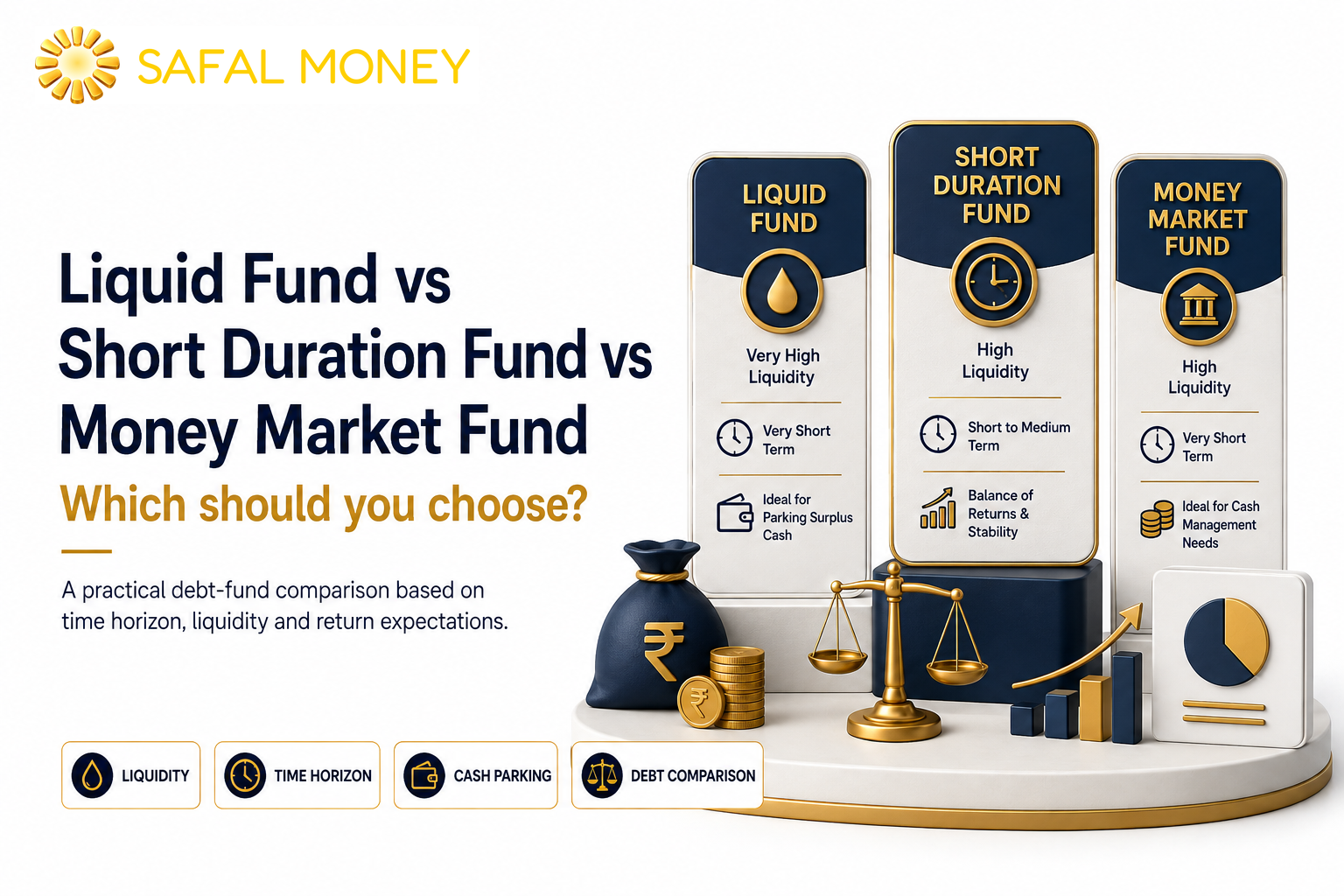
Three of the most commonly used debt mutual fund categories in India — liquid funds, money market funds, and short duration funds — look deceptively similar on the surface. All three invest in high-quality, short-to-medium term debt instruments. All three target AAA and AA+ rated securities. All three are used by HNI investors for parking and wealth preservation.
But they are not the same. The differences — in maturity profile, interest rate sensitivity, liquidity, tax efficiency, and ideal use case — matter enormously when it comes to choosing the right one for your specific need.
Getting this choice wrong costs you in one of three ways: either you sacrifice returns by staying in a liquid fund when a money market fund would have been more appropriate, or you sacrifice liquidity by going into a short duration fund for money you need sooner than expected, or you expose yourself to more interest rate risk than your horizon justifies.
This guide eliminates all three errors. By the end, you will know exactly which category fits which need — and precisely when to move between them.
The Foundation: Where Each Category Sits on the Risk-Return Spectrum
Before comparing the three, it helps to place them on the fundamental debt fund spectrum:
| Category | Maturity Profile | Macaulay Duration | Risk Level | Typical Return (Direct, 2026) |
|---|---|---|---|---|
| Liquid Fund | Up to 91 days | Under 91 days | Lowest | 5.5–6.5% |
| Ultra Short Duration | 3–6 months duration | 3–6 months | Very Low | 6.0–7.0% |
| Money Market Fund | Up to 1 year maturity | Under 1 year | Very Low | 6.5–7.2% |
| Short Duration Fund | 1–3 year duration | 1–3 years | Low-Moderate | 7.0–7.5% |
The progression is clear: as you move from liquid to money market to short duration, maturity extends, returns improve, and interest rate sensitivity increases. The question is always: how much duration risk is appropriate for your specific investment horizon and need?
Liquid Funds: The Gold Standard for Immediate Access
What Liquid Funds Invest In
Liquid funds invest exclusively in instruments maturing within 91 days — treasury bills, commercial paper, certificates of deposit, collateralised borrowing and lending obligations (CBLOs), and tri-party repos (TREPs). The 91-day ceiling is a SEBI mandate that defines the category.
The 91-day maturity ceiling means a liquid fund's portfolio is constantly maturing and being reinvested — every few weeks, a significant portion of the portfolio rolls over into new instruments. This creates two important properties: very low interest rate sensitivity (there is nothing to reprice because instruments mature so quickly) and excellent credit risk management (even if a borrower's credit quality deteriorates, the instrument matures and is repaid within 91 days).
The Liquidity Mechanics — What T+1 Actually Means
Liquid fund redemptions are processed within T+1 business day — meaning if you submit a redemption request before the cut-off time (typically 3 PM), your money arrives in your bank account the next business day.
Many platforms and AMCs now offer instant redemption — typically up to ₹50,000 or 90% of the invested amount, whichever is lower — which processes within minutes. For emergency corpus needs, this instant redemption facility makes liquid funds the most accessible debt investment outside a savings account.
Exit loads are nil after 7 days. In the first 7 days, a graded exit load applies (ranging from 0.007% on day 1 to 0.0045% on day 6) — effectively negligible for any meaningful corpus but worth noting for very short-term parking.
The Tax Treatment of Liquid Funds
Liquid fund gains are taxed at your income tax slab rate — there is no special concessional treatment. For an HNI investor in the 30% bracket, a 6% liquid fund return nets approximately 4.2% post-tax. This is the primary disadvantage of liquid funds relative to arbitrage funds for investors in high tax brackets.
When Liquid Funds Are the Right Choice
- Emergency corpus — the non-negotiable use case. 6 months of expenses, always liquid, always safe.
- Money needed within 1–4 weeks — no other category provides comparable safety with T+1 redemption.
- SIP source funds — money sitting in your account waiting to be deployed into equity or SIF.
- Very short-term parking between transactions — property purchase proceeds, bonus income waiting for deployment.
When Liquid Funds Are NOT the Right Choice
- For money you will not need for 6+ months — the return sacrifice of staying in liquid funds for extended periods is meaningful.
- As a substitute for FDs for 1–2 year goals — short duration or money market funds are more appropriate and offer better returns for money with a defined longer horizon.
- For HNI investors in the 30% bracket with 6–18 month horizons — arbitrage funds offer comparable returns with significantly better post-tax outcomes.
Money Market Funds: The Overlooked Middle Ground
What Money Market Funds Invest In
Money market funds invest in a curated mix of money market instruments with maturity up to 1 year — treasury bills, certificates of deposit from banks, commercial paper from top-rated corporations, and call money. SEBI defines the category by the maturity ceiling (1 year) rather than a specific duration range.
The key distinction from liquid funds: money market funds can hold instruments maturing up to 1 year, compared to liquid funds' 91-day ceiling. This slightly longer maturity profile allows money market funds to capture higher yields — typically 50–100 basis points more than liquid funds — while maintaining very low interest rate risk.
Why Money Market Funds Are Underused
Money market funds occupy an important space that many investors skip over — they move directly from liquid funds to short duration funds, missing the better yield-with-minimal-risk combination that money market funds offer for 3–9 month parking horizons.
The reason for this neglect is partly behavioural (investors tend to stick with categories they know) and partly educational (money market funds are less aggressively marketed than liquid or short duration funds because they are a less differentiated product from a distributor's perspective).
For HNI investors with large debt allocations, the 50–100 basis point yield advantage of money market funds over liquid funds is meaningful. On ₹1 crore parked for 9 months, this difference amounts to ₹37,500–₹75,000 in additional returns — for essentially equivalent credit safety and only marginally more interest rate sensitivity.
The Credit Quality Check for Money Market Funds
Unlike liquid funds — where the 91-day maturity ceiling provides strong natural credit protection — money market funds can hold instruments with maturities up to 1 year. At 9–12 month maturities, the credit risk on lower-rated commercial paper becomes more meaningful. Always check the portfolio's credit rating distribution before investing in a money market fund. A well-managed money market fund should have 85–90%+ in instruments rated A1+ (the highest short-term rating) or government/PSU securities. Significant exposure to lower-rated commercial paper is a red flag.
When Money Market Funds Are the Right Choice
- 3–9 month parking horizon where liquid fund yields feel insufficient but short duration interest rate risk is unwanted.
- Advance tax payment corpus — typically parked for 2–4 months before quarterly payment dates.
- Deployment waiting room — cash waiting to be invested in equity, SIF, or longer-term instruments.
- Salary overflow for 3–6 months beyond emergency corpus requirements.
- Conservative investors who want marginally better returns than liquid funds without extending meaningful duration.
Short Duration Funds: The 1–3 Year Workhorse
What Short Duration Funds Invest In
Short duration funds invest in instruments with a Macaulay duration of 1 to 3 years — a mix of corporate bonds, government securities, certificates of deposit, and commercial paper with maturities typically ranging from 1 to 4 years. The portfolio duration mandate is the key SEBI definition — not maturity ceiling.
The higher duration of short duration funds relative to liquid and money market funds creates two meaningful differences. First, returns are typically 50–100 basis points higher than money market funds — the yield curve premium for extending from sub-1-year to 1–3 year duration. Second, interest rate sensitivity is meaningfully higher — a 1% rise in interest rates causes approximately 1.5–2.5% NAV decline in a short duration fund, which can take 6–18 months to recover.
The Return vs Risk Trade-off in 2026
In the current rate environment — with the RBI holding at 5.25% and market consensus pointing toward flat-to-slightly-lower rates over the next 12 months — short duration funds occupy a particularly attractive position. They offer:
- Better yields than liquid or money market funds — approximately 7.0–7.5% annualised for well-managed direct plans.
- Manageable interest rate risk — even if the RBI unexpectedly raises rates by 0.5%, a short duration fund with modified duration of 2 years would fall approximately 1% in NAV, recovering within 6–12 months as the portfolio rolls over.
- Reasonable tax efficiency — after 24 months, gains are taxed at the 12.5% LTCG rate rather than income tax slab, creating a meaningful post-tax advantage for HNI investors in high brackets.
The Tax Efficiency Advantage for HNI Investors
For HNI investors in the 30%+ bracket, the tax treatment of short duration funds after 24 months is a genuine differentiator versus liquid and money market funds.
Consider ₹50 lakh held for 24 months at 7.2% annual return:
| Category | Gross Return | Tax Treatment | Post-Tax Return (30% bracket) | Post-Tax Wealth Gain |
|---|---|---|---|---|
| Liquid Fund | 6.0% | Slab (30%) | 4.2% | ₹4.3L |
| Money Market Fund | 6.8% | Slab (30%) | 4.76% | ₹4.9L |
| Short Duration Fund | 7.2% | LTCG 12.5% (after 24 months) | 6.3% | ₹6.5L |
The short duration fund generates approximately ₹2.2 lakh more post-tax wealth than the liquid fund on ₹50 lakh over 24 months — purely from the combination of higher yield and better tax treatment. These are illustrative calculations only; please consult your tax advisor for your specific situation.
When Short Duration Funds Are the Right Choice
- 1–3 year investment horizon — the category's natural home.
- FD alternative for HNI investors in high tax brackets — better post-tax returns after 24 months.
- Debt allocation for medium-term goals — child's school fees, home down payment accumulation, planned large expenditure.
- Conservative investors who want better than liquid fund returns and can accept occasional small NAV dips.
When Short Duration Funds Are NOT the Right Choice
- Emergency corpus — short duration funds can experience NAV dips; emergency money must be immune to temporary mark-to-market losses.
- Money needed within 12 months — the tax advantage only kicks in after 24 months; for under-12-month horizons, liquid or money market funds are more appropriate.
- Environments of sharply rising interest rates — short duration funds suffer more than liquid or money market funds in aggressive rate hike cycles.
The Head-to-Head Comparison: 8 Dimensions
| Dimension | Liquid Fund | Money Market Fund | Short Duration Fund |
|---|---|---|---|
| SEBI Maturity/Duration | Up to 91 days | Up to 1 year maturity | 1–3 year Macaulay duration |
| Typical Returns (Direct) | 5.5–6.5% | 6.5–7.2% | 7.0–7.5% |
| Interest Rate Risk | Virtually nil | Very low | Low-moderate |
| Redemption | T+1 (instant for partial) | T+1–T+2 | T+2–T+3 |
| Exit Load | Graded; nil after 7 days | Varies; usually nil after 7–15 days | Varies; usually nil after 30–90 days |
| Tax Treatment | Income tax slab | Income tax slab | LTCG 12.5% after 24 months |
| Credit Risk | Very low | Very low (check portfolio) | Low (check portfolio) |
| Best Horizon | Up to 3 months | 3–9 months | 1–3 years |
The Horizon-Based Decision Framework
The single most powerful decision rule for choosing between these three categories is your investment horizon. Here is the precise framework:
- Under 1 month: Liquid fund only. No other category justifies the redemption and exit load complexity for such a short period.
- 1–3 months: Liquid fund as primary. Consider a money market fund if you are confident the money will not be needed for the full 3 months.
- 3–6 months: Money market fund. Better yield than liquid fund with negligible additional risk for this horizon.
- 6–12 months: Money market fund or ultra short duration fund. Short duration fund's tax advantage does not kick in within this horizon.
- 12–24 months: Short duration fund becomes increasingly attractive. The yield advantage and improving tax treatment (approaching 24-month LTCG eligibility) outweigh the marginal interest rate risk.
- 24 months and above: Short duration fund clearly preferred for tax efficiency. Consider corporate bond funds for further yield enhancement at similar duration.
The Special Case: Large Corpuses and the Splitting Strategy
Ladder Instead of Choosing One
For HNI investors managing large debt allocations — ₹50 lakh to ₹5 crore — the optimal approach is not a binary choice between these three categories. It is a structured allocation across all three based on when different tranches of the corpus are needed:
- Tranche 1 — Immediate liquidity (20–25% of debt allocation): Liquid fund. This is the emergency layer — always accessible, always safe.
- Tranche 2 — Near-term known expenses (20–25% of debt allocation): Money market fund. This covers advance tax payments, known upcoming expenditures, 3–9 month deployment waiting room.
- Tranche 3 — Medium-term wealth preservation (50–60% of debt allocation): Short duration or corporate bond fund. This is the yield-generating core of the debt allocation — maximising post-tax returns for money not needed for 1–3 years.
This laddering approach — combining all three categories — ensures the debt portfolio is neither over-liquid (sacrificing returns on long-horizon money) nor under-liquid (exposing short-horizon money to interest rate risk).
How Debt Long-Short SIF Fits as a Fourth Layer
For HNI investors with ₹10 lakh or more in their debt allocation beyond the three categories above, Debt Long-Short SIF represents a genuinely different approach — not a category to park money in, but an actively managed alternative debt strategy.
A Debt Long-Short SIF can take long positions in bonds expected to appreciate (similar to a short or medium duration fund positioned for rate cuts) while simultaneously taking short positions in interest rate futures expected to rise — providing a natural hedge against the interest rate risk that all three categories above carry in different degrees.
For investors whose debt allocation exceeds ₹25–30 lakh and who qualify for SIF, a 15–20% allocation to Debt Long-Short SIF alongside the liquid–money market–short duration ladder can add a genuinely differentiated return stream to the debt portfolio. Use SafalZenith to assess your SIF eligibility and SafalCheck™ to evaluate specific debt SIF strategies.
Free tool, no login required
Frequently Asked Questions
What is the difference between a liquid fund and a money market fund?
Liquid funds invest in instruments maturing within 91 days (Macaulay duration under 91 days) and offer T+1 redemption with virtually no interest rate risk. Money market funds invest in instruments with maturity up to 1 year - a slightly longer maturity profile that delivers 50-100 basis points more yield than liquid funds at very low additional risk. Liquid funds are better for money needed within 1-3 months. Money market funds are better for money needed in 3-9 months where the higher yield justifies the marginally longer maturity.
Which is safer, liquid fund or short duration fund?
Liquid funds are safer in terms of interest rate risk - their 91-day maturity ceiling means virtually zero sensitivity to rate changes. Short duration funds have Macaulay duration of 1-3 years and can experience temporary NAV declines of 1.5-2.5% when interest rates rise by 1%. Both categories target high credit quality, so credit risk is low in well-managed funds in either category. For money you might need within 12 months or for emergency corpus, liquid funds are always the safer choice. For money with a 1-3 year horizon, short duration funds' higher returns and better tax treatment justify the modest additional interest rate risk.
What is a money market fund in India?
A money market fund in India is a SEBI-defined debt mutual fund category that invests in money market instruments with maturity up to 1 year - including treasury bills, certificates of deposit from banks, commercial paper from top-rated corporations, and call money instruments. Money market funds sit between liquid funds (91-day ceiling) and short duration funds (1-3 year duration) on the risk-return spectrum, offering better yields than liquid funds with lower interest rate risk than short duration funds. They are most suitable for investors with 3-9 month horizons.
Is a short duration fund better than an FD for 2 years?
For HNI investors in the 30%+ tax bracket with a 2-year horizon, short duration funds often offer better post-tax returns than bank FDs. FD interest is taxed at your income slab rate (30%+ for HNI investors). Short duration fund gains after 24 months are taxed at 12.5% LTCG rate - significantly lower. On Rs 50 lakh over 24 months at comparable gross yields, the post-tax difference can be Rs 1-2 lakh in favour of the short duration fund. However, FDs provide capital guarantee (within DICGC limits of Rs 5 lakh per depositor per bank) while short duration funds do not - there is a small risk of temporary NAV decline. For guaranteed capital, FD remains preferable despite lower post-tax returns. Always consult your tax advisor for your specific situation.
Can I use a money market fund instead of a savings account?
For surplus funds beyond your immediate spending needs, money market funds typically offer significantly better returns than savings accounts - approximately 6.5-7.2% versus 3.5-4% for most savings accounts. However, savings accounts offer instant access, including UPI payments, while money market fund redemptions take T+1 to T+2 business days. For HNI investors, the optimal approach is to maintain 1-2 months of monthly expenses in a savings account for daily spending and UPI transactions, and park the remainder of the near-term corpus (3-9 month horizon) in a money market direct plan fund for better returns.
Last updated: 7 July 2026