Types of Debt Mutual Funds in India: The Complete Guide to Choosing by Need
Stop picking debt funds by name. This complete guide shows you how to choose the right debt mutual fund category by your specific need - horizon, risk, tax efficiency, and the current rate environment.
Here is a conversation that happens in every financial advisor's office in India:
"I want to invest in a debt fund." "Which one?" "A good one."
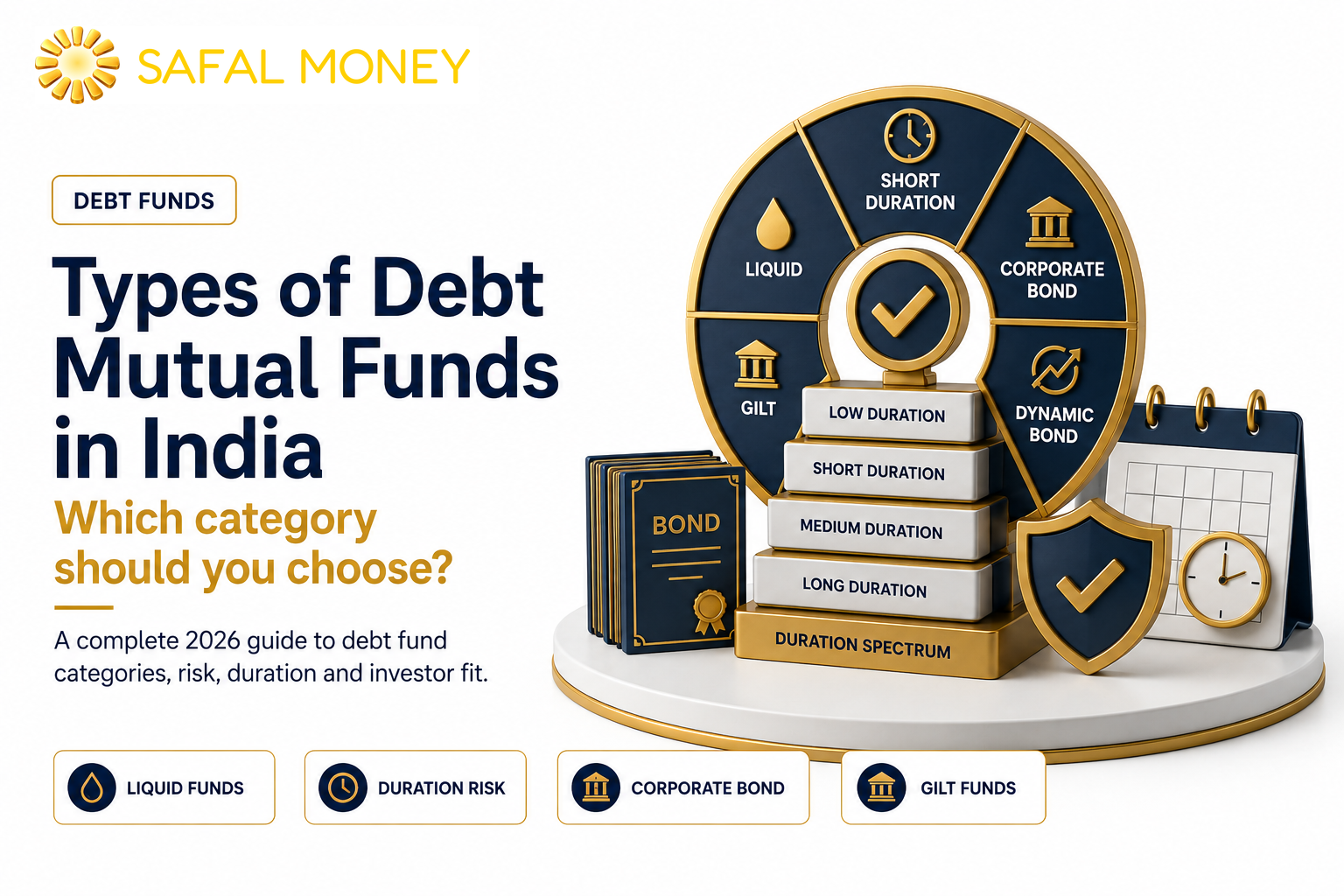
The problem is that "debt fund" is not a single product. It is an umbrella term covering 16 SEBI-defined categories, each with a different duration mandate, credit quality profile, interest rate sensitivity, and ideal use case. Choosing a "debt fund" without specifying which category is like going to a pharmacy and asking for "medicine."
The difference between picking the right and wrong debt fund category for your specific need can be the difference between steady, predictable returns and an unexpected NAV decline at exactly the wrong moment — as thousands of investors in long-duration funds discovered when interest rates rose sharply in 2022, and as credit risk fund investors discovered when IL&FS, DHFL, and others defaulted in 2018–2020.
This guide takes a different approach from most debt fund explainers. Instead of listing categories alphabetically, we organise everything around your specific need — what you are trying to accomplish, how long you have, and what the current interest rate environment requires. By the end, you will know exactly which category to use, when, and why.
The Two Risks Every Debt Fund Investor Must Understand First
Before choosing any debt fund category, you need to understand the two fundamental risks that determine how a debt fund behaves:
Interest Rate Risk (Duration Risk): When interest rates rise, bond prices fall — and vice versa. The longer the duration of a bond fund's portfolio, the more sensitive it is to interest rate movements. A fund investing in 30-year government bonds will see its NAV fall significantly when rates rise. A fund investing in 91-day treasury bills will barely notice.
Duration risk works in both directions. When rates fall, long-duration funds generate spectacular returns as bond prices rise. When rates rise, they can lose money even though their underlying instruments are government-backed and carry zero default risk.
Credit Risk (Default Risk): Not all borrowers are equally creditworthy. A bond issued by the Government of India carries virtually zero default risk. A bond issued by a mid-sized real estate developer carries meaningful default risk — and pays a higher yield to compensate. The higher the yield a debt fund promises, the more credit risk it is likely taking.
Every debt fund category sits at a specific point on these two dimensions — duration and credit quality. Understanding where a fund sits on these two axes tells you almost everything you need to know about its risk profile before you invest.
Need 1: I Need to Park Money for 1 Day to 1 Week
Use: Overnight Fund
Overnight funds invest exclusively in securities that mature in one business day — typically Tri-party Repo (TREP) agreements and similar overnight instruments. There is virtually no interest rate risk (the securities mature tomorrow, so there is nothing to reprice) and negligible credit risk (counterparties are primarily banks and primary dealers).
Returns are modest — typically close to the RBI repo rate minus the fund's expense ratio, which for direct plans is usually 0.05–0.10%. With the repo rate at 5.25%, overnight fund returns are approximately 5.0–5.1% annualised.
Overnight funds are not wealth-building instruments. They are the safest possible place to park money you need back in a few days — better than leaving it idle in a savings account but not suitable for anything beyond a 1–2 week parking horizon.
When to use: Surplus funds between transactions, very short-term parking before deployment into equity or SIF, money that must be accessible immediately.
When NOT to use: As a replacement for a liquid fund for emergency corpus — the marginal return difference does not justify the administrative effort of switching in and out of overnight funds for most individual investors.
Need 2: I Need My Emergency Corpus to Be Safe and Accessible
Use: Liquid Fund
Liquid funds invest in instruments maturing within 91 days — treasury bills, commercial paper, certificates of deposit, and similar short-term instruments. They are the gold standard for emergency corpus parking among Indian HNI investors.
Key features that make liquid funds ideal for emergency corpus:
- Redemptions are processed within T+1 business day — for most investors, this means money in your account the next morning. Some AMCs and platforms now offer instant redemption up to ₹50,000 or 90% of the invested amount.
- Exit loads are nil after 7 days of investment. In the first 7 days, a graded exit load applies — ranging from 0.0070% on day 1 to 0.0045% on day 6 — which is effectively negligible for any meaningful corpus.
- Returns are typically 5.5–6.5% annualised for well-managed liquid funds in direct plans — meaningfully higher than most savings accounts (3.5–4%) and comparable to short-term FDs without the lock-in.
The one mistake to avoid: Many investors park their entire emergency corpus in a single liquid fund from a single AMC. For very large emergency corpuses (above ₹25–50 lakh), consider splitting across two liquid funds from different AMCs — this eliminates any single-fund operational risk and provides a marginal additional safety layer.
When to use: Emergency corpus (minimum 6 months of expenses), salary overflow parking, money waiting to be deployed into equity, SIP source funds.
When NOT to use: As a substitute for short-duration funds for money you will not need for 1–3 years — the return sacrifice of keeping money in liquid funds for extended periods is meaningful.
Need 3: I Have 3 to 6 Months Before I Need the Money
Use: Ultra Short Duration Fund or Money Market Fund
Ultra short duration funds invest in instruments with a Macaulay duration of 3 to 6 months. Money market funds invest in instruments with maturity up to 1 year. Both sit between liquid funds (0–91 days) and short duration funds (1–3 years) on the risk-return spectrum.
These categories offer 20–50 basis points more yield than liquid funds — a meaningful difference for large corpuses. On ₹50 lakh, an additional 0.4% annual return is ₹20,000 per year, for essentially the same credit quality and slightly more duration.
The tradeoff is marginally more interest rate sensitivity than liquid funds. In a sharp, sudden rate rise environment, ultra short duration funds can see a small temporary NAV dip. However, given the short duration, this dip typically recovers within 1–3 months as the portfolio rolls over to higher-yielding instruments.
The credit quality check: This is the most important due diligence step for ultra short and money market funds. Some funds in these categories take meaningful credit risk to enhance yield — investing in lower-rated commercial paper or corporate bonds. Always check the portfolio's credit rating distribution before investing. A fund with more than 10–15% in instruments rated below AA should be examined carefully.
When to use: Money needed in 3–9 months — advance tax payments, known upcoming expenses, short-term goal funding. Also suitable as a slightly better-yielding emergency corpus alternative for investors comfortable with marginal duration exposure.
When NOT to use: For truly short-term money (under 3 months) — the marginal yield pick-up does not justify the extra duration exposure. Stick with liquid funds for very short horizons.
Need 4: I Have a 1 to 3 Year Horizon and Want Better Returns Than FD
Use: Short Duration Fund or Corporate Bond Fund
This is where most HNI investors should be placing the bulk of their debt allocation — in the 1–3 year maturity bucket where returns are meaningfully better than liquid funds but interest rate risk remains manageable.
Short Duration Funds invest with a Macaulay duration of 1 to 3 years. They provide a natural buffer against interest rate volatility — if rates rise and NAV dips, the portfolio rolls over to higher-yielding instruments within 1–2 years, recovering the loss. Returns are typically 6.5–7.5% annualised for well-managed direct-plan funds.
Corporate Bond Funds invest at least 80% in AAA and AA+ rated corporate bonds — the highest-rated segment of the corporate bond market. They offer 30–80 basis points more yield than comparable government securities because even the highest-rated corporate bonds carry a small credit premium over sovereign debt. For a 2–4 year horizon, this yield premium compounds meaningfully.
FD comparison: A 2-year bank FD at a major bank currently offers approximately 6.8–7.2% interest, taxed at your income tax slab (30%+ for most HNI investors). A corporate bond fund in the direct plan yielding 7.2–7.5% is taxed at 12.5% LTCG after 24 months — significantly more tax-efficient for high-bracket investors. On ₹50 lakh over 2 years, the post-tax difference can be ₹1–1.5 lakh in favour of the debt fund. Always consult your tax advisor for your specific situation.
When to use: 1–3 year financial goals, medium-term wealth preservation, debt allocation for investors whose equity portfolio covers the long-term growth requirement, FD alternative for HNI investors in high tax brackets.
When NOT to use: For emergency corpus — short duration funds can experience temporary NAV dips in rate-rising environments. Always keep emergency corpus in liquid or overnight funds.
Need 5: I Want to Benefit From Falling Interest Rates
Use: Gilt Fund or Long Duration Fund
This is the most misunderstood need in debt investing — and the most potentially rewarding if timed correctly.
When interest rates fall, bond prices rise. The longer the duration of a bond, the more its price rises when rates fall. A 10-year government bond's price rises by approximately 7–8% for every 1% fall in interest rates. A 30-year bond's price rises by approximately 15–18% for every 1% fall. This is the mathematical basis for gilt fund returns.
Gilt funds invest exclusively in government securities — the safest instruments from a credit perspective, since the Indian government is the borrower. But they carry very high duration risk. In the right interest rate environment — when rates are falling — gilt funds can generate equity-like returns over 12–24 month periods.
The 2026 context: The RBI held the repo rate at 5.25% at its June 2026 meeting. With the Iran-US deal creating downside pressure on crude oil prices — which directly reduces inflation — the probability of rate hikes has diminished. Most economists now expect rates to remain flat or potentially ease from early 2027. This creates a moderately supportive environment for gilt and long-duration funds — but ongoing Strait of Hormuz uncertainty introduces meaningful rate risk if oil prices spike again.
SafalMoney's current view: a moderate allocation to medium-to-long duration funds, rather than the longest-duration gilt funds, captures most of the rate-fall upside while limiting exposure to the oil-driven rate-hike tail risk. Wait for clearer crude price stabilisation before making large bets on very long-duration gilt funds.
When to use: When you have high conviction that interest rates are about to fall and you have a 2–4 year horizon for the rate cycle to play out. Also appropriate as a 10–15% satellite within a broader debt portfolio.
When NOT to use: For capital preservation — gilt funds can and do lose money in rate-rising environments. Never use gilt funds for money you might need at a specific point in the near term. Never confuse "government-backed" with "safe from NAV volatility."
Need 6: I Want Active Duration Management Without Doing It Myself
Use: Dynamic Bond Fund
Dynamic bond funds give the fund manager complete freedom to move the portfolio's duration from very short (1–2 years) to very long (10–15 years) based on their interest rate view. When the manager expects rates to fall, they extend duration to maximise bond price appreciation. When they expect rates to rise, they shorten duration to protect capital.
In theory, this is the ideal debt product — you never need to worry about the rate cycle because a professional is managing it for you. In practice, the quality of a dynamic bond fund depends entirely on the accuracy and consistency of the fund manager's interest rate forecasting, which is one of the most difficult things to do consistently in financial markets.
Look for a dynamic bond fund manager who has made correct duration calls across at least two full interest rate cycles — rate-rising and rate-falling. The current manager's tenure matters enormously — a fund with a 15-year track record managed by someone who joined 18 months ago should be evaluated primarily on those 18 months.
Who this is truly for: Investors with a 3+ year horizon who genuinely do not want to think about the interest rate cycle but want potential access to gilt-like returns in the right environment, combined with capital protection in the wrong environment — all within a single fund.
When to use: 3–5 year horizon, investors who prefer not to actively switch between debt fund categories as the rate cycle turns, moderate risk tolerance in the debt allocation.
When NOT to use: For short-term parking or emergency corpus. Also not suitable for investors who want predictable, low-volatility debt returns — dynamic bond fund returns can be highly variable depending on the manager's duration calls.
Need 7: I Want Maximum Yield on My Debt Allocation — Should I Use Credit Risk Funds?
Use: Almost never. Here is why.
Credit risk funds invest at least 65% of their portfolio in instruments rated below AA — bonds issued by companies with lower credit ratings that pay higher yields to compensate for higher default risk. The yield premium can be 150–300 basis points above AAA-rated instruments — which sounds attractive.
The history of credit risk funds in India is a cautionary tale that every HNI investor should know before being tempted by the higher yield.
An Honest Assessment
The Franklin Templeton fiasco of 2020 — where six credit risk and short-duration funds worth approximately ₹26,000 crore were wound up, leaving investors unable to access their money for months and in some cases years — remains the defining event in Indian debt fund history. The IL&FS default of 2018 and the DHFL default of 2019 similarly caused significant losses for investors in credit risk funds that held these instruments.
The fundamental problem with credit risk funds is asymmetric risk. The upside from a higher-yielding bond that does not default is 150–300 basis points of additional annual return. The downside from a bond that does default is the potential loss of 30–80% of the invested principal on that position. This asymmetry — small upside, catastrophic downside — means the yield premium rarely justifies the tail risk for most investors, especially those who cannot absorb meaningful capital loss.
For HNI investors who want the yield of credit risk funds with better risk management, Debt Long-Short SIF offers a structured alternative — professional management of credit exposure with the additional ability to hedge through short positions, within a SEBI-regulated, AMFI-distributed framework.
When to use credit risk funds: Rarely. Only with a genuinely long horizon (5+ years), a small satellite allocation (maximum 5–10% of debt portfolio), and thorough research into the fund's credit risk management history and portfolio transparency.
When NOT to use: As a core debt holding, for money you might need at a specific time, or for investors who cannot afford to lose a portion of principal.
Need 8: I Want Tax-Efficient Short-Term Parking — Not a Debt Fund at All
Use: Arbitrage Fund (classified as hybrid, taxed as equity)
This belongs in a debt fund guide because arbitrage funds compete directly with liquid and short-duration funds for the same investor need — short-term parking — while offering meaningfully better post-tax returns for HNI investors in the 30%+ bracket.
Arbitrage funds exploit price differences between the cash and futures markets for the same stock. Because they maintain 65%+ in equity (through arbitrage positions), they are taxed as equity funds — LTCG at 12.5% after 12 months and STCG at 20% under 12 months.
For an HNI investor in the 30% tax bracket parking ₹1 crore for 12 months:
- Liquid fund at 6.5% return: post-tax return at 30% slab ≈ 4.55%, or ₹4.55 lakh post-tax
- Arbitrage fund at 6.5% return: post-tax return at 12.5% LTCG ≈ 5.69%, or ₹5.69 lakh post-tax
The difference on ₹1 crore over 12 months is approximately ₹1.14 lakh — purely from choosing the right parking vehicle. At ₹5 crore, this difference is ₹5.7 lakh. These are illustrative calculations only — please consult your tax advisor for your specific situation.
When to use: 6–18 month parking horizon, HNI investors in the 30%+ bracket, money waiting to be deployed into equity or SIF, liquid fund alternative for tax-conscious investors.
When NOT to use: For periods under 6 months (STCG at 20% erodes much of the advantage), or for true emergency corpus (daily redemption is not guaranteed for arbitrage funds).
The Current Rate Environment Decision Guide — July 2026
Given the RBI's current stance — repo rate at 5.25%, neutral outlook, rate hike expectations pushed to October–March at the earliest — here is SafalMoney's recommended debt fund positioning by horizon as of July 2026:
| Horizon | Recommended Category | Current Rate Environment Logic |
|---|---|---|
| Under 1 week | Overnight Fund | Zero duration risk, repo-rate return |
| 1 week–3 months | Liquid Fund | T+1 liquidity, negligible rate risk |
| 3–6 months | Ultra Short / Money Market | Small yield pickup, minimal rate risk |
| 6–12 months | Short Duration / Arbitrage | FD alternative, tax efficient |
| 1–3 years | Corporate Bond / Short Duration | Yield premium over govt, manageable duration |
| 3–5 years | Medium Duration / Banking PSU | Balance of yield and duration; rate uncertainty warrants caution on very long funds |
| 5+ years | Dynamic Bond / Moderate Gilt | Selective — wait for crude price stabilisation before heavy gilt allocation |
How Does Debt Long-Short SIF Fit Into This Framework?
Every category above is long-only — the fund can only profit from bonds it holds going up in price or paying their coupon. In a rate-rising environment, long-duration debt funds lose money and there is no mechanism to offset those losses within the fund itself.
Debt Long-Short SIF changes this. By taking long positions in bonds expected to appreciate and short positions in interest rate futures or bonds expected to decline in price, a Debt Long-Short SIF can potentially generate returns in both rising and falling rate environments — depending on the accuracy of the manager's positioning.
For HNI investors with ₹10 lakh or more in their debt allocation, a Debt Long-Short SIF alongside traditional debt funds can offer a more dynamic approach to the debt component of the portfolio. The tradeoff is complexity and the ₹10 lakh minimum.
Use SafalZenith to assess whether Debt Long-Short SIF fits your overall portfolio allocation, and SafalCheck™ to evaluate specific debt SIF funds.
Free tool, no login required
Compare Before You Commit
Not sure whether SIF fits alongside your existing debt mutual fund holdings? Read SIF vs Mutual Fund, PMS and AIF: A Complete Comparison for a full side-by-side breakdown.
Frequently Asked Questions
Which debt mutual fund is best for 2026?
There is no single best debt mutual fund for 2026 - the right category depends on your specific need, horizon, and risk tolerance. For emergency corpus: liquid fund. For 1-3 years: short duration or corporate bond fund. For tax-efficient parking: arbitrage fund. For potential rate-fall benefit with moderate risk: medium duration or banking PSU fund. For active duration management: dynamic bond fund. The current rate environment, with the RBI at 5.25% and rate hike risk partially offset by lower crude oil after the Iran-US deal, suggests a barbell approach - combining short duration funds for safety with selective medium-duration funds for yield, avoiding heavy concentration in very long-duration gilt funds until the oil price trajectory clarifies.
What is the safest debt mutual fund in India?
Overnight funds are the safest debt mutual fund category - they invest only in instruments that mature the next business day, eliminating interest rate risk and virtually eliminating credit risk. Liquid funds are the second safest. Banking and PSU funds are safe from a credit perspective, investing in government-backed entities, but carry moderate interest rate risk. Importantly, no debt mutual fund is capital-guaranteed - all carry some combination of interest rate risk and credit risk. The safest categories minimise both; the riskiest, credit risk funds and long-duration gilt funds, concentrate meaningfully in one or both.
Should I choose a liquid fund or FD for my emergency corpus?
For emergency corpus specifically, liquid funds have several advantages over FDs. Liquid funds offer next-day (T+1) redemption with no penalty, while FDs impose a premature withdrawal penalty of 0.5-1% and may require visiting a branch. Returns are comparable (liquid funds 5.5-6.5% vs FD 6-7%) but debt fund returns are not fixed - they vary with market conditions. For HNI investors in the 30%+ bracket, liquid fund returns are also more tax-efficient than FD interest, which is taxed at slab rate. The one advantage of FDs is capital certainty - the principal is guaranteed, whereas liquid fund NAV can theoretically decline, though in practice this is extremely rare for high-quality funds.
What happens to debt funds when interest rates rise?
When interest rates rise, bond prices fall, which means the NAV of debt mutual funds that hold bonds falls. The degree of NAV decline depends on the fund's duration - longer duration funds fall more, shorter duration funds fall less. A liquid fund's NAV is virtually unaffected by rate changes. A long-duration gilt fund's NAV can fall 5-15% in a sharp rate-rise environment. The good news is that NAV declines in debt funds due to rate rises are typically temporary - as the portfolio rolls over to higher-yielding instruments, NAV recovers. Short and medium duration funds typically recover within 6-18 months. Long-duration funds may take longer.
Is a gilt fund safe in 2026?
Gilt funds are safe from a credit risk perspective - they invest only in government securities where the probability of default is virtually zero. However, they carry very high interest rate risk. In 2026, the safety of gilt funds depends heavily on the interest rate trajectory. If the RBI keeps rates flat or eventually cuts, the more likely scenario if crude oil stabilises at $70-$80 following the Iran-US deal, gilt funds can generate strong returns. If rates rise due to renewed oil-driven inflation, gilt funds can experience meaningful NAV declines. The current environment, with oil prices volatile and the Iran-US MOU fragile, warrants a cautious approach to very long-duration gilt funds until the crude picture clarifies.
Last updated: 6 July 2026