Gilt Funds Explained: When to Invest, When to Avoid
Gilt funds can deliver equity-like returns in rate-cut cycles - or significant losses in rate-hike cycles. This complete 2026 guide explains how gilt funds work, when to invest, and when to stay away.
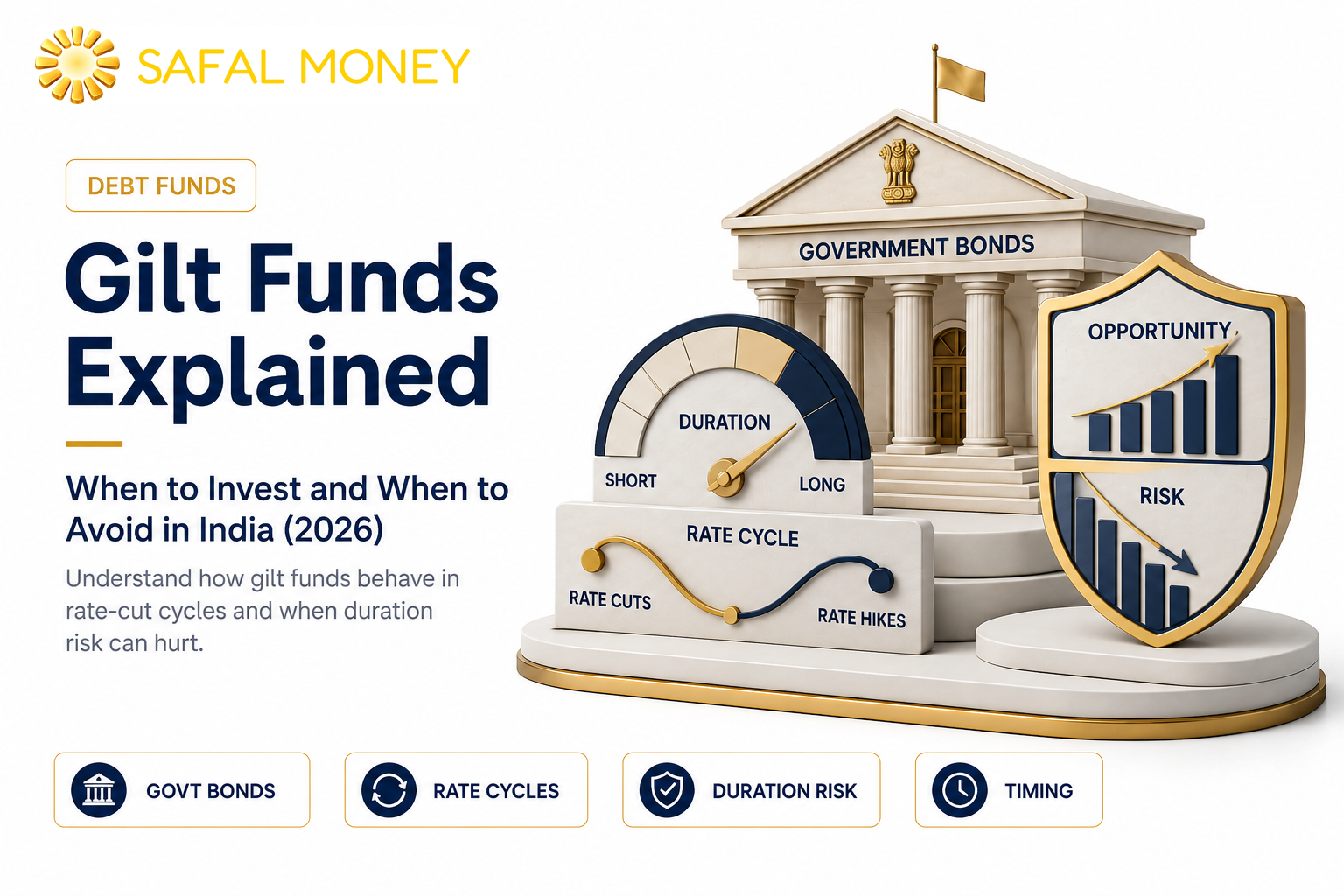
Of all the debt mutual fund categories in India, gilt funds generate the most confusion — and the most polarised investor experiences. Some investors have made 15–20% returns from gilt funds in a single year. Others have watched their "safe" government bond fund deliver negative returns for 18 months. Both experiences are real. Both are entirely consistent with how gilt funds work.
The confusion arises because gilt funds carry zero credit risk — they invest only in government securities, which the Indian government will always repay — but they carry very high interest rate risk. These two dimensions are often conflated. Investors who hear "government bonds" assume "safe" — and they are right about one dimension (credit) while being dangerously wrong about the other (interest rate sensitivity).
This article gives you the complete picture: how gilt funds work, what drives their returns, when they are the best debt fund choice available, and when they should be avoided entirely — with specific guidance for the 2026 interest rate environment.
What Is a Gilt Fund? The Plain-English Definition
A gilt fund is a debt mutual fund that invests exclusively or predominantly in government securities — bonds issued by the central government (Government of India) and state governments. The term "gilt" comes from the British tradition of printing these bonds on paper with gilded edges — symbolising their high quality and sovereign backing.
SEBI defines two gilt fund sub-categories:
- Gilt Fund: Must invest at least 80% of its assets in government securities across maturities. The fund manager has discretion over which maturities to hold — short-term treasury bills, medium-term bonds, or long-term government securities of 10, 20, or even 30-year maturity.
- Gilt Fund with 10-Year Constant Duration: Must invest at least 80% in government securities, specifically maintaining a Macaulay duration of 10 years at all times. This is a more rigid sub-category designed for investors who specifically want long-duration government bond exposure.
Both categories have one defining characteristic: they invest only in government securities. There is no corporate bond, no commercial paper, no certificate of deposit. The only borrower is the Government of India or state governments.
Why Gilt Funds Have Zero Credit Risk
The Government of India has never defaulted on its rupee-denominated debt obligations. Unlike a corporate bond — where the issuer could go bankrupt and fail to repay — a sovereign government that borrows in its own currency can always repay by creating money. This is not a theoretical guarantee; it is a structural reality of sovereign debt.
This means gilt fund investors face zero credit risk — the government will always repay the principal and interest on its bonds. There is no equivalent of an IL&FS, DHFL, or Franklin Templeton-style credit event in a gilt fund portfolio.
For investors who have been burned by credit risk funds — and many Indian investors have been, through the 2018–2020 credit crisis — gilt funds offer the clearest possible credit safety. You will always get your principal back, from every instrument in the portfolio.
But you may not get it back when you want it or at the price you expect — because of interest rate risk.
Why Gilt Funds Have Very High Interest Rate Risk
Interest rate risk in gilt funds is the direct mathematical consequence of duration. Here is the precise relationship:
When interest rates rise by 1%, a bond's price falls by approximately its modified duration percentage. For a 10-year government bond with modified duration of approximately 6–7 years, a 1% rate rise causes approximately 6–7% price decline. For a 30-year government bond with modified duration of approximately 15 years, a 1% rate rise causes approximately 15% price decline.
Gilt funds hold long-maturity government bonds, and their modified duration typically ranges from 5 to 15 years depending on the portfolio composition and fund strategy. This makes them extremely sensitive to interest rate changes.
The counterpoint is equally powerful: when rates fall by 1%, a 10-year gilt fund rises by 6–7%, and a 30-year gilt fund rises by 15%. This is the source of the spectacular returns that gilt funds can generate in rate-cutting cycles.
The Historical Return Profile: What Gilt Funds Have Actually Delivered
Gilt fund returns are among the most volatile in the debt mutual fund category — with annual returns ranging from negative territory to over 20% in different rate environments based on historical data.
- In rate-cutting cycles: When the RBI cut rates from 8% to 6.5% between 2015 and 2017, long-duration gilt funds delivered returns of 15–20% in some years — equity-like returns from government bond funds. This is the gilt fund dream scenario.
- In rate-rising cycles: When the RBI raised rates aggressively from 4% to 6.5% between 2022 and 2023, long-duration gilt funds delivered negative or near-zero returns for extended periods, even as the coupon income was collecting. Investors who bought gilt funds expecting "safe government bonds" experienced portfolio losses that took 18–24 months to recover.
- In flat rate environments: Gilt funds deliver returns close to their current yield — typically 7–8% for 10-year government bonds — with some NAV volatility but no dramatic gains or losses.
The pattern is clear: gilt funds are a timing instrument, not a buy-and-hold instrument. Their value is greatest when purchased at or near the peak of a rate-tightening cycle and held through the subsequent rate-cutting cycle.
The Two Gilt Fund Strategies — Which Is Right for You?
Strategy 1: Dynamic Duration Gilt Fund
Most standard gilt funds give the fund manager flexibility to adjust the portfolio duration based on their rate view. When rates are expected to fall, the manager extends duration (buys longer-maturity bonds) to maximise price appreciation. When rates are expected to rise, the manager shortens duration (moves to shorter-maturity treasury bills) to limit losses.
This sounds ideal — professional duration management so you do not have to time the rate cycle yourself. In practice, the quality of this approach depends entirely on the fund manager's interest rate forecasting accuracy and the speed of their portfolio adjustment.
For investors who want gilt fund exposure but do not want to make their own duration call, a well-managed dynamic gilt fund from an AMC with a strong fixed income track record is the most appropriate choice.
Strategy 2: Gilt Fund with 10-Year Constant Duration
This is a more aggressive, explicit bet on the 10-year government bond yield. The fund must maintain a 10-year Macaulay duration at all times — meaning regardless of where interest rates are or where they are going, the fund holds long-duration government bonds.
This strategy delivers the maximum benefit when rates fall and the maximum pain when rates rise. It is the purest expression of a rate-cut bet — appropriate for investors who have high conviction on the rate direction and want to maximise the portfolio impact.
For most investors, the constant duration variant is too rigid — maintaining 10-year duration even when rate signals are mixed or negative. The more flexible standard gilt fund is generally the better choice unless you have very high conviction on rate direction.
When to Invest in Gilt Funds: The 4 Green Light Conditions
Gilt funds are the right choice when all or most of these conditions are present:
Green Light 1: You are at or near the peak of a rate-tightening cycle. The optimal entry point for gilt funds is when the RBI has finished hiking rates or is about to pause. At this point, current yields are highest (because bond prices have fallen as rates rose), making the entry valuation attractive. As the rate cycle turns and rates eventually fall, gilt fund NAVs rise and generate capital appreciation on top of the high coupon income.
Green Light 2: Inflation is declining and within the RBI's target band. Falling inflation removes the primary reason for the RBI to hike rates further, increasing the probability of a rate-flat or rate-cut environment. When CPI is comfortably below 5% and trending lower, the conditions for gilt fund outperformance are improving.
Green Light 3: Your investment horizon is 3 years or more. Even in a clear rate-cut scenario, the path is rarely smooth. Rate cuts are often delayed, reversed temporarily, or smaller than expected. Investors with a 3+ year horizon can ride through these intermediate volatility periods without being forced to redeem at a loss.
Green Light 4: You are comfortable with 5–10% temporary NAV declines. Even in a favourable gilt fund environment, unexpected events — geopolitical shocks, inflation surprises, central bank changes — can cause temporary NAV declines of 5–10%. Investors who will panic and redeem at these moments should not be in gilt funds regardless of the rate environment.
When to Avoid Gilt Funds: The 4 Red Light Conditions
Red Light 1: Rates are rising or the RBI has just started hiking. This is the worst time to invest in gilt funds — you will be buying as bond prices fall, and the losses will accumulate until the hiking cycle ends. This is precisely what happened to investors who bought gilt funds in late 2021 or early 2022, just as the rate hike cycle was beginning.
Red Light 2: Geopolitical shocks are creating oil price uncertainty. When crude oil prices are volatile — as in the current Iran-US situation in 2026 — inflation trajectory becomes unpredictable. Unexpected inflation spikes can force central banks to hike rates even when the base case is a cut. Gilt funds with long duration are exposed to significant NAV risk in this scenario.
Red Light 3: Your horizon is less than 2 years. Short-horizon investors should not be in gilt funds. Even if the rate cut happens as expected, the path could be bumpy enough to cause negative returns over 12–18 months. Short-duration funds or corporate bond funds are more appropriate for sub-2-year horizons.
Red Light 4: Your portfolio cannot absorb a 15% temporary decline. In the worst-case scenario for a gilt fund — a sudden unexpected 150 basis point rate hike — a fund with 10-year duration could decline 15% in NAV. If your total investable corpus is ₹50 lakh and ₹20 lakh is in gilt funds, a 15% decline means ₹3 lakh in paper losses. If that would cause you to panic-sell, gilt funds are not appropriate regardless of the rate environment.
The 2026 Gilt Fund Question: Is Now the Right Time?
As of July 9, 2026, the gilt fund investment decision is genuinely complex — and depends on the Iran-US situation more than any other single factor.
The case for gilt funds now: The RBI has held rates at 5.25% for three consecutive meetings after a substantial cutting cycle. The next move is more likely to be down than up if crude oil stabilises. At 5.25% repo rate and 10-year government bond yields around 6.8–7.0%, the entry yield is attractive relative to the post-rate-cut scenario. A 50 basis point cutting cycle from here would generate 3–4% additional return from price appreciation in a 10-year gilt fund.
The case against gilt funds now: The Iran-US MOU is fragile. Fresh tanker attacks in early July 2026 pushed Brent crude back above $76. If the deal breaks down and crude returns to $100+, the RBI faces renewed inflation pressure and the rate hike risk revives — which would be highly damaging for gilt funds. The tail risk of a rate hike scenario (estimated 15% probability) represents a meaningful risk of 8–12% NAV decline for long-duration gilt funds.
SafalMoney's 2026 Gilt Fund Positioning
Given the uncertainty, we recommend a moderate rather than aggressive gilt fund allocation — no more than 20–25% of the total debt portfolio. A combination of dynamic bond funds (which can reduce duration if the rate view changes) and moderate gilt fund exposure (to capture upside if rates do cut) is more appropriate than a concentrated long-duration gilt bet in the current environment.
Gilt Fund vs Dynamic Bond Fund: Which Is Better Now?
This is the most common comparison investors make when considering long-duration debt exposure:
| Dimension | Gilt Fund | Dynamic Bond Fund |
|---|---|---|
| Investment Universe | Government securities only | Government + corporate bonds |
| Duration Management | Fund-defined (or constant 10yr) | Manager-discretionary |
| Credit Risk | Zero | Low (if well-managed) |
| Return in Rate-Cut Cycle | High (pure duration play) | Moderate to high |
| Return in Rate-Rise Cycle | Negative (full duration loss) | Moderate negative (can reduce duration) |
| Appropriate for | High-conviction rate-cut bets | Uncertain rate environments |
| Manager Dependency | Lower (index-like for constant duration) | High |
In the current 2026 environment — where rate direction is uncertain due to the Iran-US geopolitical situation — dynamic bond funds have the advantage of flexibility. If the rate-cut scenario plays out, a well-positioned dynamic bond fund with extended duration will perform nearly as well as a gilt fund. If the rate-hike tail risk materialises, the dynamic bond fund manager can reduce duration to limit losses, while a gilt fund is fully exposed.
For investors choosing between the two in the current environment, dynamic bond funds from AMCs with demonstrated rate-cycle navigation track records offer better risk-adjusted positioning.
Gilt Fund vs Corporate Bond Fund: The Risk-Return Choice
| Dimension | Gilt Fund | Corporate Bond Fund |
|---|---|---|
| Credit Risk | Zero — sovereign only | Low — AAA/AA+ corporate |
| Duration | Long (5–15 years typically) | Moderate (2–5 years typically) |
| Yield | Government bond yield (lower) | Government yield + credit spread (higher) |
| Interest Rate Sensitivity | Very high | Moderate |
| Best Used For | Rate-cut capital appreciation plays | 2–4 year yield enhancement over FD |
For investors who want better-than-FD returns with moderate interest rate risk and minimal credit risk, corporate bond funds are generally more appropriate than gilt funds for 2–4 year horizons. Gilt funds are specifically for investors who want to actively participate in the rate-cut cycle with maximum price appreciation potential.
How to Evaluate a Gilt Fund Before Investing
Before investing in any gilt fund, check these five factors:
- Modified Duration: This directly quantifies your interest rate risk. A fund with modified duration of 6 means a 1% rate change causes approximately 6% NAV change. Know this number before investing.
- Current Yield to Maturity (YTM): The YTM of the portfolio tells you the "carry" — the annual income return you will receive if rates stay flat. Higher YTM at a good entry point improves the risk-reward.
- Fund Manager's Rate-Cycle Track Record: Has this fund manager correctly positioned the portfolio through previous rate cycles? A manager who extended duration at rate peaks and reduced duration before rate hikes has demonstrated the skill that makes a dynamic gilt fund valuable.
- Expense Ratio: Gilt funds should have low expense ratios since the portfolio is simple government bonds. Direct plans should be in the 0.1–0.3% range. Any gilt fund charging above 0.5% in direct plan is overpriced.
- Exit Load: Some gilt funds have short exit loads of 0.25–0.50% within 15–30 days. Ensure you understand the exit load structure before investing, particularly if you might need to exit quickly in a volatile rate environment.
Free tool, no login required
Frequently Asked Questions
What is a gilt fund in India?
A gilt fund is a debt mutual fund that invests at least 80% of its assets in government securities - bonds issued by the central government and state governments. Gilt funds carry zero credit risk because the Government of India has never defaulted on rupee-denominated obligations. However, they carry very high interest rate risk - when rates rise, gilt fund NAVs fall significantly, and when rates fall, gilt funds generate strong capital appreciation. SEBI defines two gilt sub-categories: standard gilt funds (variable duration) and gilt funds with 10-year constant duration.
Are gilt funds safe?
Gilt funds are safe from a credit risk perspective - there is zero risk of the Government of India defaulting on its bonds. However, they are not safe from an interest rate risk perspective - long-duration gilt funds can lose 8-15% in NAV if interest rates rise sharply. The word safe when applied to gilt funds refers only to credit safety, not capital stability. Investors who need capital stability should use liquid funds or short-duration funds rather than gilt funds.
When should I invest in gilt funds?
Invest in gilt funds when interest rates are at or near their peak in a tightening cycle and the next move is expected to be downward. Optimal conditions include inflation declining toward the RBI's 4% target, the RBI pausing its hiking cycle, and a stable global macro environment without inflationary shocks. In 2026, the RBI is holding at 5.25% with potential for future cuts - but the Iran-US geopolitical situation and crude oil uncertainty create meaningful rate-hike tail risk. A moderate gilt fund allocation (20-25% of debt portfolio) is appropriate; a concentrated bet is not justified given current uncertainty.
What is the difference between a gilt fund and a dynamic bond fund?
A gilt fund invests exclusively in government securities with zero credit risk but high interest rate sensitivity. A dynamic bond fund invests across government and corporate bonds, with the fund manager adjusting duration based on their rate view. In a clear rate-cut environment, both benefit - but gilt funds typically deliver higher capital appreciation due to longer duration. In an uncertain rate environment, dynamic bond funds have the advantage of being able to reduce duration to limit losses if the rate view changes. Dynamic bond funds carry a small amount of credit risk but are typically managed conservatively with high credit quality.
Can gilt funds give negative returns?
Yes. Gilt funds can and do give negative annual returns when interest rates rise sharply. Historical examples include periods like 2013 (taper tantrum), 2018 (IL&FS crisis caused rate expectations to shift), and 2022 (RBI rate hike cycle). In a 150 basis point rate hike cycle, a gilt fund with 10-year duration can decline 12-15% in NAV. These losses are typically temporary - as rates eventually stabilise and the fund collects coupon income - but the recovery period can be 18-36 months, during which investors with short horizons may be forced to redeem at a loss.
Last updated: 9 July 2026