Building Generational Wealth: The 20-Year MF + SIF Strategy for Indian HNI Families
How Indian HNI families build generational wealth through a 20-year MF + SIF strategy - corpus targets, family portfolio architecture, trust structures, and the compounding blueprint every HNI needs.
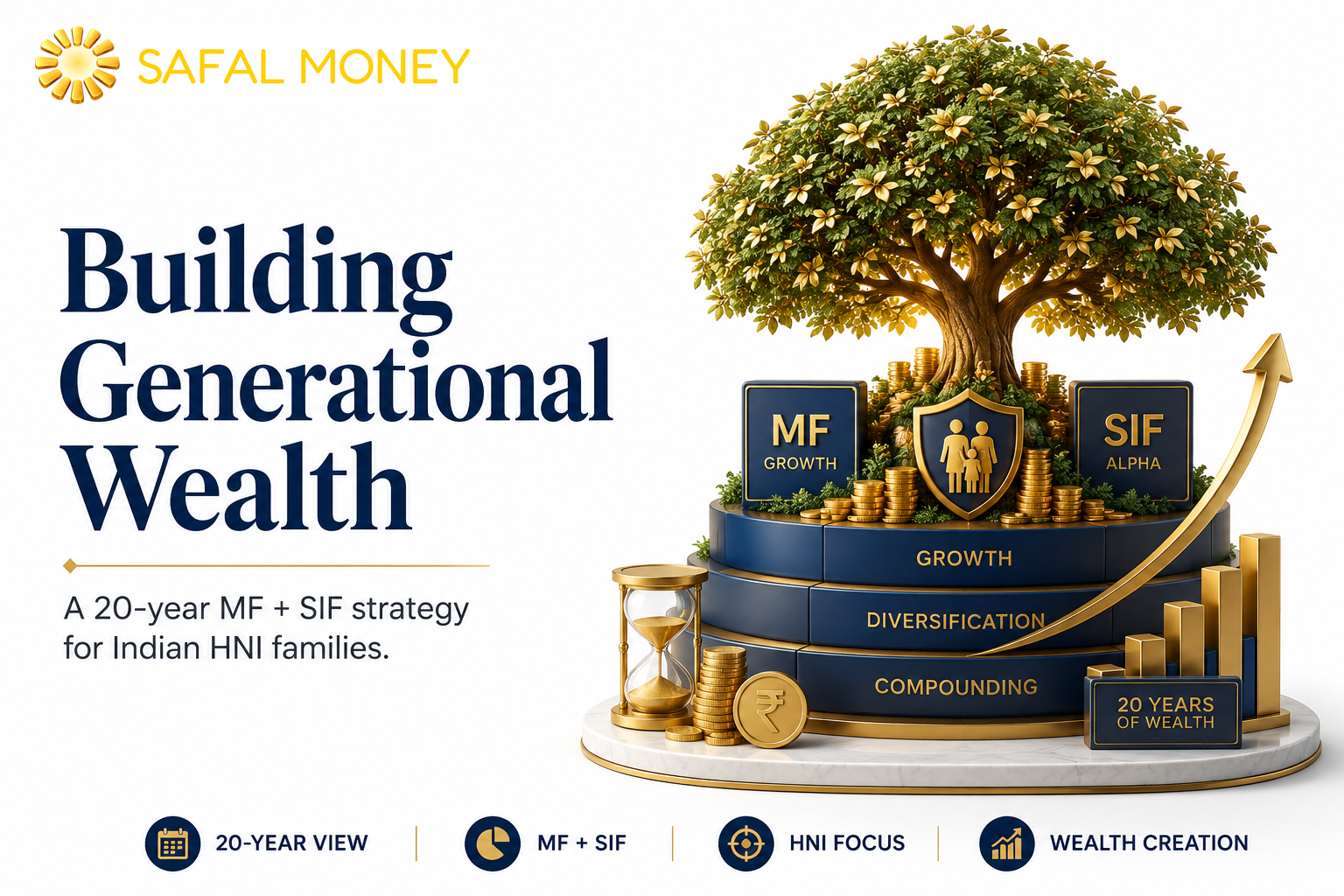
Most Indian HNI investors think about wealth in one generation. They build a corpus for their own retirement, plan for their children's education, and consider estate planning as an afterthought.
Generational wealth - wealth that compounds across multiple generations, funds opportunities for children and grandchildren, and creates lasting family financial security - requires a fundamentally different approach. It requires a longer time horizon than most investors consider, a portfolio architecture designed for multi-decade compounding, and structural decisions about how wealth is held, transferred, and governed across generations.
This article builds the complete 20-year MF + SIF framework for Indian HNI families who want to think beyond their own retirement and create wealth that genuinely compounds across generations.
What Is Generational Wealth and Why It Requires a Different Strategy
Generational wealth is not simply "a lot of money." It is wealth structured to survive and grow across time - through market cycles, family transitions, tax events, and the inevitable human tendency to spend what is available.
Three structural differences separate generational wealth strategies from standard retirement planning:
Time horizon: A retirement portfolio is typically built over 20–30 years and drawn down over 20–30 more. A generational wealth portfolio has an effective horizon of 50–75 years - spanning the investor's active earning years, their retirement, and the early financial lives of the next generation. This longer horizon changes everything about optimal asset allocation.
Compounding scale: The mathematics of compounding over 50+ years are qualitatively different from 20-year compounding. ₹1 Cr compounding at 12% annually becomes ₹29 Cr in 30 years - but ₹289 Cr in 50 years. The extra 20 years adds nearly ten times more wealth than the first 30. Generational wealth strategies protect this long compounding runway above all else.
Governance and transfer: Money passed to the next generation without structure, values, and governance is frequently dissipated within a generation. The structural decisions - how wealth is held, transferred, and governed - are as important as the investment decisions.
The 20-Year Compounding Blueprint: What ₹1 Cr Becomes
Before building the strategy, it is worth anchoring on the compounding mathematics that make the 20-year horizon so powerful for HNI families.
₹1 Cr invested today at different return assumptions:
| Return Rate | 10 Years | 20 Years | 30 Years |
|---|---|---|---|
| 10% (conservative) | ₹2.59 Cr | ₹6.73 Cr | ₹17.45 Cr |
| 12% (moderate) | ₹3.11 Cr | ₹9.65 Cr | ₹29.96 Cr |
| 14% (MF + SIF blend) | ₹3.71 Cr | ₹13.74 Cr | ₹50.95 Cr |
| 16% (aggressive SIF alpha) | ₹4.41 Cr | ₹19.46 Cr | ₹85.85 Cr |
The difference between 12% and 14% - just 2 percentage points - translates to ₹4.09 Cr more on ₹1 Cr over 20 years. For a family with ₹5 Cr invested, this 2% difference compounds to over ₹20 Cr in additional wealth over 20 years.
This is the core argument for incorporating SIF into a generational wealth strategy. SIF Equity Long-Short funds target alpha of 2–4% above their benchmark through the long-short mechanism. Even if half that alpha is realised consistently, the compounding impact over 20 years is transformative.
The Three-Generation Portfolio Architecture
A generational wealth portfolio serves three overlapping time horizons simultaneously - the current generation's retirement needs, the next generation's early financial needs, and the long-term family endowment that compounds across all generations.
Bucket 1 - Current Generation Income and Security (Horizon: 0–10 years)
This bucket covers the current investor's retirement income, near-term expenses, and capital needs. It prioritises stability and income generation over growth.
Recommended allocation: Debt mutual funds (short-to-medium duration) 30%, Arbitrage funds 15%, Balanced Advantage MF 20%, SIF IDCW strategy 10%, Gold ETF 5%. Total: 80% of portfolio.
This bucket generates income through SWP from debt funds, IDCW distributions from SIF, and arbitrage fund redemptions - covering living expenses without needing to touch the growth portfolio.
Bucket 2 - Next Generation Foundation (Horizon: 10–20 years)
This bucket is designed to compound over the next 10–20 years, building the foundation for wealth transfer to the next generation. It can afford more volatility because the time horizon is long enough to absorb market corrections.
Recommended allocation: Equity MF (Large Cap Index + Flexi Cap + Mid Cap) 50%, SIF Equity Long-Short 30%, International MF 10%, Gold ETF 10%. Total: remaining 20% of portfolio in growth instruments.
The SIF Equity Long-Short allocation here is doing the heavy lifting on alpha generation - targeting 2–4% annual alpha above the equity benchmark over the 10–20 year horizon.
Bucket 3 - Endowment Fund (Horizon: 20+ years)
The endowment bucket is wealth that will not be touched in the investor's lifetime - it is explicitly designated for the next generation. Because of the 20+ year horizon, it can hold maximum equity and SIF exposure.
This bucket is typically structured through a family trust or HUF (Hindu Undivided Family) to provide both governance and tax efficiency for long-term compounding. Recommended allocation: 70% equity mutual funds (index-heavy for cost efficiency over 20+ years) + 30% SIF Equity Long-Short.
Why SIF Is the Alpha Engine of a 20-Year Generational Strategy
Over a 5-year horizon, SIF's structural advantage over conventional equity mutual funds is meaningful but not dramatic. Over a 20-year horizon, even modest sustained alpha creates wealth differences that are measured in crores.
The alpha compounding argument:
An investor with ₹2 Cr in Bucket 2 generating 12% annually (equity MF only) compounds to ₹19.3 Cr over 20 years.
The same ₹2 Cr, with 30% in SIF generating 14% blended returns (12% equity MF on 70% + 16% SIF alpha on 30%) compounds to ₹21.8 Cr over 20 years - a difference of ₹2.5 Cr from a 2% blended return improvement.
At ₹5 Cr in Bucket 2, this difference becomes ₹6.25 Cr. At ₹10 Cr, it exceeds ₹12.5 Cr.
The downside protection argument:
Generational wealth strategies are uniquely vulnerable to sequence-of-returns risk at the point of wealth transfer. If markets fall sharply in the year the wealth is being transferred to the next generation - through inheritance, trust distribution, or planned gifting - a long-only equity portfolio suffers maximum drawdown at the worst moment.
SIF Equity Long-Short funds, through their short book, provide partial downside protection during market corrections. Over 20 years, the portfolio is likely to experience 4–6 significant market corrections. A portfolio that loses 25% instead of 40% in each correction preserves substantially more capital for the next recovery - and those recovery gains compound into the generational corpus.
Case Study: The Mehta Family's 20-Year Generational Blueprint
Rajesh Mehta, 47, is a Mumbai-based entrepreneur with a net worth of ₹8 Cr (liquid investable assets - excluding primary residence). His children are 16 and 13 years old. He wants to build a generational wealth portfolio that funds his retirement, covers his children's higher education and early career needs, and creates a lasting family endowment.
SafalScore™ for Rajesh: Score 162 → 30% SIF allocation across multiple strategies.
Rajesh's 20-year portfolio architecture:
| Bucket | Allocation | Amount | Purpose |
|---|---|---|---|
| Bucket 1 - Current Generation | 35% | ₹2.8 Cr | Retirement income, near-term needs |
| Bucket 2 - Next Generation Foundation | 40% | ₹3.2 Cr | Children's wealth foundation, 10–20 yr growth |
| Bucket 3 - Family Endowment | 25% | ₹2.0 Cr | 20+ yr compounding, HUF structure |
Within Bucket 2 (₹3.2 Cr):
- Large Cap Index MF: ₹80L (25%)
- Flexi Cap MF: ₹64L (20%)
- Mid Cap MF: ₹64L (20%)
- SIF Equity Long-Short (3 AMC partners): ₹96L (30%)
- International MF: ₹16L (5%)
Within Bucket 3 (₹2.0 Cr - HUF structure):
- Nifty 50 Index Fund: ₹80L (40%)
- Nifty Next 50 Index Fund: ₹60L (30%)
- SIF Equity Long-Short: ₹60L (30%)
20-year projection (illustrative, not guaranteed): At 12% blended return on Bucket 2 and Bucket 3 combined: ₹5.2 Cr grows to approximately ₹50 Cr over 20 years. With SIF alpha of 2% on the SIF portion, this improves to approximately ₹57–60 Cr - before accounting for additional annual investments from business income.
The HUF Structure for Generational Wealth: Tax Efficiency Across Generations
The Hindu Undivided Family (HUF) is one of India's most powerful but underutilised vehicles for generational wealth building. An HUF is a separate legal and tax entity - it has its own PAN, files its own tax return, and can invest independently of the individual members.
Key HUF advantages for generational wealth:
Separate tax slab: An HUF has its own income tax slab - the same slab rates as an individual, including the ₹2.5L basic exemption. For a family where the Karta (head) is already in the 30% bracket, routing investments through HUF allows the first ₹2.5L of investment income to be tax-free within the HUF entity - a meaningful saving on large corpora.
Separate LTCG exemption: The HUF gets its own ₹1.25L annual LTCG exemption on equity investments - in addition to the Karta's individual exemption. For a family doing annual LTCG harvesting, this doubles the annual tax-free crystallisation capacity.
Smooth succession: Assets held in HUF pass to the next generation as coparceners - without the delays and disputes that can accompany individual estate administration. The structure provides natural governance for family wealth across generations.
SIF in HUF: HUF accounts can invest in SIF, subject to meeting the accredited investor criteria at the HUF entity level. SafalMoney supports HUF onboarding for SIF investments across partner AMCs.
The Annual Investment Addition: Compounding New Money Into the Generational Corpus
Generational wealth is not built from a single lump sum - it is built by adding to the corpus consistently over 20 years. The annual addition to the generational portfolio is as important as the initial corpus.
For a family with ₹8 Cr initial corpus and the ability to add ₹50L annually from business income or salary:
Year 1: ₹8 Cr corpus + ₹50L addition. Year 5: Approximately ₹16 Cr (12% return + annual additions). Year 10: Approximately ₹32 Cr. Year 20: Approximately ₹110–130 Cr (depending on SIF alpha realisation).
The annual addition of ₹50L - deployed systematically into the Bucket 2 and Bucket 3 allocation - adds approximately ₹30–40 Cr to the 20-year outcome through its own compounding. New money added in years 1–10 has 10–20 years to compound; even money added in year 15 has 5 years of growth ahead of it.
The annual portfolio audit is the mechanism for ensuring new money is deployed correctly - into the right buckets, in the right proportions, with appropriate SIF strategy selection based on the updated SafalScore™.
Governance: The Non-Financial Layer of Generational Wealth
The most sophisticated investment strategy fails if the next generation is not prepared to steward the wealth. Indian business families have extensive experience with this reality - inherited wealth without governance, values, and financial education is frequently lost within a generation or two.
Financial education for the next generation: Begin early. Children of HNI investors should understand compounding, asset classes, and the difference between income and wealth by their mid-teens. Exposure to annual portfolio reviews - even as observers - builds financial literacy that textbooks cannot.
Family investment policy statement: Document the family's investment philosophy, target allocations, decision-making authority, and distribution rules. This document - reviewed and updated annually - creates clarity about how the generational corpus will be managed as leadership transitions.
Defined governance for HUF and trusts: Who makes investment decisions? What is the process for changing strategy? What triggers a distribution to beneficiaries? These questions, answered in advance and documented, prevent the disputes that destroy family wealth more reliably than any market correction.
Gradual responsibility transfer: Rather than handing full investment authority to the next generation at inheritance, consider a phased approach - co-management of the portfolio for 3–5 years before full transition. SafalMoney can support this transition with continued SafalScore™ recalculation and SIF strategy review as generational ownership shifts.
Frequently Asked Questions
How much corpus is needed to build generational wealth in India?
There is no single threshold - generational wealth is defined by structure and strategy as much as size. However, for a portfolio to compound meaningfully across 20+ years while funding current generation income needs, a minimum of ₹3-5 Cr in liquid investable assets is typically required to create meaningful Bucket 2 and Bucket 3 allocations without compromising Bucket 1 security. Families with ₹1-3 Cr can still apply the three-bucket framework at proportionally smaller scale - the principles remain the same.
Can SIF be held in a family trust for generational wealth?
Yes, with the appropriate trust structure. A private family trust in India can hold mutual fund investments - and legal frameworks exist for SIF investment through trust entities meeting the accredited investor criteria. Trust investment in SIF requires specific documentation at the AMC level. SafalMoney assists families in navigating the trust onboarding process for SIF investments across partner AMCs.
How should I split SIF allocation across multiple AMCs for generational wealth?
For generational wealth portfolios with significant SIF corpus (₹1 Cr+ in SIF), SafalMoney recommends distributing across 2-4 AMC partners rather than concentrating in a single fund. Different SIF fund managers have different long-short approaches - quantitative vs fundamental, sector-specific vs diversified, high-turnover vs low-turnover. Diversification across managers reduces concentration risk at the strategy level while maintaining the alpha generation objective.
What is the role of international mutual funds in a 20-year generational wealth portfolio?
International funds provide currency diversification and exposure to global growth themes - US technology, European healthcare, global infrastructure - that are not available through Indian domestic mutual funds. For a 20-year generational portfolio, a 10-15% international allocation reduces overall portfolio correlation to the Indian business cycle. However, international funds have lost their LTCG tax advantage under current Indian tax rules - gains are taxed at slab rate regardless of holding period. Factor this into the post-tax return expectation when sizing the international allocation.
How does SafalScore™ apply to generational wealth planning?
SafalScore™ should be calculated separately for each portfolio bucket - not for the combined portfolio. Bucket 1 (current generation income) will produce a lower score reflecting shorter horizon and income need. Bucket 2 (next generation foundation) will produce a higher score reflecting longer horizon and growth objective. Bucket 3 (endowment) may produce the highest score of all - a 20+ year horizon with no income need maximises the SIF allocation potential. Recalculate SafalScore™ annually for each bucket as the family's overall financial situation evolves.
Last updated: 27 July 2026