Floater Funds and Banking & PSU Funds: The Safe Debt Options for Rising Rate Environments
Floater funds and banking & PSU funds are India's safest debt options when interest rates rise. This 2026 guide compares both - how they work, which is better in rising vs falling rates, and HNI allocation guidance.
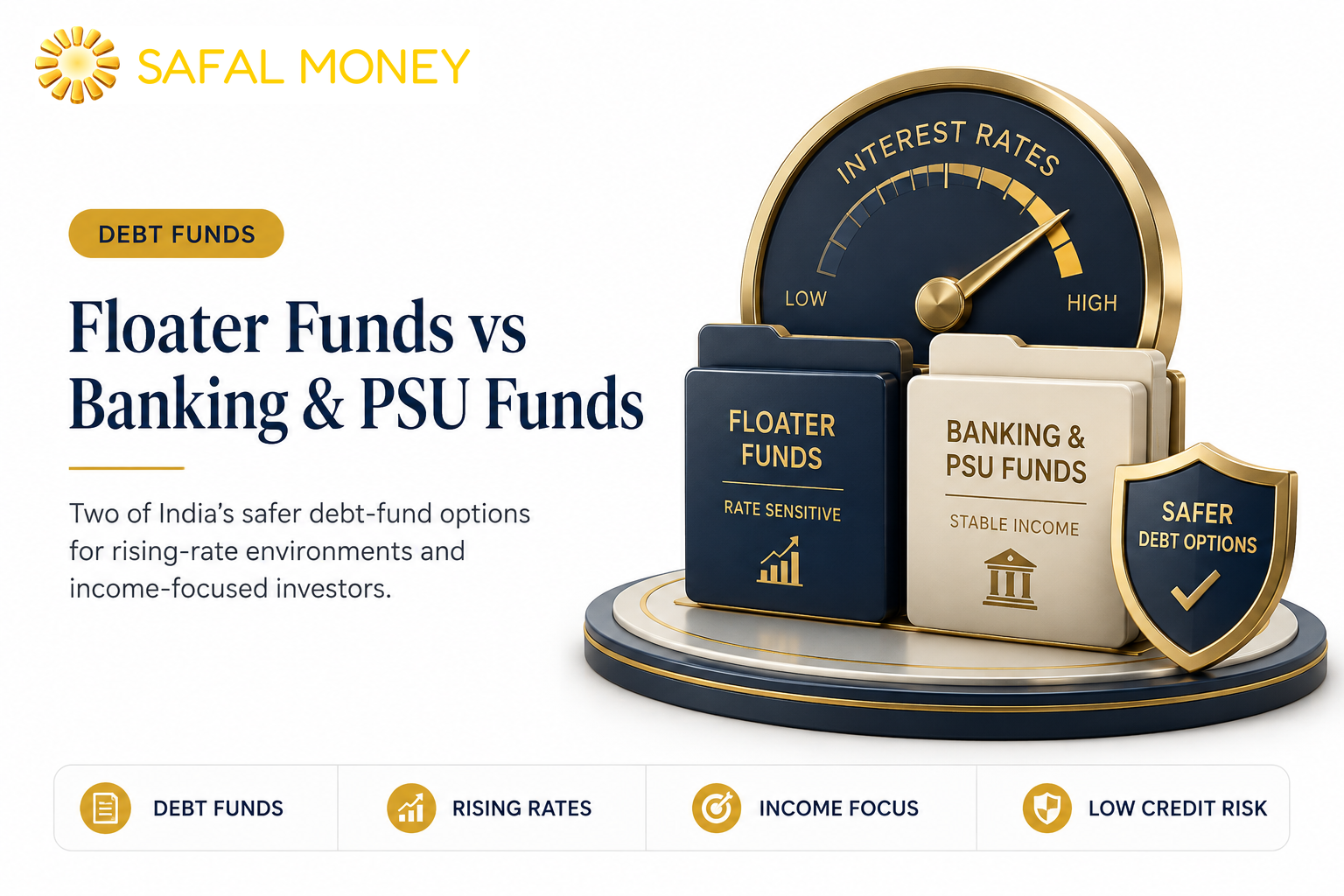
Most investors think about debt fund selection in terms of credit quality and duration. In a rising interest rate environment — where both of these dimensions matter but manifest differently — two categories consistently demonstrate superior resilience: floater funds and banking and PSU funds.
The current Indian macro environment as of July 2026 — the US Fed holding rates at 3.50–3.75% with potential hikes, the RBI holding at 5.25% with uncertain direction, the Iran war oil shock keeping inflation elevated — is precisely the environment where understanding these two categories most matters.
This guide explains how each works, why they hold up better than other debt categories in rising rate environments, how they compare to each other, and how HNI investors should use them in a complete debt portfolio.
Why Rising Interest Rates Hurt Most Debt Funds
Before understanding why floater and banking PSU funds are better in rising rate environments, understand why most debt funds get hurt when rates rise.
When interest rates rise, newly issued bonds pay higher yields. Existing bonds — issued when rates were lower — become less attractive by comparison. To equilibrate, the price of existing bonds falls — reducing the NAV of funds holding them.
The degree of NAV decline depends on the fund's duration:
- A fund with modified duration of 7 years loses approximately 7% in NAV for every 1% rise in interest rates
- A fund with modified duration of 2 years loses approximately 2% for every 1% rise
- A fund with near-zero duration loses almost nothing
This is the core interest rate risk that makes long-duration funds dangerous in rate-rising environments and short-duration or floating-rate instruments valuable.
What Is a Floater Fund? The Mechanism That Makes It Rate-Rising Proof
A floater fund invests primarily in floating rate instruments — bonds and money market securities whose interest rate resets periodically based on a benchmark rate rather than paying a fixed coupon for their entire lifetime.
SEBI mandates that floater funds invest at least 65% in floating rate instruments (including fixed rate instruments converted to floating rate through derivatives swaps).
How floating rate works: a floating rate bond might pay interest at "91-day Treasury Bill rate + 0.5%". When the 91-day T-bill rate rises (which happens when the RBI raises the repo rate), the coupon on this bond automatically increases. The investor receives more income — and crucially, the bond's price does not need to fall to equilibrate with the market, because its yield has already adjusted upward automatically.
This automatic rate reset is what makes floater funds uniquely suited to rising rate environments: fixed rate bonds see prices fall when rates rise to keep yields competitive, while floating rate bonds see yields rise automatically, so prices remain stable.
The practical result: in a rising rate environment where a short duration fund might experience 1–2% NAV decline (from its fixed rate holdings repricing), a floater fund's NAV remains relatively stable because its floating rate instruments automatically adjust to market rates.
The flip side: in a falling rate environment, floater funds receive less income as benchmark rates fall — and their prices do not rise (as fixed rate bond prices would) because there is no fixed coupon being protected. Floater funds are the best debt instrument in rising rate environments and one of the least exciting in falling rate environments.
What Are Banking and PSU Funds? The Credit Safety Layer
Banking and PSU funds must invest at least 80% of assets in debt instruments issued by banks, public sector undertakings (PSUs), and public financial institutions. We covered this category in detail separately — here we focus specifically on how they perform in rising rate environments and how they compare to floater funds.
Banking and PSU funds are not inherently floating rate instruments — most of their holdings are fixed rate bonds from banks and PSUs. So why are they relatively resilient in rising rate environments?
Reason 1: Moderate duration. Most banking and PSU funds maintain Macaulay duration of 1–4 years — shorter than corporate bond funds or dynamic bond funds that may extend to 5–8 years. With shorter duration, the NAV impact of rate rises is significantly less severe.
Reason 2: Quasi-sovereign credit quality. When interest rates rise due to inflation or monetary tightening, credit quality concerns often accompany the rate moves — as seen globally in 2022 and in India in 2018. Banking and PSU fund holdings — government-owned entities and highly regulated banks — are immune to credit quality deterioration concerns that affect private sector corporate bond holdings.
Reason 3: Portfolio roll-over advantage. In a rising rate environment, as existing bonds mature (which happens faster with shorter duration), they are replaced by new, higher-yielding bonds. Banking and PSU funds with 1–4 year duration roll over their portfolios within 12–48 months — accelerating the repricing to higher yields and recovering any temporary NAV declines relatively quickly.
Head-to-Head: Floater Funds vs Banking and PSU Funds
| Dimension | Floater Fund | Banking and PSU Fund |
|---|---|---|
| Primary instrument type | Floating rate bonds + FRIs | Fixed rate bank and PSU bonds |
| Rate-rising resilience | Very High — coupons adjust automatically | High — moderate duration limits impact |
| Rate-falling performance | Weak — yields fall, prices don't rise | Moderate — some price appreciation from moderate duration |
| Credit quality | Very High — typically AAA/A1+ only | Very High — quasi-sovereign backing |
| Duration | Very Low (often under 1 year effective) | Low-Moderate (1–4 years typically) |
| Yield in flat environment | Comparable — tracks benchmark rates | Comparable — fixed coupon at current market rates |
| Liquidity | High — daily redemption | High — daily redemption |
| Ideal rate environment | Rising rates | Rising rates (less perfectly) and flat rates |
| Tax treatment | Slab rate under 24 months, 12.5% after | Slab rate under 24 months, 12.5% after |
The key distinction: floater funds are more perfectly resilient to rate rises because their coupons adjust automatically — there is essentially no mark-to-market loss when rates rise if the entire portfolio is floating rate. Banking and PSU funds reduce interest rate risk through shorter duration but still carry some fixed-rate exposure that creates small temporary NAV dips when rates rise sharply.
Floater Funds: The Technical Details Investors Need to Know
The Benchmark Rate Dependency
Floating rate bonds in India reset their coupons based on benchmark rates — most commonly the 91-day Treasury Bill rate or the RBI repo rate. When the RBI raises the repo rate, the benchmark rises, and floating rate bond coupons reset higher at the next reset date.
Reset frequency matters: bonds that reset every 91 days adjust faster than those that reset annually. A floater fund whose holdings predominantly reset every 91 days will respond to rate changes within 3 months. Annual reset bonds lag by up to 12 months before fully reflecting the new rate environment.
The Fixed-Rate Conversion Mechanism
SEBI allows floater funds to count fixed rate instruments converted to floating rate through interest rate swaps as part of their 65% floating rate mandate. This is an important technical detail: the fund may hold a 3-year fixed rate corporate bond, but through an interest rate swap, convert the fixed rate cash flow to a floating rate cash flow — effectively making it behave like a floating rate bond from an interest rate risk perspective.
This swap mechanism gives floater fund managers more flexibility in portfolio construction — they can access the credit spread from a corporate bond market while converting its interest rate risk profile to floating rate.
The Credit Risk in Floater Funds
Floater funds predominantly invest in short-term, high-quality instruments — treasury bills, certificates of deposit from AAA-rated banks, and A1+ commercial paper. The credit quality is generally very high. However, as with ultra-short and money market funds, some floater funds include lower-rated instruments to enhance yield. Always check the portfolio's credit rating distribution before investing.
The 2026 Rate Environment: Which Category to Prefer Right Now?
The current Indian and global rate environment creates a specific dilemma for debt investors:
The hawkish US Fed case for floater funds: the US Fed, under new Chair Kevin Warsh, is holding at 3.50–3.75% with 25% market probability of a July hike. If the Fed hikes — and the RBI responds to rupee pressure by holding rates or even hiking in sympathy — floater funds will be the best-performing debt category. Their coupons will reset higher, NAV will be stable, and total return will improve.
The RBI pause case for banking PSU funds: the RBI has held at 5.25% for three consecutive meetings and is waiting for clarity on crude oil and inflation. In a flat rate environment — where neither hikes nor cuts materialise — both categories perform similarly. Banking PSU funds offer a small yield premium over floater funds in flat environments because their fixed coupons are set at current market rates without the benchmark rate lag that floating rate instruments sometimes carry.
The rate-cut eventual case against floater funds: if the Iran-US deal holds, crude oil stabilises at $70–80, inflation moderates, and the RBI eventually begins cutting — floater fund yields will fall as benchmark rates decline. Banking PSU funds will also receive lower reinvestment rates but may see some small NAV appreciation from their fixed rate holdings.
SafalMoney's Current Position (July 2026)
Given the elevated rate uncertainty — US Fed potentially hiking, RBI on pause, Iran war tail risk — a barbell combining both categories is most appropriate for the 2026 environment: 40–50% of near-term debt allocation in floater funds (maximum protection against unexpected rate rises), 30–40% in banking PSU funds (stable income with moderate duration benefit if rates eventually fall), and 10–20% in short duration funds (connecting the two with slightly higher yield potential).
Portfolio Sizing: How Much of Your Debt Allocation Should Be in These Categories?
For conservative HNI investors (age 55+, capital preservation priority): 60–70% of total debt allocation in the floater + banking PSU combination — the highest priority is protecting capital from interest rate risk while maintaining credit safety. The remaining 30–40% in liquid and money market funds for Bucket 1 and near-term liquidity.
For moderate HNI investors (age 40–55, balanced approach): 40–50% of debt allocation in the floater + banking PSU combination. Remaining allocation split between short duration corporate bond (for yield enhancement) and dynamic bond or medium duration (for eventual rate-cut positioning).
For aggressive HNI investors (age 28–40, maximising overall portfolio return): 30–35% of debt allocation in floater + banking PSU — as the defensive, stable core. The larger debt allocation can take more duration risk through medium duration and selective gilt exposure to position for eventual rate cuts.
The Tax Efficiency Framework: Holding Period Planning
Both floater funds and banking PSU funds are non-equity oriented — taxed at income slab rate for gains under 24 months and 12.5% LTCG after 24 months.
This makes the 24-month holding period the critical planning threshold for both categories. HNI investors in the 30%+ bracket should always target holding these funds for at least 24 months to access the 12.5% LTCG rate rather than the 30%+ slab rate.
Planning implication: if you are investing for a specific 2-year goal — advance tax corpus, home renovation budget, school fee corpus — invest now and plan your redemption for after 24 months. The 12.5% vs 30%+ tax rate difference on ₹10 lakh of gains over 2 years is approximately ₹1.75 lakh in tax savings.
Which Specific Funds to Consider: Evaluation Criteria
For both floater funds and banking PSU funds, use SafalCheck™ to evaluate the SafalScore™ of specific funds. Key criteria:
For floater funds: what percentage of portfolio is in genuinely floating rate instruments vs fixed-rate-swapped-to-floating (higher genuine floating rate percentage means better rate-rising protection)? Average days to reset — how quickly do the coupons respond to rate changes (shorter reset means faster benefit from rate rises)? Credit quality distribution — are all holdings A1+ or government (any sub-A1+ exposure requires justification)? Expense ratio — well below 0.5% for direct plan floater funds is the target.
For banking and PSU funds: duration — check the modified duration; above 4 years suggests the fund is taking more interest rate risk than typical for the category. Specific PSU issuer quality — are the PSUs operationally strong (NTPC, ONGC) or weaker (loss-making PSUs with implicit government support)? Proportion of holdings in government securities vs bank bonds vs PSU bonds — more government means safer, slightly lower yield. Expense ratio — below 0.5% for direct plan; below 0.3% is excellent.
Free, no login required
Frequently Asked Questions
What is a floater fund in India?
A floater fund is a debt mutual fund category that invests at least 65% of assets in floating rate instruments - bonds and money market securities whose interest rate resets periodically based on a benchmark rate (typically the 91-day T-bill rate or repo rate) rather than paying a fixed coupon. When interest rates rise, floating rate bond coupons automatically increase - keeping the bond price stable rather than falling as fixed rate bonds would. This makes floater funds uniquely resilient in rising rate environments compared to fixed-rate debt funds.
Is a floater fund better than a banking PSU fund in a rising rate environment?
Floater funds are more perfectly protected in rising rate environments because their coupons adjust automatically - there is essentially no mark-to-market NAV impact when rates rise. Banking PSU funds reduce interest rate risk through shorter duration and quasi-sovereign credit quality but still carry some fixed-rate exposure that creates small temporary NAV dips when rates rise sharply. In a falling rate environment, banking PSU funds do better - their fixed-rate holdings generate small NAV appreciation. In July 2026's uncertain environment, combining both categories provides the most balanced protection.
How does a floater fund work when RBI cuts rates?
When the RBI cuts the repo rate, the benchmark rates that floating rate bonds reset against (typically the 91-day T-bill rate) decline. This means floating rate bond coupons reset lower at the next reset date - reducing the yield income of the floater fund. Unlike fixed rate bonds - which rise in price when rates fall, generating capital appreciation - floating rate bonds simply pay less coupon income without significant price movement. In a rate-cutting environment, floater funds underperform short duration, medium duration, and gilt funds that hold fixed-rate instruments whose prices rise as yields fall.
What is the tax treatment of floater funds in India 2026?
Floater funds are classified as non-equity-oriented mutual funds for tax purposes. Gains on units held under 24 months are added to the investor's total income and taxed at their applicable slab rate (30%+ for most HNI investors). Gains on units held 24 months or more are taxed at 12.5% LTCG without indexation benefit. HNI investors should always plan to hold floater fund units for at least 24 months before redemption to access the 12.5% rate rather than the 30%+ slab rate.
Should I choose floater fund or short duration fund in 2026?
In July 2026's uncertain rate environment - US Fed potentially hiking, RBI on pause, Iran war oil tail risk - floater funds offer better protection against unexpected rate rises than short duration funds. Short duration funds carry 1-3 year fixed rate exposure that creates temporary NAV declines if rates rise sharply. Floater funds' automatic coupon reset makes them resilient to rate rises. However, if rates eventually fall (the longer-term base case if crude oil stabilises), short duration funds will benefit more from fixed-rate price appreciation. For maximum resilience across multiple rate scenarios, a combination of floater (40%) and short duration (60%) is the most balanced approach for the 2026 environment.
Last updated: 21 July 2026