US Fed Policy 2026: What Interest Rate Decisions in the US Mean for Indian Investors
New Fed Chair Kevin Warsh has flipped US rate expectations from cuts to potential hikes. Here is what the Fed's hawkish July 2026 stance means for Indian investors - rupee, FII flows, Nifty, gold and debt funds.
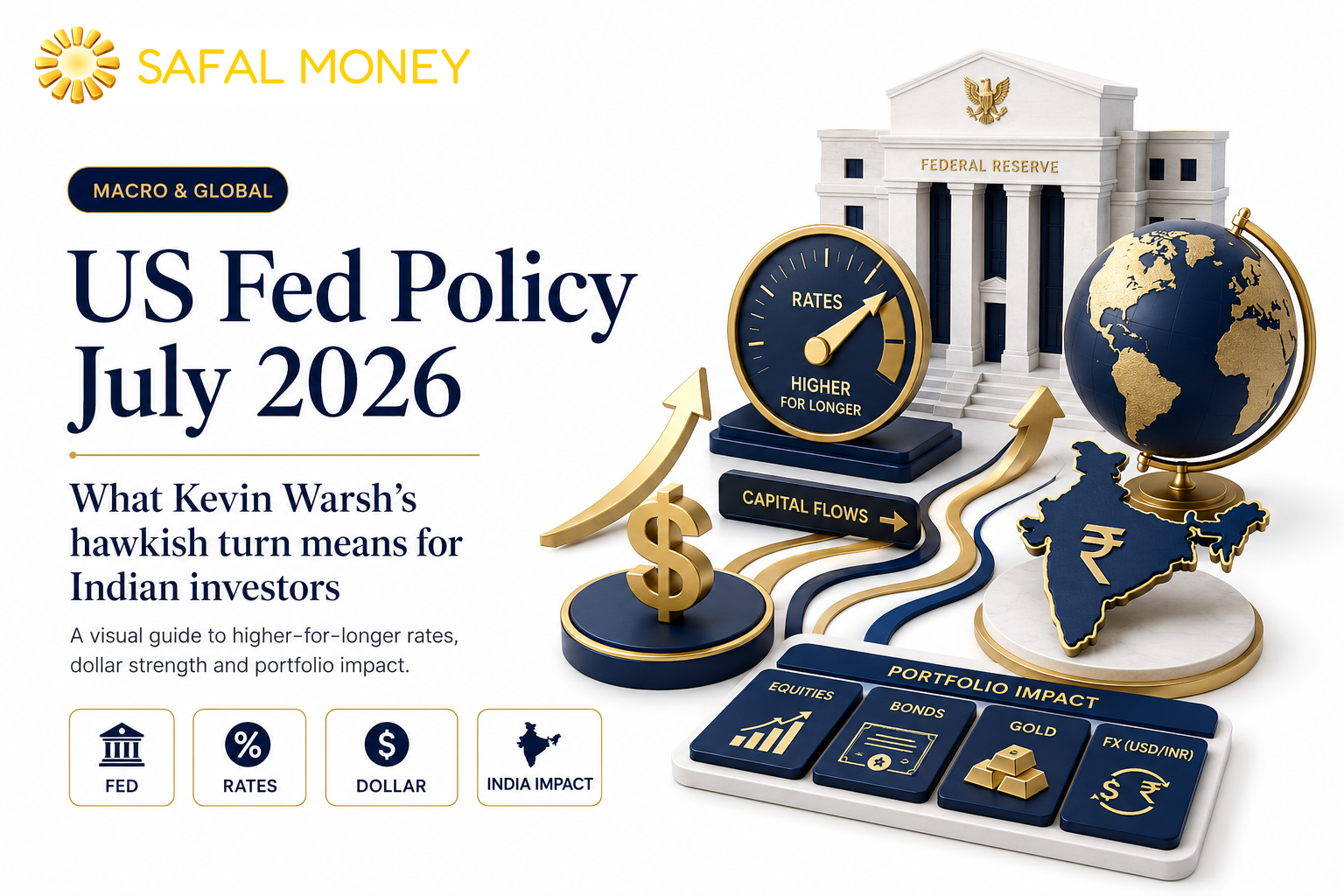
At the start of 2026, markets expected the US Federal Reserve to cut interest rates two to three times through the year — a continuation of the easing cycle that began in late 2025. Those expectations have been completely overturned.
As of July 15, 2026, the Fed funds rate stands at 3.50–3.75% — held steady for four consecutive FOMC meetings. New Fed Chair Kevin Warsh, who took office on May 22, 2026, has adopted a decidedly hawkish stance. US inflation is running at 4.2% year-over-year as of May 2026 — well above the Fed's 2% target and driven significantly by energy prices from the Iran war oil shock. Markets now price a 25% probability of a rate hike at the July 28–29 FOMC meeting — a complete reversal from the rate-cut expectations that dominated at the start of the year.
Nine of eighteen FOMC policymakers see at least one rate hike in 2026. The Fed's preferred inflation gauge — the PCE index — rose 4.1% with a core reading of 3.4%. Market expectations of interest rate cuts in early 2026 have been replaced by the potential for rate hikes.
For Indian investors, this shift has profound implications — for the rupee, FII flows, equity markets, debt fund positioning, and SIF strategy. This article gives you the complete framework.
Who Is Kevin Warsh and Why Does It Matter for India?
Understanding the change in Fed leadership is essential context for interpreting the current policy stance.
Kevin Warsh became the Federal Reserve Chairman on May 22, 2026, succeeding Jerome Powell after being nominated by President Trump and confirmed by the Senate. Warsh's appointment marks a significant transition in monetary policy philosophy and communication.
Warsh has moved quickly to distinguish his approach from that of his predecessor. Most notably, he has eliminated traditional forward guidance in favour of pure data dependence — which has introduced additional volatility into bond markets and equity valuations.
New Fed Chair Kevin Warsh shortened the Fed statement, removed forward guidance, and announced the formation of five task forces to explore potential policy and process reforms. Markets now price in a reasonable chance of a rate hike later in 2026 — a stark contrast to the one to two rate cuts expected earlier this year before energy prices rose.
What this means for India: when the Fed used to provide forward guidance — clear signals about future rate paths — Indian investors could plan FII flows, rupee positioning, and debt fund duration with more certainty. Under Warsh's data-dependent, no-forward-guidance approach, the uncertainty around US rate decisions has increased significantly. This increased uncertainty itself creates volatility — in the dollar index, in EM capital flows, and in India's financial markets — regardless of what the actual decision turns out to be.
The US Inflation Problem: Why the Fed Cannot Cut
The primary driver of the Fed's hawkish reversal is US inflation — which was supposed to be under control by now but has instead re-accelerated.
The Consumer Price Index rose 4.2% year-over-year in May 2026 — marking the highest annual increase since April 2023. Core CPI, which excludes volatile food and energy components, increased 2.9% year-over-year. The Fed's preferred inflation gauge, the PCE index, rose 4.1% with a core reading of 3.4%.
The Iran war oil shock is the primary culprit. The Iran conflict and temporary closure of the Strait of Hormuz in early 2026 caused Brent crude prices to spike above $140 per barrel, contributing significantly to headline inflation.
Even with crude oil retreating from those peaks following the June 17 Iran-US MOU, the energy price spike has embedded itself in broader price levels — through transportation, manufacturing input costs, and consumer fuel prices — in ways that take several months to fully reverse.
The Fed's dilemma: the Iran war created an exogenous inflation shock that the Fed cannot control through monetary policy — raising rates will not reduce global oil supply disruptions. But with inflation running at twice the target, the Fed cannot be seen to be tolerating elevated inflation either. Warsh's hawkish stance is a signal of credibility — demonstrating that the Fed prioritises price stability even when the inflation driver is supply-side and beyond monetary policy's reach.
The July 28–29 FOMC Meeting: What Indian Investors Should Watch
According to the CME FedWatch tool, markets currently assign approximately 25% probability to a 25-basis-point rate hike at the July 28–29, 2026 FOMC meeting. Fed Governor Christopher Waller has signalled that inflation is now the primary policy concern, with risks "completely flipped" from labour market weakness to price stability.
The July FOMC meeting is the most important US monetary policy event for Indian investors in the second half of 2026.
Fed Holds at 3.50–3.75% (Most Likely, ~60%)
Markets have largely priced this in. Limited immediate India impact. Rupee stabilises. FII flows remain cautious but do not deteriorate sharply. Nifty continues its post-Iran-deal recovery.
Fed Hikes 25bps to 3.75–4.00% (Meaningful Risk, ~25%)
Significant negative impact for India. Dollar strengthens sharply, rupee weakens — potentially toward 93–95/USD. FII outflows accelerate from India and other emerging markets as US dollar assets become more attractive. Nifty faces selling pressure, particularly in rate-sensitive sectors. Indian debt fund long-duration positioning becomes more risky as global rate expectations reset upward.
Fed Signals Rate Cuts Ahead (Unlikely, ~15%)
Very positive for India. Dollar weakens, rupee appreciates, FII inflows return. Nifty rallies, particularly in rate-sensitive sectors. Long-duration debt funds in India benefit.
The Five Channels Through Which US Fed Decisions Reach India
US monetary policy affects India through five distinct transmission channels — each affecting different parts of your portfolio:
Channel 1: Capital Flows (FII Investment)
When US interest rates are high, dollar-denominated assets offer attractive yields with the safety of the world's reserve currency. This pulls capital from emerging markets like India into the US. When US rates are low, capital searches for higher yields in EM — flowing into India. The reversal from expected cuts to potential hikes has contributed significantly to the record FII outflows that Indian markets experienced in Q1–Q2 2026.
Channel 2: The Rupee
Higher US rates → stronger dollar → weaker rupee. Every significant Fed hawkish signal causes the rupee to depreciate as dollar demand increases. A weaker rupee creates imported inflation (India's oil imports are priced in dollars), constrains the RBI's ability to cut rates, and increases the cost of dollar-denominated corporate debt.
Channel 3: Indian Equity Market (Nifty)
Fed hawkishness affects Indian equities through two sub-channels. First, FII selling — foreign investors sell Indian equities to move capital back to the US. Second, global risk appetite — when the Fed is hawkish, global risk appetite falls, reducing allocations to EM equities including India. The negative correlation between Fed rate hike expectations and Nifty performance is well-documented historically.
Channel 4: Indian Debt Markets
Higher US rates make Indian government bonds less attractive to foreign investors in relative terms — potentially causing FII outflows from the Indian debt market as well. Additionally, if the RBI is constrained from cutting rates (because a weaker rupee from US hawkishness creates inflation), Indian bond yields stay elevated, limiting the gains in long-duration debt funds.
Channel 5: Gold
The relationship between US rates and gold is complex. Higher US real rates (nominal rate minus inflation) typically pressure gold prices — because gold pays no yield and becomes less attractive when safer alternatives yield more. However, when US rates are high alongside high inflation — as is the case currently — real rates may remain low or negative, which historically supports gold. US CPI at 4.2% with Fed funds at 3.50–3.75% means US real rates are currently approximately -0.5% to -0.75% — structurally supportive for gold despite nominal rate levels.
The Dollar Index and Its India Implications
The US Dollar Index (DXY) — which measures the dollar against a basket of major currencies — is the most direct transmission mechanism from Fed policy to Indian markets.
When Warsh adopted his hawkish stance in June 2026, the DXY strengthened. A stronger dollar means:
- The rupee depreciates, increasing India's oil import bill in rupee terms
- FII investments in India yield less in dollar terms when converted back, making India less attractive
- Rupee depreciation adds to domestic inflation, limiting RBI's policy flexibility
The rupee has been under pressure through much of 2026 — one of the fastest-depreciating Asian currencies this year — partly due to oil import pressures and partly due to the Fed's hawkish shift discouraging EM capital flows.
The RBI Response
The RBI has taken proactive measures — introducing concessional swap windows to attract foreign capital, intervening in forex markets to reduce rupee volatility, and maintaining adequate forex reserves as a buffer. India's forex reserves remain above $600 billion — providing meaningful buffer against short-term rupee pressure.
What Warsh's No-Forward-Guidance Policy Means for Volatility
This is the most underappreciated implication of the Fed leadership change for Indian investors.
Under Powell, the Fed provided extensive forward guidance — clearly signalling rate path expectations through "dot plots" and press conference language. This made Fed decisions relatively predictable, reducing market volatility between meetings.
Under Warsh, this transparency has been deliberately reduced. Warsh has signalled a preference for reducing scripted forward guidance — a move that could introduce more volatility into financial markets as traders struggle to anticipate the central bank's next moves.
For Indian investors, higher Fed decision uncertainty means:
- More frequent sharp moves in the rupee and Nifty around FOMC meetings
- Less ability to position portfolios in advance of Fed decisions
- Higher premium on portfolio resilience across multiple Fed scenarios rather than positioning for one base case
This volatility-amplifying effect of reduced forward guidance is one reason SafalMoney consistently recommends diversification across equity, debt, gold, and SIF rather than making concentrated bets on specific Fed outcomes.
Impact on Indian Debt Funds: The Rate Differential Matters
The interest rate differential between India (RBI at 5.25%) and the US (Fed at 3.50–3.75%) is approximately 150–175 basis points in India's favour. This positive differential supports foreign investment in Indian government bonds.
However, if the Fed hikes to 4.00% or above while the RBI holds at 5.25%, the differential narrows to 125 basis points — reducing the relative attractiveness of Indian bonds for foreign investors.
Practical implications for Indian debt fund investors:
- Short-duration and money market funds: broadly unaffected by Fed decisions — these funds respond primarily to RBI policy and domestic credit conditions.
- Medium-duration corporate bond and banking PSU funds: moderately affected. If Fed hikes cause the rupee to weaken significantly, imported inflation could constrain the RBI from cutting rates, keeping Indian bond yields elevated. Medium-duration funds benefit from yield income but see limited NAV appreciation.
- Long-duration and gilt funds: most sensitive to Fed-driven uncertainty. The scenario where the Fed hikes while India holds creates a complex dynamic — Indian long bond yields may rise sympathetically with US yields, causing gilt fund NAV declines. Conservative positioning is warranted in long-duration funds until the Fed's July meeting outcome clarifies the rate path.
Impact on Indian Equity Markets: Sector-Wise Analysis
The Fed's hawkish turn has sector-specific implications for Indian equities:
Sectors negatively affected by Fed hawkishness:
- IT Services — when the US economy slows (which higher rates eventually cause) and corporate budgets tighten, US-focused Indian IT companies face revenue headwinds. Additionally, dollar strength versus rupee appreciation removes the currency tailwind that benefited IT companies during weak-rupee periods.
- Capital Goods and Infrastructure — companies with significant dollar-denominated debt face higher debt servicing costs when the dollar strengthens. Infrastructure projects with long gestation periods are more sensitive to discount rate changes.
Sectors relatively insulated from Fed hawkishness:
- FMCG, Pharma, Consumer Staples — these domestically-oriented sectors are driven primarily by Indian demand conditions rather than US monetary policy. Fed hawkishness does not significantly affect their earnings trajectory.
- Banking (selectively) — if the RBI holds rates steady in response to Fed hawkishness, net interest margins for banks are maintained. The impact on banking depends on whether the Fed's hawkishness translates into RBI constraint or not.
- Gold-linked equities — as discussed, US real rates remain negative despite nominal rate levels, which is structurally supportive for gold prices and therefore for gold mining and gold jewellery companies.
The SIF Dimension: How Long-Short Strategies Navigate Fed Uncertainty
The Fed's hawkish reversal — from expected cuts to potential hikes — has created exactly the kind of multi-directional sector divergence that Equity Long-Short SIF strategies are designed to exploit.
A well-managed Equity Long-Short SIF can go long domestically-oriented sectors insulated from Fed hawkishness (FMCG, pharma, domestic banking) while going short export-oriented IT or dollar-debt-heavy infrastructure companies that face specific headwinds from dollar strength and US rate expectations.
This long-short spread — capturing the divergence between Fed-sensitive and Fed-insulated sectors — can generate positive returns regardless of whether the Nifty goes up or down in response to the July FOMC decision. It is the structural advantage of the long-short approach in a multi-directional macro environment.
Use SafalZenith to determine your ideal SIF allocation. Use SafalCheck™ to evaluate which specific SIF funds' strategies are best positioned for the current US-India rate differential environment.
Portfolio Action Framework: What Indian HNI Investors Should Do Now
Given the Fed's hawkish July 2026 stance, here are the five most important portfolio actions:
Action 1: Reduce long-duration debt fund concentration. The scenario where the Fed hikes in July or September 2026 would put upward pressure on US treasury yields — which would likely cause sympathetic rises in Indian long bond yields, pressuring gilt and long-duration fund NAVs. Keep long-duration allocation to maximum 15–20% of debt portfolio until July FOMC clarity.
Action 2: Maintain gold allocation — US real rates support it. With US CPI at 4.2% and Fed funds at 3.50–3.75%, US real rates are approximately negative — historically supportive for gold. Maintain 7–10% gold allocation (SGBs for long-term holders) as both a US real rate hedge and a geopolitical uncertainty hedge.
Action 3: Do not reduce equity SIP investments. Fed uncertainty creates equity volatility — but not a reason to stop SIPs. Rupee-cost averaging through Fed volatility historically generates better outcomes than timing the market around FOMC meetings.
Action 4: Review IT sector concentration. If your equity portfolio has more than 20% in IT — directly or through funds — consider whether this concentration is appropriate given both the US economic slowdown risk and the Fed's hawkish stance. IT revenue growth headwinds from both sides make overweight IT positioning more risky in H2 2026.
Action 5: Watch the July 28–29 FOMC meeting outcome closely. If the Fed holds with a neutral statement, current portfolio positioning is appropriate. If the Fed hikes, consider reducing long-duration debt and rebalancing toward short-duration or floating rate funds. If the Fed signals eventual cuts, extend duration moderately.
Free tool, no login required
Frequently Asked Questions
What is the current US Federal Reserve interest rate in July 2026?
The US Federal Reserve's target federal funds rate is 3.50-3.75% as of July 15, 2026. This rate has been held steady for four consecutive FOMC meetings - through the tenure of both former Chair Jerome Powell and new Chair Kevin Warsh, who took office on May 22, 2026. The next FOMC meeting is scheduled for July 28-29, 2026. Markets currently assign approximately 25% probability to a 25 basis point rate hike at that meeting, reflecting the Fed's hawkish shift driven by US CPI inflation at 4.2% - well above the 2% target.
How does the US Fed rate affect Indian markets?
US Fed rate decisions affect Indian markets through five channels: capital flows (higher US rates attract capital away from India, reducing FII inflows), the rupee (dollar strengthens when US rates rise, weakening the rupee), Indian equity markets (FII selling and reduced global risk appetite hurt Nifty), Indian debt markets (narrowing India-US rate differential reduces bond market attractiveness for foreign investors), and gold (US real rates affect gold prices, which impacts gold-linked Indian investments). A hawkish Fed - as is the case in July 2026 - is generally negative for Indian equities and the rupee in the short term.
Who is Kevin Warsh and what does his appointment mean for India?
Kevin Warsh became US Federal Reserve Chairman on May 22, 2026, succeeding Jerome Powell after being nominated by President Trump. Warsh has adopted a more hawkish stance than Powell - prioritising price stability over growth support - and has eliminated the Fed's traditional forward guidance in favour of pure data dependence. For Indian investors, this means more uncertainty and volatility around FOMC meetings, as markets can no longer rely on the Fed's own rate path signals to position portfolios. Warsh's hawkishness has contributed to the shift from expected US rate cuts to potential rate hikes in 2026 - a significant negative for EM capital flows including FII investment in India.
Should I change my mutual fund portfolio based on US Fed decisions?
US Fed decisions warrant a portfolio review - not a complete overhaul. Specific actions for July 2026: reduce concentration in long-duration debt funds (gilt and long-duration corporate bond) until July FOMC clarity, maintain gold allocation as US real rates remain negative, continue equity SIP investments without stopping, review IT sector concentration given US economic slowdown risk, and await the July 28-29 FOMC outcome before making significant duration adjustments in debt funds. Never make large portfolio changes based on a single macroeconomic event - diversification across equity, debt, gold, and SIF remains the most reliable framework.
Does the US Fed rate affect SIF investments in India?
Yes - through the macro channels described above. However, a well-managed Equity Long-Short SIF can actively navigate Fed uncertainty by going long sectors insulated from US rate hawkishness (domestic consumption, pharma, FMCG) while shorting sectors specifically exposed to Fed headwinds (IT, dollar-debt-heavy infrastructure). This long-short spread allows a SIF to generate returns from the sector divergence created by Fed policy changes - regardless of whether the overall market rises or falls. This is one of the structural advantages of long-short SIF versus long-only funds in macro-uncertain environments.
Last updated: 15 July 2026