August 2026 Mutual Fund Market Update: AUM, SIP Inflows & SEBI Developments
India's mutual fund industry AUM hit ₹85.76 lakh crore as of July 2026. SIP inflows nearly touched ₹32,000 crore. SIF AUM crossed ₹20,000 crore. Here's the complete August 2026 market update for Indian investors.
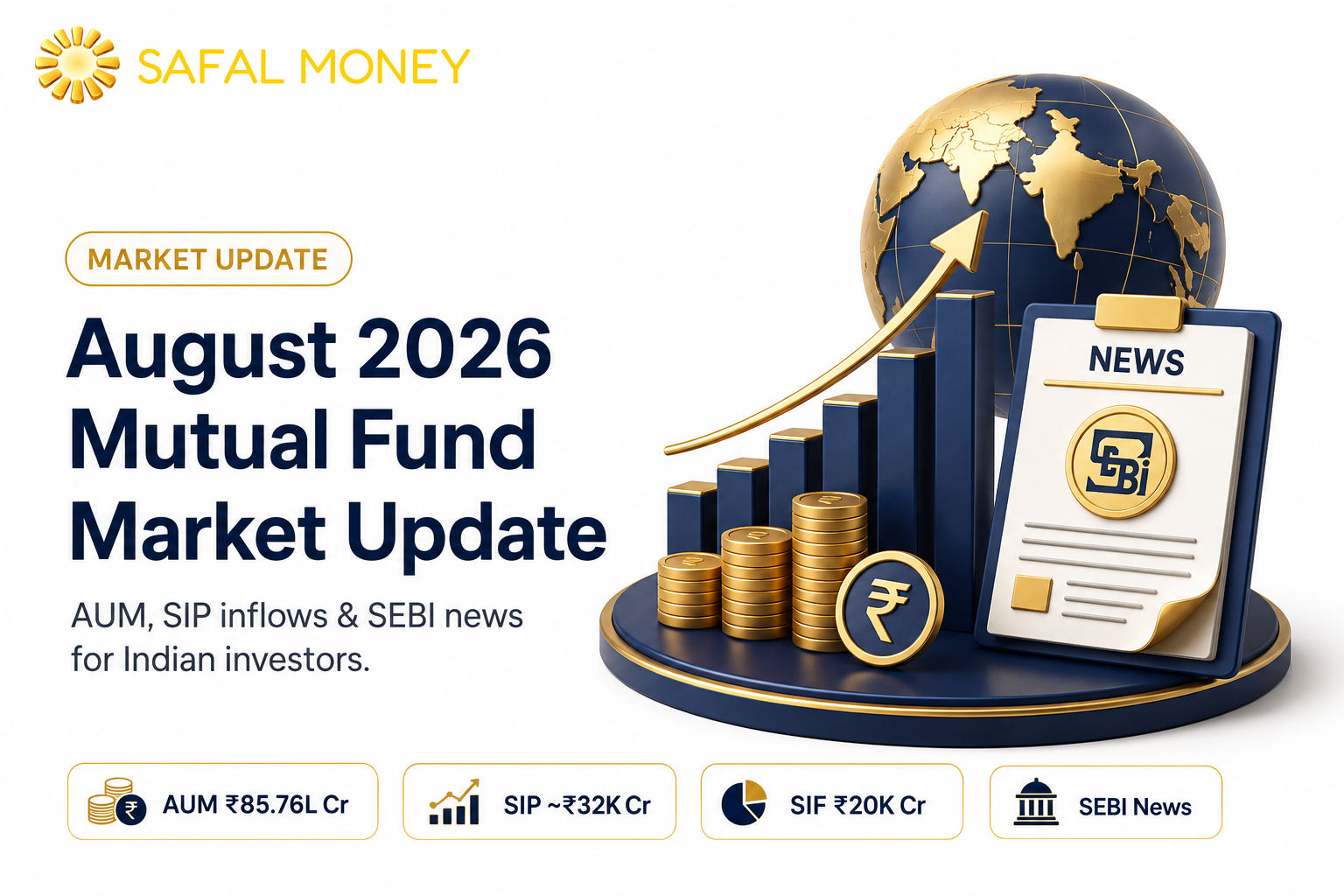
India's mutual fund industry entered August 2026 at a historic scale: AUM of the Indian MF Industry as on July 31, 2026 stood at ₹85.76 lakh crore — average AUM for July 2026 was ₹86.34 lakh crore. To put this in perspective, the industry crossed ₹30 lakh crore for the first time in November 2020. It has nearly tripled in under 6 years — growing from ₹30 lakh crore to ₹85.76 lakh crore between November 2020 and July 2026. The industry closed FY26 with AUM 12.2% higher than FY25, adding approximately ₹8 lakh crore to its asset base over the year.
Three data points define August 2026's mutual fund landscape: SIP inflows that nearly touched ₹32,000 crore monthly but are showing early signs of maturity in account growth; SIF inflows rising 30% month-on-month in July with AUM crossing ₹20,000 crore; and a debt fund environment shaped by the RBI's rate pause that is directing smart money into short-to-medium duration high-credit-quality instruments. This update walks through all three themes and what they mean for investors allocating capital in August 2026.
Industry AUM at ₹85.76 Lakh Crore — What the Number Means
The ₹85.76 lakh crore AUM figure as of July 31, 2026 is not just a headline number — it contains several important signals about where investors are currently positioned and how the industry's risk profile has evolved.
Equity dominates. Individual investors park 79% of mutual fund assets in equities, while HNIs diversify while retail investors go all-in on equities. This equity concentration in the retail investor base is a double-edged statistic: it means retail investors are participating fully in India's long-term equity growth story, but it also means that a significant equity market correction will be felt acutely in the aggregate industry AUM and in millions of individual investor portfolios.
The industry has grown faster than the economy. India's nominal GDP in FY26 was approximately ₹330 lakh crore. Mutual fund AUM at ₹85.76 lakh crore represents approximately 26% of nominal GDP — up from approximately 18% five years ago. This is still meaningfully below the global average for mature market economies (where mutual fund AUM commonly exceeds 80–100% of GDP), suggesting continued structural growth headroom for the Indian industry as financial deepening continues.
Folio count approaching 28 crore. The mutual fund industry adds 1.73 crore folios in six months — total mutual accounts count nears 28 crore. This folio growth, driven by India's expanding financial inclusion and digital access to mutual fund platforms, represents genuine broadening of the investor base — not just consolidation among existing investors.
SIP Inflows: Almost ₹32,000 Crore — Strength and Nuance
SIP data for July 2026 presents a story of genuine strength alongside an emerging nuance worth understanding.
AMFI monthly data shows SIP inflows almost touched ₹32,000 crore in July 2026, with equity inflows declining 15% from the previous month. The SIP contribution figure — nearly ₹32,000 crore per month — is one of the strongest monthly SIP figures in the industry's history. Monthly inflows of ₹31,000 to ₹32,000 crore show that continuing SIP investors are still committing significant money.
The nuance: SIP account-level data shows a more complex picture. The SIP stoppage ratio exceeded 100% in March and April 2026 per AMFI data, meaning more SIP accounts ended than started in those months. But SIP inflows remained above ₹31,000 crore and SIP AUM reached ₹16.85 lakh crore, representing 20.57% of total industry AUM. The account-level churn and the money-level stability are telling two different parts of the same story.
What this means in practice: the large, established SIP investors are continuing their commitments — the average per-SIP amount is rising even as the account count growth slows. This is a sign of maturity rather than deterioration. The broadening of SIP participation — adding millions of new small-ticket investors each year — has moderated, but the committed investor base is increasingly sophisticated and larger-ticket.
For investors in August 2026, the SIP message is unchanged from what it has always been: continue your SIPs regardless of market conditions. The investors who paused SIPs during the 2024–25 correction and restarted after markets recovered missed the cheapest accumulation window of that cycle. The investors who continued through the correction are today benefiting from the lower average unit cost accumulated during that period.
SIF Momentum: AUM Crosses ₹20,000 Crore
The Specialised Investment Fund category — which launched April 1, 2025 — has achieved a significant milestone in its 16th month of operation.
SIF inflows rose 30% month-on-month in July 2026 to ₹4,922 crore, with average SIF AUM crossing ₹20,000 crore. This is a meaningful rate of growth for a category with a ₹10 lakh minimum investment and accredited investor eligibility requirements — it indicates genuine HNI adoption beyond early curiosity-driven trials.
The 30% month-on-month inflow growth is particularly notable in the context of the broader market environment. SIF adoption is accelerating even as traditional equity fund inflows moderated in July — suggesting that HNI investors are increasingly treating SIF as a distinct, separate allocation rather than simply a variation on equity mutual fund investing.
Optimised SIF allocations, when appropriately sized using SafalZenith™, can boost returns by 3–7% annually with managed volatility. The growing SIF AUM base reflects HNI investors internalising this return-enhancement and volatility-reduction proposition. See our SIF + Mutual Fund portfolio guide for the complete allocation framework.
The Hybrid Long-Short strategy type continues to attract the majority of SIF inflows — consistent with SafalMoney's recommendation that first-time SIF investors begin with the Hybrid Long-Short category, where the debt buffer reduces drawdown severity during the investor's initial exposure to long-short derivative strategies.
Key SEBI update for SIF distributors: SEBI's proposed MF-PMS framework — reported by Cafemutual in August 2026 — could open new advisory opportunities for Mutual Fund Distributors, including expanded SIF adoption pathways. SafalMoney is monitoring this development and will update clients as SEBI publishes final guidelines.
Category Flows in July 2026: Where the Money Moved
The July 2026 AMFI data reveals specific category-level flows that are worth tracking for August 2026 investment decisions:
Equity category: Equity inflows declined 15% in July 2026 from the previous month. This moderation in equity inflows — following the strong FY26 year-end and early Q1 FY27 inflows — reflects a normalisation rather than a reversal. Equity remains the dominant category by inflow volume.
Debt category: Debt net flows adjusted for liquid/overnight instruments (which experience massive seasonal corporate tax payment distortions) show ₹18,542 crore, up 14.2% month-on-month in the most recent data. This reflects genuine debt fund allocation growth — consistent with the interest rate environment where short-duration and banking & PSU funds offer 7–8% returns with high credit quality. Debt outlook for August is driven by RBI rate decisions, oil prices, and global cues; fund managers prefer shorter-duration bets in August 2026.
Gold and Silver FoF: Gold FoF inflows remain constructive following the strong price performance. The May 2026 import duty increase from 6% to 15% has maintained a domestic gold price premium over international prices, supporting continued investor interest in gold FoF allocation.
ELSS: ELSS continues to experience modest net outflows as investors with 3-year-old SIP instalments from 2023 exercise redemptions at the lock-in expiry. This is structurally expected — investors who started ELSS SIPs in a given year begin redeeming 3 years later. It does not indicate investor sentiment shift in the category.
Key Takeaway
SIP money is steady even as new-account growth slows, SIF is accelerating (30% MoM) even as equity inflows cool, and debt is quietly gaining share in a rate-pause environment. None of these are contradictions — they're a maturing market rotating capital by category, not by conviction.
SEBI and Regulatory Developments in August 2026
Three significant regulatory developments are shaping the mutual fund landscape in August 2026:
SEBI (Mutual Funds) Regulations 2026 — Bedding In: The SEBI (Mutual Funds) Regulations 2026 — notified on January 14, 2026 and effective April 1, 2026 — repealed the 1996 regulations, folded MF Lite and SIF into the main regulatory framework, redefined control at a 10% voting rights threshold, and introduced stronger governance standards and updated expense structures.
The April 2026 effective date means the industry is now approximately 5 months into operating under the new framework. The structural changes — including the Base Expense Ratio (BER) disclosure requirement, mandatory portfolio overlap reporting, stricter "true to label" enforcement, and enhanced stress testing requirements for midcap and smallcap funds — are now visible in August 2026 factsheets as AMCs adapt their disclosure practices to the new requirements.
MF Lite Framework Gaining Traction: The MF Lite provisions, which were notified in December 2024 and took effect in March 2025, are now fully operational. MF Lite does not require a trustee company — instead using a SEBI-registered debenture trustee — significantly reducing governance infrastructure overhead and opening the door to new entrants including private equity sponsors who want to enter India's passive investing space.
The MF Lite framework is expected to drive further growth in index fund and ETF launches in H2 FY27 — increasing the low-cost passive option universe available to retail investors and strengthening the case for index funds as the largecap core allocation in diversified portfolios.
SEBI's Proposed MF-PMS Framework: Cafemutual reported in August 2026 that SEBI is exploring a framework that would allow Mutual Fund Distributors to offer Portfolio Management Services (PMS) alongside mutual funds — potentially through a simplified licensing route. If implemented, this would meaningfully expand the product range available to HNI investors through AMFI-registered distributors, complementing the SIF and conventional mutual fund products currently available. SafalMoney will publish a dedicated analysis when SEBI releases final guidelines.
Life Cycle Funds — New Category Now Live: The Life Cycle Fund category — introduced under the February 2026 SEBI categorisation circular — is now available from select AMCs. These funds automatically reduce equity exposure and increase debt exposure as the investor approaches their stated target retirement or goal date, providing built-in de-risking without requiring active rebalancing. For investors approaching retirement in the 2030–2040 window, Life Cycle Funds provide a structurally managed glide-path that eliminates the risk of being over-exposed to equity at the point of goal realisation.
SafalCheck™ Platform Update: August 2026
SafalCheck™ scores for August 2026 have been updated with July 2026 month-end AMC factsheet data. Three category-level changes are worth noting:
Debt fund scores improving: The RBI's rate pause at 5.25% and stable short-end yields have improved the risk-adjusted performance scores for short-duration, banking & PSU, and corporate bond fund categories. Funds that maintained duration discipline through the 2025 rate cut cycle are now scoring better on the duration alignment factor as the environment rewards their conservative positioning.
Midcap fund concentration flags: Several midcap funds have seen their portfolio quality scores adjusted for increased top-10 holding concentration as the market rally through H1 FY27 has pushed fund managers toward higher-conviction, fewer-name portfolios. Investors in midcap funds with top-10 holdings above 65% of the portfolio should check the current SafalCheck™ portfolio quality score.
HDFC Flexi Cap manager track record building: With Amit Ganatra now 7 months into managing HDFC Flexi Cap Fund, the SafalCheck™ manager stability factor remains at Neutral — 7 months remains insufficient for a full stability re-rating. SafalMoney will revisit this factor score at the 12-month mark (February 2027) when a more meaningful track record period will be available.
The September 2026 Outlook: What Mutual Fund Investors Should Watch
Four themes to monitor as August 2026 closes and September 2026 begins:
RBI Monetary Policy Committee (MPC) meeting — October 2026: The next formal MPC meeting in October will be watched closely for signals on whether the rate pause at 5.25% is durable or whether upside inflation risks (particularly oil and food) are re-emerging. Short-to-medium duration debt funds are the beneficiaries of continued rate stability; long-duration funds would benefit from further cuts but face meaningful mark-to-market risk if inflation forces a reversal.
Q2 FY27 Corporate Earnings Season (October–November 2026): Q2 results will be the first full quarter under the current market level and provide the clearest read on whether India's earnings growth trajectory can sustain the equity valuations that have been rebuilt since the 2024–25 correction.
SIF category track record reaching 18 months: By November 2026, the earliest SIF funds launched in April–May 2025 will have 18 months of live performance history. This will be the first sufficiently long track record period to evaluate SIF performance across a meaningful portion of a market cycle — including both the 2025 equity rally and the March 2026 correction. SafalCheck™'s SIF evaluation will gain statistical confidence as this track record lengthens.
New Life Cycle Fund launches: As more AMCs launch Life Cycle Funds under the new SEBI category framework, the comparative evaluation of these funds will become part of SafalCheck™'s coverage. The first detailed SafalCheck™ Life Cycle Fund analysis is expected in October 2026 once sufficient live fund data is available.
Is Now a Good Time to Start or Add to Mutual Fund Investments?
This is the question most investors ask at every market update — and it deserves a direct, honest answer rather than a market outlook prediction.
For SIP investments, the answer is always yes. The 2024–25 correction and subsequent recovery demonstrated once again that investors who maintained SIPs through the correction accumulated units at materially lower NAVs, significantly improving their long-term outcomes compared to investors who paused and restarted. Starting or continuing SIPs in August 2026 — regardless of whether markets go up, down, or sideways in the short term — is the structurally correct decision for long-horizon investors.
For lump-sum equity investments in August 2026: markets have recovered from the 2024–25 correction and are not offering the same valuation discount that existed in early 2025. A lump-sum STP (Systematic Transfer Plan) from a liquid fund into equity over 9–12 months is the preferred structure for new large corpus deployments in the current environment — capturing the liquid fund return on waiting capital while averaging the equity entry over an uncertain period.
For debt fund investments: current yields on short-to-medium duration, high-credit-quality debt funds (7–8% in direct plans) are genuinely competitive compared to fixed deposits and savings accounts. Lump-sum deployment into banking & PSU or corporate bond funds for a 2–3 year horizon is well-supported by the current rate environment.
For gold FoF investments: gold has delivered strong returns and retains its portfolio insurance and diversification role. Allocate to gold FoF as a permanent 5–10% portfolio position via monthly SIP — not as a return-chasing decision based on recent performance.
Free, no login required
Free, 2 minutes
Frequently Asked Questions
What is the total mutual fund AUM in India as of August 2026?
As of July 31, 2026 - the most recent month-end data available in August 2026 - the total AUM of the Indian mutual fund industry stood at ₹85.76 lakh crore, with an average AUM for July 2026 of ₹86.34 lakh crore. The industry closed FY26 with AUM 12.2% higher than FY25.
Are SIP inflows growing in India?
SIP contribution values remain strong - nearly touching ₹32,000 crore per month in July 2026, with SIP AUM reaching ₹16.85 lakh crore. However, SIP account growth has moderated - the SIP stoppage ratio exceeded 100% in March and April 2026, meaning more accounts ended than started in those months. The money committed by continuing SIP investors is growing even as the pace of new account additions has slowed.
What is the SIF AUM in India as of August 2026?
SIF average AUM crossed ₹20,000 crore as of July 2026, with SIF inflows rising 30% month-on-month to ₹4,922 crore in July 2026. The SIF category launched April 1, 2025 and has achieved this AUM milestone in approximately 16 months of operation.
What SEBI regulations affect mutual funds in 2026?
The key regulatory framework is the SEBI (Mutual Funds) Regulations 2026, effective April 1, 2026, which replaced the 1996 regulations. Key changes include: mandatory Base Expense Ratio (BER) disclosure, MF Lite framework for passive funds, SIF formalised in the main regulations, portfolio overlap reporting requirements, and stricter 'true to label' enforcement. Life Cycle Funds are a new category introduced under the February 2026 SEBI categorisation circular.
Is now a good time to invest in mutual funds?
For SIP investors: yes, always - the right time to continue a SIP is every month, regardless of market conditions. For lump-sum equity investors: use an STP structure from a liquid fund over 9-12 months rather than immediate full deployment in August 2026. For debt fund investors: yes - the current rate environment (RBI on hold at 5.25%) supports competitive 7-8% returns in short-to-medium duration, high-credit-quality debt fund direct plans.
Last updated: 28 August 2026