SIF + Mutual Fund: Building the Complete HNI Portfolio with SafalScore™ + SafalCheck™
SafalScore™ sizes your SIF allocation. SafalCheck™ selects your mutual funds. Together they build the complete HNI portfolio — equity, debt, gold, and SIF — calibrated to your risk profile, corpus, and investment horizon.
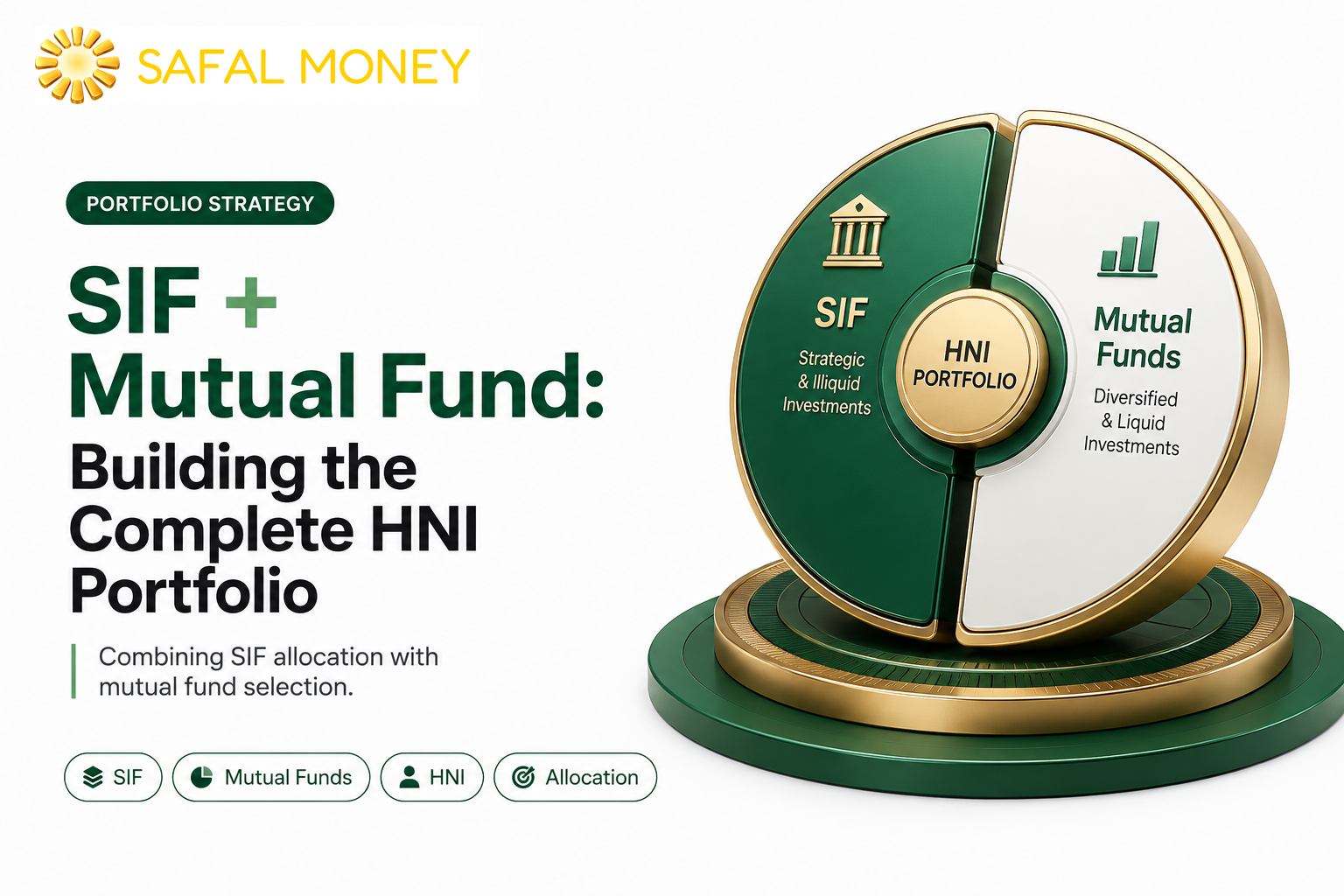
The complete HNI portfolio in India in 2026 is built across four components: equity mutual funds (for long-term capital appreciation through conventional market exposure), debt mutual funds (for stable income, capital preservation, and liquidity), gold and silver FoF (for inflation hedging and portfolio insurance), and Specialised Investment Funds or SIFs (for uncorrelated returns through long-short and alternative equity strategies unavailable in conventional mutual funds). SafalScore™ is SafalMoney's tool for determining how much of your investable corpus should go into SIF and which SIF strategy type suits your profile. SafalCheck™ is SafalMoney's tool for selecting the specific mutual funds — equity, debt, and gold — that fill the other three components. Using both tools together produces a portfolio that is built on evidence and process rather than instinct and product recommendations.
This article walks through the complete portfolio construction process from first principles — what each tool measures, how the outputs combine into a coherent portfolio, the model allocations by corpus size, and how the portfolio should be monitored and rebalanced over time. By the end, you will have a concrete framework for building your own complete HNI portfolio using SafalScore™ and SafalCheck™.
Prefer a Narrower Starting Point?
This guide walks through the full SafalScore™ + SafalCheck™ workflow across equity, debt, gold, and SIF. If you want the shorter version focused specifically on gold, equity, and SIF sizing, see Gold vs Equity MF vs SIF: Building a Truly Diversified HNI Portfolio, or for the full six-component architecture including REITs and international funds, see The Complete HNI Portfolio 2026.
Why the HNI Portfolio Needs More Than Just Mutual Funds
Most Indian investors — including many HNIs — build portfolios that consist entirely of mutual funds across equity, debt, and gold. This is a sensible foundation, and for investors with smaller corpora (under ₹25 lakh), it is the right approach. But for HNI investors with corpora of ₹50 lakh and above, the mutual fund universe has one structural gap: it cannot offer long-short equity strategies.
Conventional mutual funds in India can only go long — they can buy stocks they believe will rise, but they cannot structurally profit from stocks they believe will fall. This means that in sideways or bearish market conditions, even the best actively managed mutual fund can only minimise losses — it cannot generate positive returns from the falling component of the market.
SIFs close this gap. SIFs provide access to strategies not typically available in traditional mutual funds. The minimum investment requirement is ₹10 lakh, aggregated across all SIF strategies of the same AMC. Available strategy types include Equity Long–Short, Hybrid Long–Short, Active Asset Allocation, and Sector Rotation. The long-short capability means a SIF manager can simultaneously hold long positions in stocks expected to rise and short positions (through derivatives) in stocks expected to fall — generating returns from both sides of the market. In a falling market, the short positions profit, partially or fully offsetting the long position losses.
The result: a portfolio that includes SIF alongside conventional mutual funds has a genuinely different return profile from a pure mutual fund portfolio — specifically, lower drawdowns in bear markets and the potential for positive returns even when equity indices are falling. SIF AUM reached ₹13,182 crore by May 2026, reflecting strong investor adoption in less than a year since the category launched on April 1, 2025.
This return stream that does not depend entirely on the direction of equity markets is the technical definition of an "uncorrelated" return — and it is precisely what makes SIF a meaningful addition to a complete HNI portfolio rather than simply a different flavour of equity exposure.
The Two Tools and Their Distinct Roles
SafalScore™ — Portfolio Architecture Tool
SafalScore™ determines how much of your total investable corpus should be allocated to SIF and which SIF strategy category is most appropriate for your situation. It evaluates:
- Risk capacity: Your financial capacity to absorb a loss — based on corpus size, income stability, existing financial obligations, and the proportion of your total wealth represented by the investable corpus. An investor whose entire net worth is the ₹50 lakh corpus has lower risk capacity than an investor for whom ₹50 lakh is 20% of a ₹2.5 crore total net worth.
- Investment horizon: How long you can remain invested without needing to access the capital. SIF strategies require a minimum 3-year commitment even in an open-ended fund structure — an investor with a 2-year horizon should not be in SIF regardless of their risk capacity.
- Liquidity requirements: What proportion of your corpus needs to remain liquid for near-term expenses, emergencies, or planned financial goals. Capital committed to SIF is not available on an intraday basis — redemptions are typically fortnightly, and the ₹10 lakh aggregate minimum cannot be partially redeemed below that threshold without the units being frozen pending restoration.
- Existing portfolio composition: If you already hold significant equity exposure through direct stocks, PMS, or ULIPs, the marginal SIF allocation should account for the equity already in your portfolio. SafalScore™ looks at the full picture, not just the mutual fund component.
- Risk tolerance: Your emotional and psychological capacity to see the SIF component of your portfolio produce negative returns for 3–6 months — which is possible in any investment strategy, including SIF — without exit. Investors who cannot tolerate visible negative returns in any component of their portfolio are not suitable for SIF regardless of their financial capacity.
The SafalScore™ output is a recommended SIF allocation percentage and strategy type recommendation — not a specific fund name. The strategy types are: Equity Long-Short (most aggressive, pure equity), Equity Ex-Top 100 Long-Short (mid/smallcap-focused), Hybrid Long-Short (moderate, combining equity and debt), Active Asset Allocation, and Sector Rotation.
SafalCheck™ — Fund Selection Tool
SafalCheck™ evaluates specific mutual fund schemes across the 7-factor model (and the adapted framework for debt and gold funds) to produce composite scores for every fund within each SEBI category. It does not determine how much to allocate to equity versus debt — that comes from your target asset allocation, informed by SafalScore™. SafalCheck™ determines which specific flexicap fund, which corporate bond fund, which gold FoF, and which short-duration fund earns its place in the portfolio you have designed.
The sequential workflow: SafalScore™ first (determine SIF allocation and strategy type), SafalCheck™ second (select the specific funds for every other component of the portfolio).
The Complete Portfolio Construction Process: Step by Step
Step 1 — Determine your total investable corpus and time horizon
The starting point is clarity on two numbers: how much capital you are deploying into this portfolio, and for how long. These two inputs shape every allocation decision that follows.
For the purposes of this article, three example investor profiles illustrate the process:
| Investor | Corpus | Horizon | Risk Tolerance | Income |
|---|---|---|---|---|
| A | ₹50 lakh | 10 years | Moderate-to-high | Stable salaried |
| B | ₹2 crore | 12 years | High | Business, variable |
| C | ₹5 crore | 15+ years | Very high | Multiple streams |
Step 2 — Run SafalScore™ to determine SIF allocation
Each investor's SafalScore™ output reflects their unique combination of risk capacity, horizon, liquidity needs, and existing portfolio:
Investor A (₹50 lakh, 10 years): SafalScore™ recommends 15–20% SIF allocation — ₹7.5 lakh to ₹10 lakh. This is the minimum meaningful allocation to SIF. Strategy type: Hybrid Long-Short is recommended for a first SIF allocation — it provides the long-short return profile with the debt buffer that makes the drawdown experience more manageable for an investor new to the strategy type.
Investor B (₹2 crore, 12 years): SafalScore™ recommends 20–25% SIF allocation — ₹40 lakh to ₹50 lakh. At this corpus level, diversification across two SIF strategy types (Hybrid Long-Short + Equity Long-Short) allows both lower-risk and higher-risk SIF exposure. Strategy type: Split between Hybrid Long-Short (12%) and Equity Long-Short or Equity Ex-Top 100 Long-Short (10–13%).
Investor C (₹5 crore, 15+ years): SafalScore™ recommends 20–25% SIF allocation — ₹1 crore to ₹1.25 crore. At this level, three SIF strategy types can be deployed. Strategy type: Hybrid Long-Short (8%), Equity Long-Short (8%), and Sector Rotation Long-Short (5–8%).
What SafalScore™ does NOT recommend SIF for: Investors who are new to equity investing, who have a horizon under 5 years, who cannot meet the ₹2 crore net worth eligibility requirement for accredited investor status, who need full daily liquidity on their corpus, or who would find the fortnightly redemption window and ₹10 lakh minimum aggregate psychologically constraining.
Step 3 — Design the non-SIF target allocation
With the SIF component sized, the remaining corpus is allocated across equity MF, debt MF, and gold FoF:
| Component | Investor A (₹50L) | Investor B (₹2Cr) | Investor C (₹5Cr) |
|---|---|---|---|
| SIF | 17% (₹8.5L, Hybrid Long-Short) | 22% (₹44L, split Hybrid + Equity Long-Short) | 22% (₹1.1Cr, split across 3 strategy types) |
| Equity MF | 48% (₹24L) | 48% (₹96L) | 43% (₹2.15Cr) |
| Debt MF | 25% (₹12.5L) | 20% (₹40L) | 25% (₹1.25Cr) |
| Gold FoF | 10% (₹5L) | 10% (₹20L) | 10% (₹50L) |
The equity allocation reduces slightly from Investor A to Investor C — not because equity is less important at higher corpus levels, but because the absolute rupee value of equity drawdowns becomes more significant at higher corpus, and the SIF component is providing a partial equity-market-correlated return stream that reduces the need for pure equity allocation to be as high.
Step 4 — Run SafalCheck™ to select specific funds
With the target allocations determined, SafalCheck™ selects the specific funds for each component. The August 2026 SafalCheck™ top scores provide a starting list for each category:
Equity MF component:
- For the largecap/index core (30–35% of equity allocation): UTI Nifty 50 Index Fund or SBI Nifty 50 Index Fund (direct plan, sub-0.20% TER, eliminates the active management uncertainty in the most efficiently priced equity segment).
- For the all-cap growth core (40–45% of equity allocation): HDFC Flexi Cap Fund (Direct, SafalCheck™ 68/100, strong historical track record with the manager change watch factor) or Parag Parikh Flexi Cap Fund (Direct, SafalCheck™ 71/100, strongest manager stability in the category with value-investing discipline).
- For the midcap satellite (15–20% of equity allocation): Kotak Emerging Equity Fund or Nippon India Growth Fund (direct plan), both of which score well on SafalCheck™'s consistency and downside protection factors for the midcap category.
Debt MF component: For the 1–3 year stability layer (60% of debt allocation): ICICI Prudential Banking & PSU Debt Fund or HDFC Banking & PSU Debt Fund (direct plan) — top SafalCheck™ scores on credit quality and category-relative ranking. For the 2–3 year income layer (40% of debt allocation): ICICI Prudential Corporate Bond Fund or HDFC Corporate Bond Fund (direct plan).
Gold FoF component: HDFC Gold ETF FoF (Direct) as the category SafalCheck™ leader on tracking accuracy and total effective cost, or SBI Gold Fund (Direct) for investors who prefer SBI's institutional backing.
Step 5 — Select the specific SIF funds using SafalCheck™'s 8-factor SIF evaluation
SafalCheck™ evaluates SIF funds on an 8-factor model adapted for the SIF structure: strategy clarity and mandate consistency, fund manager SIF experience, long-short execution discipline, net equity exposure volatility, derivative usage transparency, redemption liquidity terms, TER relative to SIF category peers, and track record (where available).
As of August 2026, SIF AUM reached ₹13,182 crore by May 2026, with most funds having 3 to 8 months of live performance history. Most SIFs still have only 3 to 8 months of since-inception history, covering both a strong market rally and the Nifty's 11.30% correction in March 2026, making direct return comparisons potentially misleading.
Given this limited track record, SafalCheck™'s SIF evaluation places highest weight on the non-performance factors: strategy clarity, fund manager credentials and prior long-short experience, TER relative to peers, and redemption terms. The leading SIF funds by these criteria as of August 2026 include schemes from Edelweiss Altiva, SBI Magnum SIF, ITI MF Diviniti, Bandhan Arudha, and Tata Titanium — each with strong AMC backing, clearly documented strategy mandates, and competitive TER structures.
For a first SIF allocation, SafalMoney recommends investing in the Hybrid Long-Short strategy type from a large, operationally mature AMC — the debt buffer in the hybrid strategy reduces the drawdown severity during market corrections, making the first SIF experience more manageable. The Equity Long-Short strategy can be added as a second allocation once the investor has 12+ months of experience with the SIF structure.
Step 6 — Structure the investment through SIPs and STP
With the target allocation and specific fund selections determined, the implementation structure:
- SIF allocation: Lumpsum deployment into the chosen SIF fund(s) from idle capital, or STP from a liquid fund into the SIF over 3–6 months if uncomfortable with immediate full deployment. SIF minimum additional purchase after the initial ₹10 lakh is ₹10,000 — ongoing top-ups to the SIF allocation can be made in smaller amounts.
- Equity MF allocation: For fresh capital — STP from a liquid fund over 9–12 months for the equity component, given August 2026's post-correction-recovery market levels. For ongoing savings — monthly SIP into the equity funds aligned with the regular income cadence.
- Debt MF allocation: Lumpsum deployment — debt funds do not benefit meaningfully from averaging entry, and the current 7–8% short-duration yield is competitive for immediate deployment.
- Gold FoF allocation: Monthly SIP for the gold FoF component — even though gold is not as volatility-cycle-dependent as equity, a monthly SIP into gold builds the allocation gradually and maintains the discipline of consistent precious metals exposure.
How the Portfolio Behaves in Different Market Conditions
The purpose of building across four components is that each behaves differently in different market conditions:
In a bull equity market (rising Nifty 50): Equity MF component leads returns. SIF Hybrid Long-Short may slightly lag pure equity (the short positions reduce upside capture during broad rallies). Gold may underperform. Debt provides stable income.
In a sideways equity market: SIF's long-short capability generates returns from both long positions in outperformers and short positions in underperformers — potentially the strongest performer in this environment. Equity MF treads water. Gold moves with global sentiment. Debt provides steady accrual.
In a bear equity market (significant Nifty correction): SIF's short positions profit from falling stocks, reducing or offsetting the long-position losses. Gold typically rises (safe-haven demand). Debt remains stable. Equity MF portfolio falls — but the SIF and gold buffers mean the total portfolio falls less than the equity allocation alone.
This asymmetric portfolio behaviour — participating in bull market gains through equity while having partial protection in bear markets through SIF short positions and gold — is the core architectural benefit of the SIF + MF + gold combination. No single market condition devastates all four components simultaneously.
Key Takeaway
No single market condition hurts all four components at once — equity leads bull markets, SIF's long-short book earns in sideways and falling markets, gold rises in stress, and debt is steady throughout. That's the architectural point of combining them.
Monitoring the Combined Portfolio — Annual Review Framework
The complete HNI portfolio requires an annual review across three dimensions:
Performance review: Evaluate each component against its benchmark and peer group. For equity MF, compare against the Nifty 500 TRI (flexicap) or relevant category benchmark. For SIF, compare against the stated strategy benchmark in the Scheme Information Document. For debt, compare against the category benchmark (e.g., CRISIL Banking & PSU Debt Index). For gold, compare against domestic gold price returns. Use SafalCheck™ for updated fund scores annually — any fund whose score has declined below 55 warrants investigation and potential replacement.
Allocation rebalancing: Check whether allocation has drifted from targets. A 5%+ drift in any component triggers rebalancing per the framework described in our MF + SIF rebalancing guide. Use new SIP money where possible before selling to minimise tax events.
SIF liquidity monitoring: Verify the SIF allocation remains at or above the ₹10 lakh aggregate minimum with each AMC. If market movements have reduced the SIF value below ₹10 lakh, you have 30 days to restore the minimum by adding capital before units are frozen. Annual monitoring prevents this situation.
Who Is This Portfolio For and Who Should Wait
This complete portfolio is appropriate for investors with ₹50 lakh+ in investable corpus who meet the SIF eligibility criteria (₹2 crore net worth per SEBI's investor eligibility framework for SIF, or income criteria as applicable), a minimum 7-year investment horizon for the equity components and a minimum 3-year horizon for the SIF component, comfort with fortnightly SIF redemption windows and the ₹10 lakh minimum aggregate requirement, and investors who have exhausted or are comfortable with mutual fund-only portfolio construction and are specifically looking for the uncorrelated return stream that SIF's long-short capability provides.
Investors who should build only the mutual fund component for now: Corpus below ₹25 lakh — SIF allocation would be too concentrated. Investment horizon under 5 years. Eligibility requirement not met (consult SafalMoney or a SEBI-registered investment advisor to verify). First-time equity investors who need to build comfort with market cycles before adding the complexity of long-short derivative strategies.
For these investors, the equity MF + debt MF + gold FoF combination — built entirely using SafalCheck™ — is a complete and well-designed portfolio. The SIF component can be added when the corpus and horizon align.
Free, 2 minutes
Free, no login required
Frequently Asked Questions
What is the difference between SafalScore™ and SafalCheck™?
SafalScore™ is SafalMoney's SIF allocation tool - it determines how much of your corpus should go into SIF and which SIF strategy type suits your risk profile and horizon. SafalCheck™ is SafalMoney's mutual fund evaluation tool - it scores every equity, debt, and gold fund on 7 factors to help you select specific funds for your portfolio. They work sequentially: SafalScore™ for SIF architecture, SafalCheck™ for fund selection.
Can I build the complete HNI portfolio without SIF?
Yes. The equity MF + debt MF + gold FoF combination built through SafalCheck™ is a complete, well-diversified portfolio. SIF adds an uncorrelated long-short return stream that provides additional bear market protection - but it requires ₹50 lakh+ corpus, SIF eligibility, and comfort with the strategy's complexity. Investors who do not meet these criteria should build a strong mutual fund portfolio first.
How do I check if I am eligible for SIF investment?
SIF eligibility in India requires meeting the accredited investor criteria - approximately ₹2 crore net worth (excluding primary residence) as a key threshold. Your primary residence is explicitly excluded from the calculation. Financial assets (equity, mutual funds, FDs, PPF, NPS, gold ETFs, bonds) and real estate (other than primary home) count toward the threshold. Consult SafalMoney or a SEBI-registered investment advisor to verify your specific eligibility.
What is the minimum investment in SIF in India?
The SEBI-mandated minimum investment in SIF is ₹10 lakh, aggregated across all SIF schemes of the same AMC. This means if you invest in two SIF schemes from the same AMC, the combined investment must be at least ₹10 lakh - not ₹10 lakh each. Minimum additional purchases after the initial investment are ₹10,000. If your SIF balance falls below ₹10 lakh, you have 30 days to restore it before units are frozen.
How is SIF taxed in India in 2026?
Equity-oriented SIFs (65%+ equity): STCG at 20% (under 12 months), LTCG at 12.5% after 12 months with ₹1.25 lakh annual exemption - same as equity mutual funds. Hybrid/Other SIFs: STCG at slab rate (up to 30%), LTCG at 12.5% after 12 months, no ₹1.25 lakh exemption. Verify the specific SIF fund's tax treatment in its Scheme Information Document, as different funds within the same SEBI category may have different equity vs debt allocations that affect the tax treatment.
Last updated: 21 August 2026