SIF vs Fixed Deposit: Why HNI Investors Are Choosing Long-Short Over Bank Deposits
SIF vs Fixed Deposit - which is better for HNI investors in 2026? This honest comparison covers returns, tax efficiency, liquidity, risk, and why SIF is increasingly replacing FDs in sophisticated HNI portfolios.
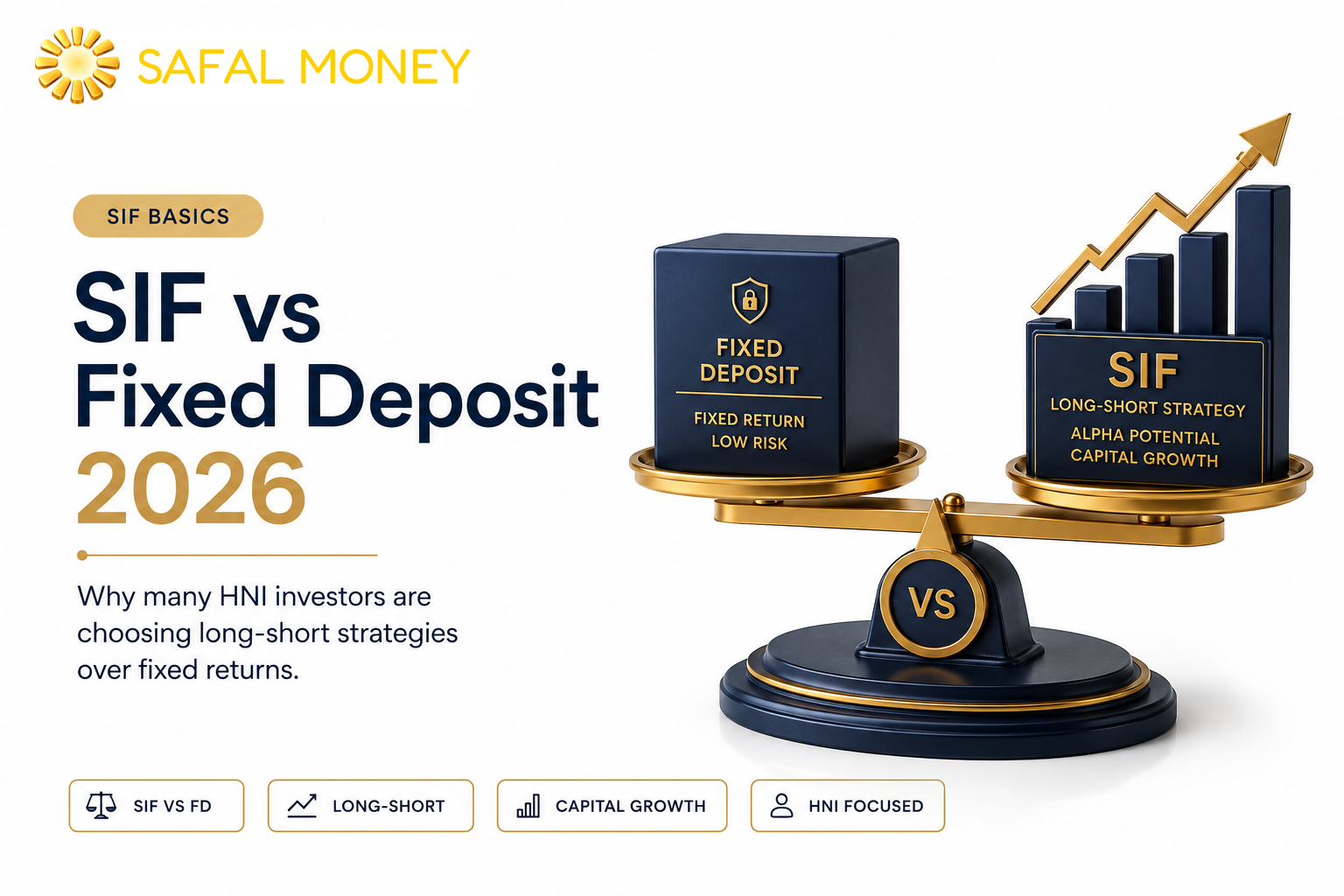
For decades, the Fixed Deposit was the default wealth preservation instrument for Indian HNI investors. Safe, predictable, government-insured (up to ₹5 lakh per depositor per bank), and available at every branch of every bank in the country. The FD's simplicity made it the most trusted instrument in Indian personal finance.
But for HNI investors in the 30%+ tax bracket, the FD's simplicity conceals a fundamental problem: it is one of the most tax-inefficient investment instruments available. Every rupee of FD interest is taxed at your income slab rate - 30%+ - every year, whether you need the money or not. On a ₹50 lakh FD at 7% annual interest, ₹1.05 lakh in tax is paid annually on ₹3.5 lakh of interest. The after-tax return is approximately 4.9% - well below inflation for most Indian HNI households.
This is the context in which a new generation of Indian HNI investors is discovering SIF - and making a deliberate, informed decision to reallocate a portion of their FD corpus toward long-short strategies.
This article does not argue that SIF replaces FDs entirely - that would be irresponsible. It explains precisely where SIF and FDs serve different roles, where SIF offers compelling advantages over FDs for a specific portion of the HNI corpus, and where FDs remain irreplaceable.
The FD's Fundamental Problem for HNI Investors: Tax Drag
Let us start with the mathematics that drives the FD-to-SIF migration among Indian HNI investors.
Scenario: ₹50 lakh invested for 3 years
| Instrument | Gross Return | Annual Tax (30% bracket) | Post-Tax Annual Return | Post-Tax Value After 3 Years |
|---|---|---|---|---|
| Bank FD at 7% | ₹3.5L/year | ₹1.05L/year | ~4.9% | ₹57.35L |
| Short Duration MF at 7.3% | ₹3.65L/year | ₹1.095L (slab under 24M), then 0 (LTCG 12.5% after 24M) | ~5.5% effective | ₹59.3L |
| Equity Long-Short SIF (illustrative 13% gross) | ₹6.5L/year | ₹0.81L (LTCG 12.5% after 12M) | ~11.4% effective | ₹68.5L |
| Hybrid Long-Short SIF (illustrative 9% gross) | ₹4.5L/year | ₹0.5625L (LTCG 12.5% after 12M) | ~8.0% effective | ₹63.0L |
All SIF return figures are illustrative only - not projections or guarantees. They reflect the kind of return differential that the long-short strategy is designed to generate, based on global long-short fund research and early Indian SIF data.
The post-tax differential is stark - even a conservative Hybrid Long-Short SIF at illustrative 9% gross return delivers approximately ₹5.65 lakh more post-tax wealth than a 7% FD over 3 years on ₹50 lakh. For aggressive Equity Long-Short SIF at illustrative 13% gross, the difference is approximately ₹11.15 lakh.
This differential compounds dramatically over longer horizons - which is why HNI investors with 5+ year time horizons are increasingly questioning why they hold large FD balances when SIF offers structurally superior post-tax returns for equivalent risk-per-unit-of-time on a 3-5 year horizon.
The Honest Risk Comparison: SIF Is Not FD-Safe
This is where full transparency is essential - and where most SIF marketing materials fail their readers.
FDs are capital-guaranteed instruments (within DICGC limits of ₹5 lakh per depositor per bank). The principal will be returned in full on maturity regardless of what happens to interest rates, equity markets, or the broader economy. For money that absolutely cannot lose value - emergency corpus, short-term goal funding, liquidity reserve - FDs are irreplaceable.
SIF is categorised as Very High risk - the highest SEBI risk classification for any investment product. The NAV of a SIF fund can and does decline. During the March 2026 Iran war crash, the best-performing Hybrid Long-Short SIF fell approximately 6-8% in NAV. The worst-performing fell significantly more. For Equity Long-Short SIF, declines of 15-25% during sustained bull markets (when the short book loses money) are expected features of the strategy.
The comparison is only fair when you compare the right things:
FD is appropriate for: emergency corpus, known short-term expenses (under 2 years), liquidity reserve, capital that absolutely cannot decline.
SIF is appropriate for: long-horizon wealth building (3+ years), corpus where some NAV fluctuation is acceptable in exchange for meaningfully better post-tax returns, portfolio layer that provides uncorrelated alpha alongside conventional equity and debt funds.
The investor who moves emergency corpus from FD to SIF has made a dangerous mistake. The investor who keeps emergency corpus in liquid funds and moves their 3-5 year surplus corpus from FD to SIF has made an intelligent, well-considered allocation decision.
The Tax Efficiency Gap: The Primary Driver of Migration
For HNI investors in the 30% bracket, the tax treatment difference between FDs and SIF is the most compelling reason to consider the migration.
FD tax treatment: All interest income taxed at income slab rate (30%+) every financial year - regardless of whether you have withdrawn the money or not. TDS applies when FD interest exceeds ₹40,000 per year per bank. You pay tax on income you have not yet received in cash - a cash flow disadvantage.
Equity-oriented SIF tax treatment (for funds with 65%+ equity): No tax until you actually redeem. Gains on units held 12+ months taxed at 12.5% LTCG - with ₹1.25 lakh annual exemption. You choose when to trigger the tax event by choosing when to redeem. Tax deferral plus a lower rate creates a powerful compound benefit.
The combination of tax deferral and lower LTCG rate creates a compounding advantage that widens year by year. On ₹1 crore held for 10 years:
| Instrument | Pre-tax Amount at 10 Years | After-Tax Wealth (30% bracket) |
|---|---|---|
| FD at 7% (taxed annually) | ₹1.97 crore | ₹1.71 crore |
| Equity SIF at 12% (taxed once at 12.5% LTCG at redemption) | ₹3.11 crore | ₹2.94 crore |
| Hybrid SIF at 9% (taxed once at 12.5% LTCG at redemption) | ₹2.37 crore | ₹2.22 crore |
These are illustrative calculations only, assuming consistent returns that cannot be guaranteed. The post-tax wealth gap is approximately ₹1.23 crore between FD and Equity SIF, and approximately ₹51 lakh between FD and Hybrid SIF - on ₹1 crore over 10 years. This is entirely attributable to the combination of higher gross return (which is not guaranteed) and superior tax treatment (which is structurally determined by the instruments).
The Liquidity Comparison: FD Wins on Paper, Loses in Practice for Long-Term Corpus
FDs offer apparent daily liquidity - most banks allow premature withdrawal with a penalty of 0.5-1%. This seems superior to SIF's fortnightly redemption window.
But for HNI investors who have genuinely segmented their portfolio - emergency corpus in liquid funds (immediate T+1 access) and 2-5 year surplus in SIF (fortnightly redemption, 14-day maximum wait) - the fortnightly wait for SIF is irrelevant for money that is genuinely allocated for 3+ years. No investor with a proper emergency corpus in liquid funds should ever be in a situation where they need SIF funds within 2 weeks for an unplanned expense.
The FD's "daily liquidity" advantage is largely illusory for long-term surplus corpus - because breaking an FD early incurs a penalty and loses the remaining interest. A 3-year FD broken after 18 months may pay only 6.5% (the 1-year rate) instead of 7% (the 3-year rate), minus a 0.5-1% premature withdrawal penalty. The effective return from early breakage is often lower than a SIF redemption at fortnightly window with applicable exit load.
The genuine liquidity advantage of FD: for money with a specific, known date of use - school fees due in 14 months, home renovation budget needed in 8 months - a fixed tenure FD guarantees capital at exactly the right date. SIF's fortnightly window and NAV volatility make it unsuitable for goal-dated money. This is the real case for FDs - not emergency corpus and not long-term surplus, but specifically dated goal-oriented money.
Capital Safety: The Irreplaceable FD Advantage
For all of SIF's advantages in return potential and tax efficiency, one dimension remains definitively in the FD's favour: capital guarantee.
A bank FD guaranteed by the Deposit Insurance and Credit Guarantee Corporation (DICGC) up to ₹5 lakh per depositor per bank cannot go below the guaranteed amount. Principal is safe - period.
SIF NAV can decline. It has declined - during the Iran war crash, every SIF strategy showed negative NAV movement. The declines were temporary and have partially recovered, but the declines were real and real investors experienced them.
For HNI investors who have worked hard to build wealth and have specific portions of that wealth where capital preservation is non-negotiable - elderly parents' medical corpus, children's education corpus due in 2 years, home down payment being accumulated - FDs remain the correct instrument.
The FD-to-SIF migration is appropriate only for surplus, long-horizon capital where the investor genuinely accepts the possibility of temporary NAV decline as the price of meaningfully better long-term post-tax returns.
The Right Allocation: How Much FD vs SIF
For a typical HNI investor with ₹1 crore in investable assets currently held entirely in FDs, here is how SafalMoney thinks about the optimal migration.
Keep in FD / Liquid Fund / Short Duration MF:
| Purpose | Amount | Instrument |
|---|---|---|
| Emergency corpus (6 months expenses) | ₹8-10L | Liquid fund (not FD - daily liquidity needed) |
| Specific goal corpus (children education, home renovation) within 2 years | ₹10-15L | FD (capital guaranteed, specific tenure) |
| Conservative income corpus (living expenses if portfolio-dependent) | ₹15-20L | Banking PSU + Short Duration MF |
Consider migrating to SIF:
| Purpose | Amount | Instrument |
|---|---|---|
| Long-horizon wealth building (3+ years) | ₹15-20L | Hybrid Long-Short SIF |
| Aggressive alpha generation (5+ years) | ₹10-15L | Equity Long-Short SIF |
Remaining corpus: equity mutual funds (index + active mid/small cap), gold, REITs.
The FD corpus that is genuinely appropriate for SIF migration is the surplus - the money that has been sitting in FDs by default rather than by deliberate design, being taxed at 30%+ annually, and not fulfilling any specific near-term goal. For most HNI investors, this is 20-35% of their total FD corpus.
The Migration Process: How to Move FD Corpus to SIF
Step 1: Segment your FD holdings. Review every FD. Categorise each as: emergency/liquidity, specific dated goal, conservative income corpus, or long-horizon surplus (SIF-appropriate). Only the last category is appropriate for SIF.
Step 2: Plan FD maturity dates. Do not break FDs prematurely to invest in SIF - the premature withdrawal penalty and rate reduction erode the benefit. Plan to redirect at natural maturity dates.
Step 3: Calculate your SIF allocation. Use SafalZenith to determine what percentage of your total portfolio should be in SIF. This gives you the target SIF corpus to build toward through FD maturity redirections. See the SIF corpus calculator for the specific build-up framework.
Step 4: Evaluate SIF funds. Use SafalCheck™ to identify which SIF funds best match your recommended strategy type. Prioritise funds with the strongest SafalScore™ for your profile.
Step 5: Obtain accredited investor certificate. Apply through NSE Emerge or BSE (3-7 business days). Do this before your first FD matures so you are ready to invest immediately.
Step 6: Invest at FD maturity. As each FD matures, redirect the appropriate portion to SIF through SafalMoney. Keep the remainder in banking PSU funds or short duration funds - not new FDs - for better post-tax efficiency on the non-SIF allocation. Once your SIF allocation is in place, plan your annual tax-loss harvesting strategy to maximise the tax efficiency advantage further.
The Psychological Barrier: Why Familiar Feels Safe
Many HNI investors intellectually understand the FD-to-SIF case but struggle to act on it. The barrier is not information - it is familiarity. FDs feel safe because they have always been safe. The NAV volatility of SIF - even the more conservative Hybrid Long-Short variety - creates anxiety that FDs never did.
This psychological barrier is real and valid. SafalMoney's approach is never to push investors past their genuine comfort level. If the thought of a 6% NAV decline in your Hybrid Long-Short SIF keeps you awake at night, the SIF allocation should be smaller than what the mathematics suggest - because the value of any investment strategy is destroyed by selling at the wrong time due to emotional discomfort.
Start small. Invest ₹10 lakh - the minimum - in a Hybrid Long-Short SIF and experience one full market cycle including a correction. Monitor the NAV without reacting. When the first correction happens and the NAV recovers, the abstract understanding becomes embodied experience. That experience changes the psychological relationship with NAV volatility - and makes further migration easier.
Free, no login required
Frequently Asked Questions
Is SIF better than FD for HNI investors?
For long-horizon surplus corpus (3+ years) of HNI investors in the 30%+ tax bracket, SIF offers meaningfully better post-tax returns than FDs - due to the combination of higher gross return potential (not guaranteed) and superior tax treatment (12.5% LTCG after 12 months vs 30%+ annual slab tax on FD interest). However, FDs offer capital guarantee and specific-dated liquidity that SIF cannot provide. SIF is not a replacement for emergency corpus, short-term goal corpus, or conservative income corpus - it is specifically appropriate for long-horizon surplus capital where the investor accepts NAV volatility as the price of better long-term returns.
What is the tax difference between SIF and FD?
FD interest is taxed at the investor's income slab rate (30%+ for most HNI investors) every financial year - whether or not the money is withdrawn. Equity-oriented SIF gains (65%+ equity) are taxed at 12.5% LTCG only when units are redeemed, after a minimum 12-month holding period, with ₹1.25 lakh annual exemption. For an HNI in the 30% bracket, this means FD tax is 30%+ annually vs SIF tax of 12.5% deferred until redemption - a substantial difference that compounds significantly over 3-10 year horizons.
Is SIF safe like a fixed deposit?
No - SIF is not capital-guaranteed like a bank FD. SIF is categorised as Very High risk by SEBI. NAV can and does decline - during the March 2026 Iran war crash, Hybrid Long-Short SIF funds fell 6-10% and Equity Long-Short SIF funds fell 15-25% in some cases. These declines were temporary and have partially recovered, but capital safety is not a feature of SIF in the way it is for bank FDs (within DICGC limits). SIF is appropriate only for long-horizon surplus corpus where the investor genuinely accepts the possibility of temporary capital decline.
How much of my FD corpus should I move to SIF?
Only the surplus, long-horizon portion of your FD corpus is appropriate for SIF migration - typically 20-35% of total FD holdings. Keep emergency corpus (6 months expenses) in liquid funds, keep specific dated-goal corpus in FDs or short-duration debt funds, keep conservative income corpus in banking PSU or short-duration funds. The remainder - money that has been in FDs by default rather than by design, being taxed at 30%+ annually without serving a specific goal - is the candidate for systematic SIF migration at natural FD maturity dates. Use SafalZenith to calculate the precise SIF target allocation for your profile.
What is the minimum FD corpus needed before considering SIF?
The SIF minimum investment is ₹10 lakh. To invest ₹10 lakh in SIF without creating dangerous portfolio concentration, your total investable corpus (including FDs, mutual funds, stocks, and other investments) should be at least ₹30-50 lakh - so the ₹10 lakh SIF investment represents 20-33% or less of total portfolio. If your entire wealth is in FDs and totals ₹12 lakh, this is not the time for SIF - build your mutual fund foundation first, then add SIF when total corpus exceeds ₹35-40 lakh.
Last updated: 23 July 2026