Rising Bond Yields: Impact on Debt Fund Returns (2026)
Rising bond yields hit debt fund NAVs through duration risk. Learn why, how RBI’s Oct 2026 rate hike matters, and how to position your portfolio.
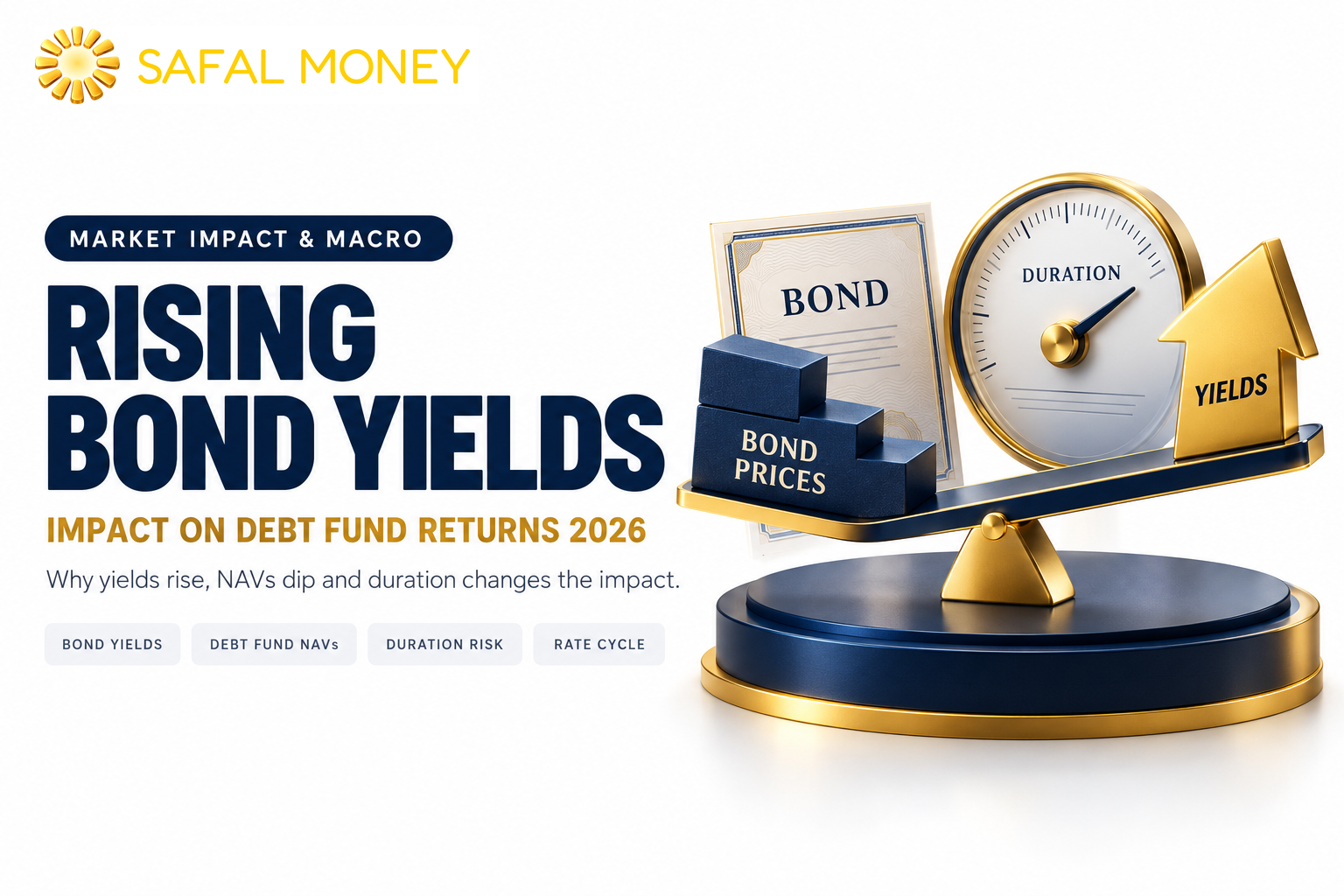
If you checked your debt mutual fund statement in October 2026 and noticed the NAV had dipped slightly rather than ticking up steadily, you’re not imagining it, and you’re not alone. The RBI’s Monetary Policy Committee raised the repo rate by 25 basis points this month — from 5.25% to 5.50%, its first hike since February 2023 — and shifted its policy stance from “neutral” to “calibrated tightening.” That single decision has rippled through India’s bond market, pushing yields higher and putting a temporary dent in the NAVs of many debt funds, especially longer-duration ones.
This is one of the most common sources of confusion among debt fund investors, who often assume debt funds are “safe” in the sense of never losing value. They can, and rising yields are exactly the mechanism that causes it. This article breaks down what a bond yield actually is, why rising yields mean falling bond prices and falling debt fund NAVs, which funds are hit hardest, and — importantly — why this isn’t necessarily bad news for your long-term debt fund returns.
What Is a Bond Yield, in Plain Terms?
A bond yield is simply the annual return an investor earns on a bond if they buy it today and hold it, expressed as a percentage of its current market price — and it moves inversely to the bond’s price. When a bond’s price falls, its yield rises (because the same fixed coupon payment now represents a larger percentage return on the lower price paid), and vice versa.
Think of a bond paying a fixed ₹100 coupon annually. If the bond’s market price is ₹1,000, its yield is 10%. If new bonds are now being issued at higher rates because the RBI has raised the policy rate, this older ₹1,000 bond becomes less attractive by comparison — so its price falls until its yield rises enough to match the new, higher-rate environment. This price-yield seesaw is the single most important mechanical fact to understand about bond investing.
Why Do Rising Yields Mean Falling NAVs for Existing Debt Fund Holders?
Debt mutual funds hold portfolios of bonds that are marked-to-market daily, so when market yields rise and existing bond prices fall, the fund’s NAV falls correspondingly, even though the fund hasn’t “lost” any money in a realised sense. This is the direct transmission mechanism from a central bank rate decision to your account statement.
After the RBI’s 25-bps hike to 5.50% in October 2026, debt instruments across the curve repriced to reflect the new, tighter monetary stance. Funds holding government securities, corporate bonds, and other fixed-income paper saw the market value of those holdings adjust downward, which is reflected instantly in the scheme’s NAV. This is a paper, mark-to-market effect on existing holdings — it is not the same as a credit default or a permanent loss of capital, assuming the underlying bonds are held to maturity or the issuer doesn’t default.
Why Are Longer-Duration Funds Hit Harder Than Shorter Ones?
Longer-duration debt funds are more sensitive to interest rate changes because their underlying bonds have more years of future cash flows that need to be “re-discounted” at the new, higher rate — a concept measured by a bond’s duration. A fund holding bonds with an average duration of 7 years will see a much larger price swing from a 25-bps yield move than a fund holding bonds with an average duration of 1 year.
| Fund Type | Typical Duration | Sensitivity to 25-bps Yield Rise | Best Suited For |
|---|---|---|---|
| Overnight / Liquid Fund | ~1 day – 3 months | Minimal | Very short-term parking, emergency funds |
| Ultra Short / Low Duration | ~3–12 months | Low | 6–12 month horizon |
| Short Duration Fund | ~1–3 years | Moderate | 1–3 year horizon |
| Medium/Long Duration Fund | ~4–10+ years | High | Long horizon, rate-cut expectation |
This is why the same RBI rate hike can leave a liquid fund investor almost unaffected while a long-duration gilt fund investor sees a more noticeable NAV dip in the same week.
What’s Currently Pushing Yields Up or Down in October 2026?
Three forces are driving India’s bond yields this month: the RBI’s own calibrated-tightening stance following its 25-bps hike, an upward revision to the FY2026-27 CPI inflation projection to 5.2%, and global rate cues from the US Federal Reserve, which reporting in early-to-mid October 2026 suggested was pausing after a run of hikes while flagging “more hikes ahead” as a live possibility rather than a cut cycle (US Federal Reserve).
Domestically, the RBI also raised its FY2026-27 GDP growth projection to 7.1% from 6.7%, a combination of stronger growth and higher inflation expectations that together justify a tighter policy stance — and bond markets have been repricing to reflect that calibrated tightening path rather than anticipating near-term rate cuts. (RBI)
Why Can Panic-Selling During a Yield Spike Lock In a Temporary Loss?
Selling a debt fund during a yield-driven NAV dip converts what would otherwise be a temporary, mark-to-market paper loss into a permanent, realised one — because once yields stabilise or the fund’s existing bonds mature or roll down the curve, much of that NAV dip tends to recover naturally. This is the single costliest mistake conservative debt investors make during a rate-hike cycle.
Unless an investor has a genuine, immediate need for the money, or has lost confidence in the fund’s underlying credit quality, exiting purely because of a short-term, rate-driven NAV dip usually works against the investor’s own interest. Debt funds are structurally designed to recover this kind of mark-to-market movement over the fund’s effective holding period, provided the bonds are of reasonable credit quality.
Is There a Silver Lining to Rising Yields?
Yes — rising yields mean that fresh money invested into debt funds today buys into a higher-yielding bond portfolio, which sets up for better prospective returns going forward, even though existing holdings take a short-term NAV hit. This is the flip side of the same mechanism that caused the dip.
An investor starting a fresh SIP into a debt fund in October 2026, after the RBI’s hike to 5.50%, is effectively buying bonds at higher yields than were available a few months ago — meaning the accrual income embedded in the fund’s future returns has actually improved, even as the near-term NAV chart looks choppier.
How Should You Choose Fund Duration Based on Your Rate-Cycle View?
The right duration choice depends on your view of where the rate cycle is headed and your own investment horizon — investors expecting further tightening or uncertain about the path should favour shorter-duration funds, while those expecting a peak in rates and eventual cuts may consider gradually extending duration. Matching duration to your actual need for the money is the more reliable discipline, regardless of your rate-cycle view.
A practical rule many conservative investors follow: don’t invest in a fund whose average duration meaningfully exceeds your own investment horizon, since that mismatch is precisely what creates vulnerability to yield-driven NAV swings right when you need to redeem. Rising bond yields are an uncomfortable but entirely mechanical part of the debt-investing cycle — the RBI’s October 2026 rate hike to 5.50% has pushed yields up and dented NAVs at the margin, hardest for longer-duration funds, but this is a temporary repricing effect rather than a permanent loss, and it quietly improves the return outlook for fresh investments. The right response is structural: match duration to horizon, resist the urge to exit on a dip, and let the fund’s natural maturity and roll-down process do its work, and explore more of SafalMoney’s market-impact guides for further context.
Free, 2 minutes
SafalMoney fund guides
Frequently Asked Questions
Why do debt mutual fund NAVs fall when bond yields rise?
Debt funds hold bonds that are marked-to-market daily, and since bond prices move inversely to yields, a rise in market yields causes the existing bonds’ prices — and therefore the fund’s NAV — to fall, even though this is typically a temporary, non-permanent effect.
Should I sell my debt fund when yields are rising?
Generally no, unless you have an immediate cash need or credit-quality concerns, because selling during a yield spike converts a temporary, mark-to-market paper loss into a permanent, realised one, and NAVs typically recover as bonds roll down the maturity curve.
Which debt funds are most affected by rising yields?
Longer-duration funds — those holding bonds with higher average duration, such as medium-to-long duration or gilt funds — are affected the most, while overnight, liquid, and ultra-short duration funds see minimal impact from the same yield move.
Do rising yields mean better returns eventually?
Yes, for fresh investments — rising yields mean new money is deployed into higher-yielding bonds, improving the accrual income embedded in future fund returns, even as existing holdings see a short-term NAV dip.
How can I protect my debt fund portfolio from yield volatility?
Match your fund’s average duration to your actual investment horizon, favour shorter-duration funds if you expect continued rate tightening or need the money soon, and avoid panic-selling during temporary, rate-driven NAV dips.
Last updated: 23 October 2026