Quant Mutual Fund qSIF Review 2026: Can the Algorithm Deliver Alpha?
A complete review of Quant Mutual Fund's qSIF platform - India's first SIF, four strategies, VLRT model, Sandeep Tandon's quant approach, NAV, performance, and SafalMoney's honest verdict.
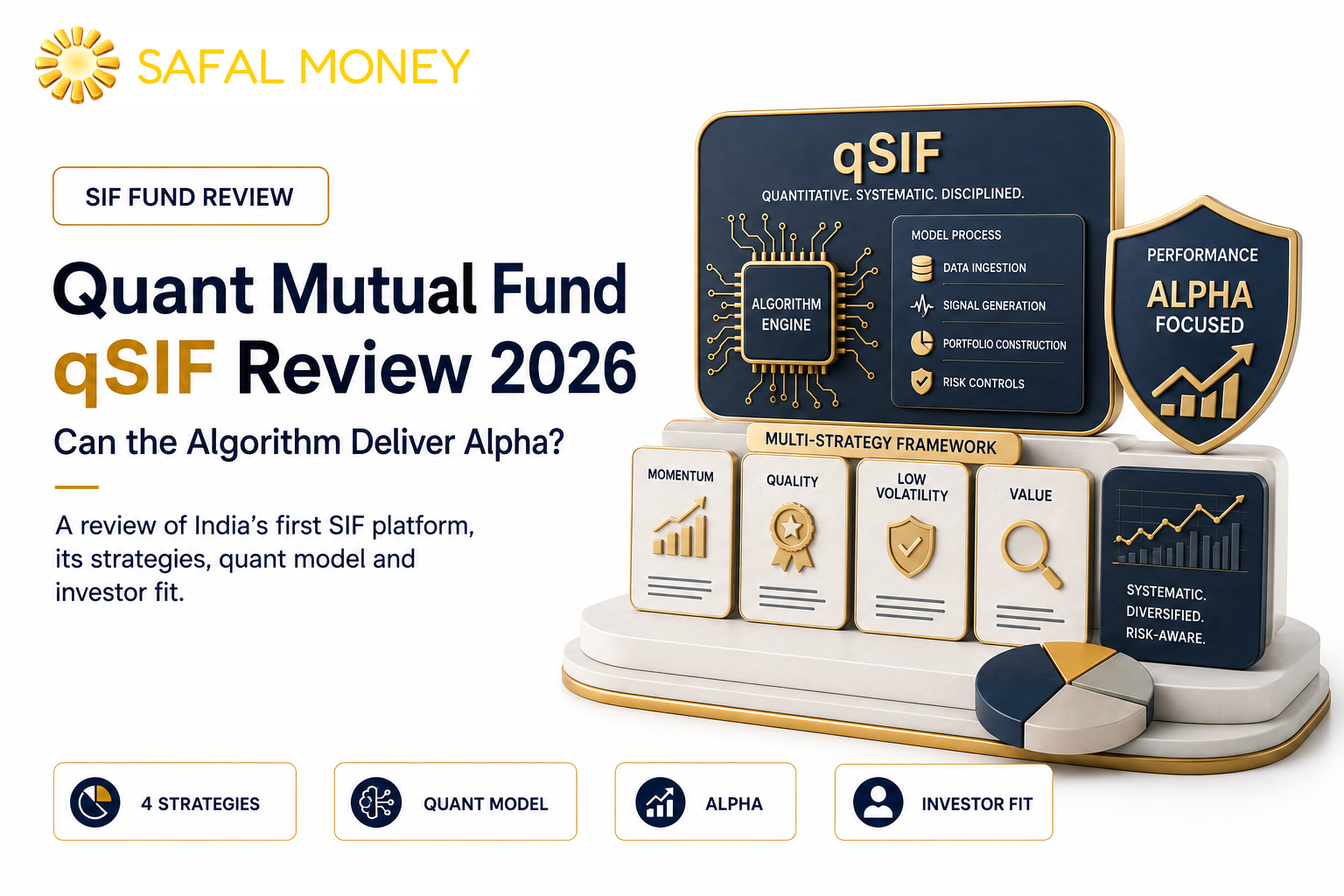
This is the eighth article in SafalMoney's SIF Fund Review series. After reviewing ITI AMC, Edelweiss, SBI, Tata, 360 ONE, ICICI Prudential, and Mirae Asset, we now turn to the fund house that holds the most historically significant position in India's SIF story — Quant Mutual Fund and its qSIF platform.
Quant Mutual Fund launched India's very first Specialised Investment Fund — the qSIF Equity Long-Short Fund — in October 2025. It was not just the first SIF. It was the proof of concept for the entire category. In a market where every other AMC was still evaluating the SIF framework, Quant moved first — reflecting its established DNA as India's most aggressively quantitative and contrarian AMC.
As of July 2026, Quant has four qSIF strategies live — more than any other AMC — spanning equity long-short, hybrid long-short, equity ex-top 100, and the most unique offering in the Indian SIF space: a Sector Rotation Long-Short Fund that makes concentrated macro bets on 4 sectors simultaneously.
This review covers all four strategies, Quant's quantitative VLRT investment model, and the most honest assessment yet of whether algorithmic investing translates into SIF alpha. For a general primer on how quant-driven SIFs work as a category, see Quant-Based SIFs in India.
Quant Mutual Fund: The Most Controversial and Most Interesting AMC in India
Quant Mutual Fund is not a conventional fund house. Under founder and CIO Sandeep Tandon, Quant has built a reputation as India's most explicitly quantitative, data-driven AMC — using its proprietary VLRT (Valuation, Liquidity, Risk Appetite, and Time) framework to make investment decisions systematically rather than through discretionary stock-picking.
This approach has generated both spectacular performance (Quant's equity funds delivered some of the highest returns in the industry in 2022–2023) and spectacular controversy.
Unresolved SEBI Investigation
In June 2024, SEBI initiated a front-running investigation into Quant Mutual Fund — allegations that trading information was being leaked ahead of fund trades. Quant denied the allegations and cooperated with the investigation. As of mid-2026, no final SEBI order or finding of misconduct has been published, and Quant continues to operate normally with full AMFI registration. SafalMoney's position: investors should be aware of the ongoing regulatory context. The absence of a SEBI finding does not mean the investigation is closed or resolved. This is a watch point, not a disqualification, but it is information that any prudent investor deserves to have when making SIF allocation decisions.
The qSIF Platform: Four Strategies at a Glance
| Strategy | Launch | AUM (Latest) | NAV (Latest) | Expense Ratio | Key Manager |
|---|---|---|---|---|---|
| qSIF Equity Long-Short Fund | October 2025 | ₹592 crore (Jun 2026) | ₹10.65–₹10.73 (Jul 2026) | 0.95% | Sandeep Tandon, Sameer Kate + team |
| qSIF Hybrid Long-Short Fund | October 2025 | ₹104 crore (Apr 2026) | ₹10.63 (May 2026) | Not disclosed | Ankit A. Pande, Jignesh Shah, Sanjeev Sharma, Sandeep Tandon, Sameer Kate |
| qSIF Equity Ex-Top 100 Long-Short | Early 2026 | ₹233 crore (Jul 2026) | ₹10.63 (Jul 2026) | 2.75% | Same multi-manager team |
| qSIF Sector Rotation Long-Short | April–May 2026 NFO | Very early stage | ₹10+ | 2.10% | Quant investment team |
With four strategies across the full SIF spectrum, Quant has the most comprehensive qSIF lineup — matching 360 ONE DynaSIF in breadth and exceeding all other AMCs in category diversity.
Strategy 1: qSIF Equity Long-Short Fund — India's Pioneer SIF
Fund Snapshot
| Parameter | Details |
|---|---|
| Fund Name | qSIF Equity Long-Short Fund |
| Launch Date | October 8, 2025 |
| AUM | ₹592 crore (June 2026) |
| NAV | ₹10.65 (June 25, 2026); ₹10.73 (July 8, 2026) |
| Since Inception CAGR | 6.49% |
| Expense Ratio | 0.95% (Direct) |
| Standard Deviation | 11.64 |
| Alpha | 3.67 |
| Sortino Ratio | 0.05 |
| Benchmark | Nifty 500 |
| Minimum Investment | ₹10,00,000 |
| Exit Load | 1% within 15 days; nil after |
India's First SIF — The Pioneer Advantage and Its Costs
The qSIF Equity Long-Short Fund has the longest live track record of any SIF in India — approximately 9 months as of July 2026. This pioneer advantage is genuine and meaningful — it has experienced more varied market conditions (the pre-Iran war period, the war crash, and the partial recovery) than any other SIF fund.
The since-inception CAGR of 6.49% is the most notable performance data point in the Indian SIF category. On an absolute basis — over approximately 9 months including the severe Iran war geopolitical shock — a 6.49% annualised return is respectable. It compares well against the Nifty 500 performance over the same difficult period.
Independent assessment confirmed that Quant's qSIF outperformed the marquee brand houses (SBI, ICICI) through the March 2026 crash — a significant distinction that validates the VLRT model's ability to navigate market stress.
The Risk Metrics: A Pattern Emerging Across Quant's qSIF Platform
However, the risk metrics tell a more nuanced story. The qSIF Equity Long-Short Fund shows a standard deviation of 11.64 — significantly higher than Edelweiss Altiva (3.50) or SBI Magnum (3.69), but importantly this is an Equity Long-Short fund (not Hybrid), so equity-like volatility is expected and appropriate. Its Sortino ratio of 0.05 is very low, suggesting the positive CAGR is coming with meaningful downside volatility events.
For an Equity Long-Short SIF, the standard deviation of 11.64 is not alarming — it is lower than a pure small cap fund and comparable to a balanced hybrid fund. The concern is more about the Sortino ratio, which ideally should be above 1.0 for a fund generating positive alpha.
The VLRT Model — What It Means for Long-Short Strategy
Quant's VLRT framework evaluates investments across four dimensions: Valuation (is the asset cheap or expensive?), Liquidity (is there adequate market liquidity to enter and exit?), Risk Appetite (what is the prevailing market risk sentiment?), and Time (what phase of the market cycle are we in?).
Applied to an Equity Long-Short SIF, the VLRT model theoretically provides systematic signals for long positions (stocks that score well on Valuation and align with current Risk Appetite and market Time cycle) and short positions (stocks that score poorly on Valuation, show deteriorating Liquidity, and are in an unfavourable Time cycle phase).
The VLRT model's main advantage is its systematic, rules-based nature — decisions are made by the model, not by individual analysts' gut calls. This reduces cognitive bias, emotional decision-making, and the single-manager risk that undermines many discretionary long-short funds.
The main risk: systematic models can fail in unusual market conditions that fall outside the model's historical training data — exactly the kind of black swan environment created by the Iran war in February 2026.
Strategy 2: qSIF Hybrid Long-Short Fund — The Conservative Sibling
Fund Snapshot
| Parameter | Details |
|---|---|
| Fund Name | qSIF Hybrid Long-Short Fund |
| Launch Date | October 2025 (earliest SIF launch overall) |
| AUM | ₹104 crore (April 2026) |
| NAV | ₹10.63 (May 2026) |
| Since Inception CAGR | 5.71% |
| Asset Allocation Mandate | 25–75% equity, 25–75% debt, up to 25% shorts |
| Benchmark | Nifty 50 Hybrid Composite Debt 50:50 Index |
| Fund Managers | Ankit A. Pande, Jignesh Shah, Sanjeev Sharma, Sandeep Tandon, Sameer Kate |
Performance Context
The qSIF Hybrid Long-Short Fund was launched simultaneously with the Equity Long-Short in October 2025 — making it also one of India's earliest SIF strategies. The since-inception CAGR of 5.71% is positive but modest — particularly for a fund that has been live through the highest-volatility environment of the SIF category's existence.
The AUM of ₹104 crore — significantly smaller than the Equity Long-Short (₹592 crore) or Edelweiss Altiva (₹3,500+ crore) — suggests that despite the early launch advantage, the qSIF Hybrid has not attracted the same investor interest as the more prominent hybrid peers. This may reflect brand preference for larger AMCs in the hybrid category, or may reflect performance that has not been compelling enough to drive inflows.
The five-manager team structure is the most crowded management committee in the SIF category — potentially creating decision-by-committee dynamics that slow down portfolio responsiveness.
Strategy 3: qSIF Equity Ex-Top 100 Long-Short Fund — The SMID Quant Play
Fund Snapshot
| Parameter | Details |
|---|---|
| Fund Name | qSIF Equity Ex-Top 100 Long-Short Fund |
| AUM | ₹233 crore (July 6, 2026) |
| NAV | ₹10.63 (July 6, 2026) |
| Expense Ratio | 2.75% |
| Standard Deviation | 13.98 |
| Alpha | 5.27 |
| Sortino Ratio | 0.05 |
| Top Holdings | Manappuram Finance, Power Generation stocks |
The High Expense Ratio Problem
A 2.75% Expense Ratio Is a Very High Hurdle
The qSIF Equity Ex-Top 100 Long-Short Fund has the highest expense ratio of any SIF strategy reviewed in this series — 2.75%. For context, Edelweiss Altiva Hybrid charges approximately 0.65–0.70%, and SBI Magnum charges 0.47%. At 2.75%, this fund must generate approximately 2.05–2.30% of additional annual alpha over peers simply to match them on a net-cost basis. Mid and small cap stocks can generate significant alpha over large caps — the information asymmetry argument is strong. But 2.75% expense ratio means 2.75% of your investment is being consumed annually before you see any return. Over 5 years on ₹10 lakh, this amounts to approximately ₹1.4 lakh in additional costs versus a 0.55% expense ratio peer, purely from the cost differential.
The alpha of 5.27 suggests the fund is generating positive excess returns — but with standard deviation of 13.98 and Sortino ratio of 0.05, that alpha is coming with high volatility and meaningful downside risk.
Strategy 4: qSIF Sector Rotation Long-Short Fund — The Most Unique SIF in India
The qSIF Sector Rotation Long-Short Fund is the most structurally distinctive SIF product in the Indian market — and the most genuinely risky one.
What makes it unique: the fund concentrates 80%+ of its portfolio into just 4 sectors at any given time — not 40 stocks across 10 sectors, but 4 sectors with high conviction. The VLRT model identifies which 4 sectors are currently most attractive based on valuation, liquidity, risk appetite, and time cycle signals. When the model signals a sector rotation, the fund actively shifts concentration to the new set of 4 sectors.
The strategy's bull case: if macro sector rotation calls are correct — say, rotating from IT to Banking to Infrastructure as the market cycle evolves — the returns from a concentrated sector bet can be dramatically higher than a diversified fund. The long-short overlay adds the ability to short the sectors the model identifies as most likely to underperform.
The honest risk assessment: concentration risk is built in by design. Putting 80%+ into 4 sectors means one wrong macro call can significantly hurt returns. The sector rotation strategy depends on timing — getting macro and cyclical calls right, consistently, is one of the most difficult things in investing. A wrong sector rotation at the wrong time compounds losses faster than a diversified fund would.
The TER of 2.10% — while lower than the Ex-Top 100 fund — is still significantly above most SIF peers and creates a meaningful hurdle for net-of-cost outperformance.
This is the highest-risk, highest-potential-return strategy in the SIF category. It is appropriate only for investors with very high risk tolerance, genuine understanding of sector rotation investing, and the ability to absorb significant short-term losses if sector calls are wrong.
qSIF Performance: The Honest Scorecard
Taking the full picture together — pioneer status, VLRT model performance, March 2026 crash behaviour, and regulatory context:
| Dimension | qSIF Assessment |
|---|---|
| Pioneer Status | Genuine — first SIF in India, longest track record |
| Since Inception CAGR | 6.49% (Equity LS), 5.71% (Hybrid LS) — positive in difficult environment |
| March 2026 Crash Performance | Outperformed marquee houses (SBI, ICICI) — VLRT model held up |
| Risk Metrics | High volatility (SD 11–14) and very low Sortino (0.05) across strategies |
| Expense Ratios | Mixed — Equity LS (0.95%) reasonable, Ex-Top 100 (2.75%) very high |
| Regulatory Context | Unresolved SEBI investigation — significant watch point |
| Strategy Breadth | Strongest in category — 4 strategies including unique Sector Rotation |
Who Should Consider qSIF — and With What Caution?
qSIF Equity Long-Short is potentially suitable for:
- Aggressive investors who specifically want India's longest-track-record SIF
- Investors who believe in quantitative, VLRT-model-driven investing over discretionary stock picking
- Those comfortable with higher volatility in exchange for potential systematic alpha
qSIF Sector Rotation Long-Short is potentially suitable for:
- Very aggressive investors who want the highest-concentration, most distinctive SIF strategy available
- Investors who understand sector rotation investing and accept the binary risk of concentrated macro bets
- A small satellite allocation (5–10% of SIF budget) for sophisticated investors wanting maximum differentiation
Who should NOT be primarily in qSIF:
- Investors who need regulatory certainty before making large allocations — the SEBI investigation makes qSIF a watch-and-wait situation for primary SIF allocations
- Conservative investors — qSIF's strategies all show high volatility metrics inconsistent with conservative mandates
- Investors comparing qSIF Hybrid to Edelweiss Altiva — Altiva's track record, lower volatility, and regulatory clarity make it the more defensible choice in the Hybrid Long-Short category
SafalMoney Verdict: Pioneer Credentials, Regulatory Caution
Quant's qSIF platform has two genuine distinctions: India's longest SIF track record and the most structurally innovative strategy lineup including the unique Sector Rotation Long-Short Fund.
The VLRT model has demonstrated some ability to navigate market stress — outperforming conventional AMC SIF funds through the March 2026 crash is a meaningful data point.
However, three concerns prevent SafalMoney from recommending qSIF as a primary SIF allocation for most investors: the unresolved SEBI front-running investigation, the consistently low Sortino ratios across strategies suggesting downside volatility that undermines the alpha quality, and the very high expense ratios on the Ex-Top 100 and Sector Rotation strategies.
Use SafalCheck™ to monitor qSIF's SafalScore™ alongside regulatory developments. Use SafalZenith to determine your SIF allocation before considering any specific fund.
Free, no login required
Frequently Asked Questions
Is Quant qSIF a good investment?
Quant's qSIF platform holds India's longest SIF track record - the qSIF Equity Long-Short Fund was India's first SIF, launched in October 2025. The since-inception CAGR of 6.49% is positive and the VLRT model outperformed marquee AMC funds through the March 2026 crash. However, SafalMoney notes three concerns: an unresolved SEBI front-running investigation, high volatility metrics (Sortino ratios of 0.05 across strategies), and very high expense ratios on some strategies (2.75% for Ex-Top 100). qSIF is a watch-and-monitor situation rather than a straightforward primary allocation recommendation.
What is the VLRT model used by Quant Mutual Fund?
VLRT stands for Valuation, Liquidity, Risk Appetite, and Time - Quant's proprietary quantitative investment framework. It evaluates investment opportunities across these four dimensions simultaneously: whether an asset is cheap or expensive (Valuation), whether market depth is adequate (Liquidity), what the prevailing investor sentiment is (Risk Appetite), and what phase of the market cycle is current (Time). The VLRT model drives both stock selection and portfolio construction across Quant's conventional mutual funds and qSIF strategies, making Quant the most explicitly algorithmic SIF manager in India.
What is the qSIF Sector Rotation Long-Short Fund?
The qSIF Sector Rotation Long-Short Fund is the most structurally unique SIF strategy in India. It concentrates 80%+ of its portfolio into 4 selected sectors at any time - based on VLRT model signals - and uses short derivatives to bet against sectors expected to underperform. When the model signals a sector rotation, the fund actively shifts to a new set of 4 sectors. This is a concentrated, macro-driven strategy with the highest potential return and highest concentration risk of any SIF currently available. It is appropriate only for very aggressive investors who understand and accept the binary risk of concentrated sector bets.
What is Quant Mutual Fund's SEBI investigation status?
In June 2024, SEBI initiated a front-running investigation into Quant Mutual Fund. As of July 2026, no SEBI final order or finding of misconduct has been published, and Quant continues to operate normally with full AMFI registration. The investigation remains unresolved. SafalMoney recommends that investors who prioritise regulatory certainty monitor SEBI proceedings before making large qSIF allocations. This is a watch point, not a disqualification, and should be evaluated alongside the fund's investment merits.
How does qSIF Equity Long-Short compare to Edelweiss Altiva Hybrid?
These are different fund types - qSIF Equity Long-Short is a pure equity strategy while Edelweiss Altiva is a Hybrid Long-Short - making direct comparison imperfect. In the Hybrid Long-Short category, Edelweiss Altiva leads on performance clarity, lower volatility, better crash protection, and regulatory straightforwardness. In the Equity Long-Short category, qSIF has the longest track record (6.49% CAGR since October 2025) but high volatility and low Sortino ratio. For investors choosing a primary SIF allocation, Altiva's regulatory clarity and demonstrated crash protection currently make it the more defensible baseline choice.
Last updated: 11 July 2026