Common Mutual Fund Investing Mistakes Indian Investors Make, And How to Avoid Them
Discover the most common mutual fund investing mistakes Indian investors make in 2026, from chasing returns to ignoring costs, and how to fix each one.
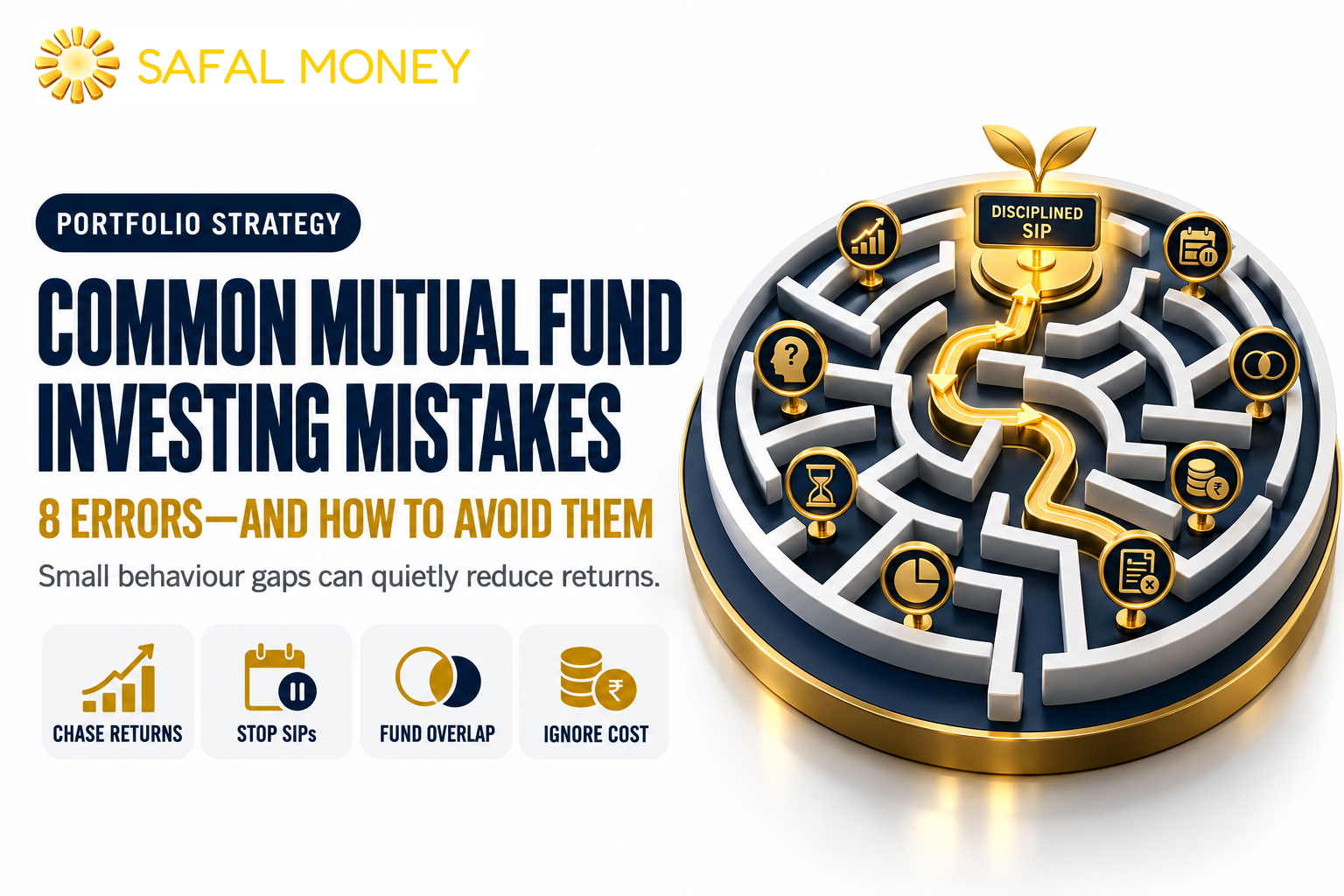
Every year, millions of new SIP accounts open across India, and every year, a familiar set of avoidable errors quietly eats into the returns those SIPs were supposed to generate. None of these mistakes require a market crash to hurt you; they happen in ordinary years, made by ordinary, well-meaning investors who simply didn’t know better. This article walks through eight of the most common mutual fund mistakes Indian investors make in 2026, why each one happens, and exactly what to do instead. None of these are exotic errors reserved for beginners either; even experienced investors with a decade of SIPs behind them fall into several of these traps. Read through with your own portfolio open in another tab, because chances are at least two or three of these will apply to you.
Mistake 1: Chasing Last Year’s Top-Performing Fund
Buying a fund because it topped last year’s returns chart is one of the most reliable ways to underperform, because a fund’s best year is often driven by a concentrated bet or sector rally that rarely repeats. Category leaderboards reshuffle constantly; a smallcap fund that returned 55% in one calendar year is frequently a middling or even bottom-quartile performer the following year once its winning sector cools off.
The fix is to evaluate funds on rolling, multi-year returns and consistency across market cycles rather than a single standout year. A fund manager’s process, portfolio concentration, and how the fund behaved during both up and down markets tell you far more than a single headline number ever will.
Mistake 2: Stopping SIPs During a Market Downturn
Pausing a SIP when markets fall defeats the entire purpose of rupee-cost averaging, since a downturn is precisely when your fixed SIP amount buys more units at a lower price. Investors who stopped SIPs during the 2020 COVID crash or the 2022 correction locked in losses on existing units while missing the cheaper units that would have boosted their eventual recovery.
The counterintuitive truth is that a falling market is often the best time to be investing more, not less, provided your investment horizon remains long enough to ride out the volatility. If a downturn genuinely changes your risk appetite or your financial situation, that’s a conversation about your overall asset allocation strategy, not a reason to abandon a SIP that’s still years from its goal.
Mistake 3: Over-Diversifying Across Too Many Overlapping Funds
Holding 12-15 mutual funds doesn’t create real diversification if most of them are flexicap or largecap funds holding the same 30-40 blue-chip stocks with slightly different weights. Past a certain point, adding more funds simply adds paperwork and tracking difficulty without meaningfully reducing risk or improving returns, since the underlying holdings start to overlap heavily.
For most individual investors, 4-7 well-chosen funds across genuinely different categories, such as a largecap, a flexicap, a midcap, and a debt or hybrid fund, provide sufficient diversification. Beyond that, you’re often just diluting your best ideas and making annual portfolio reviews unnecessarily painful. Check for overlap directly by comparing top holdings across your funds rather than assuming different fund names mean different portfolios.
Mistake 4: Ignoring Expense Ratio Because “It’s Just 1%”
Dismissing a 1-1.5 percentage point expense ratio difference as negligible ignores how dramatically that gap compounds over long holding periods. On a 20-year SIP, the difference between a fund charging 0.5% and one charging 1.8% can amount to a meaningfully different final corpus, purely from costs, with no difference in underlying skill.
This gap matters most acutely when comparing Regular and Direct plans of the same scheme, since the underlying portfolio is often identical but the cost structure isn’t. According to AMFI’s Total Expense Ratio disclosures, TER differences between plans of the same scheme can commonly run into a percentage point or more annually, a gap worth understanding clearly before you invest, even when the immediate difference in your account statement looks small.
Mistake 5: Comparing Funds Across Different Categories Directly
Comparing a largecap fund’s 12% return to a smallcap fund’s 22% return and concluding the smallcap fund is simply “better” ignores that the two categories carry fundamentally different risk profiles and behave completely differently across market cycles. Smallcap funds tend to outperform sharply in bull markets and fall harder in corrections, while largecap funds offer more stability at the cost of explosive upside.
Meaningful comparisons should always happen within the same category and against the same benchmark, comparing a largecap fund to other largecap funds and to its relevant index, not across categories with different volatility profiles. Our guide on choosing between fund categories covers this distinction in more depth for anyone building a category-diversified portfolio.
Mistake 6: Not Reviewing the Portfolio for Years After the Initial Investment
Setting up a SIP and never revisiting it is common, but a portfolio built five or seven years ago rarely still fits your current goals, risk appetite, or life stage without adjustment. Funds change fund managers, shift investment styles, or simply get outpaced by newer, better-run alternatives in the same category, and none of that shows up unless you actually look.
An annual review, at minimum, should check whether your funds are still meeting their category benchmarks, whether your allocation still matches your goals, and whether any fund has drifted from its stated mandate. This doesn’t mean switching funds constantly, but genuinely never checking in is its own quiet risk that compounds just as surely as costs do.
Mistake 7: Choosing Regular vs Direct Plan Without Understanding the Trade-off
Picking a Direct plan purely for the lower expense ratio, without accounting for the value of ongoing guidance, or picking Regular without understanding what that extra cost buys, both stem from the same underlying mistake: not actually understanding the trade-off being made. Direct plans skip distributor commission and therefore carry a lower expense ratio, but investors managing Direct plans on their own take on the full responsibility for fund selection, monitoring, and rebalancing.
Regular plans, distributed through advisors like AMFI-registered mutual fund distributors, cost more but include ongoing support, portfolio reviews, and guidance through market cycles, which many investors genuinely value and would otherwise pay for separately. Neither choice is universally “correct”; the mistake is picking one without weighing what you’re gaining or giving up in the trade.
| Factor | Direct Plan | Regular Plan |
|---|---|---|
| Expense ratio | Lower | Higher (includes distributor commission) |
| Ongoing guidance | Self-managed | Included via distributor/advisor |
| Best suited for | Confident, hands-on investors | Investors who value ongoing support |
| Fund selection responsibility | Entirely on the investor | Shared with the distributor |
Mistake 8: Investing Without a Clear Goal or Time Horizon in Mind
Starting a SIP simply because “everyone is investing in mutual funds,” without attaching it to a specific goal or timeline, makes it nearly impossible to choose the right fund category or know when it’s appropriate to exit. A goal-less SIP also gets abandoned more easily during volatility, since there’s no clear finish line reminding the investor why they started.
Every investment should answer two questions before the first rupee goes in: what is this money for, and roughly when will I need it. A retirement SIP, a child’s education fund, and a three-year car down payment fund all deserve entirely different fund categories, and skipping this step is often the root cause behind several of the other mistakes on this list. Structuring your portfolio around explicit goals, as covered in our goal-based investing guide, tends to resolve most of these issues at the source.
SafalMoney fund guides
Frequently Asked Questions
What is the biggest mistake mutual fund investors make?
Chasing last year’s top-performing fund is arguably the most common and costly mistake, since it ignores that strong single-year performance is rarely repeatable and often signals a concentrated, higher-risk bet rather than consistent skill. Evaluating funds on rolling, multi-year, risk-adjusted performance instead avoids this trap.
Should I stop my SIP when the market falls?
No, in most cases you should continue your SIP through a downturn, since falling prices mean your fixed contribution buys more units, which benefits your average purchase cost over time. Stopping a SIP during a correction typically locks in the disadvantage without capturing the recovery that follows.
How many mutual funds is too many to hold?
For most individual investors, holding more than 7-8 funds usually signals unnecessary overlap rather than genuine diversification, especially if several funds belong to similar categories with overlapping top holdings. A focused portfolio of 4-7 well-chosen funds across distinct categories is typically sufficient.
Why shouldn’t I compare a largecap fund with a smallcap fund directly?
Largecap and smallcap funds carry fundamentally different risk and volatility profiles, so a direct return comparison ignores the very different amount of risk taken to achieve those returns. Fair comparisons should always happen within the same category and against the relevant benchmark index.
How often should I review my mutual fund portfolio?
An annual review is a reasonable baseline for most investors, supplemented by a check after any major life event or significant market movement. This review should assess whether each fund is still meeting its benchmark, whether your allocation still matches your goals, and whether any fund has drifted from its original mandate.
Last updated: 30 September 2026