Asset Allocation by Age: How Your Mutual Fund Mix Should Change in Your 30s, 40s, and 50s
Wondering how your mutual fund mix should shift as you age? This guide breaks down asset allocation by decade with practical Indian examples and a quick self-check.
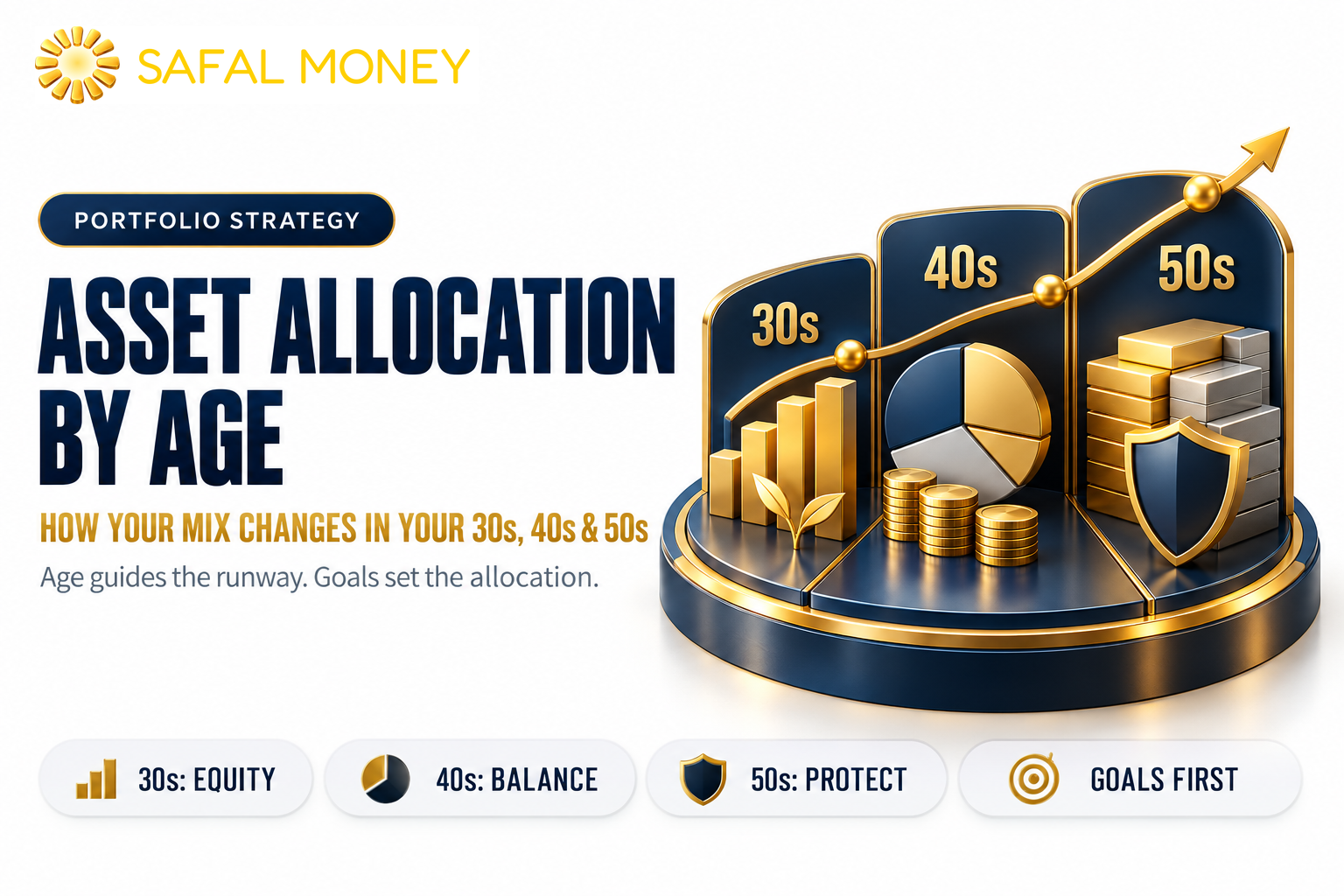
A 32-year-old software engineer in Bengaluru and her 54-year-old father in Nashik cannot sensibly hold the same mutual fund portfolio, even if both are equally comfortable with market ups and downs. One has three decades of earning years ahead; the other is a few years from drawing down his savings. Yet a surprising number of Indian investors build their portfolios around what’s trending rather than where they stand in life. This article walks through how asset allocation should evolve through your 30s, 40s, and 50s, why age matters less as a number and more as a stand-in for something else entirely, and how to sanity-check your current mix as of September 2026. By the end, you’ll have a framework, not just a rule of thumb, to build on.
Why “Age” Is a Proxy for Time Horizon, Not a Rule in Itself
Age itself changes nothing about how markets behave; what changes is how much time you have before you need the money. A 35-year-old saving for retirement at 60 has a 25-year horizon, but the same 35-year-old saving for a home down payment next year has a horizon of months, and the two pools of money deserve entirely different allocations despite belonging to one person.
This is the single most important idea in this article: age-based rules are shorthand for time horizon and risk capacity, both of which typically shrink as people grow older, but not always in lockstep. A person who starts investing late, inherits wealth in their 40s, or has no dependents may have a very different risk capacity than their birth certificate suggests. Treat every age bracket below as a starting assumption to be adjusted, not a verdict.
In Your 30s: High Equity Allocation Makes Sense While the Runway Is Long
In your 30s, a portfolio tilted 75-90% toward equity mutual funds is typically appropriate because you have two to three decades to recover from any single market downturn. This is the decade where aggressive category exposure, including flexicap, midcap, and even a measured smallcap allocation, does the most compounding work, since a rupee invested here has the longest possible runway before you need it.
The logic is straightforward: equity markets are volatile in any given year but have historically rewarded patience over long periods. If a portfolio in your 30s falls 25% in a bad year, you have 20-plus years for subsequent recoveries and fresh SIP contributions to more than make up the difference. This is also the decade to build the habit of investing consistently through SIPs across market cycles, rather than trying to time entries and exits. A common structure at this stage might be 55-60% largecap and flexicap funds, 20-25% mid and smallcap funds, and the remainder in debt or hybrid funds for near-term goals like an emergency fund or a wedding.
In Your 40s: Debt and Hybrid Funds Enter the Picture as Goals Approach
By your 40s, allocation should typically shift to something closer to 60-70% equity and 30-40% debt or hybrid funds, because major goals like a child’s higher education or a home purchase start moving from “someday” to “within 5-10 years.” The runway hasn’t disappeared, but it has shortened enough that a sharp drawdown right before you need the money would actually hurt.
This is the decade to introduce debt funds and hybrid categories like balanced advantage or aggressive hybrid funds, not because equity has become undesirable, but because specific, dated goals need money that won’t be at the mercy of a market correction the year you need to pay a tuition bill. It helps to bucket your portfolio by goal at this stage: retirement money, which is still 15-20 years out, can stay aggressive, while the “child’s college in 2033” bucket should start de-risking. For a deeper look at goal-based bucketing, see our guide on structuring a portfolio around life goals. Expense ratios and fund overlap also deserve more scrutiny here, since portfolios accumulated over a decade often carry redundant funds.
In Your 50s: Capital Protection Becomes a Bigger Priority Than Growth
In your 50s, the priority typically inverts: protecting what you’ve built starts to matter more than squeezing out additional growth, and a 40-50% equity, 50-60% debt and hybrid mix is a reasonable starting point for most people nearing retirement. The reasoning is simple. If a severe market correction hits in the two or three years before you retire and you’re forced to withdraw during that dip, sequence-of-returns risk can permanently dent your retirement corpus in a way that a 30-year-old would simply ride out.
This doesn’t mean abandoning equity. Someone retiring at 60 may still live another 25-30 years, so a meaningful equity allocation, often through largecap or conservative hybrid funds, helps the corpus keep pace with inflation over a multi-decade retirement. What changes is the glide path: allocations should shift more gradually and deliberately toward debt instruments, target-maturity funds, and conservative hybrid categories as the withdrawal date nears, rather than making one large switch.
The “100 Minus Age” Rule of Thumb: Useful Starting Point, Not a Strict Formula
The “100 minus age” rule suggests your equity allocation should roughly equal 100 minus your current age, so a 35-year-old holds 65% equity and a 55-year-old holds 45%. It’s a reasonable back-of-envelope starting point in 2026, but it ignores income stability, dependents, existing assets, and actual goals, which is why it should never be applied mechanically.
Some practitioners now use “110 minus age” or even “120 minus age” given longer life expectancies and the fact that many Indian investors have additional safety nets like EPF, PPF, or real estate that a pure mutual fund calculation doesn’t capture. The rule’s real value is as a conversation starter: if your current equity allocation is wildly different from what the rule suggests, that’s worth investigating, not necessarily correcting.
| Age Bracket | Typical Equity Allocation | Typical Debt/Hybrid Allocation | Primary Focus |
|---|---|---|---|
| 30s | 75-90% | 10-25% | Aggressive growth, long compounding runway |
| 40s | 60-70% | 30-40% | Balancing growth with approaching mid-term goals |
| 50s | 40-50% | 50-60% | Capital protection, glide path to retirement |
| 60s+ | 25-40% | 60-75% | Income generation, inflation-beating stability |
Adjusting Allocation for Goals, Not Just Age, When They Don’t Line Up
When your goals and your age point in different directions, the goal should win, because money is spent against goals, not against birthdays. A 50-year-old with no dependents, a paid-off home, and a 25-year retirement horizon may reasonably carry more equity than the age-based table suggests, while a 35-year-old with a home down payment due in 18 months should hold that specific bucket almost entirely in debt or liquid funds regardless of how aggressive the rest of their portfolio is.
The practical fix is to stop thinking about “my allocation” as one number and start thinking about “my allocations” as several numbers, one per goal. A retirement bucket, a child’s education bucket, and a near-term liquidity bucket can and should carry very different equity-to-debt ratios even when they sit inside the same investor’s overall portfolio.
How Often to Revisit Your Allocation as You Move Through Life Stages
Most investors should review their overall allocation once a year and after any major life event, such as a marriage, a child’s birth, a job change, or a market move large enough to distort your original ratios by more than 5-10 percentage points. Annual reviews catch the gradual drift that happens as equity holdings, when markets do well, quietly grow to a larger share of the portfolio than intended.
Life-event triggers matter more than the calendar in some years. A layoff, a large inheritance, or a serious health diagnosis can change your risk capacity overnight in ways that a scheduled annual review might miss for months. Treat the yearly check as the minimum cadence, not the only one, and don’t hesitate to rebalance mid-year if your equity allocation has drifted meaningfully from target, a practice explored further in our piece on rebalancing your mutual fund portfolio.
A Simple Checklist to Sanity-Check Your Current Mix Against Your Age and Goals
Before your next SIP date, run through this quick list. First, calculate your actual equity percentage across all mutual fund holdings and compare it to the “100 minus age” starting point; a gap of more than 15-20 percentage points either way deserves a closer look. Second, list your goals by the year you’ll need the money and check whether each corresponding bucket’s allocation matches its actual timeline rather than your age.
Third, check for overlap and redundancy, since many investors in their 40s and 50s unknowingly hold five or six equity funds that behave almost identically. Fourth, confirm your emergency fund and near-term liquidity needs are covered in debt or liquid funds regardless of your overall equity tilt. Finally, according to the Securities and Exchange Board of India, all mutual fund investors should read scheme documents carefully before investing, so use this review as a prompt to revisit the risk categorization (as per AMFI’s classification norms) of every fund you currently hold.
Free, 2 minutes
SafalMoney fund guides
Frequently Asked Questions
How should my mutual fund allocation change with age?
Generally, equity allocation should decrease and debt or hybrid allocation should increase as you age, moving from roughly 75-90% equity in your 30s to 40-50% by your 50s. The shift should be gradual and driven primarily by how close your specific financial goals are, not a single switch made on a birthday.
Is the “100 minus age” rule still relevant in 2026?
It remains a useful starting benchmark but not a strict formula, since it ignores factors like income stability, existing assets, and actual goal timelines. Many investors today use variations like “110 minus age” given longer life expectancies, but the number should always be adjusted against your real financial picture.
Should a 50-year-old still hold equity mutual funds?
Yes, most 50-year-olds should still hold meaningful equity exposure, often 40-50% of their portfolio, because a typical retirement can last 25-30 years and needs growth to outpace inflation. The key difference from a 30-year-old’s portfolio is a more gradual, deliberate glide path toward debt as retirement nears.
How often should I rebalance my age-based allocation?
A once-a-year review is a reasonable minimum, supplemented by a check whenever a major life event occurs or your equity allocation drifts more than 5-10 percentage points from target. Rebalancing too frequently can add unnecessary costs and taxes, so annual or event-driven reviews strike a good balance.
What matters more, age or financial goals, when deciding allocation?
Financial goals matter more whenever they conflict with age-based defaults, since money is ultimately spent against specific goals and timelines, not against your age. Age-based rules are best used as a starting assumption that gets overridden by the actual time horizon and purpose of each portion of your portfolio.
Last updated: 30 September 2026