Direct Plan vs Regular Plan: What Actually Changes in Your Returns?
Direct and regular plans invest in the same portfolio with the same fund manager — the only difference is the expense ratio. Here's exactly how much that difference costs you over 10, 15, and 20 years, with real numbers from India's most popular funds in 2026.
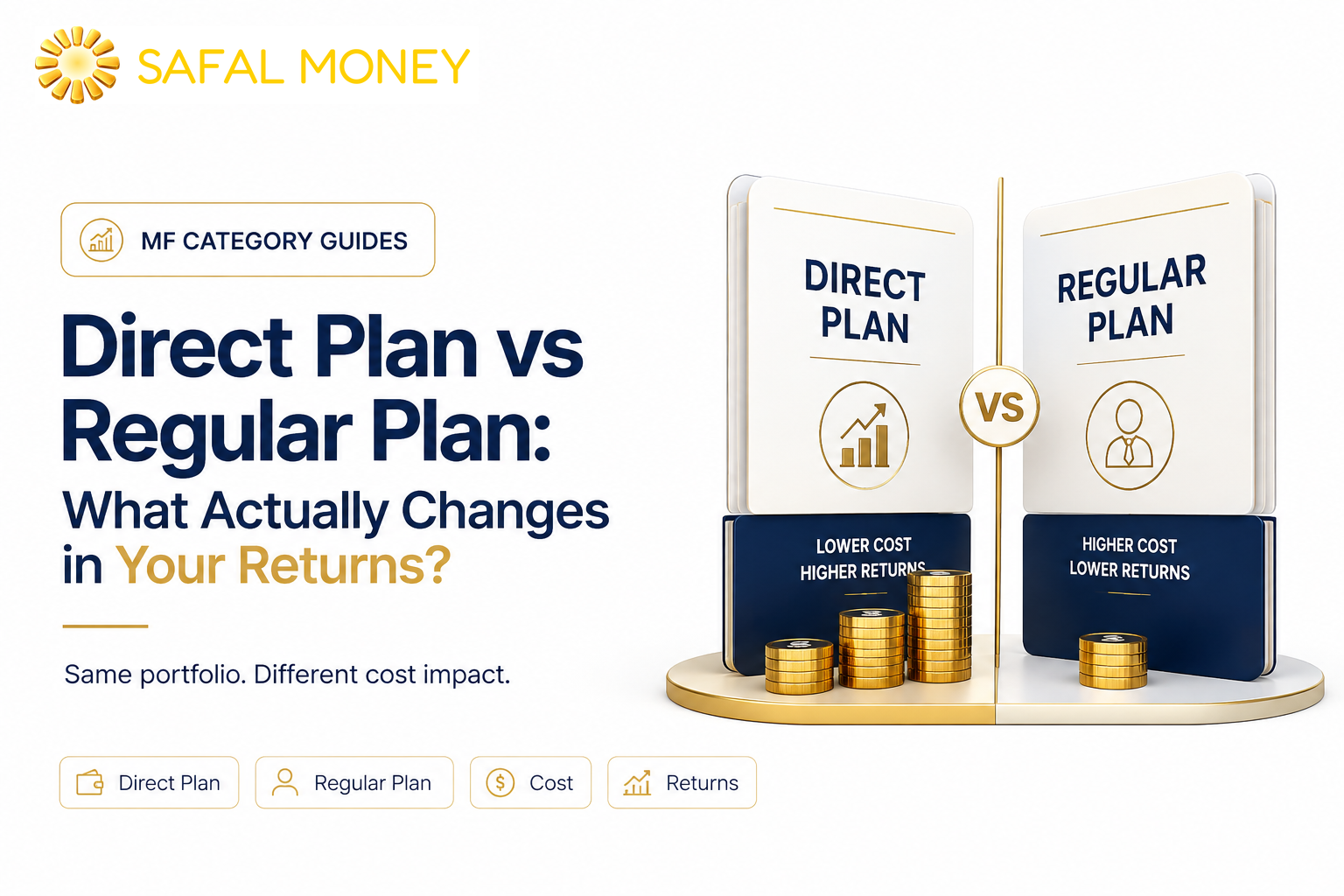
Direct and regular mutual fund plans invest in exactly the same portfolio — the same fund manager, the same stocks, the same investment strategy, and the same benchmark. The only structural difference between them is that the regular plan includes a distributor commission baked into the expense ratio, and the direct plan does not. This single difference — typically 0.5 to 1.0 percentage points per year in the total expense ratio — compounds into a wealth gap over 10, 15, and 20 years that most investors dramatically underestimate when they first encounter the comparison.
The Total Expense Ratio (TER) gap is typically 0.5–1.0 percentage points per year in favour of direct plans. Over 20 years on a ₹10,000 SIP, that gap can compound into ₹20–40 lakh of extra wealth — real money that goes either to the investor in the direct plan or to the distributor in the regular plan, depending solely on which plan was chosen at the time of the original investment.
This article explains exactly what direct and regular plans are, how the expense ratio gap works in practice with real numbers, when a regular plan is genuinely the right choice, how to check which plan you are currently in, and how to switch if you need to.
What Is a Direct Plan and What Is a Regular Plan?
Every mutual fund scheme in India comes in two variants — direct and regular. The portfolio inside is identical — same fund manager, same stocks, same strategy. The difference is entirely in who you bought the fund from and what that costs you.
Direct plan: You buy the fund directly from the Asset Management Company (AMC) — through its website, MF Central portal (mfcentral.com), or a SEBI-registered direct investment platform that earns no commission. Because no distributor is involved, no distributor commission is paid. The AMC passes this saving to you in the form of a lower Total Expense Ratio (TER). In 2026, direct plans are easily accessible via AMC websites, the MF Central portal, and platforms like Zerodha Coin, Groww, Kuvera, INDmoney, and Paytm Money — all of which offer direct plans without commissions.
Regular plan: You buy the fund through an intermediary — a bank, a mutual fund distributor, an insurance agent, or a financial advisor who is an AMFI-registered distributor. The AMC pays this intermediary a trail commission on the AUM they bring in — typically 0.5% to 1.0% per year. This commission is not paid from a separate fee; it is embedded in the fund's expense ratio. The regular plan TER is higher than the direct plan TER by exactly the amount of the distributor commission.
The practical implication: if you buy a fund through a bank's wealth management desk, most online investment apps that earn commissions, or a traditional mutual fund distributor — you are almost certainly in the regular plan, paying the higher TER and receiving lower returns than the direct plan investor in the same fund.
The Exact Numbers: How Much Does the TER Gap Actually Cost?
The mathematics of the direct-versus-regular gap are simple but the magnitude of the outcome consistently surprises investors who calculate it for the first time.
A basic illustration: Assume you invest ₹1,00,000 in a mutual fund that delivers a 10% gross annual return. Under a regular plan with 1.5% TER, your net return is approximately 8.5%. Under a direct plan with 0.5% TER, your net return is approximately 9.5%. The 1% annual difference on ₹1 lakh produces ₹1,000 of additional return in year 1. Unremarkable in isolation.
Compounded over 10 years at these net returns:
- Regular plan (8.5% net): ₹1,00,000 grows to approximately ₹2,26,098
- Direct plan (9.5% net): ₹1,00,000 grows to approximately ₹2,47,863
- The 10-year gap: ₹21,765 — on a ₹1 lakh investment.
Compounded over 20 years:
- Regular plan (8.5% net): ₹1,00,000 grows to approximately ₹5,11,205
- Direct plan (9.5% net): ₹1,00,000 grows to approximately ₹6,14,353
- The 20-year gap: ₹1,03,148 — more than the original investment, on ₹1 lakh invested once.
Now scale to a ₹10,000 monthly SIP over 20 years at the same 1% TER gap:
- Regular plan (8.5% net): SIP corpus approximately ₹66–68 lakh
- Direct plan (9.5% net): SIP corpus approximately ₹74–80 lakh
- The SIP gap over 20 years: ₹20–40 lakh of additional wealth — generated purely by eliminating the distributor commission.
This is not a theoretical projection. These are the mathematical consequences of the compounding difference between two plans that invest in an identical portfolio. The money does not disappear — it goes either to you (direct plan) or to the distributor (regular plan).
Real TER Gaps in India's Most Popular Funds — August 2026
SafalMoney's recent fund reviews provide concrete real-world TER gaps that illustrate this principle:
- Direct plan TER: 0.55%
- Regular plan TER: 1.08%
- Annual gap: 0.53%
On ₹50 lakh invested as a lump sum in HDFC Flexi Cap Fund for 15 years at 18% gross return, the TER gap of 0.53% per year compounds to approximately ₹40–45 lakh of additional terminal corpus in the direct plan versus the regular plan.
- Direct plan TER: 0.52%
- Regular plan TER: 1.21%
- Annual gap: 0.69%
On a ₹10,000 monthly SIP in Parag Parikh Flexi Cap Fund over 15 years at 13% gross return, the 0.69% TER gap means the regular plan investor pays approximately ₹8–10 lakh more in cumulative distributor commissions than the direct plan investor — on a total SIP contribution of ₹18 lakh.
- Direct plan TER: 0.63%
- Regular plan TER: 1.33–1.69%
- Annual gap: 0.70–1.06%
The gap is even larger in the smallcap category — where higher gross returns mean the compounding impact of each basis point of TER difference is greater in absolute terms.
The consistent pattern: Every major fund in every category has a direct plan TER that is 0.5% to 1.0%+ lower than the regular plan. This gap is always in favour of the direct plan investor. It never narrows or reverses. It is structural, not cyclical.
What Does the Distributor Actually Do for the Commission?
This is the question every regular plan investor should ask before concluding that paying the distributor commission is worthwhile.
SEBI's rationale for allowing the regular plan structure is that distributors provide a service — advice, fund selection, paperwork, portfolio monitoring, and investor education — that justifies a fee. The commission is not described as a charge to the investor; it is described as compensation to the distributor from the AMC. In practice, however, the AMC pays the commission from the fund's assets, which means the investor bears the cost through the higher expense ratio.
What a good distributor or SEBI-registered investment advisor provides: guidance on which fund categories suit your goals and risk profile, fund selection using analytical tools, behavioural coaching to prevent panic-selling during corrections, annual portfolio review, and rebalancing advice. For investors who genuinely need these services and benefit from them, the distributor fee can be justified.
What many distributors in the regular plan model actually provide: recommending funds from AMCs that pay higher trail commissions rather than those that are most suitable for the investor, switching investors between funds periodically to reset the commission clock, selling regular plans of funds where direct plans are readily available without explaining the difference, and providing minimal ongoing service after the initial investment.
The honest assessment: the value of the service determines whether the commission is justified. A genuinely skilled, independent, SEBI-registered investment advisor who provides ongoing portfolio management, tax optimisation, and goal-based financial planning may well deliver more value than the commission costs — particularly for complex HNI portfolios. A bank relationship manager or mutual fund agent who simply processes transactions and receives trail commission provides no service that justifies the 0.5–1.0% annual fee.
Direct Plan Is Not Just for Sophisticated Investors
The most persistent myth about direct plans is that they are only for experienced investors who deeply understand mutual funds and can manage their own portfolio. This myth benefits distributors more than investors.
The reality: in 2026, choosing a direct plan requires three things that most investors already have or can easily acquire:
- A KYC-completed mutual fund account. If you have invested in a regular plan mutual fund, you already have KYC. The same KYC applies to direct plan investments.
- Access to a direct plan platform. Direct plans are available through AMC websites directly, MF Central (mfcentral.com — the SEBI-mandated consolidated mutual fund platform), and commission-free fintech platforms. The interface for investing in a direct plan is identical to a regular plan — you enter the fund name, the amount, your bank account details, and confirm.
- Knowledge of which fund to buy. This is the one aspect where investors who previously relied on a distributor for recommendation need to do their own research — or use SafalCheck™ to evaluate funds systematically, or consult a fee-based SEBI-registered investment advisor who charges a flat fee rather than a trail commission.
Direct mutual funds are easily accessible via AMC websites, the MF Central portal, and SEBI-registered fintech platforms. You can start a SIP or make a lump sum investment directly within minutes if your KYC is complete.
When Should You Actually Stay in the Regular Plan?
Despite the compelling case for direct plans, there are specific situations where remaining in a regular plan — or choosing it for new investments — is a rational decision:
When you receive genuine ongoing advisory services. If your distributor or advisor provides regular portfolio reviews, goal-based financial planning, tax optimisation across your full financial picture, and genuinely independent fund recommendations — and you cannot or do not want to replicate this service yourself — the regular plan commission may be a fair price for that service. The key word is genuine: not a once-a-year phone call, but active, valuable, personalised advisory.
When switching would create a large capital gains tax event. Switching from a regular plan to a direct plan is treated as a redemption from the regular plan and a fresh investment in the direct plan. This triggers capital gains tax — 12.5% LTCG on equity fund gains above ₹1.25 lakh, or slab-rate tax on debt funds. For investors with very large unrealised gains (say, ₹20–30 lakh of LTCG in an equity fund held for 5+ years), the tax cost of switching may exceed several years' worth of TER savings, making it rational to hold the regular plan units to term and invest all future money in direct plans.
When the corpus is very small and advisory needs are high. For first-time investors with very small corpus (₹5,000–₹10,000 SIPs) who genuinely need guidance and would otherwise not invest at all, the 0.5% annual TER gap on a small corpus is less than the value of being in the market. Getting started — even in a regular plan — is better than not starting because of analysis paralysis around the plan type.
These are the exceptions. For the large majority of investors who have access to direct plan platforms and are comfortable making basic fund category and scheme decisions — or using tools like SafalCheck™ to help with those decisions — the direct plan is the clear financial choice.
Key Takeaway
Direct and regular plans hold the identical portfolio — the only variable is who keeps the commission. Unless you're receiving genuinely valuable ongoing advice, or switching would trigger a large capital gains tax bill, the direct plan is the mathematically superior choice.
How to Check Whether You Are Currently in a Direct or Regular Plan
This is a practical step that every investor should take. The plan type is visible in three places:
On your AMC statement or NSDL/CDSL CAS (Consolidated Account Statement): Every line item on your mutual fund statement shows the plan type. Look for the words "Direct" or "Regular" in the scheme name. For example: "HDFC Flexi Cap Fund — Direct Plan — Growth" versus "HDFC Flexi Cap Fund — Regular Plan — Growth." These are two different NAVs, two different ISIN numbers, and two different expense ratios.
On the mutual fund platform you use: Log into the platform where you manage your mutual fund investments. Every fund in your portfolio will show "Direct" or "Regular" in the scheme name.
On MF Central (mfcentral.com): Log in with your PAN to see your consolidated holdings across all fund houses and all plans in one view. This is the most comprehensive check available.
If your current holdings show "Regular" against funds where you could be investing in the direct plan — and you are not receiving ongoing advisory services that justify the commission — consider migrating to direct plans. Remember the tax implications of switching before doing so.
How to Switch from Regular to Direct Plan
- Calculate the tax impact first. Before switching, calculate the capital gains tax that would be triggered by redeeming your regular plan units. For equity funds with holding period above 12 months, LTCG above ₹1.25 lakh is taxed at 12.5%. If your unrealised gain is ₹10 lakh, the tax on switching is approximately ₹1.09 lakh — which would take several years of TER savings to recover. If your unrealised gain is small (under ₹3–4 lakh), switching is likely financially sensible even with the tax cost.
- Choose your direct plan platform. MF Central is the recommended starting point — it is SEBI-mandated, free, and allows you to hold and manage direct plans across all AMCs from one login. Commission-free fintech platforms offer the same direct plans with more user-friendly interfaces.
- Redeem the regular plan and invest in the direct plan. Redeem from the regular plan (triggering the capital gains tax event). The redemption proceeds arrive in your registered bank account within T+2 to T+3 business days. Reinvest in the corresponding direct plan of the same fund.
- For future SIPs, start new ones in the direct plan. Even if you decide not to switch existing regular plan holdings due to the tax cost, start all new SIPs in the direct plan immediately. New money should always go to the direct plan — there is no tax implication for choosing which plan to start a new SIP in.
A pragmatic approach for large portfolios: switch regular plan units gradually over multiple financial years, staying within the ₹1.25 lakh annual LTCG exemption to minimise the tax cost of the switch. Redeem ₹1.25 lakh of gains per year from the regular plan, reinvest in the direct plan, and repeat annually until the migration is complete.
The Platforms Where Direct Plans Are Available in 2026
Direct plans are available through platforms that earn no commission. In 2026, the most commonly used commission-free direct plan platforms include MF Central (the official SEBI portal), AMC websites, and commission-free fintech platforms:
MF Central (mfcentral.com): The official SEBI and AMFI-mandated consolidated mutual fund platform. Supports all AMCs, all direct plans, SIP, lump sum, and switching. Free to use. Requires Aadhaar-based authentication.
AMC websites directly: Every AMC in India maintains its own investor portal where direct plan investments can be made — HDFC MF, Parag Parikh (PPFAS), Nippon India, SBI MF, and others. The limitation is that you need separate logins for each AMC.
Commission-free fintech platforms: Zerodha Coin, Kuvera, INDmoney, Groww (direct plan option), and Paytm Money all offer direct plans without distributor commission. Each platform generates revenue through other means (premium features, advisory subscriptions, or other financial products) rather than mutual fund trail commissions.
Before using any platform, confirm that the plan being offered is explicitly labelled "Direct" in the scheme name — not Regular. Two checks matter before you invest: the plan name must read Direct, and the platform must deduct no commission.
The SafalMoney Position on Direct vs Regular
SafalMoney is an AMFI-registered Mutual Fund Distributor. We are transparently declaring our position: we believe in the direct plan for investors who can make their own informed fund selection decisions, use tools like SafalCheck™ to analyse funds systematically, and do not need ongoing distributor advisory services.
For investors who specifically want SafalMoney's research, SafalCheck™ fund selection guidance, and portfolio monitoring — and who value the continuity of a single advisory relationship — a fee-transparent arrangement with a SEBI-registered investment advisor (RIA) who charges a flat fee rather than trail commission is the most investor-aligned structure. Under such an arrangement, the investor invests in direct plans (benefiting from the lower TER) and pays the advisor a transparent, separately agreed fee for the advisory service.
This is the model that aligns advisor incentives with investor outcomes — and it is the model SafalMoney encourages for investors who genuinely want guided portfolio management.
Free, no login required
Free, 2 minutes
Frequently Asked Questions
What is the difference between direct and regular mutual fund plans?
Direct plans are purchased from the AMC without intermediary involvement, so the expense ratio is lower. Regular plans are purchased through distributors or advisors who receive a trail commission embedded in the fund's higher expense ratio. Both plans invest in an identical portfolio - same fund manager, same stocks, same strategy.
How much more do I earn in a direct plan over a regular plan?
The TER gap is typically 0.5-1.0% per year. Over 20 years on a ₹10,000 monthly SIP, this gap compounds into ₹20-40 lakh of additional wealth in the direct plan. Over 10 years on a ₹1 lakh lump sum at a 1% TER gap, the additional corpus is approximately ₹21,000 - entirely attributable to the lower cost.
Is it safe to invest in direct mutual funds?
Yes. Direct plans are regulated by SEBI with the same regulatory requirements as regular plans. The underlying portfolio is identical. The only difference is the lower expense ratio. Direct plans are available on the official SEBI-mandated MF Central platform and all major SEBI-registered investment platforms.
How do I know if I'm in a direct or regular plan?
Check your mutual fund statement or the consolidated account statement on MF Central (mfcentral.com). Every scheme name includes 'Direct Plan' or 'Regular Plan' in its official title. If the scheme name does not explicitly say 'Direct,' you are in the regular plan.
Should I switch from regular to direct plan?
For most investors without ongoing advisory services, yes - but calculate the capital gains tax impact of the switch first. If unrealised gains are large, switching all at once may be costly. Consider migrating gradually using the annual ₹1.25 lakh LTCG exemption, and start all new SIPs in the direct plan immediately regardless of what you do with existing regular plan units.
What platforms can I use to invest in direct mutual funds in India in 2026?
MF Central (mfcentral.com) is the official SEBI portal and the safest starting point. Commission-free fintech platforms - Zerodha Coin, Kuvera, INDmoney, Paytm Money - also offer direct plans without commission. Always confirm the plan is labelled 'Direct' before investing.
Last updated: 18 August 2026